


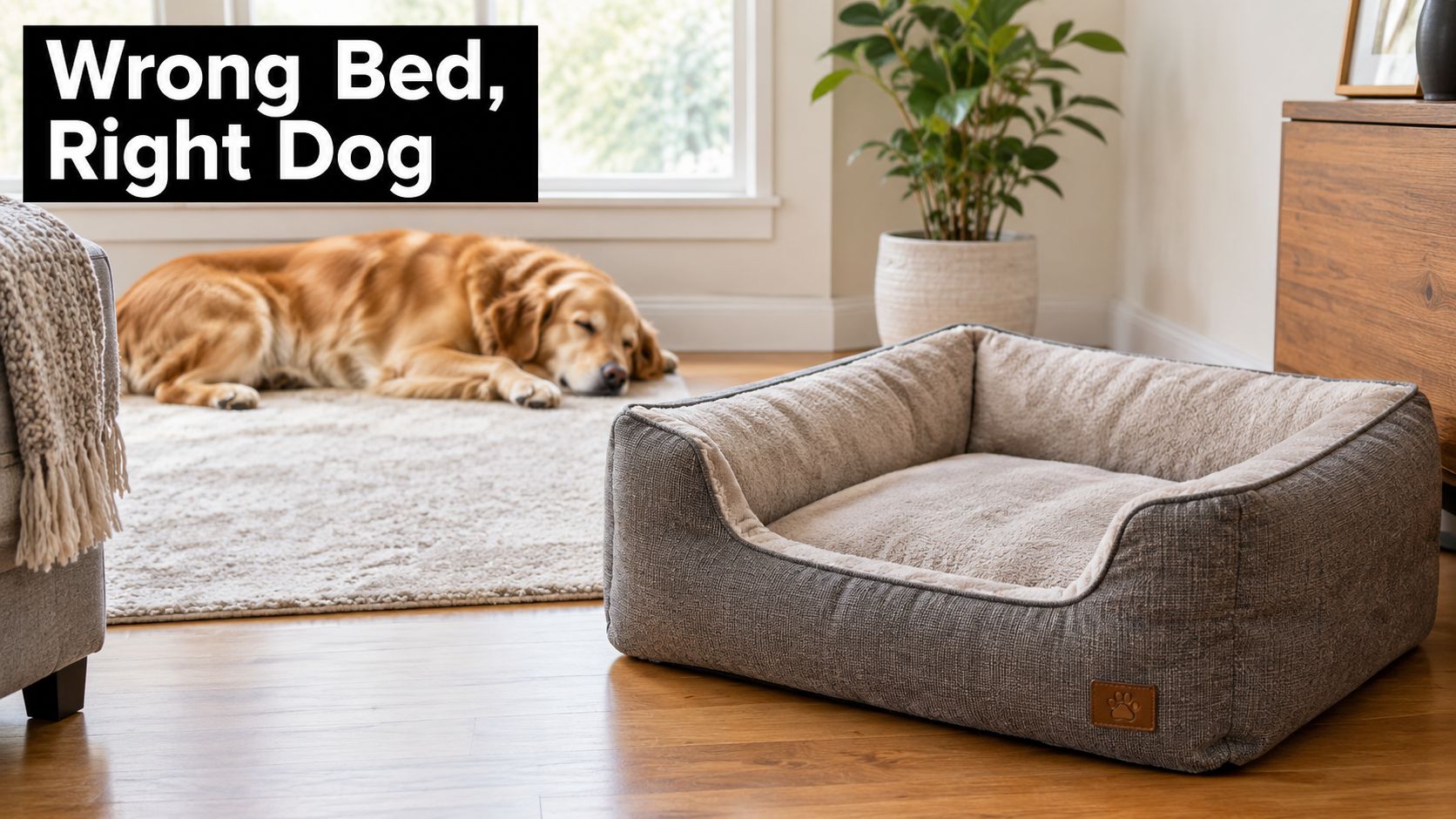
You've finally found a dog bed that suits your living room. The fabric is beautiful, the shape looks substantial, and the price suggests it should last. Two days later, your dog is asleep on the rug beside it, while the new bed becomes an expensive piece of floor decor.
That usually isn't stubbornness. The bed may be too small, too unstable, too warm, too difficult to clean, or just wrong for the way your dog sleeps. How to choose a dog bed comes down to two questions: does it support the dog's body and habits, and can it survive the realities of your home? A successful bed has to function as a health essential and as furniture you can live with every day.
Why Most Dog Beds Fail Before They're Even Unboxed
Your dog settles on the rug beside the new gray bed, while the expensive purchase stays untouched. That choice is practical feedback. The rug may feel cooler, offer firmer traction, or provide more room to stretch. If the dog's elbows spill over the edge or the filling collapses under their weight, a bed that looks soft can feel worse than the floor.
Comfort is more than softness
A thick, plush cushion is not a reliable default. Puppies need surfaces that tolerate accidents and chewing. Senior dogs benefit from stable support and an entrance they can cross without climbing. Dogs with itchy skin need covers and fillings that release hair, dander, and moisture rather than trapping them against the body.
Your home sets another limit. A bulky bolster that blocks a walkway will be shifted repeatedly, and a bed that slides on polished flooring can make entry difficult for a weak or cautious dog. Good design solves practical problems first. It keeps the bed stable, accessible, easy to clean, and visually suited to the room.
A dog bed is both a health item and a piece of furniture. Choose it with the same care you would give any object that stays on the floor every day.
Practical rule: Choose the bed your dog can use easily and you can maintain consistently, not the bed that looks most luxurious in a product photograph.
The two-minute pre-purchase test
Before comparing colors or textures, check four details:
- Sleeping footprint: Does your dog curl, stretch on their side, or sprawl with legs in every direction?
- Physical access: Can they step onto the surface without jumping, climbing, or slipping?
- Cleaning system: Can the dog-contact textiles be washed and dried thoroughly?
- Room compatibility: Will the bed stay stable, suit the floor, and look intentional beside your furniture?
Hygiene belongs near the top of this list. Bedding collects fur, skin flakes, saliva, dirt, and occasional urine or vomit. The cleaning standard for pet bedding is covered in detail below, because washability determines whether the bed can remain suitable for daily use.
The strongest choice balances support, access, maintenance, and appearance. Select enough cushioning without a surface that holds moisture, enough structure without creating a high entrance, and enough visual presence to belong in the room. Start with your dog's body and routine. Let the aesthetic confirm the decision.
Measuring Your Dog for a Perfect Fit
Ignore breed labels until you've checked the actual dimensions. “Large” means different things from one manufacturer to another, and a long, lean dog can need a different bed from a heavier dog with the same weight. The reliable method is simple: measure the body, account for stretching, then confirm the bed's weight rating.
Measure the usable sleeping length
Have your dog stand or lie fully extended on a flat surface. Measure from the tip of the nose to the base of the tail, not to the end of the tail. Add approximately 8 to 12 inches, or 20 to 30 cm, to that measurement. This gives the dog room to reposition and stretch without pushing their head or legs over the edge, following the dog bed sizing guidance from PetSmart.
Measure the dog in the position that reveals their largest footprint. If your dog usually begins curled up but later sleeps on their side, size for the side-sleeping position. A raised bolster can further reduce the usable flat area, so check the interior sleeping dimensions rather than relying on the outside measurement.
Check weight and movement
Length is only half the fit. Confirm the manufacturer's weight rating separately, because a bed can offer generous surface area and still compress too far under a heavier dog. When the sleeping surface bottoms out, the dog is effectively resting on the floor beneath the filling.
For an older dog, or one with arthritis, hip dysplasia, or another mobility problem, inspect the entrance and base. The dog should be able to step on without jumping, and the bed shouldn't slide across the floor during entry or exit. A low profile with a firm, non-skid base is often more practical than a dramatically thick design.
Use this worksheet rather than guessing from a breed name:
| Dog Length (Inches) | Recommended Bed Length (Inches) | Best For |
|---|---|---|
| Your measured length | Measured length plus 8 to 12 inches | Dogs that curl and stretch |
| Your measured length while fully extended | Measured length plus 8 to 12 inches | Side sleepers and sprawlers |
| Near-term adult measurement for a growing puppy | Adult estimate plus 8 to 12 inches | Planning a washable interim bed |
For additional reference, compare the manufacturer's measurements with this dog bed size chart by breed, but don't let a breed label replace your tape measure. A puppy also deserves a practical plan. Buying only for the puppy's current dimensions can leave you with a bed they outgrow quickly, while an oversized bed may be awkward and harder to keep clean. A washable interim option can make more sense during rapid growth.
Here's a concise visual walkthrough of the measuring process:
During the first week, observe the result. Your dog should return voluntarily, change position without struggling, and remain supported in their preferred posture. Repeated edge-sleeping, reluctance to enter, difficulty rising, or choosing the floor consistently means the dimensions, firmness, or access height need another look. If movement appears painful, treat that as a veterinary concern rather than trying to solve it with bedding alone.
Selecting the Right Bed Type for Your Dog's Needs
Bed type should follow the dog, not the trend. A cloud bed, an orthopedic mattress, and a structured signature bed can all be excellent choices, but they solve different problems. The useful comparison is not “Which one looks softest?” It's “What will this dog do on it, and what will this dog struggle with?”

Cloud beds for nesting and lounging
Cloud-style beds suit dogs that burrow, curl, or seek a soft landing after an active day. Their generous cushioning can feel inviting, and a deep surface may help a relaxed dog settle. The trade-off is practical: excessive loft can make entry harder, retain heat, and complicate washing if the interior cannot be cleaned properly.
Choose this style for a dog that uses plush surfaces willingly and can climb onto the bed without hesitation. Don't choose it just because the room needs a softer visual texture.
Orthopedic beds for stable support
Orthopedic construction makes sense when pressure distribution and resilient support matter. It can be useful for older dogs or dogs with joint conditions, but orthopedic doesn't automatically mean tall, hard, or heavily padded. The bed still needs a stable base and an accessible edge.
A low-entry mattress may serve a mobility-limited dog better than a thick bed with a high sidewall. If the dog slips while getting up, avoids the bed, or repeatedly struggles to stand, consult a veterinarian. Bedding can improve access and comfort, but it isn't a substitute for assessing pain or mobility changes. For a clear explanation of the category, see this guide to what an orthopedic dog bed is.
Signature and reversible designs for shared spaces
A structured signature bed is the strongest all-round choice for a design-conscious household that wants visual order without sacrificing daily comfort. It can provide a defined place to rest, suit a living-room layout, and offer enough support for dogs that alternate between curling and stretching.
Reversible beds add a useful maintenance advantage. Turning the surface over can refresh the feel between deeper washes, provided both sides are intended for dog contact and can be cleaned according to the care label. Crown and bolster styles can work well for nesters, but measure the flat interior. A dramatic rim is not useful if it leaves too little room for the dog's body.
Match the bed to behavior
Watch your dog for a normal day before ordering:
- Curling and burrowing: Choose a nest-like shape with a comfortable perimeter, but keep the entrance easy to cross.
- Stretching and sprawling: Choose a broad, flatter surface without bulky bolsters that steal usable space.
- Frequent repositioning: Prioritize a stable base and enough flat area for movement.
- Hesitating at the edge: Lower the entry and remove sliding as a source of uncertainty.
- Chewing or accident-prone behavior: Put washability and durable construction ahead of decorative texture.
A small reward can also help a reluctant dog build a positive association with the new sleeping place. Keep a few suitable dog treats nearby during calm bed training, and reward voluntary settling rather than forcing the dog onto the surface. The bed should become a choice, not a command backed by pressure.
The best category is the one that solves the dog's actual friction point. Plushness matters for some dogs. For others, stable access, usable floor area, and easy laundering matter more than the label sewn onto the side.
Materials and Fillings - Durability Meets Comfort
The outer fabric determines how the bed feels against the skin. The filling determines whether the dog remains supported after repeated use. Treat those as separate decisions, because a beautiful cover cannot rescue a filling that clumps, holds dampness, or collapses beneath the dog.
Foam, fiber, and structure
Memory foam or other supportive foam can distribute pressure well when it resists bottoming out under the individual dog's load. It suits dogs that need a more stable sleeping surface, but it can be heavy, slower to dry, and difficult to clean thoroughly if the foam itself is exposed to accidents.
Poly-fill creates a softer, more informal feel and can suit curlers who like to nest. Its weakness is uneven compression and clumping after washing, especially when the construction doesn't keep the fill distributed. If you choose fiber, inspect the seams, the laundering instructions, and whether the insert can be dried completely without becoming misshapen.
Bolsters are structural elements, not fillings, but they change the bed's performance. They can provide a headrest and a sense of enclosure. They can also reduce usable floor space and create a higher barrier for dogs with limited mobility.
A filling is only comfortable if it remains supportive after the care routine your household can actually maintain.
Design for hair, moisture, and washing
Smooth, tightly woven fabrics usually release hair more easily than shaggy surfaces. Plush textures can feel wonderful, but they deserve extra scrutiny in homes with allergies, heavy shedding, or frequent outdoor activity. Check whether the dog-contact surface dries quickly and whether the material retains odor after laundering.
The allergy question deserves more attention than it receives. Research on households with dogs identified the dust-mite allergen Der p 1 in dog bedding, as well as in other household soft furnishings, and reported measurable concentrations in the bedding of households with atopic dogs. That makes the research on dust-mite allergens in dog bedding relevant to material selection, not just veterinary theory.
For a style-led project, decorative fabric can be useful as an accent or a removable outer layer, but it shouldn't replace a washable sleeping system. If you're evaluating tactile options for a custom accessory or coordinated room detail, a resource such as the Shannon Cuddle Critter Barkley fabric kit can help you consider texture and pattern separately from the bed's structural core.
Inspect the construction
Look for reinforced seams, a base that won't slide, and a cover or complete body that can withstand repeated laundering. Avoid assuming that a thicker bed is automatically more supportive. Resilience matters more than height, particularly for a heavy dog or one that needs stable footing.
The most attractive material is the one that still feels clean, dry, and intact after ordinary use. Choose texture for the dog's comfort, but choose construction for the life you'll ask the bed to lead.
Hygiene and Washability - The Non-Negotiables
A muddy walk on Monday, a stomach accident on Wednesday, and a damp bed by Friday expose whether a dog bed is genuinely practical. A fresh-looking cover does not make an absorbent insert clean. Saliva, dirt, urine, and vomit can settle inside the bed, where they remain out of sight and difficult to remove. I would choose a simpler bed that washes and dries properly over a sculptural design that becomes unusable after one accident.

Buy the complete care system
Set every week as the baseline for washing pet bedding, then clean it sooner after accidents, illness, or heavy outdoor use. Washing and drying methods depend on the care label, so inspect those instructions before buying. Soap or detergent should come before any disinfecting step, and the bed must be fully dry before your dog uses it again.
Use the CDC veterinary bedding guidance when deciding how to handle bedding for an ill animal. Separate bedding can make isolation easier in a multi-pet home, while correctly laundered soft bedding can return to use.
Check these specifications before purchase:
- Whole-bed access: Confirm whether the complete bed can be washed, not only the outer cover.
- Drying practicality: Make sure the filling can dry fully without holding dampness.
- Seam strength: Choose construction that can tolerate repeated wash cycles without opening.
- Shape retention: Avoid inserts likely to clump, twist, or collapse after laundering.
- Material tolerance: Follow the manufacturer's instructions for temperature and cleaning products.
A removable cover helps, but it does not solve every hygiene problem. Puppies, incontinent dogs, and dogs recovering from illness need a sleeping system that lets you clean the interior as well as the surface. A sealed waterproof layer can also protect the filling, provided the design still allows the whole bed to dry thoroughly.
Make maintenance realistic
Test the weekday routine before you buy. Check that the bed fits your machine without being tightly compressed, run the approved cycle on a weekday morning, and reserve the afternoon for air circulation or permitted tumble drying. If the bed is still damp at bedtime, it is too demanding for your household. Odor and microbial growth become more likely when a wet insert returns to use.
The care label controls the process. High heat may suit some washable materials, but foam and specialty fabrics can warp, shrink, or break down. Follow this practical dog-bed cleaning guide instead of applying one temperature to every construction.
For fur and dander that have spread to upholstery or flooring, deep cleaning for pet owners offers a broader household reference. The bed still needs a manageable home routine.
A washable bed belongs in the room as furniture, but hygiene decides whether it earns that place. Compare the best machine-washable dog beds by complete-bed access, drying time, and post-wash structure. Softness attracts a dog on day one. Washability keeps the bed usable, presentable, and sanitary over time.
Health Considerations and Styling for Modern Homes
The right bed is not the thickest one, the trendiest one, or the one that disappears most completely into the room. It is the one that suits the dog's body, the dog's behavior, the household's cleaning capacity, and the room's traffic pattern.
For an allergic or atopic dog, start with the maintenance system. Choose a surface that releases hair and dander, a filling that dries thoroughly, and construction that doesn't turn the interior into a hidden reservoir. A luxurious high-loft bed can be a poor choice if it stays damp or cannot be washed thoroughly. Frequent laundering matters more than a “plush” label.
For a senior or mobility-limited dog, watch the approach rather than trusting the word “orthopedic.” A low, stable bed with a non-skid base may be more useful than a tall cushion that forces the dog to climb. If your dog repeatedly avoids the bed, slips entering or exiting, struggles to rise, or begins sleeping on the floor, reassess the design and discuss persistent mobility changes with a veterinarian.
Build the room around use
Place the bed where the dog already wants to rest, while keeping it clear of drafts, door swings, and high-traffic bottlenecks. A rectangular bed usually gives a cleaner architectural line and more flexible sleeping space. A round or enclosed shape can suit a dog that curls and seeks a defined boundary.
For a modern interior, coordinate the bed with the room's larger palette rather than matching every accessory. A warm neutral can soften dark flooring, a muted charcoal can anchor pale furniture, and a restrained pattern can add interest without turning the dog's corner into visual clutter. Prioritize a washable textile over a fragile fabric that only looks good when untouched.
Nandog Pet Gear offers Cloud, Orthopedic, Signature, Crown, and Reversible collections, including designs made for machine washing and contemporary interiors. Treat those collections as options to compare against your dog's measurements, entry needs, sleeping style, and care routine. The design decision comes last. The usable sleeping surface and cleanability come first.
Use this final filter before purchasing:
- Fit: The dog can lie fully supported in their largest regular sleeping position.
- Access: The dog can enter, exit, rise, and turn without slipping or jumping.
- Care: The complete sleeping system can be washed and dried as directed.
- Health: The materials and structure suit allergies, age, body condition, and mobility.
- Home: The bed stays stable and looks deliberate in its intended location.
A dog bed earns its place in a modern home by being used, not merely admired. Measure first, observe the dog's movement, read the care label, and then select the color and silhouette that you'll be happy to see every day.
Choose a bed that combines your dog's measured sleeping space, accessible support, and a care routine you can maintain. Visit Nandog Pet Gear to compare design-led dog beds made for comfortable rest and a home that still feels like yours.