

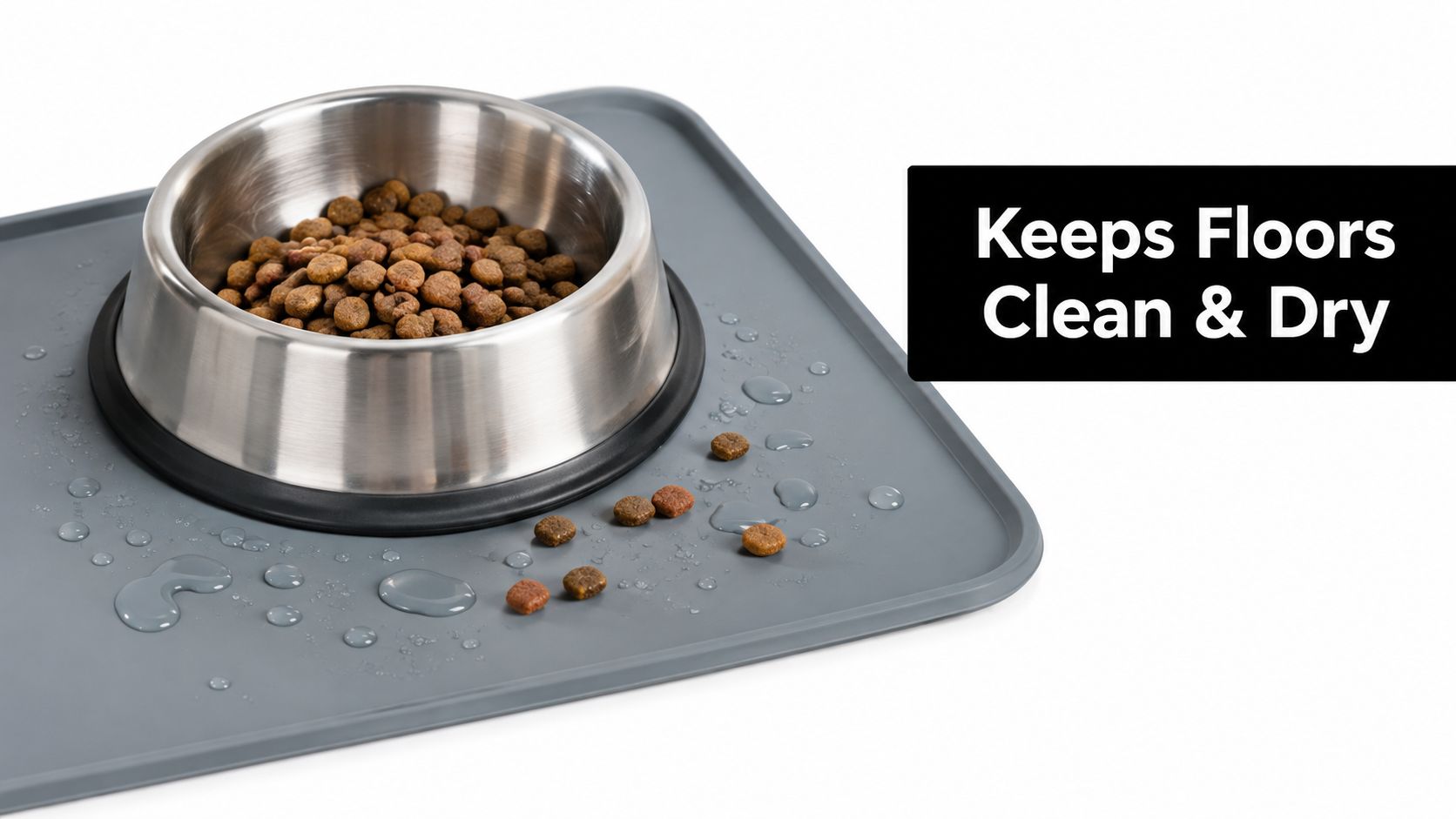
Most advice about a pet mat for bowls starts with waterproofing, color, and whether the pattern matches the kitchen. Those details matter, but they miss the harder problem. A feeding mat sits where food residue, water, saliva, and floor dust meet every day, so its surface and cleaning routine affect the hygiene of the entire feeding area.
A well-designed mat creates a cleanable boundary around the bowls. A poorly designed one can become another surface that holds moisture and debris. The difference comes down to material, geometry, and maintenance, not marketing language such as “antibacterial” or “germ-proof.”
Rethinking the Pet Mat for Bowls as a Hygiene System
A dog drinks enthusiastically, pushes the bowl forward, and leaves a trail of water across the floor. A cat drops wet food beside the dish, then walks through it and carries residue toward the hallway. In both cases, the mat does more than catch a visible spill. It defines the area where feeding mess can be contained, removed, and cleaned without treating the entire floor as a food-contact zone.
That boundary only works if the mat itself is easy to maintain. A fabric layer may absorb the first spill, but it can also retain moisture after the surface looks dry. Deep grooves may make a product look distinctive while giving food particles places to collect. A smooth, sealed surface usually offers a more reliable starting point because you can see residue, remove it, and dry the mat completely.
Practical rule: Choose the mat as though it were part of the feeding equipment, not as a decorative frame for the bowls.
The same thinking applies to the bowls. A mat won't compensate for bowls that aren't cleaned regularly, and a premium bowl won't eliminate the need to maintain the surrounding surface. Guidance on food-safe dog bowls is useful here because the bowl and mat should be considered together, as two connected parts of the feeding station.
Containment is only half the job
A raised edge can keep water and liquefied food from spreading onto flooring. That feature helps most when the edge is broad and smooth, rather than narrow, sharply angled, or interrupted by decorative seams. You need enough height to slow a spill, but you also need to reach every part of the channel with a cloth or brush.
The mat should also sit flat. A curled corner creates a trip point, gives a pet something to chew, and lets liquid travel underneath. A flexible product is useful for storage and handling, but flexibility shouldn't mean permanent deformation after washing.
What the mat should make easier
The best design reduces friction in the routine you already have. You should be able to lift it without spilling trapped water, rinse away food without scrubbing a maze of texture, and dry it before the next meal. If you need special chemicals or a complicated process to keep the mat usable, the design has failed at its main job.
For households with puppies, kittens, several pets, or people who have close contact with the feeding area, that convenience matters even more. The right mat doesn't claim to sterilize the floor. It gives you a defined surface that supports consistent cleaning.
The Science of Clean Feeding Surfaces
A feeding mat becomes a hygiene problem when its construction makes residue difficult to remove. Woven fibers, absorbent backing, open seams, and deep texture can hold water and food particles between cleaning sessions. A fully sealed, low-texture surface gives residue fewer places to hide and makes visual inspection more meaningful.
The CDC guidance on pet food safety recommends cleaning feeding mats and placemats frequently. It also recommends cleaning bowls after every use for wet food, and at least daily for dry food and water. That distinction matters because the mat's cleaning frequency should follow actual exposure, not a generic promise printed on packaging.
Cleaning and disinfecting aren't interchangeable
Cleaning removes visible dirt, grease, and food residue. Disinfecting is a separate step intended to kill germs after cleaning. Treating those words as synonyms leads to two common mistakes: assuming a quick wipe has controlled contamination, or using disinfectant on a dirty surface and expecting it to perform properly.
For an everyday feeding station, start by removing debris, washing with soap or detergent and warm water, rinsing thoroughly, and drying completely. If raw pet food contacts the mat, the cleaning response should be immediate rather than tied to a fixed schedule. The CDC also advises cleaning and disinfecting objects and surfaces that contact raw food, so a mat isn't a substitute for disinfecting the surrounding area when contamination spreads beyond its boundary.
Why surface texture changes the workload
A smooth surface lets you find a smear and remove it. A heavily textured surface can make the same residue harder to see and harder to reach. This doesn't mean every textured mat is automatically unsafe, but it does mean the owner must evaluate whether the pattern can be scrubbed, rinsed, and dried without leaving damp pockets.
Material safety is also separate from cleanability. NSF's home-product protocols describe evaluation areas that include material safety, labeling, durability, functionality, and harmful substances for products that contact food. Silicone and rubber appear among the material categories, but the word “silicone” alone doesn't prove that a finished mat has been tested for repeated washing, odor retention, deformation, or cracking.
A credible product brief should identify the elastomer, pigment system, and any coating. It should also state the cleaning method, drying requirements, and dishwasher compatibility. Those details tell you far more than a broad claim that the product is hygienic.
Choosing Materials, Silicone, Rubber, and Beyond
The material determines how much work the mat creates after the meal. Two products can both be described as waterproof, yet one may have a sealed, stable surface while the other relies on a backing or finish that degrades with washing.
| Material | Cleanability | Durability | Odor Resistance |
|---|---|---|---|
| Silicone | Usually straightforward when the surface is fully sealed and low-texture. Check compatibility with the stated detergent or dishwasher cycle. | Can perform well when it stays flat and resists cracking, but quality varies by formulation and thickness. | Stronger when the surface doesn't absorb residue and the mat dries completely. |
| Rubber | Can provide useful grip and resilience, but the exact compound and surface finish matter. | Often robust under everyday handling, though repeated washing may expose weakness in coatings or edges. | Depends on whether the finished surface retains smells or includes absorbent areas. |
| Fabric | Easy to fold and may suit a soft interior aesthetic, but fibers and backing can hold moisture and food debris. | May wear, curl, stain, or lose shape with frequent washing. | More vulnerable when the material stays damp or absorbs food residue. |
Silicone isn't a complete specification
Silicone is popular because it can be molded into a single-piece form with a raised perimeter and relatively smooth surface. That geometry can simplify rinsing, but it doesn't establish food-contact safety or long-term performance by itself. Look for documentation about the finished article, not just a material name.
The strongest specification describes the actual elastomer and surface treatment, then explains how the product handles repeated washing. Stable flatness, rounded edges, resistance to odor retention, and resistance to cracking are practical indicators of whether the mat will remain useful after the novelty wears off.
Rubber trades softness for more variables
Rubber can provide a secure feel on the floor and may suit pets that push bowls while eating. The trade-off is that rubber isn't one uniform material category. Compounds, pigments, coatings, and backing layers can change how the mat reacts to detergent, heat, moisture, and sunlight.
Inspect the edges and underside. If the product has a porous backing, glued layers, or a finish that can peel, the mat may be harder to maintain than its top surface suggests. A secure grip is valuable only if the entire construction remains cleanable.
Fabric works best with realistic expectations
Fabric mats can look warm and domestic, but absorbency is a liability around wet food and water. They may be suitable where appearance and portability take priority, provided the owner accepts frequent laundering and complete drying. They aren't the obvious choice for anyone seeking a quick-rinse feeding boundary.
A practical waterproof pet mat should therefore be judged by the finished product. Ask whether the surface is fully sealed, whether the underside can trap liquid, and whether the manufacturer explains care rather than relying on a waterproof label alone.
Selecting the Right Size and Features
Start with the bowls, not the available space on the shelf. Place the food and water bowls where your pet normally eats, note their combined footprint, and allow a visible margin around the outside. The mat should catch the common splash and dropped morsel without forcing the bowls onto an unstable edge.
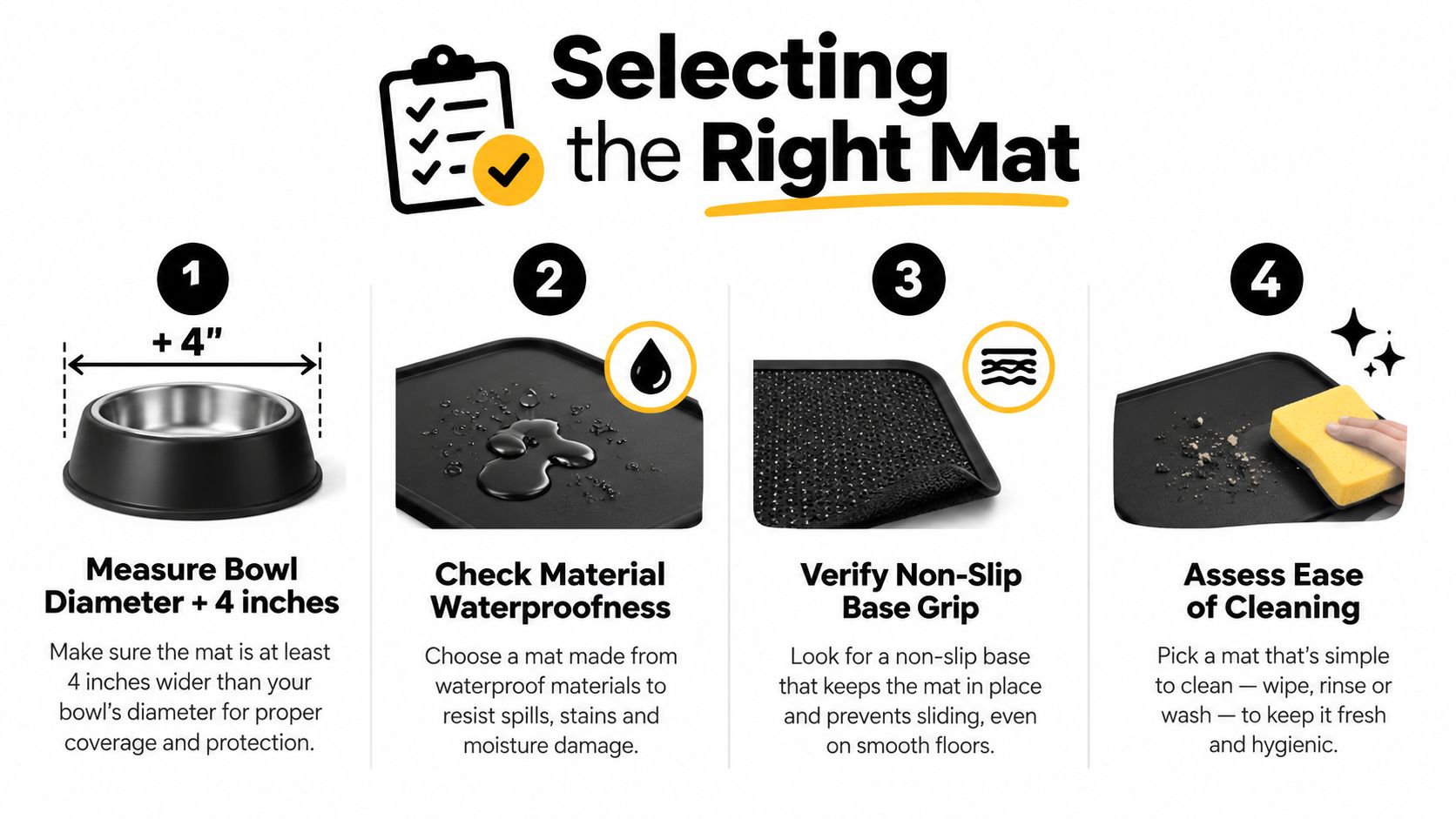
A simple measuring rule is to use the bowl diameter plus four inches when estimating coverage, as shown in the selection infographic below. For multiple bowls, measure the complete arrangement rather than adding clearance to each bowl in isolation. Pets often nudge dishes sideways, so a mat that fits only the starting position may fail during an ordinary meal.
Four checks before purchase
- Measure the actual setup. Include the distance between bowls, the direction your pet approaches from, and the space needed to lift each bowl without knocking the other.
- Inspect waterproofness at the edges. A sealed top isn't enough if liquid can reach an absorbent underside through a seam or folded perimeter.
- Test the grip against your floor. A non-slip base may behave differently on tile, sealed wood, vinyl, or a textured surface. Stability should come from the finished underside, not from placing a separate towel beneath it.
- Read the cleaning instructions. Confirm whether the mat can be rinsed, wiped, or placed in a dishwasher, and whether it needs a particular drying method.
Raised edges need usable geometry
A perimeter is helpful when it forms a shallow containment tray, but an intricate lip can increase cleaning time. Choose a boundary with broad transitions and rounded corners so a cloth or brush can reach the entire channel. Avoid designs that create narrow pockets beneath the bowl.
The floor matters, too. On a smooth surface, a grippy underside can stop bowls and mat from migrating. On a textured floor, the same underside may collect dust or become difficult to rinse. The correct feature is the one that remains functional in your home, not the one that sounds strongest in a product description.
Use the following video as a visual reference while assessing how a mat fits into the feeding station:
Integrating Design with Functionality
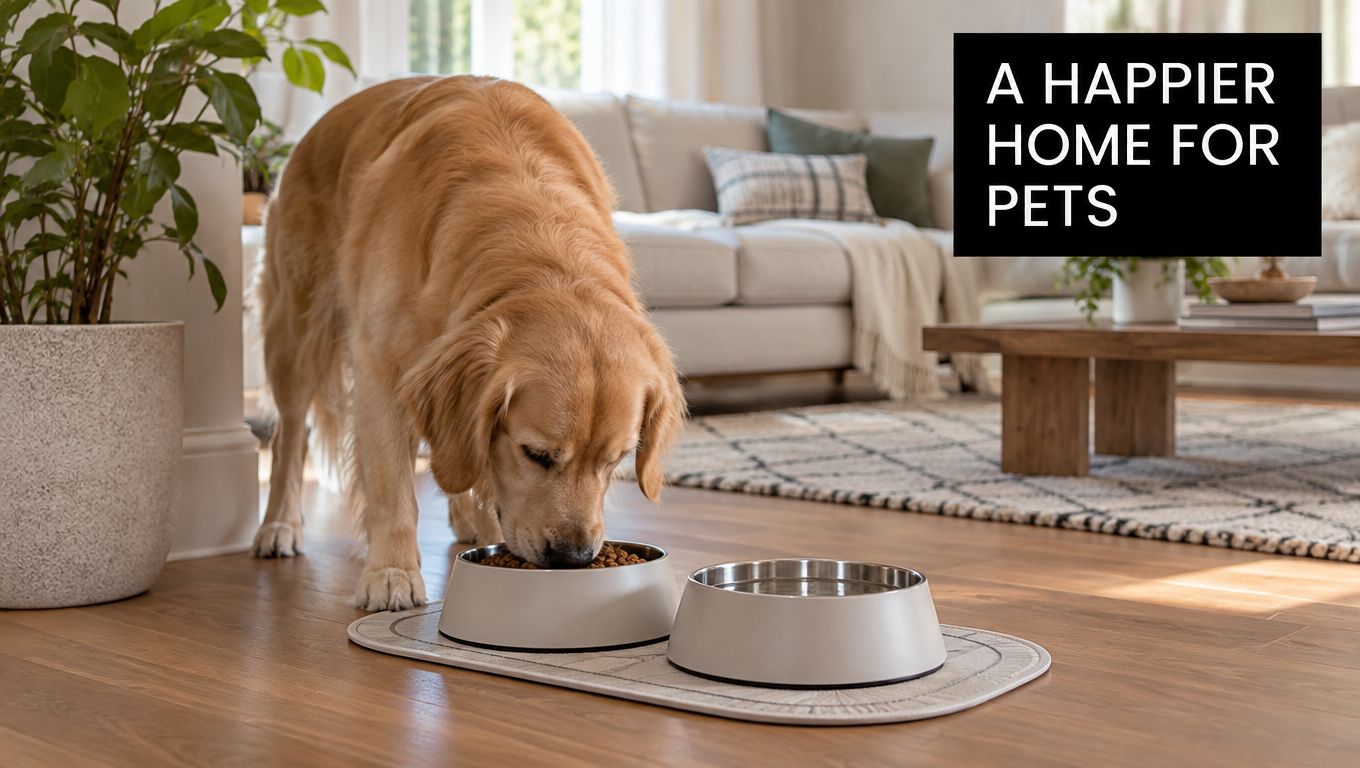
A feeding area is often visible from the kitchen, living room, or entryway. Owners don't want a utilitarian rectangle that looks temporary, but visual polish shouldn't conceal construction compromises. A successful design makes the cleanable surface, stable footprint, and containment features feel intentional rather than industrial.
That balance starts with restraint. A quiet color, a considered silhouette, and a low profile can fit contemporary interiors without adding deep texture. The mat can look soft and refined while remaining nonporous, provided the softness comes from shape or visual treatment rather than absorbent fibers.
Attractive details that earn their place
A rounded outline can soften the product's appearance and make corners easier to wipe. A low raised perimeter can frame the bowls while containing minor spills. A reversible color treatment may help the mat coordinate with changing rooms, but both sides must remain practical to clean if the product is intended for regular reversal.
Designers should also consider what happens after washing. A beautiful mat that curls, fades, holds odor, or becomes difficult to grip won't remain attractive in daily use. The finished article needs stable flatness, durable pigment, sealed transitions, and a surface that tolerates the cleaning process stated by the manufacturer.
The premium look shouldn't depend on vague claims
Words such as “luxury,” “clean,” and “healthy” describe an impression, not a test result. A more useful product description tells the buyer what the mat is made from, how it contains liquid, what floors it suits, and how to wash and dry it.
Design test: If the visual detail adds a seam, pocket, coating, or texture, ask what cleaning benefit it provides. If there isn't one, the detail should be treated as a maintenance cost.
Style-conscious households can have both appearance and function, but the order matters. Build the hygiene requirements first, then shape the product around them. That approach produces a feeding station that belongs in the room without turning design into an excuse for difficult care.
Cleaning and Maintenance Best Practices
A reliable routine starts with the mess you can see. Remove food particles before adding water, then wash the mat with soap or detergent and warm water. Rinse until no cleaner or residue remains, and dry every surface completely before placing it back under the bowls.
For wet food, clean the mat whenever food or liquid reaches it rather than waiting for a convenient weekly reset. Water bowls and wet-food bowls also need their own cleaning routine, because a mat can't make up for a dirty dish. Guidance on dishwasher-safe dog bowls can help you coordinate bowl care with the mat's material and washing instructions.
A simple care sequence
- Remove debris first: Scrape or lift solids away so washing water doesn't spread residue across the mat.
- Wash the whole surface: Pay attention to the raised perimeter, underside, and corners.
- Rinse thoroughly: Detergent left behind can attract dust and may irritate a pet's mouth or paws.
- Dry completely: Stand or lay the mat where air can reach both sides, then check for dampness before reuse.
- Respond to raw-food contamination: Clean and disinfect affected objects and surrounding surfaces according to appropriate safety guidance.
If you use a washing machine for a compatible mat, protect the grip and avoid a cycle that the manufacturer doesn't approve. This practical guide to protect mat grip in washer offers useful handling context for flexible mat products, though the pet product's own care label should take priority.
A mat that looks clean but remains damp isn't ready for service. Inspect the edges, underside, and surface texture regularly for cracking, peeling, odor retention, or loss of flatness. Replace it when those defects prevent thorough cleaning.
Nandog Pet Gear offers design-forward feeding essentials and everyday accessories built to fit naturally into modern homes. Visit Nandog Pet Gear to explore stylish pet products that combine practical care with considered design.