


You notice it after an ordinary walk. Your dog scratches at the neck, shakes their head, and keeps turning around as if something is bothering them. When you part the fur, there's a pink or reddened ring beneath the collar. The natural reaction is to blame the collar material, but the material may only be part of the story.
A soft dog collar for sensitive skin works best as a complete comfort system. The fabric matters, but so do pressure, seam placement, hardware, cleaning, and the amount of time the collar stays on. A gentle collar that's too snug can still rub. A breathable collar that's left damp can still irritate. The aim isn't to find a magic “hypoallergenic” label. It's to identify what your dog's skin is reacting to and remove that trigger methodically.
Why Your Dog's Neck Is Red and What to Do First
Start by removing the collar for a quiet inspection period, unless your veterinarian has told you it must remain on for safety or treatment. Look at the skin in good light and note where the irritation sits. A narrow line directly beneath an edge often points toward pressure or friction, while scattered redness can have a different cause.
Your dog may be dealing with a simple rub, a reaction to a material or hardware component, moisture trapped against the skin, or an underlying problem that happens to appear beneath the collar. Scratching, head shaking, licking, hair thinning, scabs, odor, and discharge all provide useful clues, but they don't establish a diagnosis by themselves.
First observation: Don't replace the collar immediately and assume the new one solved the problem. Record what you saw before changing several variables at once.
A practical neck check
Use this short checklist before shopping for another collar:
- Location: Is the redness under the entire band, concentrated at one seam, or limited to the buckle and D-ring?
- Surface: Does the skin look dry and pink, rubbed and hairless, moist, crusted, or swollen?
- Timing: Did the problem appear after rain, bathing, swimming, grooming, a long walk, or a new product?
- Behavior: Is your dog scratching only when the collar is on, or throughout the day?
- Pattern: Does the irritation improve when the collar is removed, then return after it goes back on?
A friction rub usually follows the contact path. A reaction around one buckle may raise suspicion about hardware or a finish rather than the whole strap. If the skin remains irritated even without the collar, the collar may not be the main cause.
For now, keep the area dry and avoid applying human creams or household remedies unless your veterinarian recommends them. Take a clear photograph so you can compare the skin later. If your dog seems painful, the area is spreading, or the skin is broken, skip repeated product experiments and arrange veterinary advice.
Soft Collar Materials That Actually Work for Sensitive Skin
Material selection should begin with pressure and friction, not with the word “hypoallergenic.” A veterinary-science review found that collar material can change peak force and contact pressure, which helps explain why padded, fabric, and rounded-edge designs are often positioned as comfort-focused options for dogs with delicate skin (the veterinary review on dog-worn equipment). Lower pressure and reduced rubbing can make contact easier to tolerate, but they can't compensate for a poor fit.
The construction matters as much as the fiber. Look for padding that spreads load instead of creating a thick ridge, seams that don't sit against the thinnest skin, and edges that feel smooth when you run a finger along the inside. A soft exterior can hide stiff stitching, a rough binding, or a rigid buckle.
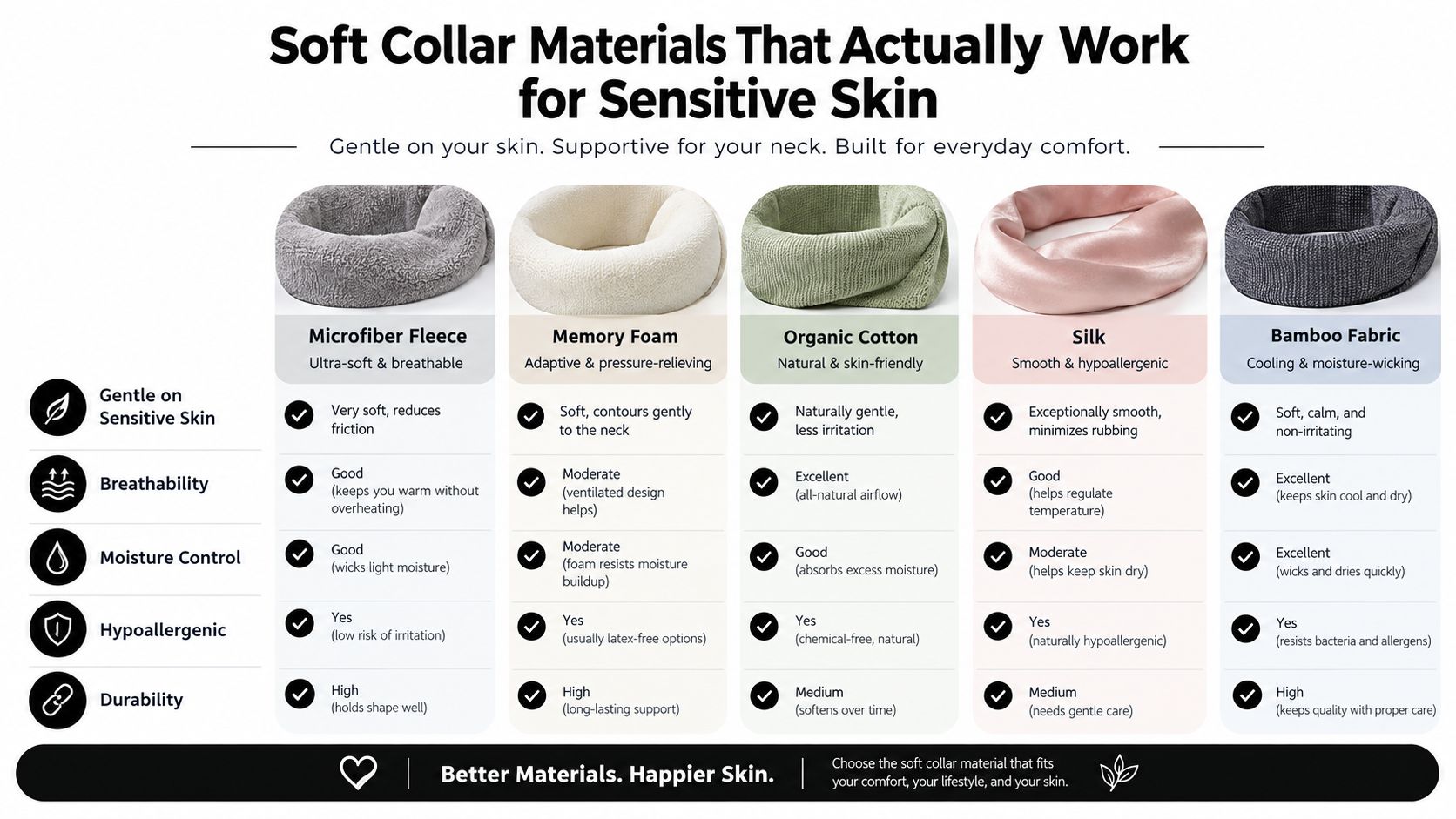
Soft collar materials compared for sensitive skin
| Material | Pressure Distribution | Moisture Resistance | Friction Level | Best For |
|---|---|---|---|---|
| Padded nylon | Good when padding is even and edges are smooth | Usually practical for everyday use, depending on construction | Low to moderate | Dogs needing a durable, cushioned everyday collar |
| Neoprene | Cushions contact and can feel flexible | Useful for wet-prone routines, but must dry fully | Low when seams are well finished | Dogs needing flexible padding and an easy-care surface |
| Cotton blend | Soft and breathable against the coat | Can retain moisture if not dried thoroughly | Low when closely woven and finished well | Dry-weather use and dogs that prefer a fabric feel |
| Hemp | Can soften with use and offers a fabric alternative | Moisture behavior varies by weave and finish | Low to moderate | Owners seeking a natural-fiber option with clear construction details |
| Silicone or coated material | Smooth surface and simple wipe-clean care | Often strong against surface moisture | Can be low, but inspect edges carefully | Dogs whose collars get dirty or wet frequently |
Neoprene isn't one single construction standard. Its softness, thickness, lining, and seam treatment all affect comfort, so learn how the material is used in a collar rather than judging the name alone. This plain-language explanation of neoprene material can help you understand why flexible padding and surface finish deserve attention.
Match the design to the skin problem
For a dog with short fur and a visible rub line, prioritize a broad, smooth interior and rounded edges. For a dog that gets wet often, choose a surface that doesn't stay damp, then make complete drying part of the routine. For a dog with a history of reacting to several materials, introduce one change at a time and ask your veterinarian whether a controlled trial is appropriate.
The evidence for options such as padded nylon, neoprene, hemp, cotton, and silicone remains more nuanced than product labels suggest. Treat “hypoallergenic” as a starting claim to investigate, not proof that every dog will tolerate the collar.
How to Measure and Fit a Collar Without Causing Irritation
A soft collar can still chafe when it presses continuously against the neck. Fit it after your dog is calm, with the coat lying naturally rather than compressed by your hand.
Follow a repeatable measuring routine
- Place a flexible tape around the neck where the collar will sit. Keep it level and avoid pulling it tight.
- If you don't have a tape, use a strip of paper or string, mark the overlap, and measure that length against a ruler.
- Check the manufacturer's sizing guide rather than guessing from breed or weight. Different collars use different measurement points, and this dog collar sizing guide explains the process in more detail.
- Choose a collar that allows adjustment around the measured neck, especially if your dog's coat changes after grooming or across seasons.
- Once fastened, slide two fingers between the collar and your dog's neck. The fingers should fit without forcing them underneath and without leaving the collar loose enough to twist freely.
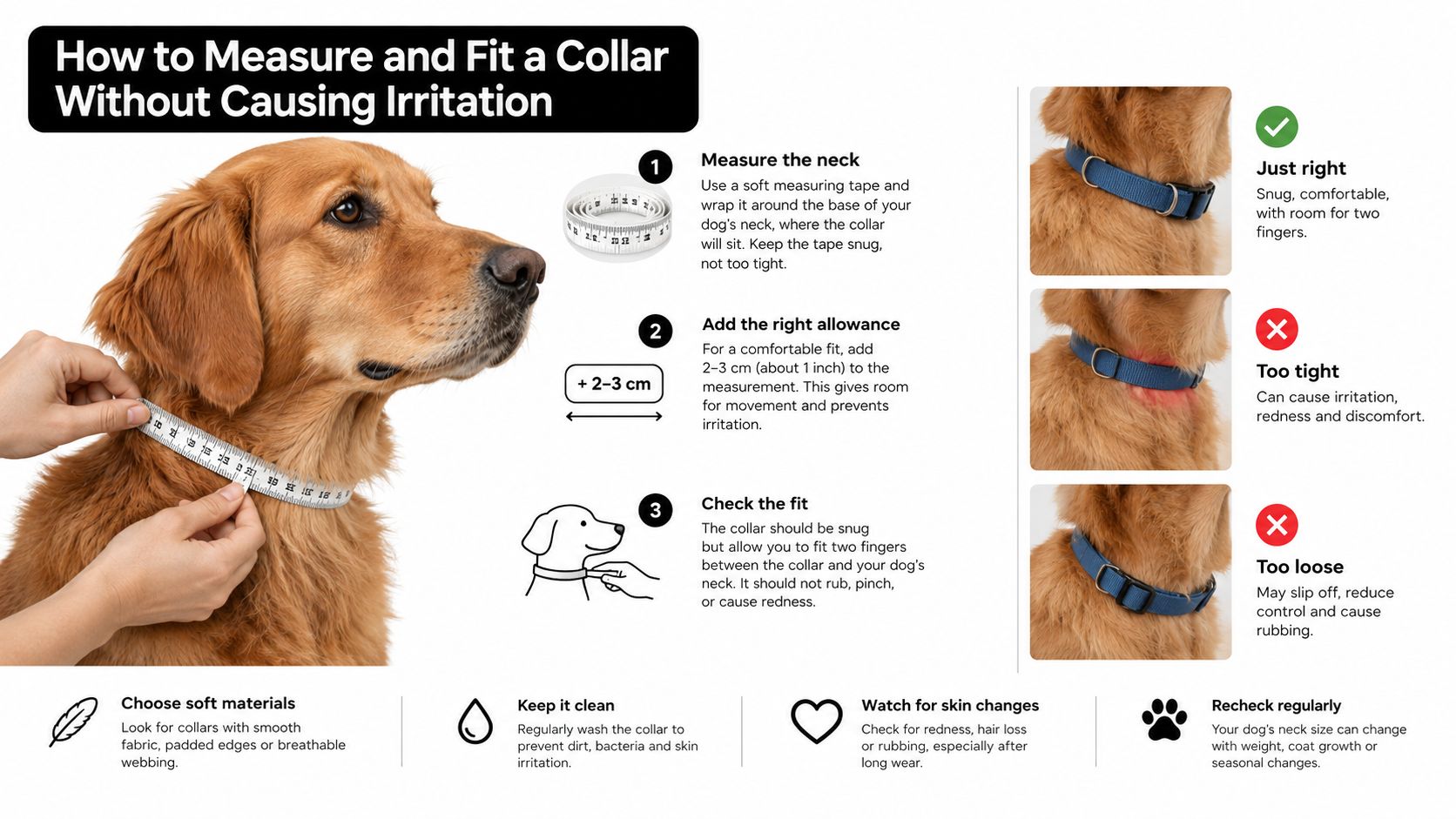
Inspect the contact points
Run your fingers around the inside surface. Find the seams, labels, buckle, and D-ring. A collar may feel soft overall but still place a hard component on a small, vulnerable patch of skin. Turn the collar so bulky hardware doesn't rest against an irritated area, provided the design remains secure and safe for its intended use.
Check the neck shortly after putting the collar on, again after activity, and after removing it. Watch for a developing red line, flattened or thinning hair, dampness, scabbing, or repeated scratching. Early changes are easier to address than a raw patch.
Fit is a process, not a one-time purchase decision. Recheck after grooming, weight change, coat growth, wet walks, and any adjustment to daily wear.
Many dogs don't need the same collar on continuously. Rotate clean, fully dry collars when practical, and build in collar-free periods in a secure environment. Never remove an identification or safety measure in a situation where your dog could escape, and ask your veterinarian or trainer how to balance skin breaks with identification needs.
Cleaning and Maintenance Routines That Protect Sensitive Skin
A collar collects whatever touches your dog's neck. Saliva, dust, rainwater, shampoo residue, and skin oils can remain in padding or around stitching. The longer those residues stay against the skin, the harder it becomes to tell whether your dog is reacting to the original material or to a dirty, damp surface.
Choose the simplest cleaning method that matches the collar's care instructions. Hand-wash delicate fabric in lukewarm water with a mild, unscented cleanser, rinse thoroughly, and press out water without twisting the collar. A padded collar that is machine washable may need a laundry bag, a gentle cycle, and low agitation, but the label should decide.
A low-effort weekly check
- Wash: Clean the collar when it has visible dirt, odor, or product residue, and make regular cleaning part of your weekly pet-care rhythm.
- Rinse: Remove cleanser completely. Residue can irritate skin even when the collar itself is well made.
- Dry: Air-dry the collar fully before putting it back on. Don't seal damp padding in a drawer or bag.
- Inspect: Flex the strap and examine the edges, stitching, buckle, and D-ring for roughness, fraying, cracks, or corrosion.
- Rotate: Use a clean alternative when the usual collar is wet or still drying.
Waterproof or wipe-clean surfaces can simplify maintenance, but they still need inspection around joins and hardware. A collar that smells musty, stays damp inside, or has a rough edge shouldn't go back on just because the outside looks clean.
For practical care ideas, see this guide to a washable dog collar. The important point isn't a particular washing method. It's connecting cleaning with the skin check, so maintenance becomes a way to catch wear before it becomes irritation.
After a bath or wet walk, remove the collar if your dog's surroundings are secure, dry the neck gently, and let the collar dry separately. Don't trap moisture between the strap and the skin while waiting for the coat to dry.
Collar Alternatives and When to Switch Away From Neck Wear
Some dogs need less neck contact, not a softer version of the same contact. A harness can move leash pressure toward the chest, while a breakaway design can reduce the consequences of snagging in situations where that feature is appropriate. Each option solves a different problem, and none should be selected without considering control, escape risk, anatomy, and the dog's behavior.
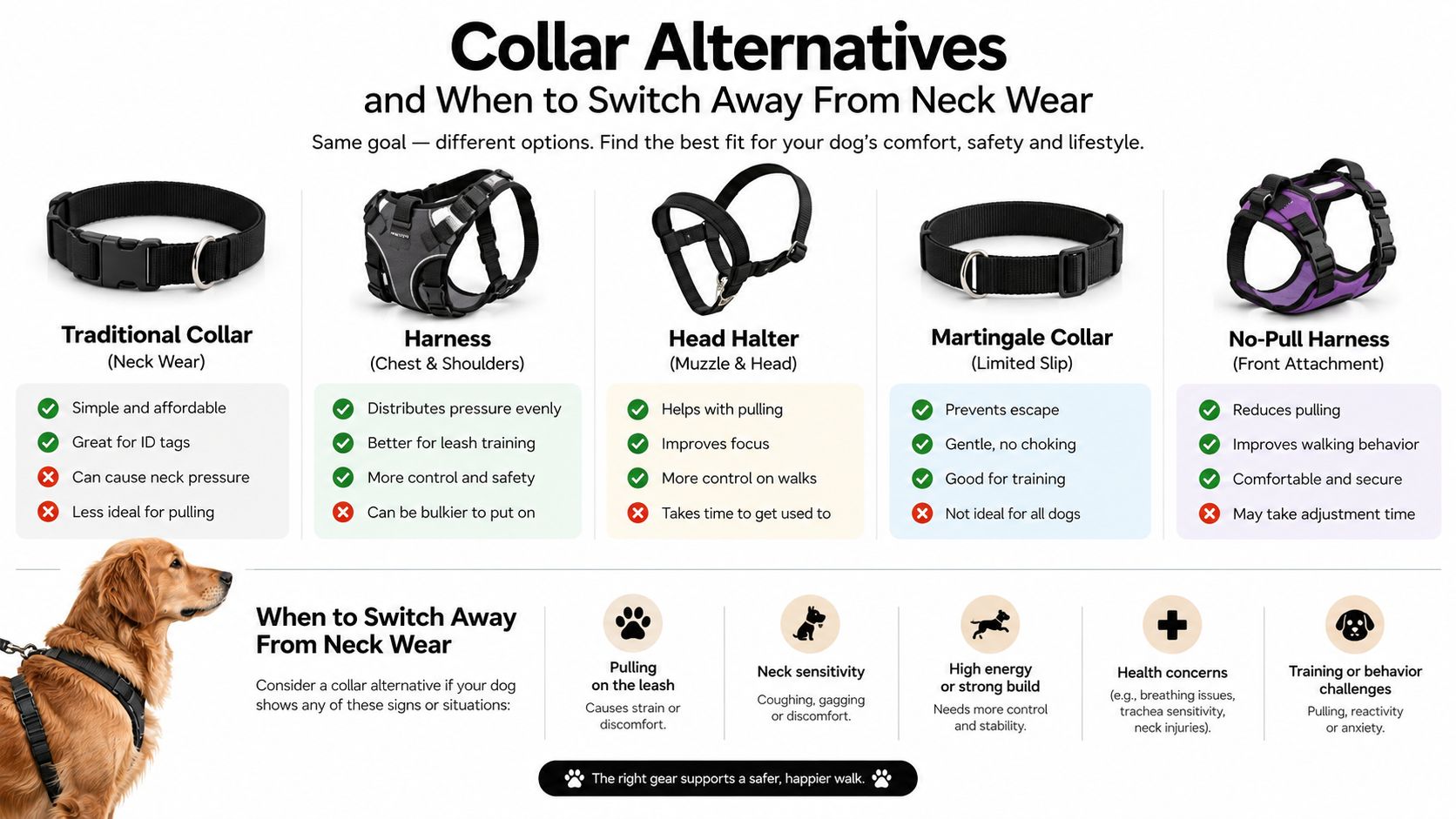
Compare the main options
| Option | Pressure Location | Useful When | Trade-Off to Check |
|---|---|---|---|
| Soft everyday collar | Neck | Identification and routine use when the skin tolerates it | Still exposes the neck to contact and leash force |
| Front-clip harness | Chest, with steering influence | Dogs that pull and need guidance away from the neck | Poor fit can rub the chest or restrict movement |
| Back-clip harness | Chest and back | Calm walkers or dogs that dislike neck pressure | May provide less steering for a strong puller |
| Breakaway collar | Neck, with a release feature | Situations where snag prevention is a priority | It may not be suitable for leash walking or every identification need |
| Vest-style harness | Broad chest and torso area | Dogs needing broader load distribution | Heat, bulk, and coat friction require monitoring |
| Head halter | Around the head and muzzle | Carefully trained dogs needing specialized control | Requires gradual training and may be unsuitable for some dogs |
A front-clip harness can help a dog whose neck becomes sore during leash walks, but the chest straps must sit clear of the armpits. A back-clip model may suit a relaxed walker who needs identification without directing force through the throat. A head halter isn't a casual substitute. Introduce it gradually and use professional guidance if your dog resists or paws at it.
A 2020 peer-reviewed survey of Elizabethan collars found that about 25% of respondents reported a collar-related injury, and itching or irritation represented 61.1% of those reported injuries (peer-reviewed survey of Elizabethan collars). That research concerned recovery cones rather than everyday collars, so it isn't a direct comparison between collars and harnesses. It does show why contact-worn equipment deserves active monitoring, especially for a dog already showing skin sensitivity.
Can a Collar Actually Help Sensitive Skin Instead of Hurting It
Most owners hear about collars as potential irritants. A narrower area of veterinary research asks a different question: could a specialized collar support the skin rather than merely avoid damaging it?
A 2023 clinical study involved 12 dogs with confirmed non-seasonal atopic dermatitis wearing a sphingomyelin-rich dermatological collar for 8 weeks. The report described no associated side effects and significant CADESI improvements of 43% at 4 weeks and 48.6% at 8 weeks (clinical study of the sphingomyelin-rich dermatological collar). Those findings concern a specific dermatological product and a defined clinical group. They don't mean an ordinary padded collar treats atopic dermatitis.
Comfort collars and therapeutic collars are different
An everyday comfort collar aims to reduce mechanical stress. Its value depends on smooth construction, suitable pressure distribution, correct sizing, dry surfaces, and appropriate wear time. A therapeutic or dermatological collar may include a material or formulation intended to interact with the skin in a particular way. That makes it closer to skin-care equipment than a standard accessory.
This distinction matters when reading premium product claims. Ask:
- What is the collar designed to do beyond holding identification?
- Has the product been evaluated in dogs, or is the claim based only on material marketing?
- Is the collar intended for a diagnosed skin condition?
- What wear schedule and monitoring instructions accompany it?
- Should a veterinarian supervise its use?
A collar can still cause contact dermatitis even when its material sounds gentle. Recent veterinary literature includes a leather-collar contact dermatitis case cited in a review, which is a useful reminder that “natural” and “soft” aren't guarantees of tolerance. A dog with atopic dermatitis may need a medical plan that includes bathing, parasite control, allergy investigation, medication, or dietary assessment. A specialized collar may have a role, but it shouldn't replace that evaluation.
Troubleshooting Irritation and Deciding When to See a Vet
When irritation returns, change one variable at a time. Remove the collar and observe whether the skin settles. If it improves, re-examine the contact map, fit, hardware, and wear conditions before buying another product.
Use the contact pattern as a clue
If the redness follows the full band, assess tightness, edge pressure, seam placement, and how long the collar stays on. A soft material won't prevent rubbing if it presses continuously.
If the reaction sits beneath one buckle, D-ring, or label, inspect that component for roughness, residue, corrosion, or a finish your dog may not tolerate. Test a different construction only after the skin has recovered, rather than placing new hardware on an active sore.
If irritation appears after rain, bathing, or swimming, suspect trapped moisture and incomplete drying as well as the material itself. A waterproof surface can resist water on the outside while moisture remains around the neck or inside a padded section.
If the skin remains affected without the collar, consider environmental exposure, parasites, infection, or an existing allergic condition. Independent veterinary guidance also emphasizes that tight fit, rough seams, frayed edges, and constant friction can trigger irritation, while soft materials alone won't solve a collar that's too snug (guidance on collars for dogs with sensitive skin).
Don't let the price tag make the diagnosis. An expensive collar can still be the wrong size, the wrong shape, or unsuitable for your dog's skin.
If you suspect a wider allergy problem rather than a collar-only reaction, a veterinary allergy resource such as cat and dog allergy relief can help you understand why identifying the trigger matters. Use it as background information, not as a substitute for an examination.
Seek veterinary care for persistent redness, weeping or moist skin, hot spots, bald patches, foul odor, swelling, scabbing, or pain when the collar area is touched. Arrange prompt advice if your dog is intensely scratching, seems unwell, or the irritation spreads. Your veterinarian may need to examine for infection or dermatitis and decide whether testing or treatment is appropriate.
Until then, keep the area clean and dry, prevent further rubbing, and don't apply leftover medication without professional direction. A controlled, patient process protects your dog's skin better than cycling through several “hypoallergenic” products in quick succession.
Putting It All Together Into a Simple Comfort Routine
The reliable approach is small and repeatable. Choose a collar for its construction, fit it with room for comfortable movement, keep it dry and clean, and treat the skin as feedback rather than an afterthought.
Your weekly comfort check
- At the start of the week: Run your fingers over the inside surface and inspect seams, edges, and hardware.
- After wet activity: Remove or loosen the collar only when safe, dry the neck, and dry the collar completely before reuse.
- During normal wear: Look for scratching, head shaking, a red contact line, hair thinning, or dampness.
- After grooming: Recheck the fit because coat length and collar position may have changed.
- At the end of the week: Wash the collar according to its care instructions and record any skin change in a simple note or photograph.
If the dog stays comfortable, keep the routine stable. If irritation appears, pause the collar when safe, identify whether the pattern points to fit, hardware, moisture, or material, and make one adjustment. Persistent or painful changes belong with a veterinarian, and ongoing neck sensitivity may make a harness or another identification arrangement more suitable.
For broader ideas about reducing discomfort in daily life, the pet comfort guide from Heartstrings Pet Hospice offers useful context beyond collar selection. The central lesson remains practical: a soft dog collar for sensitive skin isn't defined by fabric alone. Comfort comes from the interaction between material, pressure, maintenance, wear time, and observation.
Nandog Pet Gear offers waterproof Poly-Flex sport collars and other everyday pet accessories designed around flexible materials, easy-care surfaces, and comfortable use. Visit Nandog Pet Gear to explore collar and harness options, then compare their construction and fit with your dog's skin-care routine before choosing.