


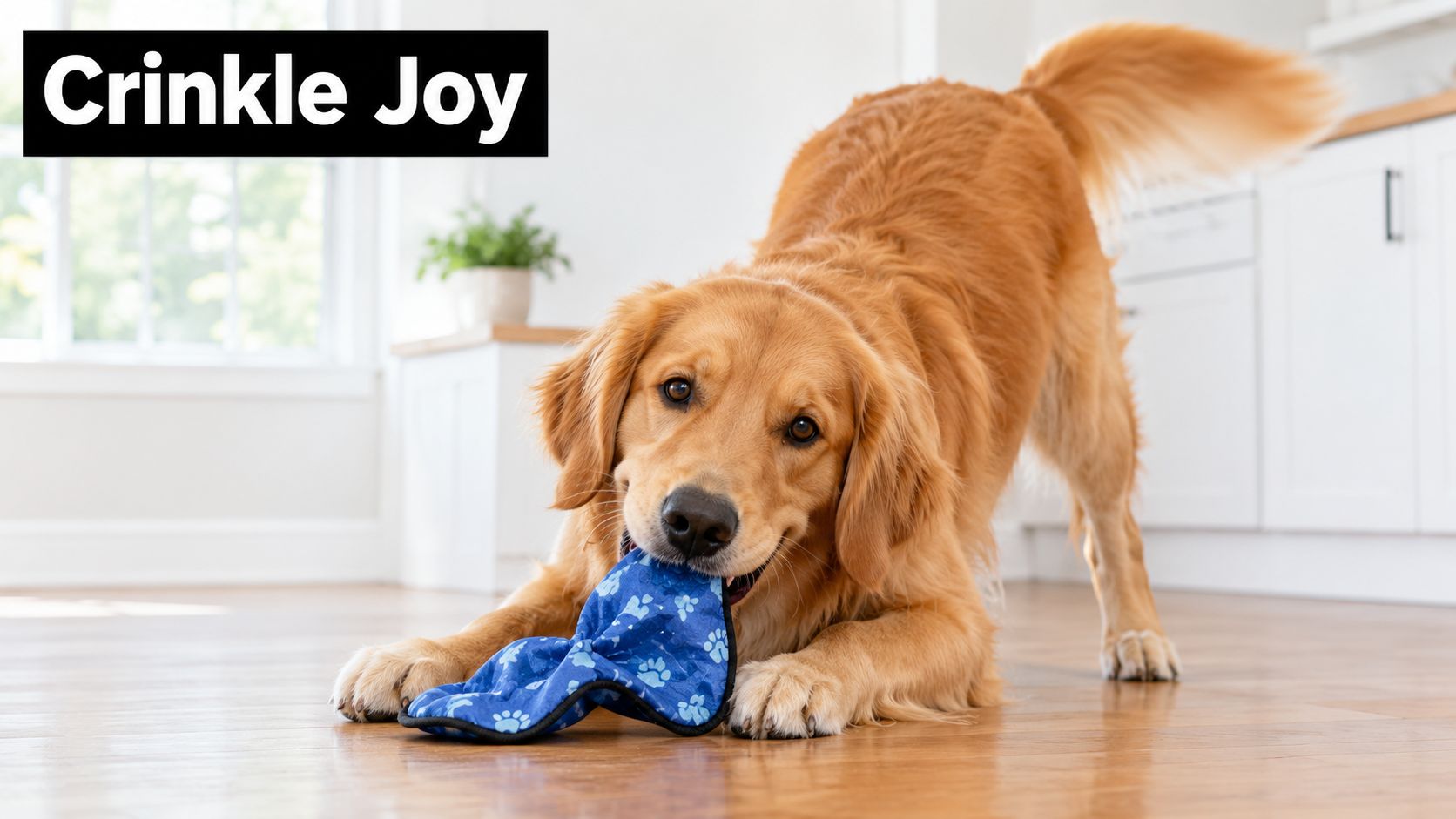
A puppy finds a crinkle toy on the kitchen floor and stops mid-step. The ears point forward, the body lowers into a play bow, and one bite produces an instant rustle. Suddenly, the soft toy seems more interesting than every other object in the room. You may wonder, why do dogs like crinkle toys so much when the sound resembles little more than paper or plastic being moved?
The answer isn't one mysterious preference. Sound, texture, movement, prey-drive mimicry, and novelty work together. A crinkle toy gives your dog immediate feedback without requiring a hard bite, while its soft surface makes the experience different from a rubber chew or a sharp squeaker. That combination can turn a simple toy into a small sensory puzzle.
The same appeal also creates a responsibility. A dog that investigates and carries a crinkle toy may be enjoying healthy enrichment. A dog that tears open the toy, swallows the inner layer, or becomes unable to disengage needs a different plan.
The Moment Every Dog Parent Recognizes
Your dog notices the toy before you've even picked it up. The head turns toward the faint rustle, the tail begins to move, and the dog approaches with the careful focus usually reserved for something alive. When the first bite makes the toy answer back, the dog paws at it, shakes it, drops it, and bites again.
That response makes sense from a behavior perspective. Dogs are highly responsive to auditory cues, and a toy that produces sound when touched creates a clear connection between the dog's action and the toy's response. Veterinary behavior guidance also describes toys, games, and food as useful tools for building positive associations during counter-conditioning, which helps explain why sound-based play can hold attention and support a positive emotional experience. (Veterinary Partner explains the role of play and reinforcement in behavior work)
Five sensory ingredients
- Sound: The rustle stands out from a quiet room and tells the dog that its movement caused something to happen.
- Texture: The fabric or plush exterior feels soft, while the inner layer adds resistance and movement under the mouth or paws.
- Prey-like motion: A toy that folds, flutters, or shifts can resemble the movement of leaves or a small animal hidden in grass.
- Novelty: Even a familiar toy can become interesting again when it appears after time away.
The crinkle is often the first feature that captures attention, but it isn't the entire explanation. The dog hears an unusual response, then uses its mouth, paws, nose, and eyes to investigate the object. Each sense confirms that the toy is interactive.
Practical rule: A crinkle toy is most useful when the dog can engage with it easily, pause voluntarily, and leave the toy without distress.
Understanding the sound comes first because the sound starts the conversation between dog and toy. The dog acts, the toy responds, and that exchange invites another investigation.
How Sound Captures a Dog's Attention
A crinkle toy doesn't need to be extremely loud to be noticeable. It needs to produce a sound that changes when the dog bites, paws, shakes, or drags the toy. That variation gives the dog information about movement and cause and effect.
A useful comparison is the difference between a rustle and a squeak. A squeaker usually produces a concentrated, sharp signal when the dog applies enough pressure. A crinkle layer creates a broader, less abrupt series of small sounds as it bends and moves. The exact volume depends on the toy, the distance, the force of the bite, and the surrounding room, so owners shouldn't assume one fixed loudness range for every crinkle product.
Independent acoustic testing of noisy dog-shaped airflow toys measured 88.1 to 112.3 dB(A) at ten centimeters and 85.2 to 102.5 dB(A) at fifty centimeters, with mean readings of 102 ± 10 dB(A) and 94 ± 8 dB(A) at those distances. (The acoustic testing discussion provides those measured readings for noisy dog toys) Those measurements concern noisy airflow toys, not every squeaker or crinkle toy, but they show why some owners seek a softer sensory alternative.
Why irregular sounds keep the investigation going
A predictable sound can still be enjoyable, but a changing rustle gives the dog a reason to keep testing the toy. One bite may create a faint crackle, while a paw press or shake produces a longer burst. The dog can't know exactly what the next movement will sound like, so each action offers fresh information.
This is especially helpful for a gentle chewer. The dog doesn't need to clamp down hard to make the toy respond. A small mouth movement can be enough to trigger the rustling layer, which keeps the interaction accessible without asking for powerful chewing.
| Sound Feature | Crinkle Toy | Squeaker Toy |
|---|---|---|
| Main signal | Rustling, crackling, or folding noise | Concentrated chirp or squeak |
| Trigger | Biting, pawing, shaking, or moving the toy | Usually pressure on the squeaker |
| Feedback pattern | Changes with movement and compression | Often repeats a more consistent sound |
| Sensory feel | Softer, textured, and less abrupt for many dogs | Sharper and more immediately attention-grabbing |
| Typical play style | Investigation, carrying, pawing, and repeated handling | Biting, chasing, shaking, and fast interaction |
Sound-sensitive dogs still need individual observation. Watch whether your dog approaches willingly, keeps a loose body, and can pause. If the toy causes startling, avoidance, or mounting tension, a quieter object or a non-auditory activity may be a better fit.
The Bite and Rustle Feedback Cycle
The appeal becomes easier to understand when you follow one play sequence rather than treating “crinkle” as a single feature.
Five moments in the loop
- The dog bites or paws the toy. The soft exterior compresses, folds, or shifts.
- The inner layer rustles. The toy produces immediate auditory feedback.
- The dog notices the result. The sound confirms that the action changed the object.
- The dog repeats the action. Another bite or paw movement tests whether the sound happens again.
- The pattern becomes familiar. Repeated successful interactions make the toy easy to understand and rewarding to revisit.
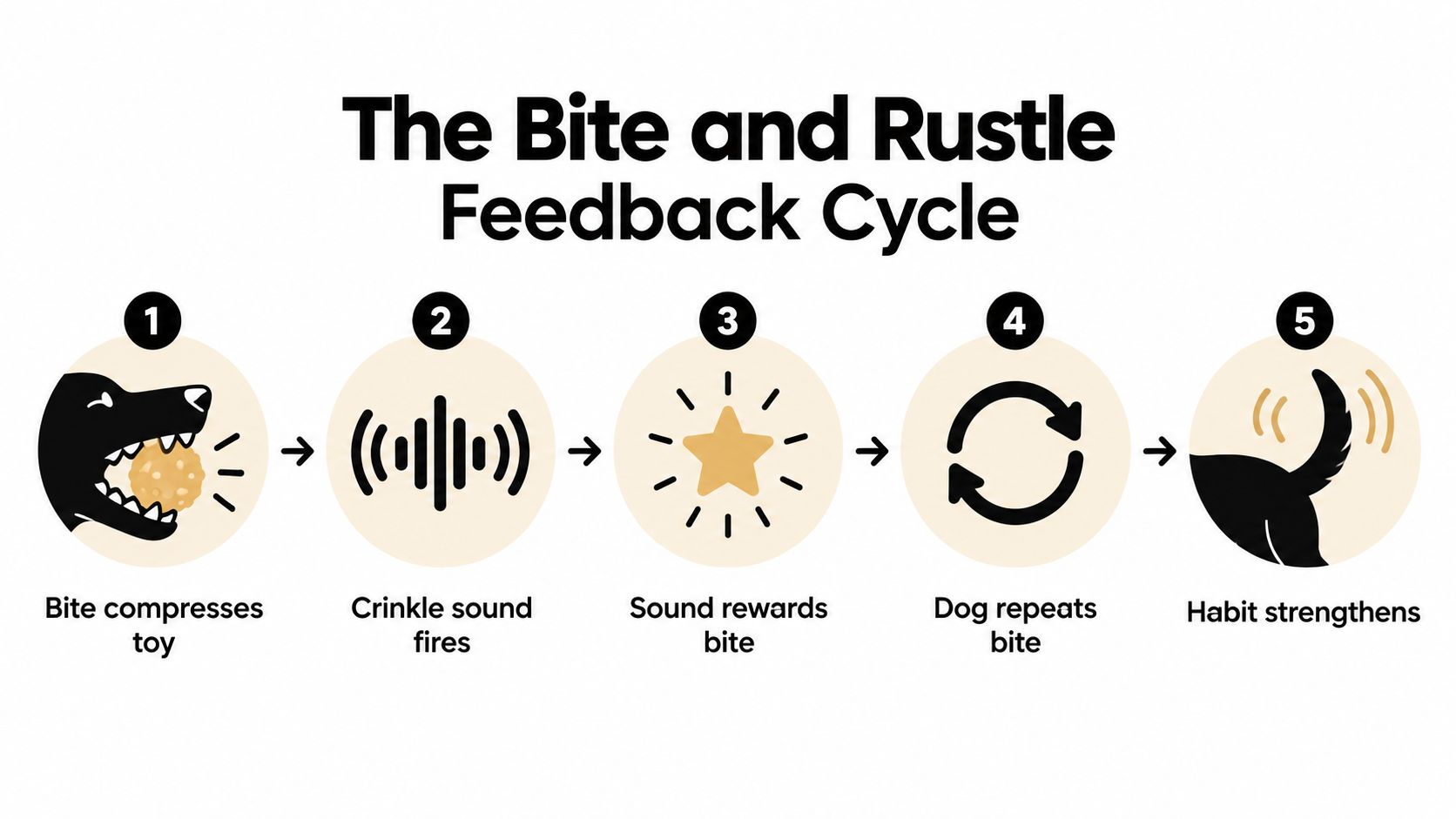
This is a plain-language example of reinforcement. The dog performs an action, receives an interesting consequence, and becomes more likely to perform the action again. The reward isn't necessarily food. For a sound-motivated dog, the rustle itself can be valuable because it makes the toy feel responsive.
The texture strengthens the loop. A soft outer surface gives way under the teeth, while the inner layer creates a distinct crinkly resistance. The mouth receives tactile information at the same time as the ears receive sound. That combination can feel richer than biting a silent plush toy.
A silent pause can be part of the attraction. When the dog stops moving, the toy stops responding, which may prompt another curious touch.
The cycle doesn't mean every dog will play continuously or that longer play is always better. Healthy enrichment includes breaks. A dog that drops the toy, looks away, sniffs, or moves to another activity is showing useful self-regulation. Let that pause happen rather than turning the toy into a test of endurance.
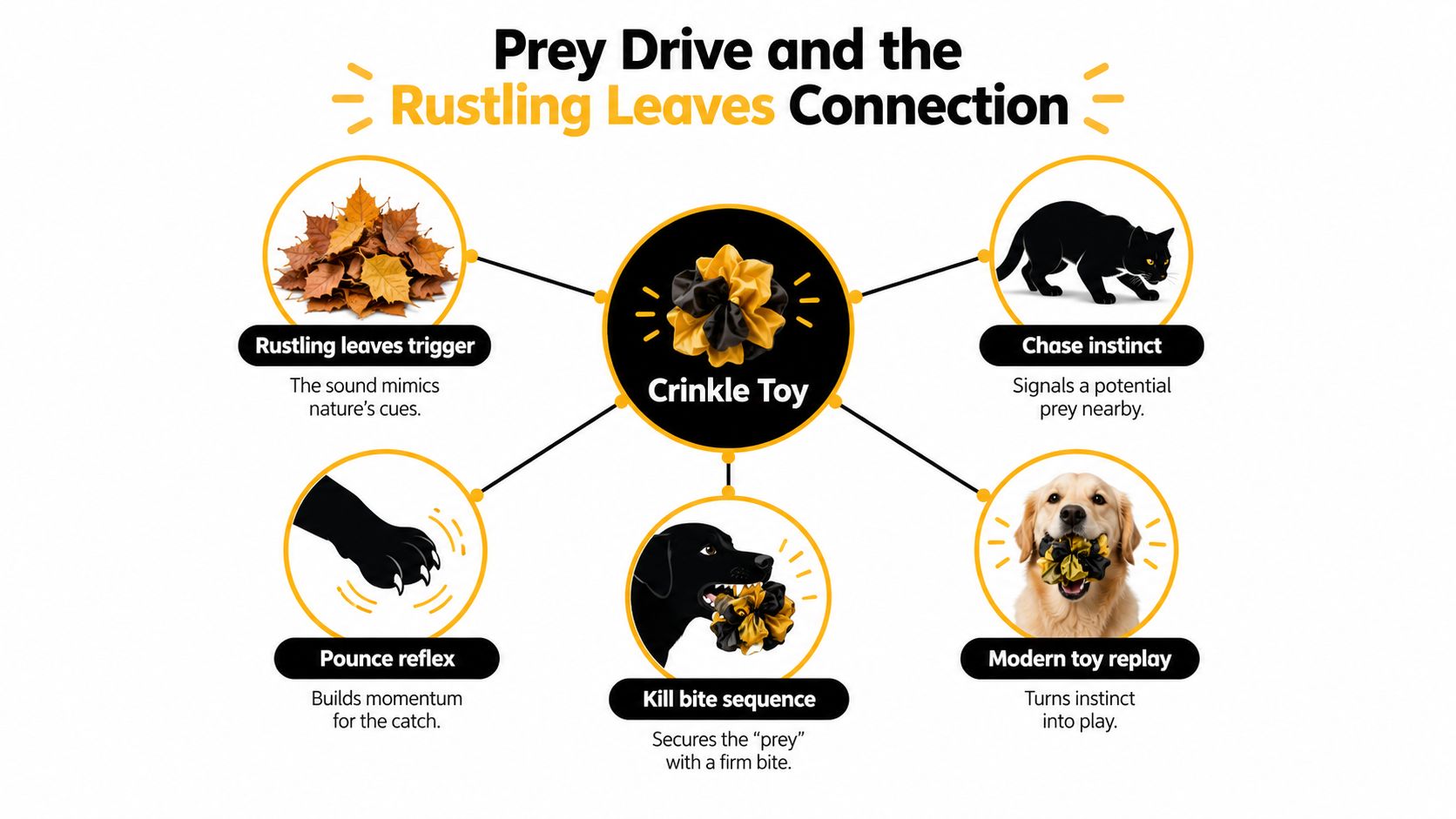
Prey Drive and the Rustling Leaves Connection
A crinkle sound can resemble familiar outdoor noises, such as paper, dry leaves, or movement hidden in grass. Several descriptions of canine toy preference connect that rustling quality with play patterns associated with small prey movement, including pouncing, shaking, and carrying. (A discussion of crinkle sounds and prey-related play patterns)
The dog doesn't need to believe the toy is a real animal. The sound and motion may just invite a sequence that already feels natural: orient toward the noise, lower the body, approach, grab, shake, and carry. One dog may tilt its head and creep forward. Another may skip the stalking phase and immediately fling the toy across the room.
The same toy can serve different dogs
A dog with strong interest in movement may focus on the toy as it slides or flutters. A mouthy puppy may care more about the combination of soft fabric and resistance. A dog living in an apartment may enjoy the opportunity to chase, grab, and carry indoors without needing a large outdoor space.
Breed tendencies can influence play style, but they don't predict an individual dog's preference with certainty. A terrier may dissect the toy, a retriever may carry it back, and a scent-oriented dog may ignore it until you add a hidden treat or move it along the floor. Observe the behavior in front of you rather than choosing a toy solely from a breed label.
For a broader example of how dogs respond to interactive movement and human participation, compare crinkle play with the engagement described in Nandog's guide to why dogs like tug-of-war.
Think of tossing a crinkle toy as shaking a small bush. The rustle creates an invitation, but the dog decides whether that invitation leads to a pounce, a carry, a gentle investigation, or no response at all.
How Crinkle Toys Compare to Squeakers and Plush
Your dog doesn't need one perfect toy. Different formats answer different behavioral needs, and a thoughtful toy rotation can prevent every play session from becoming the same kind of high-energy interaction.
A crinkle toy sits between quiet comfort and sharp excitement. It offers more feedback than silent plush, but its rustling response is usually less abrupt than a concentrated squeak. Compared with solid rubber, it feels lighter and changes shape more readily, which makes it suitable for dogs that enjoy carrying, pawing, folding, and investigating.
| Toy Type | Primary Sound | Best For | Engagement Style |
|---|---|---|---|
| Crinkle | Rustle or crackle | Dogs that enjoy sound with softer feedback | Pawing, carrying, folding, biting, and investigating |
| Squeaker | Sharp squeak | Dogs motivated by immediate bite feedback | Chasing, biting, shaking, and interactive play |
| Plush | Usually quiet | Comfort, carrying, and gentle handling | Cuddling, carrying, resting, and soft mouthing |
| Rubber | Often quiet, with bounce or impact sounds | Dogs that enjoy durable chewing or fetching | Chewing, retrieving, bouncing, and food-based enrichment |
A squeaker may encourage a firm bite because pressure produces the signal. A crinkle layer can respond to smaller movements, including a paw press or a light mouth grip. That difference matters for puppies, gentle chewers, and dogs that become startled by sudden squeaks.
For a closer look at the behavioral appeal of squeaky play, see Nandog's explanation of why dogs like squeaky toys. Then watch your own dog. If the dog carries plush toys but ignores them when awake, crinkle may add useful interaction. If the dog becomes frantic around any noise, quiet rubber or scent-based enrichment may be the calmer choice.
When Crinkle Play Becomes a Problem
A dog can look excited and still be too aroused to play safely. Wagging, fast movement, and repeated biting don't automatically prove that the dog feels relaxed. The important question is whether the dog remains flexible, responsive, and able to stop.
A healthy play session usually includes changes in pace. The dog may grab the toy, release it, sniff the floor, look toward you, or choose another activity. Concern rises when the dog becomes rigid, guards the toy, panics when a person approaches, or tears at the object with no interest in playing with it as a whole.
Watch the whole dog
Potential warning signs include:
- Rigid posture: The body becomes stiff rather than loose and bouncy.
- Whale eye or tucked tail: The dog shows stress while continuing to hold the toy.
- Frantic shredding: The dog targets seams or the inner pouch instead of engaging with the toy.
- Guarding behavior: The dog growls, snaps, freezes, or rushes away when someone comes near.
- Poor recovery: The dog remains agitated after the toy disappears or struggles to settle.
A dog that shakes a toy and then rests may be completing a satisfying play sequence. A dog that rips through the fabric, pulls out the crinkle layer, and searches for pieces has shifted from enrichment to destruction. That distinction matters because loose material can become an ingestion hazard.
End the session calmly. Put the toy away rather than grabbing it in a confrontation, offer a trade for a calmer chew or food-based activity, and give the dog space. If the dog repeatedly guards toys, swallows non-food objects, or cannot disengage, consult a qualified behavior professional and your veterinarian.
If the lining is exposed, punctured, or available to swallow, the toy is no longer a play object. Remove it.
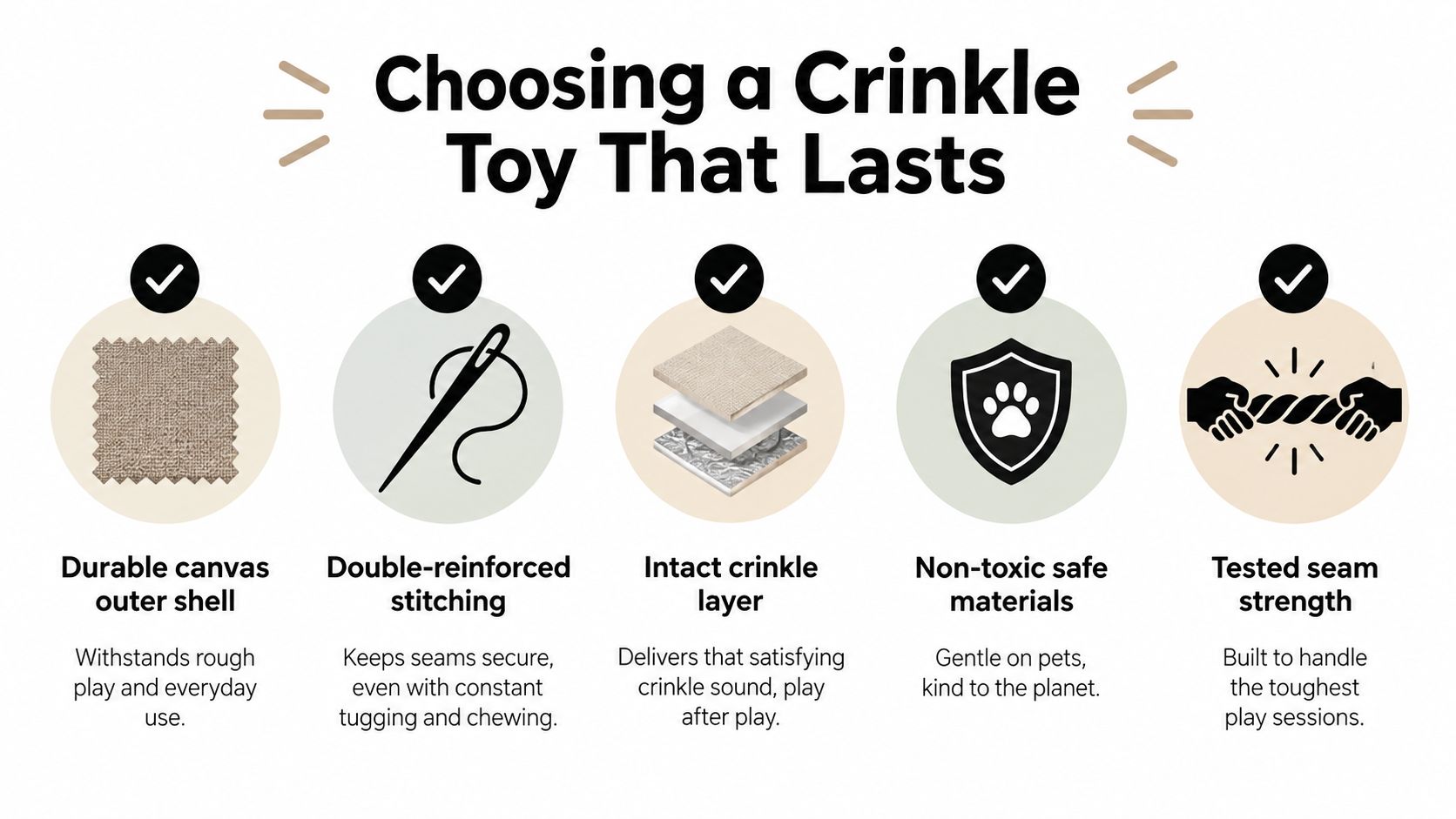
Choosing a Crinkle Toy That Lasts
Start with construction, not character design. A cute shape won't compensate for weak seams or an inner layer that becomes accessible after the first determined session. Choose a toy that matches your dog's mouth, movement, and history with fabric objects.
Use a practical inspection checklist
- Outer fabric: Look for a surface that feels firmly woven and doesn't pull apart easily under ordinary handling.
- Seams: Examine every edge, corner, limb, and attachment point before giving the toy to your dog.
- Inner layer: The crinkle material should remain enclosed, with no loose flap or exposed edge.
- Size: Avoid small detachable elements that your dog could carry off and swallow. A large dog may need a larger toy that can be handled without gulping.
- Toy purpose: Treat a plush crinkle toy as a supervised activity item, especially if your dog has a history of shredding.
Don't rely on a single inspection at purchase. Examine the toy after play and laundering, because moisture, pulling, and repeated compression can change the fabric and seams. Remove the toy if stuffing, plastic, stitching, or decorative parts become exposed.
For dogs that destroy soft toys quickly, compare the construction guidance in Nandog's article about durable dog toys for aggressive chewers. The right choice may still be a crinkle toy, but it may need shorter sessions, direct supervision, and storage out of reach between play periods.
Avoid assuming that adding both a squeaker and a crinkle layer automatically improves a toy. Multiple sound features can be engaging, but structural integrity and your dog's chewing style matter more than novelty. If your dog targets the sound source, choose a different format rather than hoping a stronger interest will become safer with time.
Putting the Sensory Puzzle Together
The best answer to why do dogs like crinkle toys is a combined one. The sound attracts attention, the texture gives the mouth and paws something to explore, the movement can echo prey-related play, and the changing response adds novelty. Remove one element and the toy may still work, but the combination explains why a soft object can compete successfully with a whole toy bin.
Use that model to choose enrichment rather than buying by appearance alone. A dog that enjoys sound but becomes frantic may need quieter play. A dog that likes carrying may prefer soft fabric. A dog that shreds needs a safer chew or food puzzle. A dog that loses interest quickly may benefit from rotation, not a more complicated toy.
Engagement isn't the same as suitability. The toy must hold attention without creating an avoidable swallowing or stress risk.
Keep the crinkle toy available as part of a varied routine instead of leaving it on the floor all the time. Bring it out for a short supervised play period, then store it and offer another activity on a different occasion. Pair independent crinkle play with a brief game of tug, fetch, scent exploration, or a calm chew so your dog receives both solo enrichment and social interaction.
Finally, observe the details. Does your dog prefer a light rustle or a heavier crackle? Does pawing produce more interest than biting? Does the dog settle after play, or become harder to calm? Those observations turn future toy choices into informed experiments and help you keep the sensory benefit while respecting the safety boundary.
Nandog Pet Gear offers plush toys with interactive elements such as squeakers and crinkle textures, alongside comfort-focused beds and everyday pet accessories. Visit Nandog Pet Gear to explore options that support supervised sensory play and comfortable daily routines.