


Your dog circles the bed, lowers their body, then gets up again. Perhaps they're older, carry extra weight, or have started moving carefully after walks. You may be wondering whether an orthopedic bed truly differs from a thick cushion, or whether "orthopedic" is just a marketing label.
The best orthopedic dog beds combine pressure-relieving foam, appropriate thickness, accessible design, and practical construction. The right choice won't cure arthritis or replace veterinary care, but it can give a painful or stiff dog a steadier surface for resting, getting up, and settling down.
Why Orthopedic Dog Beds Matter for Joint Health
An aging dog may still want to sleep near the family, yet a human mattress can create practical problems. It may sit too high for a stiff dog to reach, feel too soft for steady support, or leave too much space for comfortable positioning. A dedicated floor-level bed lets you choose the entry height, dimensions, and support around the dog rather than adapting the dog to household furniture.

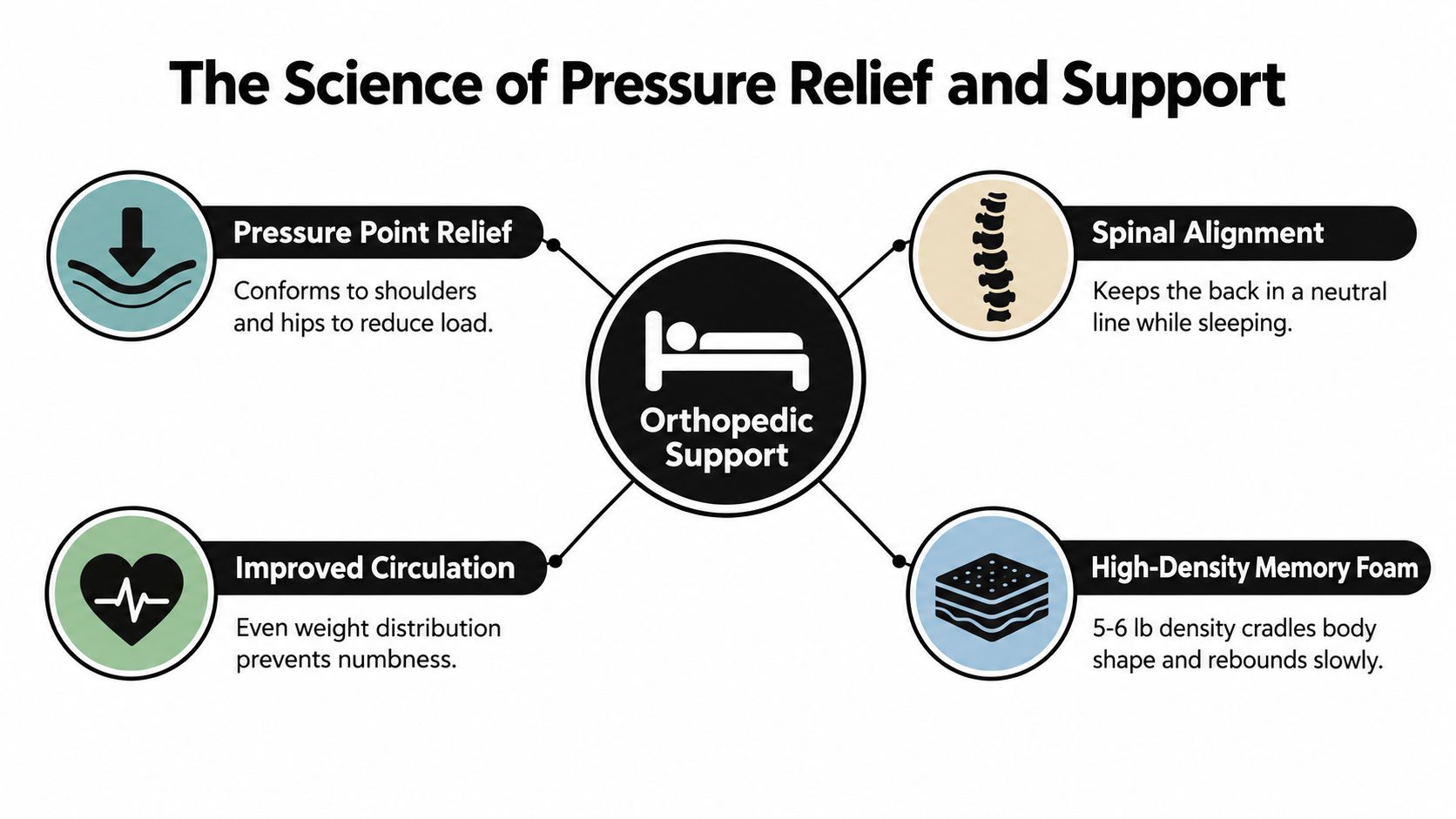
Orthopedic support is about pressure distribution. A dog with arthritis, hip dysplasia, stiffness, or limited mobility places concentrated weight on areas such as the hips, shoulders, elbows, and ribs. High-density foam spreads that load across more of the body, much like a supportive human mattress keeps one joint from bearing the full force of a sleeper's weight. A bed that is too soft can allow the body to sink too far, which may make changing position or standing harder.
Support also has to fit the dog's condition and daily routine. A large senior dog may need more resistance against bottoming out, while a smaller or frailer dog may need an easier step-in edge. The useful question is not just whether a bed feels plush in your hand. It is whether the surface stays stable under the dog and remains practical to clean after repeated use.
A targeted comfort tool, not a cure
An orthopedic bed supports a broader mobility plan. It can provide a steadier place to rest, but it cannot diagnose pain, repair a damaged joint, or replace prescribed treatment. If your dog struggles to rise, changes position repeatedly, limps, or avoids stairs, arrange a veterinary assessment.
Daily habits matter as well. Alongside a suitable bed, pet parents can review guidance on daily dog joint and mobility support, including the routine surrounding rest, movement, and comfort.
The category has grown beyond a niche accessory. Consumer coverage of arthritis-focused beds describes the orthopedic segment growing toward $5.1 billion by 2034, with memory foam presented as the most common construction, according to Dogster's market and arthritis-bed overview. That coverage signals rising interest in wellness-focused pet care, not a universal need for orthopedic bedding. The strongest case is a dog whose joints benefit from consistent pressure relief, stable support, and a design owners can keep clean.
The Science of Pressure Relief and Support
A plush surface feels comfortable when you press it with your hand. That simple test can mislead you, because a dog's body creates concentrated load at bony contact points. If the material compresses too easily, the dog may sink until the joints meet the firmer base underneath. The result is softness without meaningful support.
Memory foam works differently from loose fiberfill. It slowly conforms to the body, increasing contact across the surface rather than leaving the hips or shoulder to carry much of the load. A multilayer bed can combine a responsive base, which helps prevent bottoming out, with a contouring upper layer that cushions pressure-sensitive areas.
What pressure mapping tells us
The most useful evidence here is mechanical rather than a claim that orthopedic beds treat disease. A pressure-mapping study cited in veterinary coverage found that memory foam reduced pressure at key bony points in dogs lying on their sides, compared with a standard mattress or blankets. The shoulder, hip, and rib areas showed the clearest difference in that comparison, as described in this veterinary coverage of elevated beds and arthritis.
That finding helps explain why a true orthopedic bed isn't defined by softness alone. The material needs to spread force across a larger area while remaining stable enough to support the dog's body. A bed that collapses under the pelvis may feel plush for a few minutes, but it doesn't necessarily maintain a comfortable posture during a long rest.
Support has a practical limit
A dog should be able to settle without sinking into a deep pocket. The spine should remain reasonably supported, and the dog shouldn't have to push hard against the mattress to stand. For dogs with reduced mobility, this matters as much as the initial sensation of comfort.
The useful question isn't “Does this bed feel soft?” It's “Does this bed support the dog without creating pressure points?”
Look for a stable foam core, a surface that conforms gradually, and an edge that doesn't force a stiff dog to climb. Bolsters can support the head, but a high wall at every entrance may undermine the very accessibility an arthritic dog needs.
Choosing the Right Foam, Thickness, and Firmness
Foam construction determines whether a bed keeps supporting your dog after the novelty wears off. Product descriptions often use “orthopedic,” “therapeutic,” and “supportive” interchangeably, so evaluate the actual build instead of relying on the label.
| Construction | How it behaves | Most suitable when |
|---|---|---|
| Memory foam | Contours slowly around the body and spreads load | A dog needs pronounced pressure relief or spends long periods resting |
| High-density poly foam | Provides a firmer, more responsive base | A heavier dog needs resistance against sinking |
| Multilayer foam | Combines a supportive foundation with a pressure-relieving top | You want contouring without sacrificing stability |
| Egg-crate foam | Uses shaped peaks and valleys to distribute weight and improve airflow | A lighter or smaller dog needs moderate cushioning and easier ventilation |
Thickness is not decoration
Veterinary experts commonly cite about 4 to 5 inches of memory foam as a strong target for pressure distribution, while very thin layers may provide little more than surface cushioning, according to NBC Select's guidance on dog-bed construction. The suitable choice still depends on the whole structure. A thin comfort layer over a stable base can perform differently from a thin single slab.
Heavier dogs and dogs that move less need foam that resists bottoming out. Test a candidate bed by pressing firmly through the top. If your hand quickly reaches the floor or the base feels unstable, the bed may not provide enough protection for a large or stiff dog.
Match firmness to the dog
Firmness isn't the same as hardness. A very rigid surface may create its own pressure points, while an excessively yielding one can make standing difficult. Aim for a surface that compresses enough to cradle the dog but rebounds enough to keep the body supported.
The Nandog guide to memory foam pet beds can help you compare how memory foam construction differs from ordinary padded bedding. Also check whether the manufacturer provides clear information about the foam layers, the cover, the recommended weight range, and any independent material certification.
A low entry is especially important for dogs with mobility problems. Choose a bed with at least one accessible side rather than a high, continuous bolster that requires stepping over an obstacle. If the dog sleeps hot, consider breathable cover fabric or a construction that allows airflow, but don't trade away the density needed for joint support.
How to Measure Your Dog for a Perfect Fit
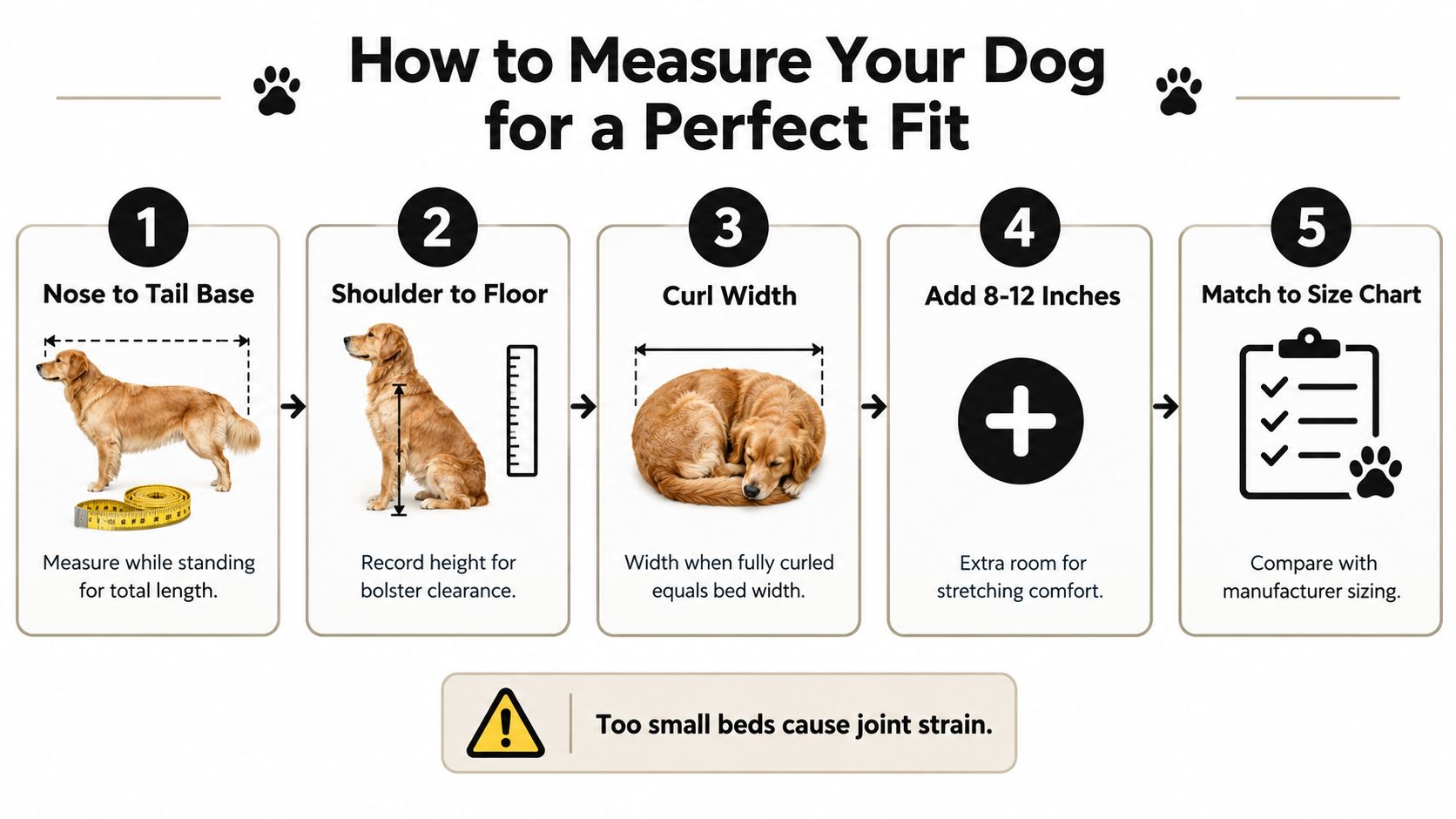
A dog that cannot stretch, turn, or settle comfortably may place pressure on the same joints for hours. Measure your dog instead of relying on breed labels, because body shape and sleeping habits differ even among dogs of similar size.
Take the measurements in a natural position
- Measure length. With your dog standing, measure from the nose to the base of the tail. Add attention to this measurement if your dog usually sleeps fully stretched out.
- Measure curled width. Observe your dog settling into a curled position, then measure the widest part of the curl. This helps match the bed to a compact sleeping style.
- Check shoulder height. Measure from the floor to the top of the shoulders. For beds with bolsters, this indicates whether the sides will remain easy to step over.
- Add room for movement. Leave enough usable space for turning, stretching, and repositioning without sliding over the edge. Measure the interior sleeping area, since a thick bolster can make the outside dimensions misleading.
- Compare the manufacturer's chart. Check the bed's interior measurements and recommended weight range. A “large” label does not mean the same thing from one brand to another.
The Nandog dog bed size chart by breed offers a useful starting reference, but tape measurements should determine the final choice. Senior dogs may benefit from extra usable surface because repositioning can be difficult. Large dogs also need a base that keeps its support rather than compressing under concentrated weight.
Why a dedicated bed still matters
Many dogs share human furniture, yet a separate floor-level bed gives them a consistent resting option. It also gives larger or less mobile dogs an easier route to comfortable sleep, without requiring a jump onto a sofa or bed.
The choice should account for both orthopedic fit and daily ownership. A generously sized bed may spread pressure more effectively, but it also has more fabric to clean and more material that must withstand repeated use. Measure the sleep area first, then check whether the cover and construction suit your cleaning routine.
Use the following video as a visual aid while taking measurements. Confirm the result against the product's interior dimensions before ordering.
Balancing Support with Washability and Durability
A bed can have excellent foam and still fail in a real home if you can't clean it properly. Dirt, saliva, spilled water, muddy paws, and accidents eventually reach the sleeping surface. For puppies, seniors, dogs with incontinence, and pets with allergies, maintenance affects whether the bed remains comfortable and usable.

Protect the foam core
Memory foam generally shouldn't be treated like a loose cushion that you can throw into a washing machine. Look for a removable, machine-washable cover and a water-resistant or waterproof liner beneath it. The cover handles routine soil, while the liner keeps moisture away from the foam and helps preserve the bed's structure.
A sturdy zipper matters because frequent removal puts stress on weak closures. Fabric should also tolerate claws, digging, and repeated laundering without becoming rough or losing its shape. If the cover can't come off, check the care instructions carefully and decide whether spot cleaning is realistic for your household.
The best ownership value comes from a bed that's supportive on day one and cleanable throughout its useful life.
Consider the maintenance tradeoff
More structured foam can deliver stronger joint support, but it may be harder to wash as a complete unit. Softer or segmented designs may simplify cleaning while compressing sooner under a heavy dog. The sensible compromise is a supportive core paired with a washable outer layer and moisture barrier.
The washable pet-bed category reached about $2.8 billion in 2025 and is projected to reach $4.6 billion by 2034 at a 6.2% compound annual growth rate, while orthopedic beds were estimated at $799 million and represented 28.5% of global washable-pet-bed revenue, according to Marketintelo's washable pet bed market coverage. Those figures point to a practical buyer priority: comfort and hygiene increasingly need to coexist.
For broader household routines, guidance on easy bedding maintenance with pets can help you think beyond the dog bed itself. For product-specific construction considerations, compare features in Nandog's washable orthopedic dog-bed guide. Prioritize designs that let you remove, wash, dry, and replace the cover without wrestling with the foam.
Common Myths About Orthopedic Dog Beds
Myth one, every soft bed is orthopedic. Plushness describes the surface sensation, not the support underneath. A fluffy fiber-filled bed may feel inviting but can compress around the hips and shoulders, leaving the dog with little stable cushioning. A supportive design needs sufficient foam structure, appropriate thickness, and resistance to bottoming out.
Myth two, orthopedic beds are only for senior dogs. Aging dogs are obvious candidates, but a younger large-breed dog, a dog predisposed to hip problems, or a dog recovering from reduced mobility may also benefit from a stable resting surface. The decision should follow the dog's body, movement, and sleeping habits rather than age alone.
Myth three, firmer always means better. Hardness can create pressure rather than relieve it. The ideal surface balances contouring and stability, allowing the dog to settle into the foam without sinking so far that standing becomes difficult.
Myth four, an orthopedic bed treats arthritis. It doesn't. Pressure redistribution may improve rest and reduce discomfort associated with contact points, but it won't reverse joint disease. Dogs showing pain, reluctance to move, limping, or difficulty rising need veterinary advice.
The universal-upgrade problem
Orthopedic beds are often marketed as a wellness improvement for every dog. A healthy dog may enjoy one, but the strongest practical case is narrower: dogs with arthritis, hip dysplasia, stiffness, large body mass, or limited mobility are more likely to need pressure-relieving construction.
Buy for a defined need, not for the word “orthopedic” on the package.
Also question features that conflict with access. A tall bolster may look luxurious but create a barrier for a dog that struggles to step over edges. A waterproof liner may protect the foam, but a cover that cannot be cleaned easily can still make ownership frustrating. Evaluate the complete bed, not one attractive specification.
Why Nandog's Orthopedic Collection Stands Out
A practical recommendation should connect directly to the criteria that matter: supportive foam, a suitable sleeping area, accessible construction, and manageable cleaning. Nandog Pet Gear offers an orthopedic dog bed made with memory foam and positioned for dogs with joint pain or arthritis, with a removable, washable cover, premium micro-plush fabric, and medium and large size options.
The design approach also reflects a common household reality. A dog bed usually stays in a living room, bedroom, or other visible area, so materials and appearance influence whether owners keep using it rather than moving it out of sight. Nandog's broader bed range follows its Dream Better mission, combining comfort-focused construction with styles intended to fit contemporary interiors.
That doesn't remove the need to check fit and care instructions. Confirm that the interior sleeping area suits your dog's stretched length, that the foam feels stable under their weight, and that the cover can be cleaned in a way your routine supports. If your dog has diagnosed arthritis, hip dysplasia, or ongoing pain, treat the bed as one part of a veterinary-informed comfort plan.
A useful buying decision comes down to three questions:
- Does the foam distribute pressure without bottoming out?
- Can your dog enter, settle, and stand without strain?
- Can you clean and protect the bed often enough for daily life?
Nandog Pet Gear offers memory-foam orthopedic beds with washable covers, premium fabrics, and medium and large size options for dogs that need a more supportive place to rest. Visit Nandog Pet Gear to compare its orthopedic collection and choose a bed that balances joint comfort, fit, and practical care.