


You're halfway down the sidewalk when your dog spots a squirrel, surges forward, and turns an ordinary walk into a test of grip, hardware, and balance. The leash may look attractive in the product photo, but the key question is whether it gives you predictable control without making the dog uncomfortable or putting your hands, wrists, and shoulders in the line of fire.
The best dog leashes for walking aren't chosen by color or popularity alone. They're chosen as part of a leash, harness, and handling system that fits your dog's behavior, your walking environment, and the person holding the other end. A leash that works on a quiet trail can be awkward on a crowded sidewalk, while a city leash may be the wrong tool for recall practice.
| Leash Type | Best For | Control Level | Common Limitation |
|---|---|---|---|
| Standard fixed-length leash | Daily neighborhood and city walks | High | Offers limited range |
| Retractable leash | Open spaces with reliable impulse control | Variable | Difficult to manage around people and dogs |
| Hands-free belt | Running or steady hiking | Moderate | Can transfer pulling force to the handler's body |
| Training leash | Loose-leash work and close handling | Very high | Shorter reach can limit exploration |
| Slip leash | Quick handling, vet visits, and shelter use | Moderate | Can create neck pressure if misused |
| Chain leash | Dogs that chew through fabric | High | Heavier and less comfortable in the hand |
| Long line | Recall practice and open-field freedom | Variable | Creates tangles and needs space |
Why the Right Walking Leash Changes Everything
A wrong leash announces itself quickly. The handle cuts into your palm as your dog pulls, the clip twists sideways, or the extra length wraps around a stroller. In a busy area, those small annoyances become control problems. You're forced to watch the leash instead of the dog, shorten it manually, or react after your dog has already reached the end.
A fixed-length leash removes much of that uncertainty. For ordinary sidewalks, a 6-foot leash is the most common expert-recommended length because it gives a dog room to sniff and take potty breaks while keeping enough proximity for urban control, as explained in Wirecutter's everyday dog leash guidance. That doesn't make it ideal for every dog or every setting. It makes it a dependable starting point.
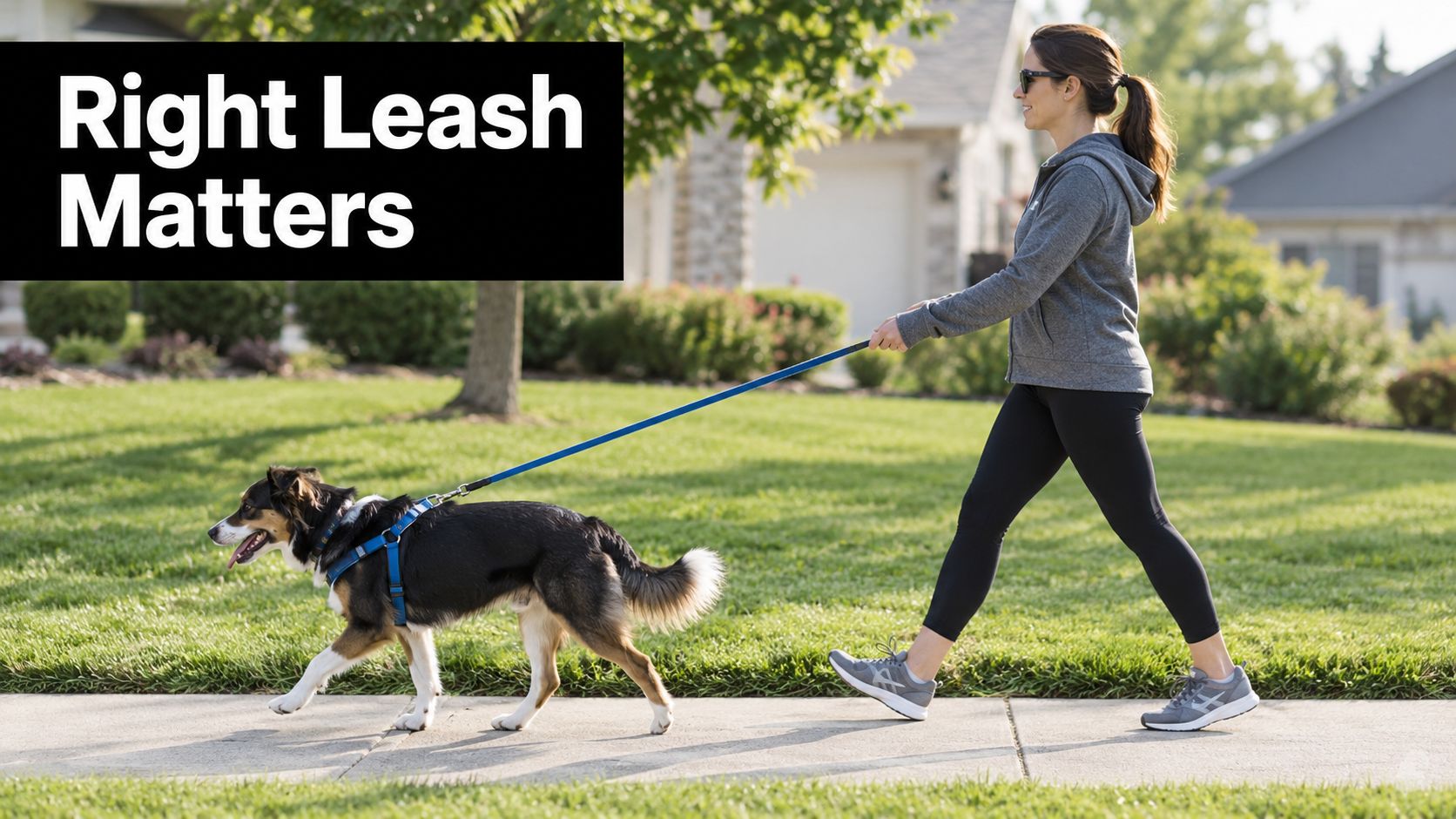
Match the leash to the walk
Consider two ordinary scenarios. On a crowded pavement, a retractable leash may give your dog more distance than you can safely monitor. The line can extend toward a cyclist, another dog, or a doorway before you've had time to lock the reel. On an open field, that same range can help a trained dog explore while remaining connected to you.
A training lead creates a different lesson. When the length stays consistent, your dog receives clearer feedback about slack and tension. If pulling reliably produces more available line, the dog may keep testing that option. For leash manners, a predictable tool usually supports clearer communication than one that constantly changes length.
The setup matters just as much as the strap. A leash clipped to a poorly fitted collar may place pressure on the neck, while a suitable harness can improve directional control and reduce restriction for some dogs. Current veterinary discussion also points out that evidence on ideal equipment designs remains limited, and that leash walking can alter gait while collars may increase intraocular pressure in some brachycephalic dogs. The dog collar and leash combination guide is useful context, but the final choice should account for fit, breed anatomy, pulling behavior, and professional advice where needed.
Practical rule: Buy for the walk you take most often, then add a specialized leash only when your routine genuinely demands it.
Leash Types Compared for Real Walks
A standard fixed-length leash remains the most useful daily tool for many owners. It behaves the same way every time, stays easy to gather at a crossing, and gives you a straightforward connection during loose-leash practice. Standard leashes held 38.4% of the global dog leash market in 2025, according to Dataintelo's dog leash market overview, which fits what handlers see in everyday use. Simple designs continue to solve the most common walking problem, keeping a dog close enough to guide without constantly managing excess line.
Retractable leashes reward range rather than precision. They can work in an open area with a dog that responds promptly and doesn't approach strangers without permission. They're much harder to manage near roads, shared paths, elevators, and unfamiliar dogs. Variable tension can also make loose-leash training less clear because the dog learns to move against a moving boundary.
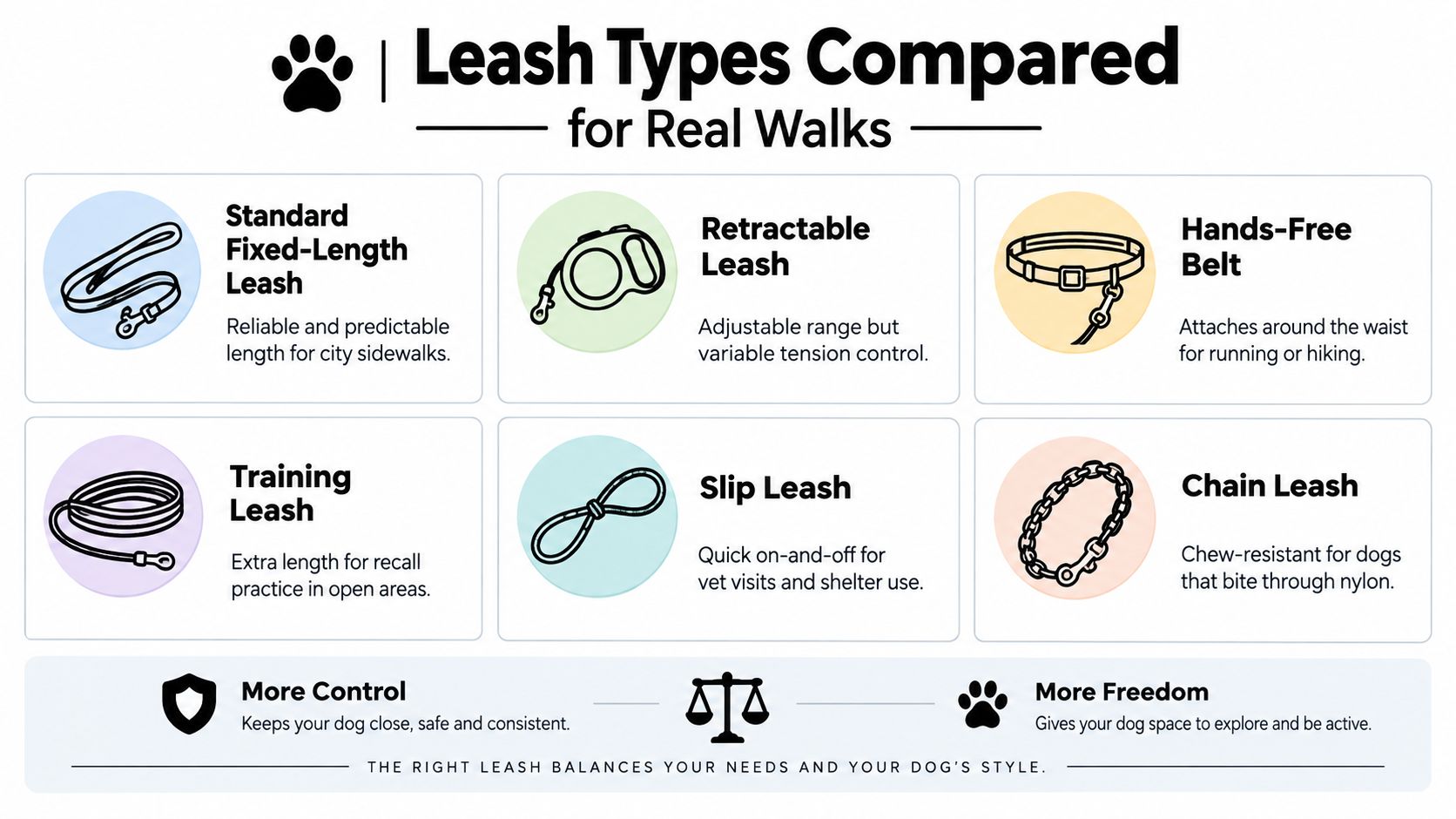
Choose the tool for the task
A hands-free belt can be comfortable for steady jogging or hiking when the dog already walks predictably. It isn't my first choice for a reactive dog, a sudden puller, or a crowded street because force transfers directly to your waist and torso. Keep your hands available for balance, but don't confuse hands-free with risk-free.
Training leashes and short traffic leads serve opposite ends of the same problem. A short lead keeps a dog close during a market stop, a narrow pavement, or a sudden change in foot traffic. A longer training line gives distance for recall practice in an open area, where you can manage the line without wrapping it around people, trees, or paws.
Slip leashes are convenient for quick transitions, veterinary handling, or shelter work. They can be useful in experienced hands, but they're a poor default for sustained pulling because the loop tightens around the neck. Chain leashes make sense for dogs that chew through nylon, although they're heavier and can feel unpleasant when a dog hits the end of the line.
Material changes handling as much as category. Nylon is light and flexible, leather feels natural once broken in but needs care, and waterproof coated materials are easier to wipe after wet or muddy walks. Rope can be comfortable and strong, but its round profile may be harder to grip securely during a hard pull.
| Leash Type | Best For | Control Level | Common Limitation |
|---|---|---|---|
| Fixed leash | Sidewalks, errands, and daily manners | High | No adjustable range |
| Retractable | Open areas with responsive dogs | Low to variable | Thin line and changing tension |
| Hands-free belt | Running and controlled hiking | Moderate | Pulling loads the torso |
| Training lead | Recall and distance exercises | Variable | Needs clear, open surroundings |
| Slip leash | Brief handling situations | Moderate | Neck pressure increases with tension |
| Chain leash | Persistent leash chewers | High | Weight and rigid feel |
| Long line | Exploration with a physical connection | Variable | Tangling and drag management |
Critical Leash Features That Affect Control and Comfort
A leash can have durable webbing and still fail at the connector. The clip, swivel, stitching, and handle receive the sharpest load when a dog lunges. Independent gear coverage has highlighted locking carabiners with pull ratings up to 2,425 pounds on some premium leashes, while common small bolt snaps may have working loads around 50 to 90 pounds, according to Wirecutter's dog leash training review. Those figures aren't interchangeable safety guarantees, but they show why hardware deserves more attention than a fashionable strap.
A locking carabiner is often preferable to a basic spring-loaded clip for a strong or easily startled dog. It reduces the chance that the gate will open after twisting against a ring. Check the gate movement, the swivel action, and the connection between clip and webbing. If stitching looks sparse, uneven, or hidden beneath a decorative sleeve, treat that as a warning rather than a design detail.
Length and handle design
For routine walking, the familiar 6-foot fixed length balances exploration and proximity. A shorter traffic handle helps when you need the dog close beside you, especially near a curb or through a doorway. Gear coverage places this second grab loop about 8 to 12 inches above the clip, which reduces slack and gives the handler a faster way to shorten the connection.
Handle comfort matters because discomfort changes how you hold the leash. A narrow, rough loop encourages you to tighten your grip, while a padded or smoothly finished handle lets you keep a relaxed but secure hold. Avoid threading the leash around your wrist or fingers. A sudden pull can trap the hand before you can release it.
Width should match the dog's force and your hand. A tiny, lightweight leash may be easy to carry but unpleasant with a powerful dog. A thick chain can resist chewing but adds weight and may make ordinary walking tiring. Look for reinforced attachment points, clean stitching, and a handle that remains usable when wet.
Reflective details help visibility in low light, but they don't replace a light, reflective clothing, or attention near traffic. Waterproof construction also has a practical advantage. A leash that can be wiped clean is easier to keep in regular rotation after rain, mud, or a puddle.
For wet-weather routines, compare construction rather than relying on the word “waterproof.” Nandog's waterproof leash guidance is relevant because surface finish, hardware, and cleanability all affect whether a leash stays comfortable and serviceable after repeated exposure to moisture.
How to Match Leashes to Dog Size, Behavior, and Routine
Start with behavior, not breed labels. A small reactive dog can produce a sharp, difficult-to-predict pull, while a large calm dog may be easy to guide with a simple fixed leash. The leash should control the dog without forcing the handler to compensate for poor fit or unsuitable attachment equipment.
For a puppy, choose a light fixed leash with hardware the puppy can't drag heavily or chew easily. Keep training sessions simple and supervised. A calm adult dog that already walks on a loose leash usually needs less equipment, not more. For a strong puller, pair a fixed leash with a properly fitted front-clip, non-tightening harness. A 2025 review found this style is often the best balance for pullers, while chest-strap and Y-shaped back-clip harnesses appear least restrictive for dogs that don't pull, according to the Frontiers review of canine walking equipment.
| Scenario | Recommended Leash Type | Why It Works |
|---|---|---|
| Puppy learning sidewalk manners | Fixed-length leash | Provides consistent feedback and simple handling |
| Strong puller | Fixed leash with front-clip harness | Supports redirection without relying on leash length |
| Calm loose-leash walker | Standard fixed leash | Avoids unnecessary weight and complexity |
| Older handler | Comfortable fixed leash with secure connector | Reduces sudden handling demands |
| Crowded city route | Short traffic lead or fixed leash | Keeps the dog close near curbs and people |
| Hiking with reliable control | Hands-free belt or fixed leash | Leaves the hands available when terrain allows |
| Recall practice | Long training line | Allows distance in an open area |
| Dog that freezes outdoors | Soft, predictable fixed leash | Limits pressure and keeps the session calm |
Hands-free designs deserve extra caution with reactive dogs. If the dog bolts toward a trigger, the belt can pull you off balance before your hands can shorten the line. A conventional handle gives you more options to redirect, release, or move the dog behind you.
A dog that stops and refuses to move needs a different response from a dog that pulls. Don't drag the dog forward or turn the leash into a contest. Use gradual exposure, rewards, and calm pauses, and consult this practical resource on training a dog that freezes outside if the behavior persists.
A collar may be appropriate for a dog that already walks with a loose leash. For pullers, brachycephalic dogs, or dogs with neck sensitivity, ask a veterinarian or qualified trainer to assess the complete setup. The dog leash for pulling guide can help you compare attachment approaches, but no leash can replace fit and training.
Human Safety and Injury Risks Many Buyers Miss
Most leash shopping advice starts with the dog's size and ends with the clip. That misses the person holding the leash. A review cited almost 423,000 emergency-room visits in the United States from 2001 to 2020, with annual cases rising from about 7,200 to about 32,000, according to Harvard Health's coverage of dog-walking injuries. A 2024 review found the most serious injuries disproportionately affected adults over 65, particularly women.
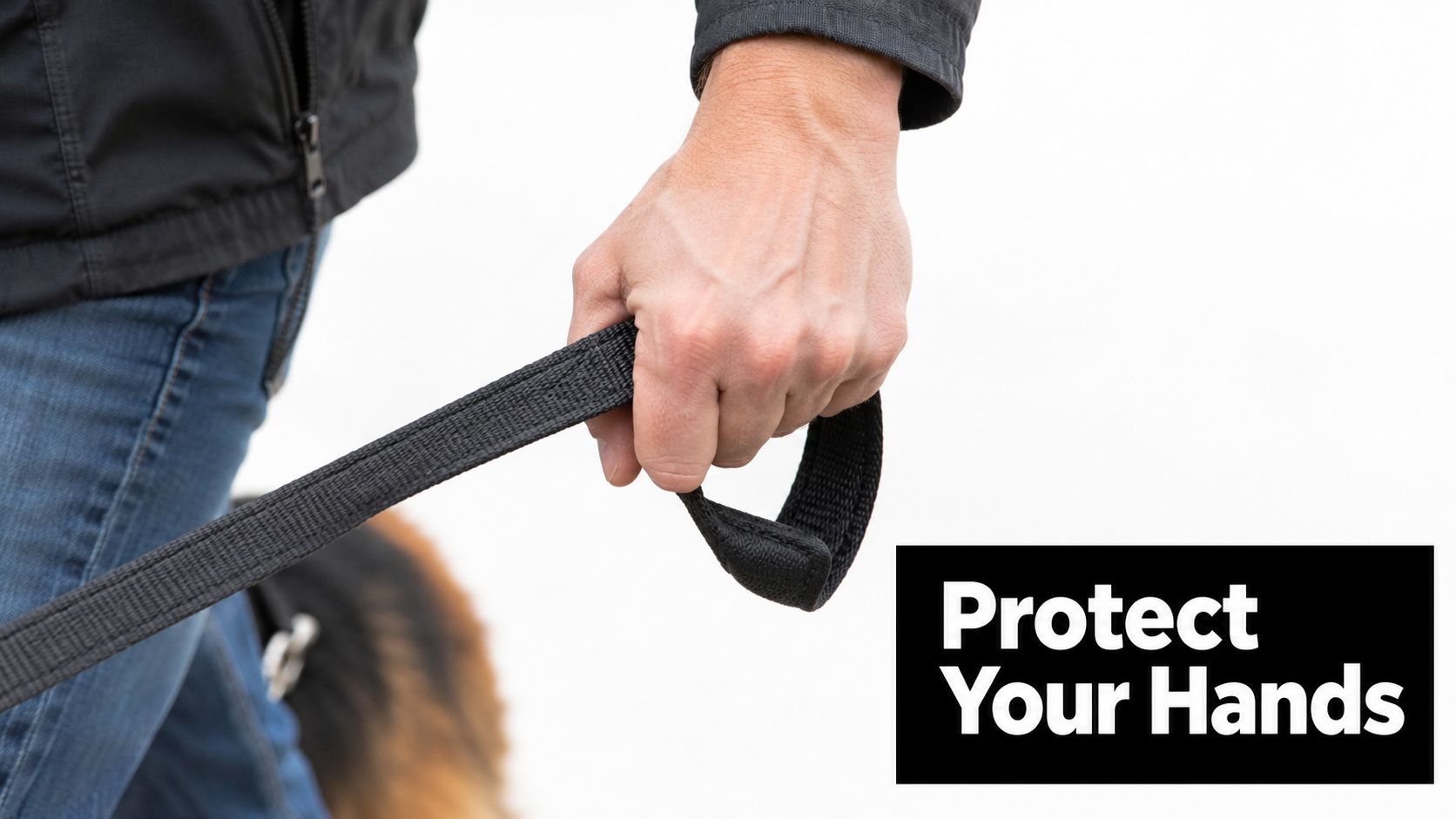
The dangerous habit is wrapping the leash around fingers, the palm, or the wrist. If the dog lunges, the line can constrict before you can let go, causing injuries to the fingers, hand, or wrist. Hold the handle with a relaxed grip, keep the loop accessible, and never coil excess line around your body.
Plan for sudden force
A 2026 UDC study found that a typical dog walk can generate 28 pounds or more of leash force for half of participants and 45 pounds or more for a quarter, along with increased gait variability. That combination matters for anyone who has reduced balance, joint pain, or limited reaction time. A traffic handle can help you shorten the dog's range, but it won't make an unstable dog safe to hold in every situation.
Stand with your feet under you rather than leaning backward against the leash. Keep the dog on the side that gives you room from traffic and obstacles. If you're walking an unfamiliar or reactive dog, avoid attaching the leash to a hands-free belt until you've tested the dog's behavior under controlled conditions.
A comfortable handle is a safety feature because pain makes handlers grip harder and react slower.
Aggressive encounters create another layer of risk. Keep distance from unfamiliar dogs, don't allow greetings without consent, and learn the local rules for public walking. For general background on injury claims and animal attacks, Spivak & Sakellariou's animal attacks resource provides legal context, not a substitute for prevention or professional behavioral support.
The following demonstration is useful for reviewing hand position and leash control before you change equipment.
Final Buying Checklist and Quick Recommendations
Choose the leash by answering four questions before you buy:
- Where do you walk most? Use a fixed leash for streets, crossings, and crowded routes. Reserve retractable and long-line options for open spaces where you can manage distance.
- What does your dog do under pressure? Pulling, freezing, lunging, and chewing each call for a different response. Don't select equipment based only on body size.
- Where does the leash attach? A suitable harness may offer better control and less restriction than a collar for a pulling dog. Check the fit before blaming the leash.
- Can you hold it safely? Test the handle, connector, stitching, and release. Never wrap the leash around your fingers or wrist.
For most daily urban walks, start with a 6-foot fixed leash, a secure connector, and a comfortable handle. Add a short traffic handle for crowded areas, a long training line for recall work, or a hands-free setup only when your dog's behavior and the terrain make it sensible. Hiking requires more attention to grip, weather resistance, tangling, and whether the dog can safely move around rocks, roots, and other trail users.
Inspect the leash regularly. Replace it when webbing frays, stitching separates, hardware bends, or the locking mechanism stops working smoothly. The best dog leashes for walking are the ones that keep their behavior predictable after repeated use, not the ones with the longest feature list.
Nandog Pet Gear offers walking accessories including waterproof Poly-Flex leashes, neoprene-handled designs, and options with secure metal hooks for everyday handling. Match the leash to your dog's harness, walking environment, and grip needs, then visit Nandog Pet Gear to explore the available walking gear.