


For most adult German Shepherds, the right bed is an XL or jumbo orthopedic bed with at least a 44 × 32 inch sleeping surface and about 4 inches of foam, with 5 to 7 inches making more sense once the dog is above about 80 pounds. That's not just about comfort. German Shepherds have a documented hip-dysplasia history of up to about 35%, so the best bed for a German Shepherd needs to manage pressure at the hips, elbows, and spine instead of just feeling plush.
A lot of dog bed advice for this breed is too shallow. It says “buy a big bed” or “get memory foam” and stops there. That misses the question. A German Shepherd isn't just a large dog. It's a large, high-mass breed with a long body, heavy shoulder load, and a well-known orthopedic risk profile.
That changes what “best” means. For this breed, the best bed for a German Shepherd is usually the one that stays supportive under body weight, allows a full side stretch, and keeps working after repeated cleaning. Soft fill, thin cushions, and undersized donut beds often fail all three tests.
| German Shepherd Bed Style Comparison | |||
|---|---|---|---|
| Bed Style | Primary Benefit | Joint Support Level | Temperature Regulation |
| Orthopedic mattress bed | Pressure relief and full-body support | High | Moderate |
| Bolstered bed | Head support and a secure nesting feel | Moderate to high, depends on base foam | Moderate |
| Elevated cot | Airflow and easy cleaning | Low to moderate | High |
Why Joint Health Dictates Bed Choice for German Shepherds
A German Shepherd owner often notices the same pattern long before a vet gives it a name. The dog starts choosing softer flooring. It drops into a lie-down more carefully. It takes a second longer to rise after a nap. Those changes don't always mean major disease, but in this breed they should push bed support to the top of the shopping list.
German Shepherds have a long history of orthopedic vulnerability. One breed-health source notes a 32.4% prevalence of hip dysplasia in a Swiss dataset of 5,326 dogs, with 46.2% affected in 1995 to 1999 before falling to 18.0% in 2010 to 2016 in that dataset, while also summarizing the breed's large adult size at 24 to 26 inches and 65 to 90 pounds for males, and 22 to 24 inches and 50 to 70 pounds for females in common standards (breed size and hip-dysplasia data).
Why “soft” often misses the point
A bed can feel cushy to your hand and still be wrong for a Shepherd. The problem is load concentration. A big dog doesn't spread weight evenly. Hips, shoulders, elbows, and the rib side take the brunt of it, especially in side sleepers.
Another breed-specific source goes further, noting that German Shepherd Dogs had a 4.95-times higher risk of degenerative joint disease associated with hip dysplasia than the other three breeds in that study. It also cites a long-term dataset estimating canine hip dysplasia prevalence in German Shepherds at about 35%, with another source reporting 41.17% incidence in a breed-specific sample (joint-risk summary for German Shepherds).
That's why I treat bed choice less like décor and more like daily load management. A Shepherd may spend hours every day resting. If the surface compresses too easily, those hours add repeated stress instead of relief.
Practical rule: If your German Shepherd sinks through the bed enough to feel the floor underneath, it isn't an orthopedic bed in any meaningful sense.
What that means in real homes
Owners usually shop by shape first. Rectangle, sofa bed, cuddler, cot. The better sequence is different:
- Start with orthopedic need. Ask whether the dog needs pressure relief at major joints.
- Then look at body size. A Shepherd needs room to stretch without limbs hanging off.
- Only then consider style. Bolsters and aesthetics come after support.
If your dog is already older, stiff on rising, or slowing down after activity, supportive sleep surfaces matter even more. For owners dealing with aging-dog discomfort, this guide on senior dog joint pain relief pairs well with bed selection because it frames rest as part of daily mobility support, not a separate issue.
Comparing Orthopedic, Bolstered, and Elevated Bed Styles
Bed architecture matters because German Shepherds don't sleep one way. Some sprawl flat on their side. Some curl and wedge their neck into a corner. Some run hot and move to cooler surfaces. The right style depends on how your dog sleeps, how much support it needs, and how warm your home runs.
Here's the style comparison most owners need:
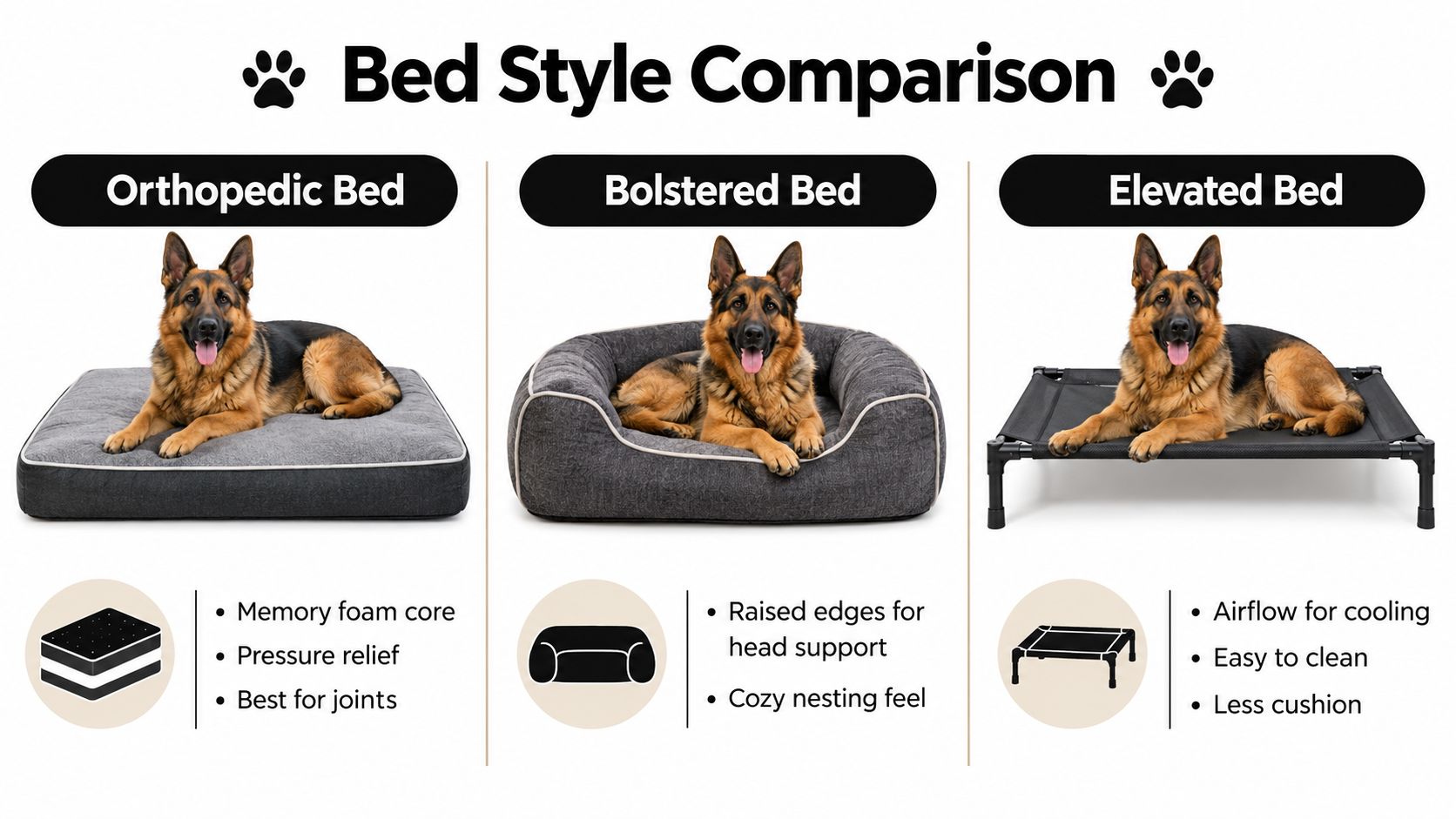
| German Shepherd Bed Style Comparison | |||
|---|---|---|---|
| Bed Style | Primary Benefit | Joint Support Level | Temperature Regulation |
| Orthopedic | Thick support core for heavy joints | High | Moderate |
| Bolstered | Edge support for dogs that lean or curl | Moderate to high | Moderate |
| Elevated | Ventilation and easy wipe-down cleaning | Low to moderate | High |
Orthopedic beds
For most households, this is the default answer. An orthopedic mattress-style bed gives the dog one flat, uninterrupted surface to stretch across. That matters because the breed commonly lands in a long side-sprawl with the hind legs partly extended.
What works:
- Dense foam construction. It resists collapse under a large frame.
- Open rectangular surface. The dog can rotate, sprawl, or lie diagonally.
- Stable entry height. Easy for seniors and dogs with sore hips.
What doesn't:
- Thin tufted pads. They flatten fast.
- Beds with deep center sag. They create a hammock effect.
- Decorative plush tops over weak fill. Soft to the touch, poor under load.
If you want examples of the category, browsing curated orthopedic beds for pets can help you compare structure and shape across brands without getting distracted by styling language.
Bolstered beds
Bolsters help some Shepherds settle faster. Dogs that like to rest their chin on an edge, sleep tucked into a corner, or watch the room from a slightly propped posture often use bolsters well.
The catch is simple. The base still has to be supportive.
A bolstered bed is only as good as the flat area inside the rails. If the inner pad is cramped or squishy, the raised sides don't fix the main problem.
Choose this style when your dog wants security and head support. Skip it when the bolsters eat too much of the interior sleep space or force the dog to curl tighter than it wants.
Elevated beds
Elevated cots solve heat and cleaning issues better than almost any plush bed. Air moves under the dog. Mud, wet paws, and shedding are easier to manage. In warm climates, some Shepherds clearly prefer them during the day.
They're rarely my first pick as the only bed for this breed. Most raised models don't offer the same pressure relief as thick orthopedic foam, especially for dogs with known stiffness or older joints. They work best as a secondary cooling station, a porch or crate-adjacent option, or a summer-day bed.
Which style wins
If you're choosing one primary bed, a flat orthopedic bed is the strongest all-around answer. A bolstered orthopedic bed works well if the inner mattress is still roomy enough. An raised bed is useful for airflow and cleanup, but usually not as the main recovery surface for a joint-prone Shepherd.
The Science of Orthopedic Foam and Pressure Relief
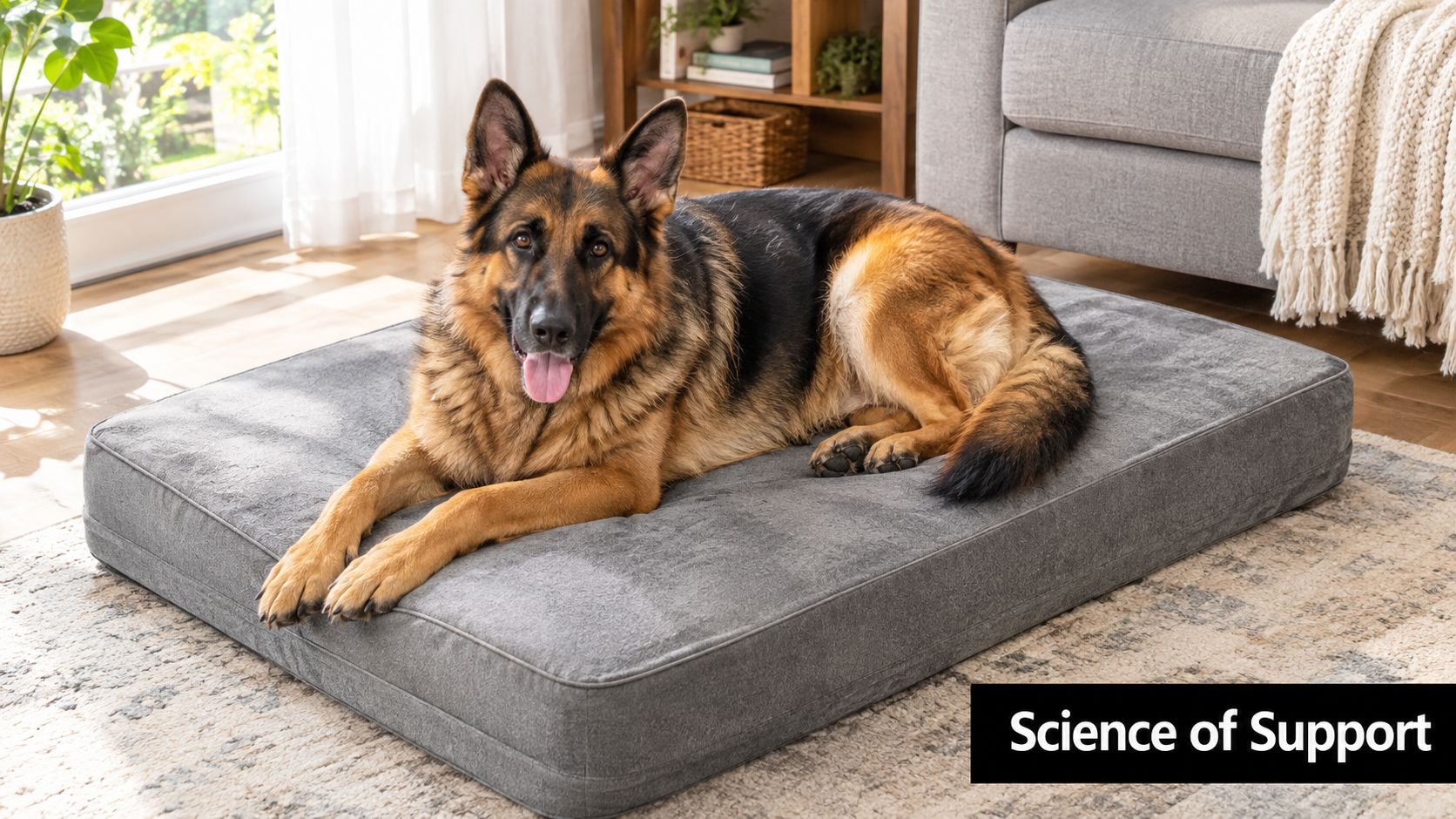
Large-breed dogs with arthritis showed measurable improvement on therapeutic bedding in a University of Pennsylvania clinical trial, including lower pain and stiffness and better mobility and restfulness (clinical trial summary on therapeutic bedding). For a German Shepherd, that matters because the breed already carries a meaningful orthopedic burden, especially at the hips and elbows. A bed is not treatment for dysplasia, but it can reduce how much force concentrates under the joints during long rest periods.
Pressure relief depends on load distribution. Analysts discussing large-breed bedding note that memory-foam-style surfaces reduce contact pressure at common load points such as the shoulders and hips better than thin mats or blankets (pressure relief for large-breed dogs). In practice, that points owners away from overstuffed plush beds and toward a firmer orthopedic core that keeps the dog suspended above the floor instead of sinking straight through to it.
Why thickness matters more than fluff
German Shepherds load a bed heavily at the shoulder, ribcage, and hip. If the foam compresses flat under those points, the bed stops functioning like a support surface. It becomes a padded cover over the floor.
That is why I put more weight on foam density and usable depth than on a pillow-top feel.
Human pressure-relief standards are not a perfect one-to-one match for dogs, but the mechanics are similar. Support surfaces work by spreading force over a wider area and limiting pressure peaks under bony joints. DME Superstore's mattress guide explains that principle clearly. The same logic applies to a Shepherd that spends hours lying on one side.
Foam quality shows up fast
Weak foam usually reveals itself within days or weeks:
- A lasting body crater forms. The bed does not rebound after the dog stands up.
- The middle sags first. The highest-load zone is already failing.
- Elbows or hips look close to the floor. Compression is eating up the support layer.
- The dog rotates off the bed or changes positions often. Rest can look unsettled when pressure builds at one joint.
Good orthopedic foam feels firmer than many owners expect at first touch. That is often a positive sign for this breed. A German Shepherd usually does better on a bed that compresses gradually under weight than on one that feels luxurious to a human hand but collapses under 70 to 90 pounds of dog.
When orthopedic support is worth paying for
Older Shepherds, dogs with diagnosed arthritis, and dogs with early morning stiffness benefit the most from a true orthopedic bed. Young adults can also benefit, especially if they are large-framed, very active, or already showing mild joint sensitivity after exercise. The goal is not extra softness. The goal is stable pressure relief over time.
If you want a material-level explanation of how these beds are built, this primer on a memory foam pet bed is a useful reference. The takeaway is simple. For a German Shepherd, firm orthopedic foam usually beats plush fill because pressure control, not fluff, is what protects shoulders, hips, and elbows during daily rest.
Sizing Requirements for a 65 to 90 Pound Dog
German Shepherds sit in a weight class where sizing mistakes show up fast. A bed can be sold as “large” and still force the dog's shoulders, hips, or hocks onto the edge, which defeats the support you paid for.
Use sleeping length, not breed label
Measure the dog in the position it uses during deep rest. For this breed, that usually means a full side stretch with the neck extended and the rear legs partly or fully out behind the body.
For most adult German Shepherds, 44 × 32 inches is a practical minimum sleeping surface, not an ideal target. Add length if your dog runs long through the body, sleeps fully stretched, or weighs near the top of the common breed range. Males often need more bed than the retail size label suggests.
That distinction matters with joint disease risk. German Shepherds are one of the breeds most associated with hip dysplasia, so a bed should let the dog rest with the spine and pelvis fully supported instead of hanging a hip off the side or curling up to fit the pad.
How to measure correctly
Use the dog, not the package label.
- Measure while your dog is lying down. Standing height does not tell you how much sleep space the body uses.
- Measure the longest relaxed position. Many Shepherds stretch farther in sleep than owners expect.
- Check the interior pad dimensions. Bolsters and thick side walls can remove several inches of usable space.
- Compare body length and sleeping style with weight. A lean, long Shepherd may need a bigger bed than a shorter dog at the same weight.
If the elbows or hips regularly press into the bolsters because the center pad is too short, the bed is too small.
What size usually works
For most adult Shepherds, start in the XL or jumbo range. Generic “large” beds often work for dogs that curl tightly, but they are commonly undersized for this breed's side-sleeping sprawl.
Flat orthopedic mats usually give the most usable surface for a 65 to 90 pound dog. Bolstered beds can work well for dogs that like head support, but owners need to size up because the walls reduce the true sleeping area. Cots also need careful measuring, since the taut fabric can feel smaller than the listed frame dimensions.
A simple rule I use is this: if the dog cannot lie on its side with all four joints on the bed and still shift positions without stepping off, go up a size.
If you want a visual measuring reference before buying, this dog bed size chart by breed is a useful starting point for matching body type to bed dimensions.
Balancing Durability, Washability, and Skin Health
Support gets most of the attention. Maintenance decides whether the bed remains usable. German Shepherds shed heavily, track in debris, and can leave a bed carrying dust, dander, and detergent residue if the cleaning routine isn't thoughtful.
That matters for comfort as much as cleanliness. Veterinary guidance notes that contact dermatitis can be triggered by detergents and other household substances, which makes bed materials and laundering habits part of the dog's skin-health picture, not just housekeeping (veterinary guidance on detergent-related itching).
What holds up in the real world
The most practical bed build for this breed usually includes a washable outer layer, a foam-protective liner or moisture barrier, and fabrics that don't trap every hair into the weave.
Look for:
- Removable or fully washable construction. Easy cleaning means the bed gets cleaned.
- Tighter-woven fabric. It tends to release hair and dust more easily than shaggy plush.
- Stable seams and zipper placement. German Shepherds can be rough on edges when circling or digging before they lie down.
What usually goes wrong:
- Beds with covers that are technically washable but awkward to remove.
- Fabrics that stay damp too long after laundering.
- Fill beds that clump or shift after a few wash cycles.
Skin health and cleaning routine need to work together
Owners sometimes create irritation accidentally by washing too aggressively. Heavy fragrances, strong detergents, and incomplete rinsing can leave residue where the dog lies for hours. The cleaner the bed, the less appealing it is if the residue itself becomes the problem.
Washability isn't just a convenience feature. On a bed used every day by a heavy-shedding dog, it's part of the comfort system.
This is also where household habits connect. Dogs that rest, travel, and hydrate in shared spaces benefit from cleaner gear overall. For owners building a more practical everyday setup, HYDAWAY's guide on picking the right bottle for your pup is a useful example of the same thinking. Materials, hygiene, and easy maintenance affect comfort well beyond the bed itself.
My material preference for this breed
For a German Shepherd, I'd take durable, washable, medium-soft fabric over ultra-plush long-pile material most of the time. The bed may look slightly less cozy in product photos, but it tends to stay cleaner, dry faster, and keep its feel longer. That's the better trade-off in daily use.
Strategic Room Placement and Daily Routine Integration
A good bed in the wrong spot gets underused. German Shepherds are social, watchful dogs. Many settle best where they can monitor the household without being stepped over all day.
Best places to put the bed
The strongest placement choices are usually:
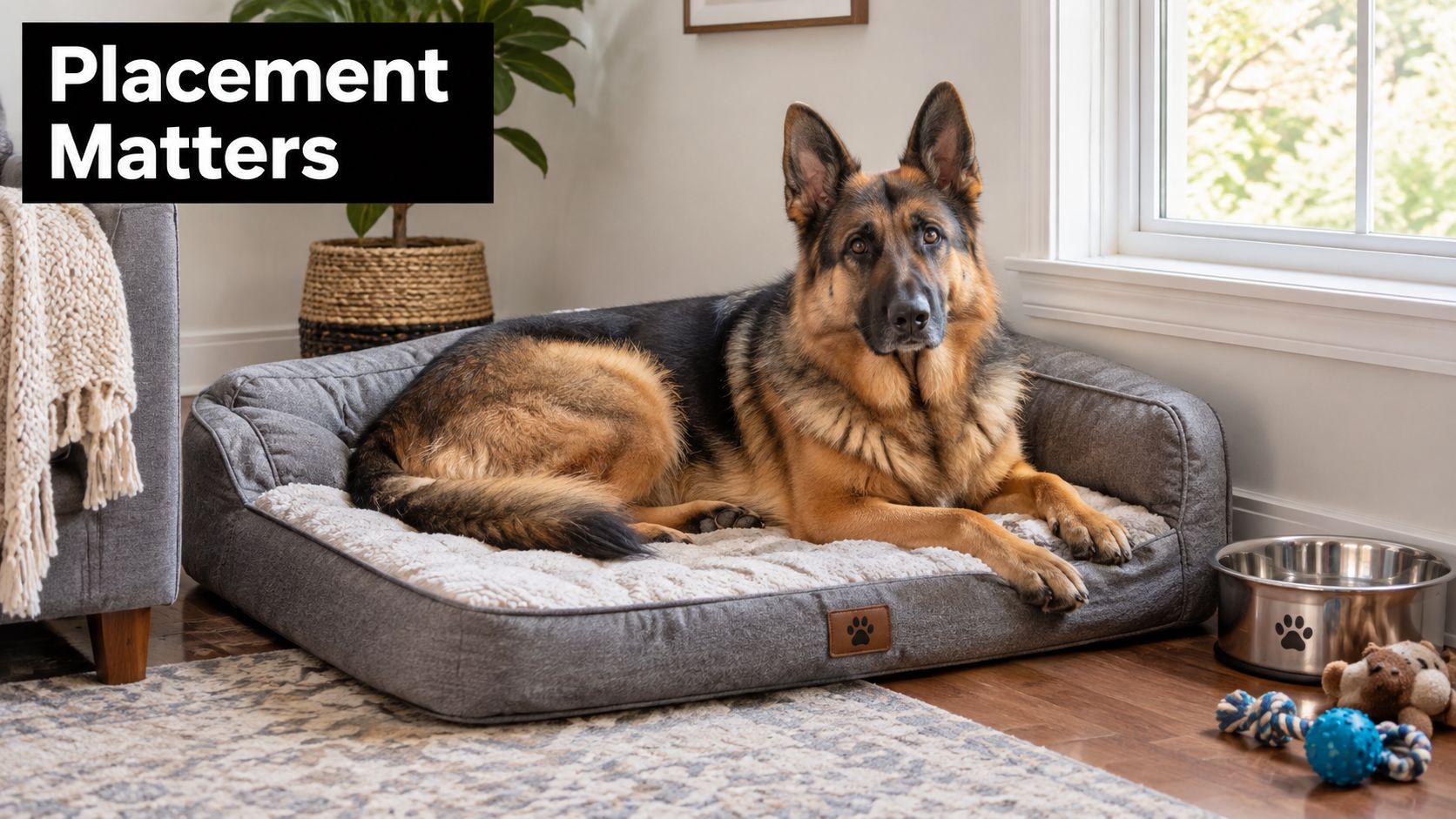
- Living room edge zones. Close to family activity, but outside the main traffic lane.
- Bedroom-adjacent areas. Helpful for dogs that relax better near their people at night.
- Quiet corners with visibility. Many Shepherds like seeing doors and movement without lying in the center of it.
Spots that often backfire
Avoid direct drafts, heat vents, and narrow hallways where people constantly pass by. A bed placed in a busy pinch point gets interrupted use. A bed placed in a hot sunny patch may be ignored by a double-coated dog that already runs warm indoors.
I also like separating the “main recovery bed” from any utility sleep station. If you use a cot on a patio or near a mudroom, keep the orthopedic bed in the calmest indoor location. That gives the dog one place for cooling and another for real rest.
Final Verdict and Purchasing Decision Framework
If you want the shortest defensible answer, buy an XL or jumbo orthopedic bed with a true foam core, a flat sleep surface of at least 44 × 32 inches, and more thickness if your German Shepherd is above 80 pounds. That combination lines up with the breed's body size, its side-stretch sleeping habits, and the pressure-relief demands of a joint-prone frame.
The buying framework I'd use
Judge every bed against these five filters:
-
Support first
The bed should resist bottoming out under a large dog. Thick orthopedic foam beats loose fill, pillow stuffing, and thin mats.
-
Usable interior space
Ignore oversized exterior dimensions if bolsters eat into the center. The dog needs room to lie fully extended.
-
Entry and exit ease
Seniors and dogs with stiffness need a stable surface that doesn't swallow their legs as they stand.
- Cleaning reality
If washing the bed is a hassle, owners postpone it. Pick construction you'll maintain.
-
Temperature fit
Warm sleepers do better on breathable surfaces and in cooler placements. Not every Shepherd wants a plush nest year-round.
What I'd skip
I'd pass on thin pads, overstuffed donut beds for full-time use, and any bed whose support depends mostly on polyester fill. I'd also be cautious with beds marketed as orthopedic when the product details don't clearly show a substantial foam base.
If you're comparing specific options, one example in this category is Nandog Pet Gear's orthopedic memory foam bed line, which is positioned for joint support and offered in larger sizing suited to bigger breeds. That's the right type of construction to prioritize. The key is still the same no matter the brand: enough flat space, enough dense foam, and enough durability to survive regular washing.
The best bed for a German Shepherd isn't the softest model on the page. It's the one that keeps the dog supported after months of use, fits the full body without crowding, and makes daily rest easier on joints that already have little margin for poor support.
If you're looking for a bed that fits this kind of decision process, Nandog Pet Gear offers orthopedic and comfort-focused dog beds designed around support, easy care, and home-friendly design. Their lineup is especially relevant if you want washable construction and larger-format options that suit a German Shepherd's size and daily use. You can browse the full collection at Nandog Pet Gear.