

The popular advice is to choose the cutest narrow collar that matches your small dog's coat. That's backwards. For a dog weighing only a few pounds, the important questions are where leash force goes, how securely the collar fits, and whether its edges or hardware irritate the neck. Appearance comes after physiology.
A collar can be useful every day, but it isn't automatically the right place to attach a leash. The best dog collars for small dogs usually work as identification and low-tension wear, while a properly fitted harness handles walking force. That distinction matters for puppies, narrow-headed escape artists, brachycephalic breeds, dogs that cough, and any small dog that pulls.
| Situation | Collar recommendation | Walking equipment | Main reason |
|---|---|---|---|
| Identification and everyday wear | Lightweight flat buckle collar | No leash force on the collar | Low bulk and visible ID |
| Calm dog with no respiratory sensitivity | Flat buckle collar | Harness preferred for regular walks | Keeps the collar's role limited |
| Narrow-headed escape risk | Properly limited martingale | Harness for leash attachment | Reduces backing out without unrestricted tightening |
| Pulling, coughing, or airway concern | Lightweight collar for ID only | Correctly fitted harness | Moves leash force away from the neck |
| Growing puppy | Highly adjustable lightweight collar | Puppy-appropriate harness | Fit changes quickly with growth |
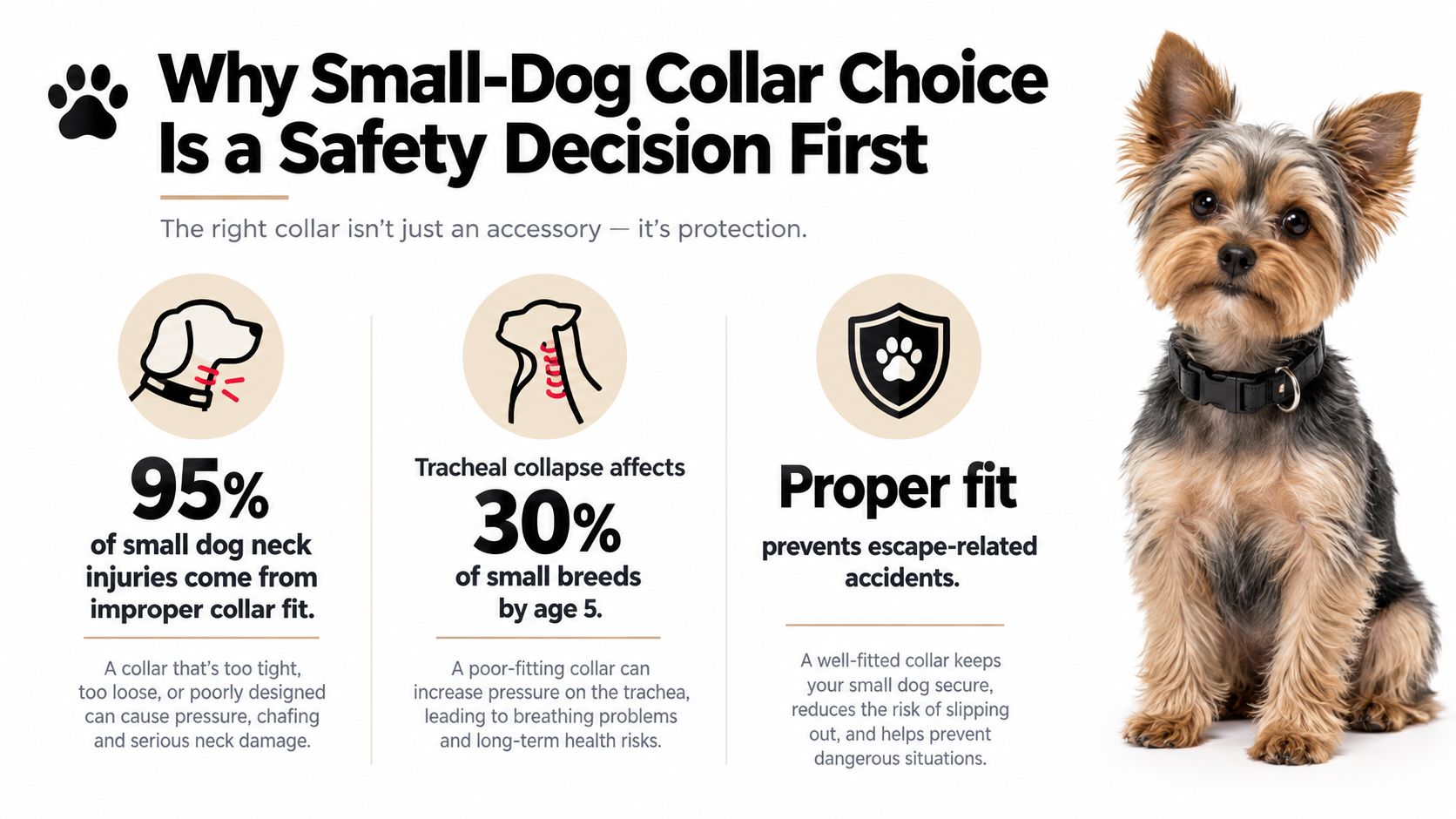
Why Small-Dog Collar Choice Is a Safety Decision First
A tiny dog can still put serious force through a leash. A veterinary review reports mean pulling forces as high as 122% of body weight in smaller dogs. For a 4-kilogram dog, that could theoretically equal about 4.88 kilograms of pulling force. The finding, reported in this veterinary review of canine restraint and neck safety, is why weight alone should not determine collar choice.
Collar construction controls how that force reaches the neck. The canine collar pressure study measured pressures from 83 kPa to 832 kPa, depending on construction and applied force, and no tested collar removed potential injury risk during pulling. At 40 N, reported pressures included 83 kPa for a lurcher-style collar, 105 kPa for padded webbing, and 125 kPa for a padded sports collar. Under an approximately 141 N lead jerk, a rolled leather collar reached 814 kPa in the study's model.
These results do not make ordinary collar wear automatically dangerous. They do rule out choosing a collar for softness or style alone. For a small dog, prioritize controlled fit, light construction, smooth contact, and minimal leash loading.
Airway shape changes the decision
The underside of the neck and laryngeal region need particular care. In dogs with pre-existing tracheal collapse, approximately 20 mmHg of direct compressive force can severely compromise the airway, while a normal canine trachea can withstand that pressure without closing, according to a veterinary review in Frontiers in Veterinary Science.
Brachycephalic dogs also warrant extra caution. Stationary collar wear increased intraocular pressure in brachycephalic dogs, while exercise with a collar increased it in both brachycephalic and long-nosed dogs. The cited research summary did not report that increase with exercise in a harness.
My default rule: Put the ID on the collar. Put walking force on the harness.
If your dog pulls, coughs on walks, has a collapsing trachea, or shows respiratory sensitivity, use the collar for identification rather than primary restraint. Remove it if you see skin irritation, hair loss, swelling, or persistent scratching, then discuss when to call the vet with a veterinary professional.
How to Measure and Fit a Small-Dog Collar
Measure the dog in front of you, not the breed label on the package. A Chihuahua, a Dachshund, and a French Bulldog may all be described as small, but their neck shapes and collar requirements can differ sharply.
Use a soft tape measure around the mid-neck, where the collar will sit. Keep the tape snug against the coat without compressing the fur. Record the measurement, then select a collar whose adjustment range places that measurement comfortably away from the buckle's extreme limits.
The familiar two-finger rule is a starting benchmark, not a complete safety test. After fastening the collar, slide two fingers between the collar and the neck. They should fit snugly, without forcing the collar against the throat or leaving enough slack for the dog to reverse out of it.
Use a fit protocol, not a one-time check
The American Kennel Club's collar measuring guidance supports measuring the individual dog, checking two-finger clearance, and testing whether the collar can slide over the head. Animal-welfare guidance also recommends regular checks of tightness, skin, and coat condition, as described by Working Animals Australia.
Use this routine:
- Measure before purchase. Measure the neck where the collar will sit, then compare the result with the manufacturer's size range.
- Check stationary fit. Confirm two-finger clearance, a flat position, and no pressure on the throat.
- Test escape resistance. With the dog calm and supervised, apply gentle upward pressure over the head. The collar shouldn't slide over the ears.
- Recheck after change. Measure after growth, weight change, grooming, coat thinning, or matting.
- Inspect the skin. Remove the collar if you see redness, hair loss, dampness, matting, scabs, or repeated scratching.
For puppies and long-coated dogs, fit changes faster than owners expect. A collar that fit after a grooming appointment may become restrictive as the coat grows back, while a collar that fit a puppy last month may become too tight after growth.
| Weight Range | Typical Neck Size | Adjustability to Look For |
|---|---|---|
| 4 to 6 pounds | Measure the individual dog rather than relying on weight | Fine adjustment, lightweight buckle, low-bulk tag point |
| 6 to 9 pounds | Measure at the collar position | Broad adjustment range without excess strap |
| 9 to 12 pounds | Confirm neck shape as well as circumference | Secure buckle, smooth edges, room for coat changes |
For a more detailed measurement method, see this guide to measuring dog collar size. Remove the collar during unsupervised situations if it can catch on furniture, crates, fencing, or another dog. A collar is valuable identification equipment, but it still needs responsible supervision.
Materials and Hardware That Matter at Small Sizes
At four to twelve pounds, collar materials are safety equipment, not decoration. Focus on weight, edge behavior, moisture, and hardware proportion. A collar that feels light in your hand can still burden a toy dog, particularly when the buckle, D-ring, and tags collect beneath the chin.
Nylon webbing is a sensible default because it is light, dries quickly, and offers many patterns. Rough edges can irritate short coats, while loose fibers may catch long hair. Polyester has a similar light profile and usually keeps printed designs clear. Thin does not automatically mean comfortable. Bend the collar around your fingers and inspect whether the edge stays smooth or folds into a sharp ridge.
Rolled leather feels smooth against the coat and limits direct edge contact, but it can weigh more than fabric at a similar width. Flat leather looks polished and suits calm everyday wear, though it may remain stiff until softened. Coated webbing and other waterproof materials wipe clean and resist soaking, but they can feel firmer and flex less than woven fabric. This explanation of neoprene material covers a related synthetic material category.
More padding isn't automatically better
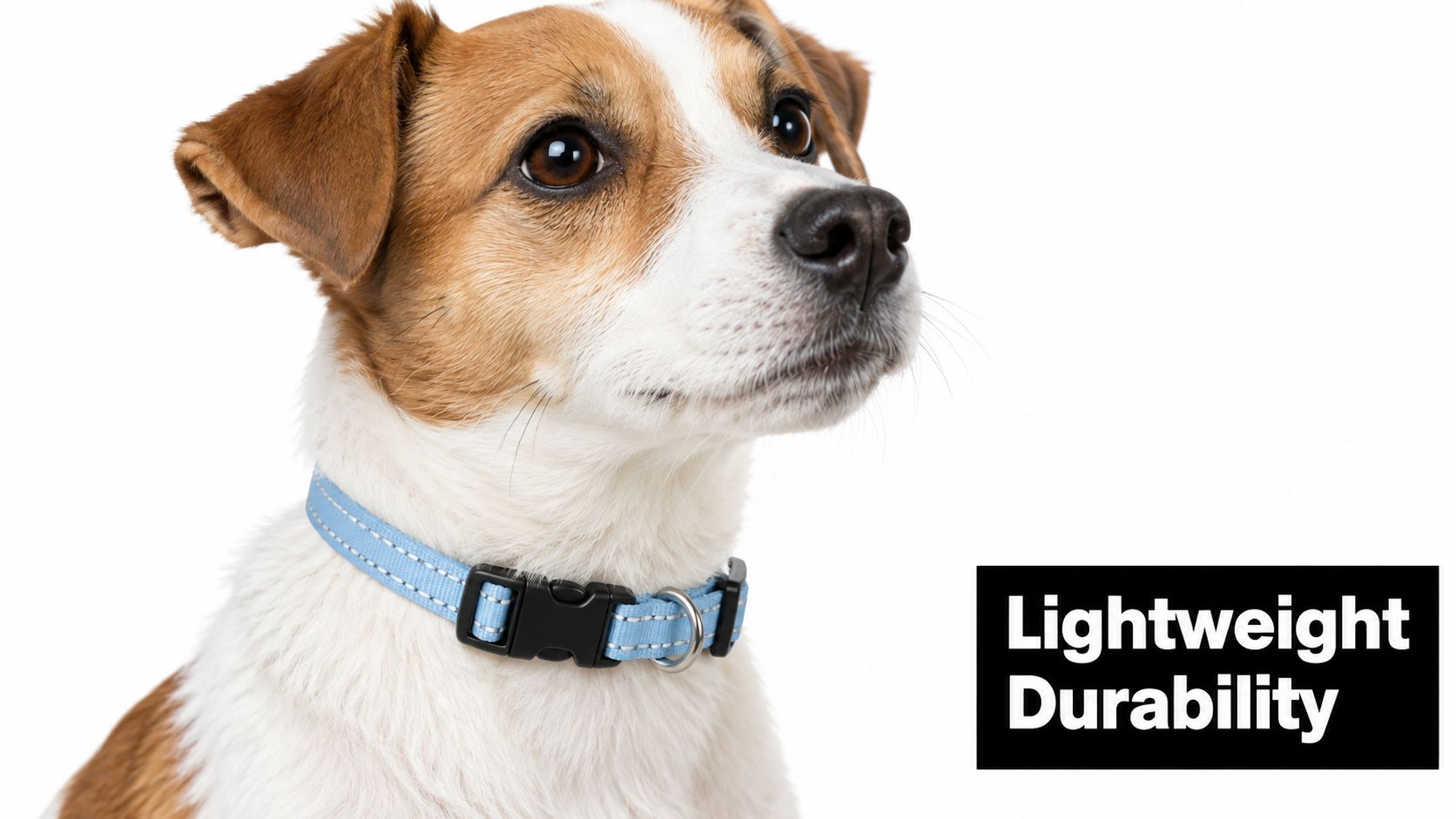
Soft, thick padding looks protective, but thickness alone does not show how pressure will reach the neck. A controlled test found that a double-layer nylon weave with ethylene-vinyl acetate cushioning created higher contact pressure than single-layer nylon or canvas. The veterinary review of collar mechanics discusses this finding.
Padding is not automatically a poor choice. Judge the collar by its behavior on the dog, not by its apparent softness. Prioritize:
- Low weight: It should not pull downward or trigger repeated neck scratching.
- Smooth edges: Binding should lie flat without an abrasive seam at the throat.
- Drying behavior: Wet fabric should not remain pressed against the skin.
- Stable shape: The collar should not collapse into a narrow cord under light tension.
- Proportionate hardware: Buckles, rings, and tags should not dominate a small neck.
Metal hardware can make a secure connection and often lasts well. Inspect each ring for rough welds and each buckle for sharp corners. Plastic side-release buckles reduce weight and are convenient, provided they close positively and remain easy to operate.
Run a finger along the underside before use. Reject burrs, protruding rivets, cracked plastic, and bulky tag attachments. The D-ring should be smooth, and the buckle should open and close confidently with one hand. If the hardware is awkward to fasten or release, it is poor equipment regardless of its appearance.
Buckle vs Martingale vs Harness Pairing
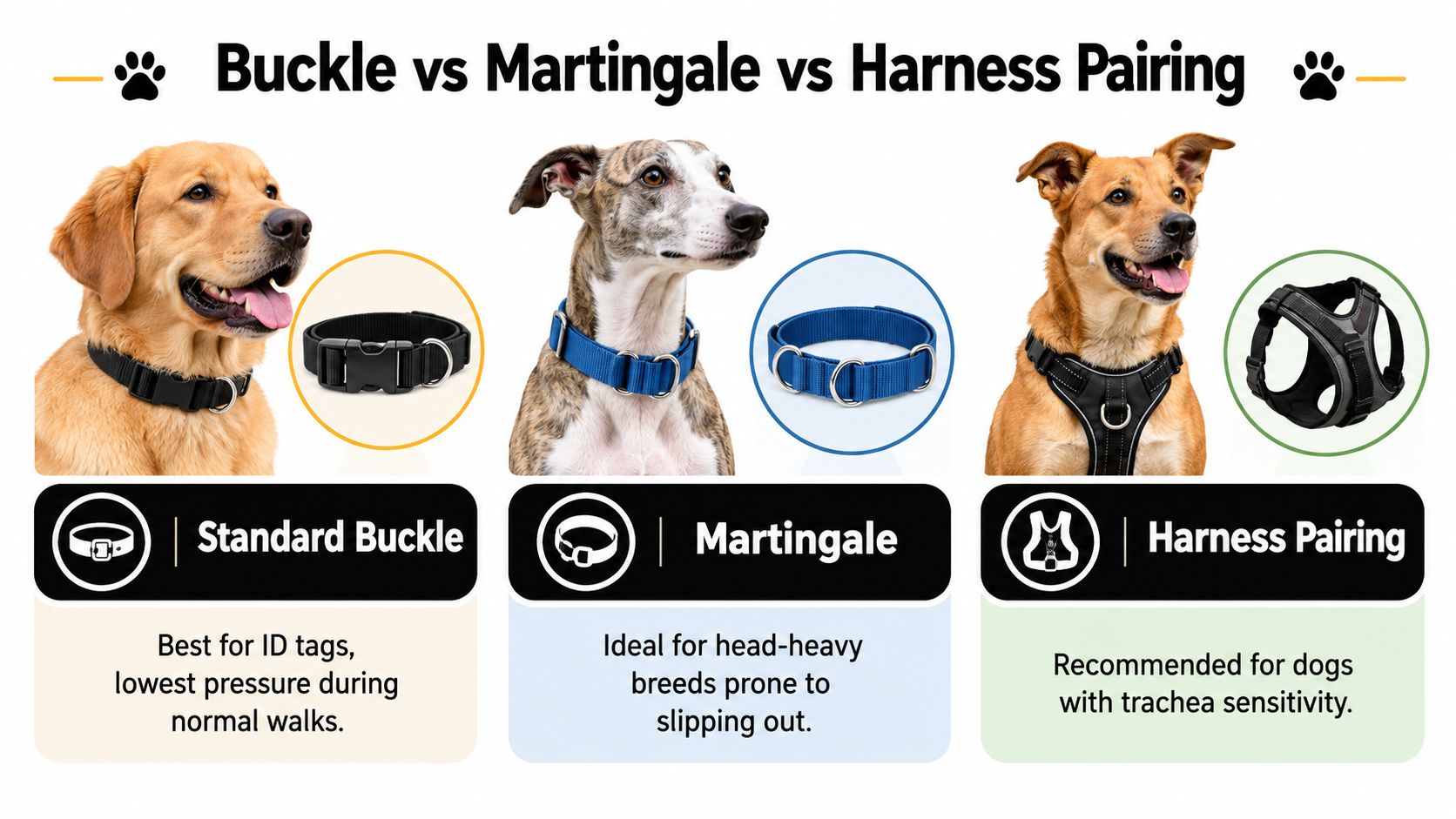
A standard flat buckle collar is the best starting point for most small dogs because it performs a simple job well: it stays on the neck, holds identification, and doesn't need to tighten around the throat. Choose a narrow, lightweight version with smooth edges and a secure tag attachment. For regular walks, I'd still attach the leash to a harness whenever the dog pulls or has airway sensitivity.
A martingale collar solves a different problem. It can help a narrow-headed dog, such as a Chihuahua or Italian Greyhound, avoid backing out of a collar. But the design must be correctly sized and limited. The tightening section should stop with two-finger clearance, rather than forming an unrestricted loop around the neck.
An unlimited-slip or choke collar is not an acceptable default for a small dog. These designs can tighten circumferentially as tension rises, creating a strangulation hazard. They also give you no dependable upper limit on neck pressure, which is precisely the risk small-dog owners should be reducing.
Match equipment to the actual problem
| Design | Appropriate use | Avoid or modify when |
|---|---|---|
| Flat buckle collar | ID, tags, calm everyday wear | The dog pulls against it |
| Limited martingale | Narrow-headed dog that backs out | It tightens without a firm stop |
| Slip or choke collar | Not a sound small-dog default | Any dog with airway or neck concerns |
| Chest harness | Primary leash attachment | It rubs, restricts shoulders, or allows escape |
A harness spreads leash force across the chest instead of concentrating it at the neck. It still needs precise fitting. The neck opening shouldn't press on the throat, the straps shouldn't cut into the armpits, and the dog should be able to move the front legs freely. Use this dog harness fitting guide when checking the harness after purchase.
The collar and harness combination is the strongest general setup because each component has a clear role. The collar carries current identification where a finder can see it immediately. The harness carries leash force during movement. The American Veterinary Medical Association explains that microchips are permanent and tamper-resistant, but they don't replace a visible collar and current tag because a finder needs a scanner and registry access to read the chip. Keep both systems current.
Care, Maintenance, and When to Replace
A small collar doesn't need a complicated maintenance program. It does need regular attention because tiny failures matter when the equipment is holding identification or preventing an escape.
Run your fingers along the entire collar once a week. Look for fraying, stretched adjustment holes, loose stitching, cracked plastic, corrosion, rough metal, and fading or peeling tag text. Flex the buckle several times and check that it closes fully. A collar that looks fine from across the room may have a worn edge hidden against the coat.
Clean according to the material
For washable nylon, follow the manufacturer's care instructions and use a mesh bag if machine washing is allowed. Air-dry it completely before putting it back on the dog. Coated webbing usually needs only a wipe with mild soap and water, followed by thorough drying around the hardware.
Leather needs different handling. Wipe away dirt rather than soaking it, let it dry naturally, and use a suitable leather conditioner according to the product's care guidance. Don't saturate the collar or leave it damp against the dog's skin.
Replace based on condition
Replace the collar when:
- Webbing stretches: The fit changes or the adjustment holes no longer hold securely.
- Stitching cracks: Any load-bearing seam begins to separate.
- Hardware corrodes: Rust can weaken the part and irritate the skin.
- Edges roughen: Friction causes rubbing, hair loss, or matting.
- Identification fades: A finder can't read the contact information quickly.
The AVMA recommends keeping a visible tag and microchip records current, including after a move or phone-number change. That redundancy matters. The collar helps a stranger contact you immediately, while the microchip provides permanent identification if the collar is lost.
Matching the Collar to Real Small-Dog Scenarios
The new puppy
A puppy needs an adjustable, lightweight flat buckle collar with very little hardware. Avoid decorating a tiny neck with a large tag stack or heavy metal ornaments. Measure before buying, check the fit frequently during growth, and inspect the skin after each wearing period.
For leash introduction, use a harness rather than teaching the puppy to lean into collar pressure. Start indoors, keep sessions calm, and watch whether the puppy scratches, freezes, or tries to escape. The collar's job is identification, not to create the first association between walking and throat tension.
The daily urban walker
The city dog needs a flat collar with a legible current tag and a separate harness for walking. Choose a narrower profile when bulk gets in the way, but don't sacrifice smooth edges or secure adjustment. Reflective details can improve visibility in dim conditions, but they don't compensate for a collar that slips over the head.
Urban dogs also encounter elevators, traffic, doorways, and sudden distractions. Test the collar for escape resistance at home, then keep the leash attached to the harness outside. If your dog coughs, pulls hard, or has a respiratory diagnosis, skip collar-based walking entirely.
Travel and public outings
Travel calls for identification redundancy and equipment that stays secure during handling. Put a current tag on the collar, keep the microchip registry details updated, and use a harness that works with the vehicle's approved restraint system. Don't attach a tether to a collar during a car ride.
A martingale may suit a narrow-headed dog that repeatedly backs out, but introduce it under supervision and check that the tightening action stops safely. For a calm dog that doesn't escape, a flat buckle collar is simpler and easier to inspect. The right travel setup reduces the chance that one loose buckle, lost tag, or sudden reverse movement leaves you without control.
The Buyer's Checklist and a Starting Recommendation
Start with the force source, not the pattern. If the dog pulls, lunges, coughs, or has airway sensitivity, the leash belongs on a correctly fitted harness. If the collar is carrying only identification and light everyday wear, choose the simplest design that stays secure and comfortable.
Use this checklist before buying:
- Measure the neck: Don't rely on a breed label or package estimate.
- Confirm two-finger clearance: Snug enough to stay put, never constrictive.
- Choose light construction: Avoid bulky buckles, oversized tags, and unnecessary padding.
- Inspect the edges: Look for smooth binding and no throat-facing burrs.
- Secure the identification: Use a stable, low-bulk attachment point and current contact details.
- Pair with a harness: Make the harness the leash connection when neck pressure is a concern.
- Plan rechecks: Measure after growth, weight change, grooming, coat changes, or matting.
- Test escape risk: Check that the collar won't slide over the head during controlled supervision.
My starting recommendation is a narrow, lightweight flat buckle collar in soft nylon or coated webbing, used for identification and ordinary low-tension wear. Pair it with a properly fitted chest harness for walks. A correctly limited martingale is a specialist option for a narrow-headed escape artist, not a general upgrade.
Nandog Pet Gear offers small dog accessories including a Waterproof Poly-Flex Sport Dog Collar with a 0.75-inch width, an adjustable 11 to 14-inch circumference, and a double-latch metal buckle, as well as an adjustable Artisan Leather Dog Collar and Leash Kit. Compare those features with your dog's measured neck, coat, breathing history, and walking setup rather than choosing by appearance alone.
If you're outfitting a small dog, browse Nandog Pet Gear for collars, harnesses, travel gear, and other everyday accessories designed around comfort and practical use. Choose the collar for visible identification, pair walking equipment thoughtfully, and check the fit before your dog's next outing.