

Most advice about a no jump harness dog starts with the wrong promise. A harness won't teach your dog that jumping is inappropriate, and no strap configuration can guarantee that all four paws will stay on the floor. What good equipment can do is reduce force, protect the neck from concentrated leash pressure, and give you enough control to train a different greeting response.
Jumping usually continues because it works. The dog gets attention, access to a person, movement, play, or some combination of those rewards. If you push the dog away, continue walking toward the visitor, or speak excitedly while the dog is airborne, the behavior may still be paying off.
A reliable setup combines appropriate harness geometry, accurate fitting, leash management, and reinforcement for calm behavior. The harness manages the moment. Training teaches the dog what to do instead.
The Truth About Anti-Jump Gear
A product listing may suggest that an anti-jump vest stops leaping as soon as you clip on the leash. That claim confuses restraint with learning. A dog can be physically managed without understanding why standing, sitting, or keeping four paws down earns access to people.
A no-jump or no-pull harness is best treated as a management aid. It can redirect leash tension toward the chest or underarm area and reduce the forward pulling force a dog uses to launch upward, but it doesn't remove excitement or replace a greeting behavior. The historical development of leash-controllable harnesses reflects that purpose. U.S. Patent 5,485,810, issued in 1996, describes a collarless design with loops crossing beneath the chest and redirecting leash tension toward the underarm and chest area. Earlier dog harness development also predates modern anti-pull products, with U.S. Patent 2,464,867 filed in 1946 and granted in 1949. These milestones are documented in the history of leash-controllable harness development.
What the harness can and can't do
The equipment may help you keep a powerful or excitable dog from driving straight into a person. It can make it easier to pause, create distance, and prevent repeated rehearsal while you reinforce a calm alternative. It can't tell the dog that the visitor is available only after calm behavior.
That distinction matters because jumping is often reinforced by ordinary human responses:
- Attention: Looking at, touching, or speaking to the dog can reward the jump.
- Access: Moving closer to a person can teach the dog that lunging gets the greeting started.
- Play: Fast hand movements and excited voices can increase arousal instead of reducing it.
- Inconsistent rules: If jumping works occasionally, the dog has a reason to keep trying.
Practical rule: Use the harness to prevent access during the jump, then use food, distance, and timing to teach the behavior that earns access.
A controlled dog-sports environment also shows why physical management deserves care. In a 2022 survey of 4,197 agility dogs, 1,737 dogs, or 41.4%, had an injury history, and 629, or 15.0%, had experienced severe injury. Jumping at least 4 inches above shoulder height was associated with higher injury odds than jumping 0–2 inches below shoulder height, with an odds ratio of 1.50. Jumping 2–4 inches above shoulder height had an odds ratio of 1.31. These figures apply to agility, not household greetings, but they reinforce a useful principle: repeated, high impact increases physical demand. The Frontiers in Veterinary Science survey also supports treating fit and movement as safety questions, not merely product preferences.
Comparing Harness Styles for Jumping Dogs
Harness style changes where leash tension travels, but no design automatically creates a polite greeting. A front attachment can redirect a dog sideways when the dog surges forward. A back attachment may offer comfortable everyday control for a trained dog while giving an enthusiastic jumper a stable point from which to push.
The important question is not whether a harness looks restrictive. It's whether the straps control movement without interfering with shoulder extension, breathing, or natural gait.
Front, back, and dual attachment
A front-clip harness places the leash connection on the chest. When the dog moves forward, the leash angle can turn the body rather than allowing a straight-line launch. That redirection may buy the handler time to pause and reward calm behavior, especially during controlled greetings.
A back-clip harness attaches over the shoulders or back. It can be simple and comfortable, but it may provide less directional control for a dog that leans into the leash. It isn't automatically wrong. It may suit a dog that already walks calmly or a situation where the handler needs a straightforward connection.
A dual-clip arrangement uses front and back attachment points, often with a compatible double-ended leash. This can spread handling options across the chest and back, but it also adds adjustment and handling complexity. If the leash angles pull the harness off-center, the setup may rub or alter movement.
Wide chest panels and vest-style designs distribute contact over more surface area, but a broad panel isn't necessarily safer if it reaches into the throat, shoulder joint, or armpit. The research on harness effects in 66 domestic dogs found that commercially available harnesses produced significant differences in gait measures, including stride length, body-weight distribution, and estimated limb angles. Effects varied by breed and harness type, so individual fitting matters more than a universal “best” style.
| Harness Style | Impact on Jumping Leverage | Best For |
|---|---|---|
| Front-clip | Redirects forward movement and can reduce straight-line launching | Dogs that need more directional management during greetings |
| Back-clip | Offers a stable connection but may let a dog lean into the leash | Calm walkers and everyday low-conflict use |
| Dual-clip | Provides flexible control across chest and back | Strong or excitable dogs whose handlers can manage the configuration |
| Wide vest panel | Distributes contact across the chest, provided shoulder movement remains free | Dogs that dislike narrow straps or need broader contact |
Choose based on conformation, movement, arousal, and handling skill. A small, narrow-bodied dog may need escape resistance and light construction. A large dog may need durable hardware and a secure multi-point adjustment. An active dog still needs unrestricted shoulder movement, even when the product is marketed for control. For a broader comparison of no-pull configurations, see Nandog's guide to the best no-pull dog harnesses.
Achieving a Safe and Secure Fit
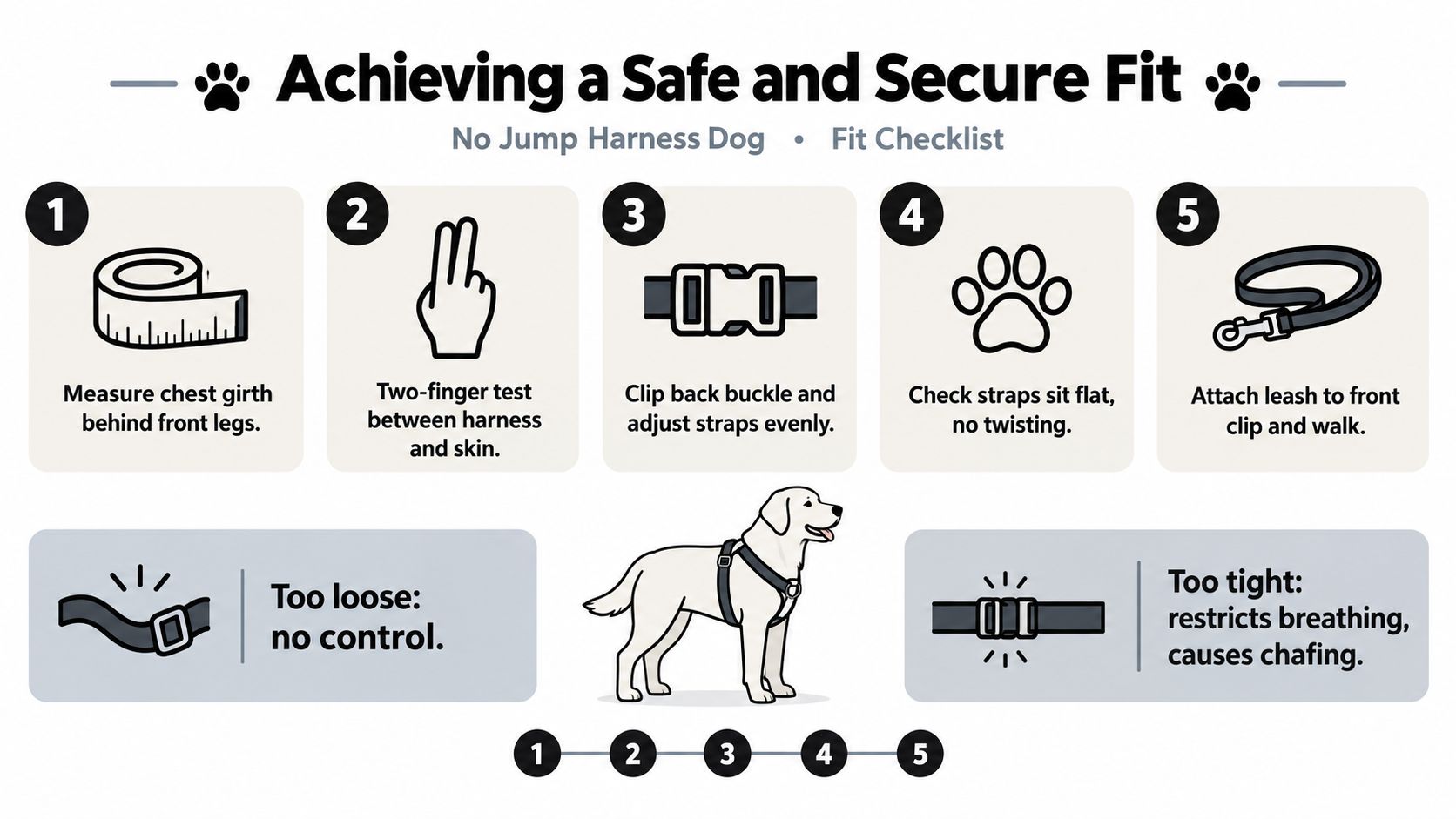
A loose harness can shift sideways, allow escape, and give you little control when the dog jumps. An overly tight one can rub the skin, interfere with breathing, or limit the shoulder movement you need for comfortable walking. Fit the dog, not the product label.
Start with the body, not the buckle
Measure the chest around the widest part of the rib cage, behind the front legs, then compare that measurement with the manufacturer's size chart. Once the harness is on, adjust each strap evenly rather than tightening only the area closest to the leash attachment.
Use the two-finger test. You should be able to slide roughly two fingers beneath the straps without forcing them through or leaving a large gap. The girth strap should sit behind the elbows and rib cage, not in the armpits. Chest material should avoid the throat and should not press directly into the shoulder joint.
A practical fitting sequence looks like this:
- Check the standing position. Look for flat straps, centered hardware, and enough clearance from the throat.
- Ask for a sit. Watch for straps that migrate forward or cut into the armpits.
- Walk slowly. Confirm that the front legs extend freely and the harness doesn't twist.
- Practice a controlled greeting. Have a calm person approach while you maintain a loose, short connection.
- Inspect after removal. Look for redness, damp rubbed areas, hair loss, or pressure marks.
The Nandog dog harness fitting guide is useful when you need a second reference for secure adjustment. A fit that looks correct while the dog stands still may change as soon as the dog walks, sits, turns, or lifts the front end.
Stop using the setup if your dog coughs, breathes differently, shortens the stride, moves unevenly, develops skin irritation, avoids the harness, or becomes increasingly frustrated.
Conditioning Your Dog to Wear the Gear
The fastest way to make a harness unpleasant is to put it on an excited dog while holding the dog in place. The dog struggles, the handler tightens their grip, and the harness becomes a signal for conflict before any leash training begins.
Start with the harness on the floor in a quiet room. Let the dog investigate it without reaching over the head or fastening anything. Reward a glance, sniff, or relaxed approach, then put the harness away before the dog becomes worried or overly stimulated.
Build the association in small stages
When the dog voluntarily moves toward the harness, hold an opening near the head or body and reward the dog for choosing to investigate. Don't push the harness over the head. The voluntary movement matters because it gives the dog a clear way to participate.
Next, fasten one part briefly, deliver food, and remove it. Gradually increase the time only while the dog remains relaxed. Watch for freezing, scratching, backing away, sudden biting at the straps, or frantic movement. Those behaviors tell you to reduce the difficulty rather than hold the dog still until the struggle ends.
Once the dog can wear the harness calmly in the room, add movement in simple steps:
- Walk a few relaxed paces without a leash.
- Attach the leash and reward slack-line movement.
- Practice turns and stops in a quiet area.
- Introduce a mild distraction at a distance.
- Rehearse a greeting only after calm responses are reliable.
This process resembles conditioning any piece of handling equipment. Dogs that already have difficulty settling may benefit from broader guidance on helping anxious dogs settle, especially if the harness triggers avoidance or high arousal.
Measure relaxation, not tolerance
A dog that stops fighting because it has given up isn't necessarily comfortable. Look for soft body language, normal movement, willingness to eat, and the ability to respond to a simple cue. If the dog can't take food or keeps twisting toward the harness, return to the previous stage.
Keep the leash separate from the early introduction. The dog first needs to learn that the harness predicts calm, rewarding experiences. Only then should you ask the dog to move, orient toward you, and manage distractions while wearing it.
The First 10 Seconds of a Greeting
The first moments determine whether the dog practices jumping or practices calm access. Your job is to prevent forward progress during the jump without adding physical or emotional pressure that makes the greeting more exciting.
Use a prepared sequence. The harness gives you a safe point of control, but your timing teaches the replacement behavior.
A practical greeting script
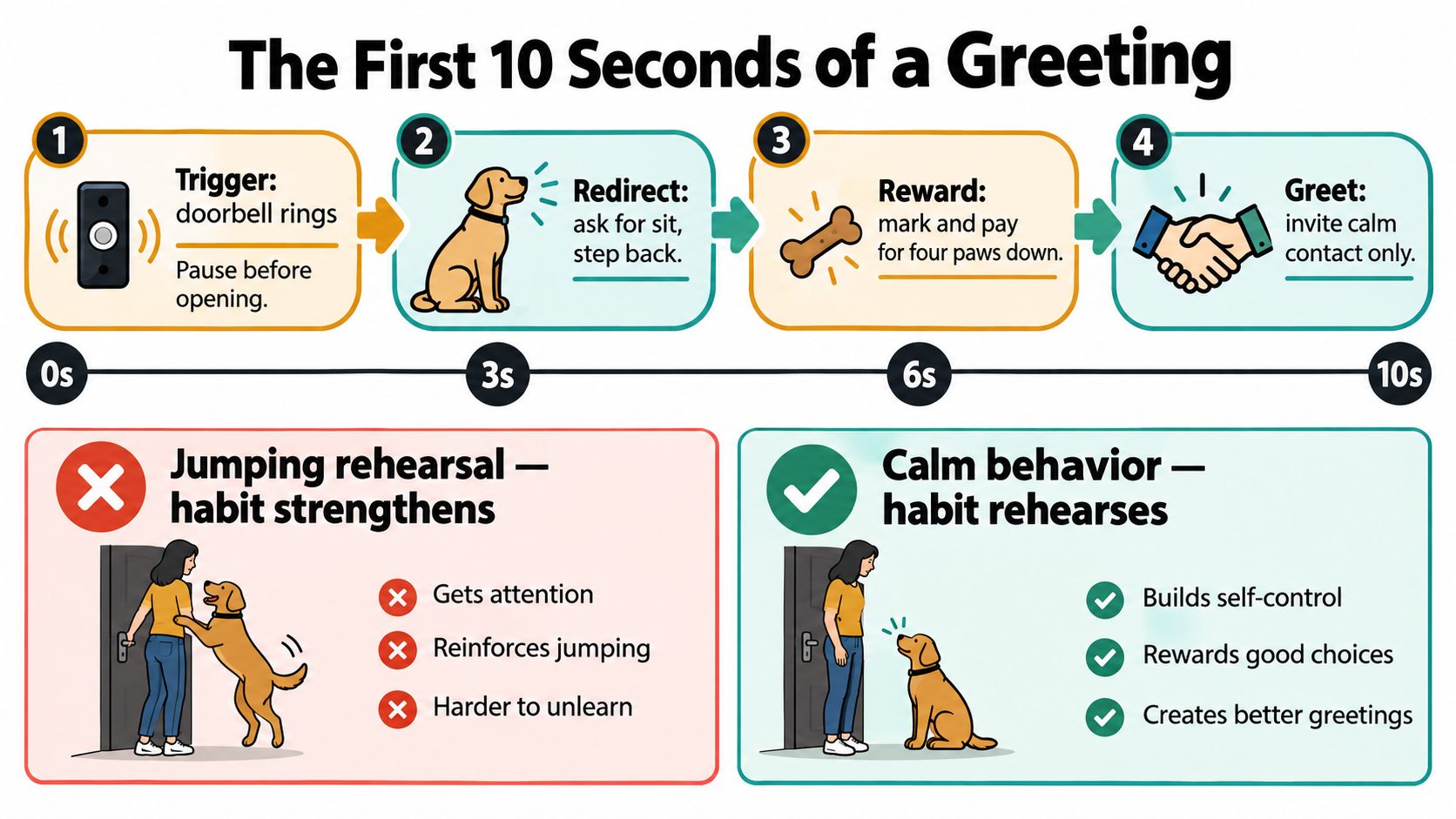
At the trigger, such as a doorbell or approaching person, pause before opening the door or moving closer. Keep the leash short enough for management, but don't hold it rigidly. Ask for a sit if your dog already knows the cue in that environment.
If the dog jumps, stop advancing immediately. Turn slightly sideways, keep your hands quiet, and avoid pushing, kneeing, grabbing at the front legs, or repeatedly saying “off.” Those responses can become attention or physical play.
As soon as the dog returns to the floor, mark the moment with a calm word and deliver the reward low, close to the floor. Feeding at floor level helps keep the dog's head and weight down instead of drawing the dog upward toward your hand.
After calm behavior repeats, invite the person to approach or touch the dog briefly. If the dog jumps again, access stops again. The visitor should become part of the same clear contingency, calm behavior opens the social door, jumping closes it.
The replacement behavior must be incompatible with launching upward. A sit works for some dogs, while a stationary stand, hand target, or mat position may work better for others. Practice the response before visitors arrive, then make the greeting harder gradually by changing distance, movement, or visitor excitement.
For puppies, short leash exercises and calm reinforcement should begin in easy environments before crowded greetings. Nandog's guide to leash training puppies provides relevant handling context for building those early habits.
Track the behavior rather than judging the harness by impression. Record 10 baseline greetings, then count jumps per greeting or jumps per minute as you reinforce four paws on the floor. In a controlled companion-dog study, noncontingent reinforcement reduced jumping in three of four dogs, with reported mean reductions of approximately 25% to 64% versus baseline. That result supports measuring behavior and adjusting the protocol, not assuming the equipment produced the improvement. The veterinary guidance on collar and harness options also supports staged introduction, secure fitting, and supervision.
Recognizing Warning Signs and Adjusting
A harness can fit well today and become unsuitable after growth, weight change, coat changes, or repeated wear. Recheck the position whenever your dog's body changes, especially during puppy growth or seasonal coat changes.
Watch the dog in motion, not just in a product photo. Coughing, altered breathing, shortened stride, uneven movement, skin irritation, avoidance, and escalating frustration all justify stopping the session and reassessing the equipment. A strap that shifts toward the throat or rubs behind the elbows needs adjustment or replacement.
A biomechanics study of 66 domestic dogs found that harness effects varied by breed and design, including changes in stride length, body-weight distribution, and estimated limb angles. That evidence supports individualized fitting when a dog has a history of orthopedic injury, unusual conformation, or musculoskeletal disease. Ask your veterinarian for guidance when movement changes persist, and seek a qualified positive-reinforcement trainer when jumping remains intense despite consistent management.
Extinction alone can also make unwanted behavior temporarily worse. An analysis of 113 datasets found increases in 36% of cases when extinction was used alone, compared with 12% when it was combined with additional operant procedures. The practical lesson is to prevent rehearsal while actively reinforcing an alternative, rather than withholding attention and hoping the jumping disappears.
If your dog needs a secure, adjustable walking option, Nandog Pet Gear offers a Neoprene Sport Dog Harness with a safety buckle, leash attachments, and three sizes. Visit Nandog Pet Gear to review its harness and walking accessories, then choose equipment that supports your dog's movement while you train calm greetings.