

A cat slow feeder is a portion-delivery and enrichment device that slows ingestion and encourages natural foraging, not an automatic weight-loss tool. Roughly a third of cats are described by their owners as overweight or obese, while regular use of food puzzles remains limited even though nearly half of owners have tried them.
You know the scene. Your cat hears the food scoop, runs to the bowl, inhales the meal, and then vomits or begs again before you've finished putting the food away. A slow feeder can turn that frantic routine into a more measured task, but only if the design matches the cat and the food.
The useful question isn't whether a slow feeder is fashionable. It's whether it helps your cat eat a measured portion comfortably, remain engaged without becoming frustrated, and finish the meal without bypassing the device.
What a Cat Slow Feeder Does
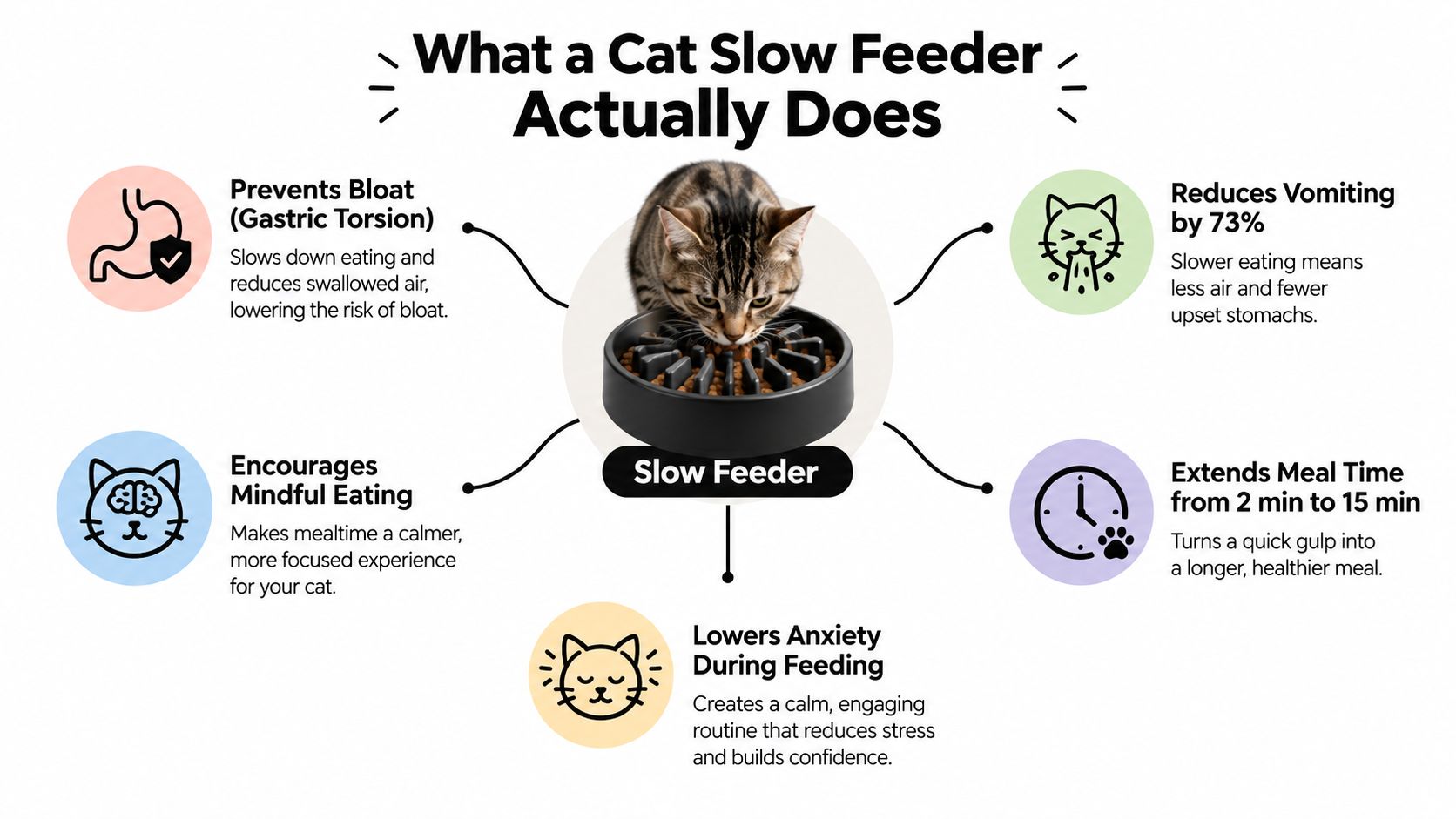
A fast eater needs controlled access to food before they need a complicated gadget. A maze bowl, shallow ridge dish, food ball, or compartment feeder places manageable obstacles between the cat and the meal. The cat must pause, reposition, lick, paw, or retrieve each bite instead of clearing the bowl in one rush.
That changes feeding speed and effort, not the food's calorie content. Loading the same daily ration into a slow feeder may extend mealtime and increase interaction with the feeding environment, but the feeder does not reduce calories by itself. Weigh portions when appropriate, and seek veterinary guidance when body condition or appetite is changing.
Slower eating is not the same as exercise
I've seen fast-eating cats settle when food stops arriving as one unrestricted pile. The cat sniffs, works through an opening, pauses, and returns to the task. That is useful enrichment, but it does not prove meaningful physical exercise.
A controlled crossover study of 19 household cats found no difference in daily or weekly activity between bowl feeding and food-puzzle feeding when accelerometers monitored movement, as reported in the veterinary study on food puzzles and feline activity. A slow feeder can encourage exploratory behavior and extend food access without functioning as a workout.
Adoption also depends on the realities of each home. In a 2018 online survey of 3,192 domestic-cat owners, 30% were using a food puzzle, 18% had tried one and stopped, and 52% had never used one. The survey identified barriers including multi-cat households, different diets, health concerns, exclusive wet-food feeding, and owners who believed their cats were too lazy, according to the survey of food-puzzle use among cat owners.
Choose the feeder your cat can use consistently. Start with modest difficulty, stable footing, and openings that release food without forcing the cat to struggle. A comfort-first design is more useful than an impressive obstacle course.
Benefits of a Cat Slow Feeder for Digestive Health and Enrichment
The strongest case for a slow feeder is controlled access to a measured meal. A cat that gulps may benefit from a feeding surface that creates pauses between bites, especially when the alternative is unrestricted access to a deep pile of food. The device can also turn a routine meal into a simple foraging task, which gives an indoor cat more control and engagement.
Weight management needs a separate conversation. In a large 2019 international owner survey, owners classified 30.5% of cats as overweight or obese using a visual body-condition scale and 32.5% using a verbal scale. When both methods agreed, the figure was 23.5%, while using either method produced 39.5%, as detailed in the international survey of feline body condition. The variation shows why home assessment can be uncertain.
A slow feeder may help a household deliver measured portions more deliberately, but it can't diagnose body condition, set calories, or treat an underlying illness. If your cat is gaining weight, losing weight, vomiting repeatedly, or showing a sudden appetite change, involve a veterinarian rather than relying on the bowl.
Separate the outcomes
The activity evidence is especially important. The controlled pilot study of 19 household cats found no overall activity difference between conventional bowls and food puzzles, so marketing that presents a feeder as an exercise solution overreaches. Think in three separate categories:
| Expectation | What the evidence supports |
|---|---|
| The cat eats more slowly | Obstacles and compartments can make food harder to access and may reduce gulping. |
| The cat receives enrichment | Foraging and problem-solving can add variety to the feeding environment. |
| The cat becomes more active | A slow feeder shouldn't be treated as a guaranteed exercise device. |
| The cat loses weight automatically | Portion size, diet, veterinary assessment, and monitoring remain necessary. |
Some cats also need a calmer overall environment. A comfortable resting place can complement feeding changes, particularly for cats that become tense around household activity. Guidance on calming faux fur cat beds can help you think about the wider environment rather than treating the feeder as the entire behavior plan.
For broader enrichment, a rope cat toy can add play outside mealtimes. Keep that activity separate from the feeder's main job. The feeder manages access to food; play, climbing, resting, and exploration meet other behavioral needs.
Types of Cat Slow Feeders and Materials
Feeder shape determines how the cat works, how easily you can clean it, and whether the design suits wet food. A low maze bowl may be a sensible first step for a cat that gulps dry food. A food ball may offer more searching, but it can be frustrating for a cat with limited mobility or little interest in manipulating objects.
Match the design to the feeding problem
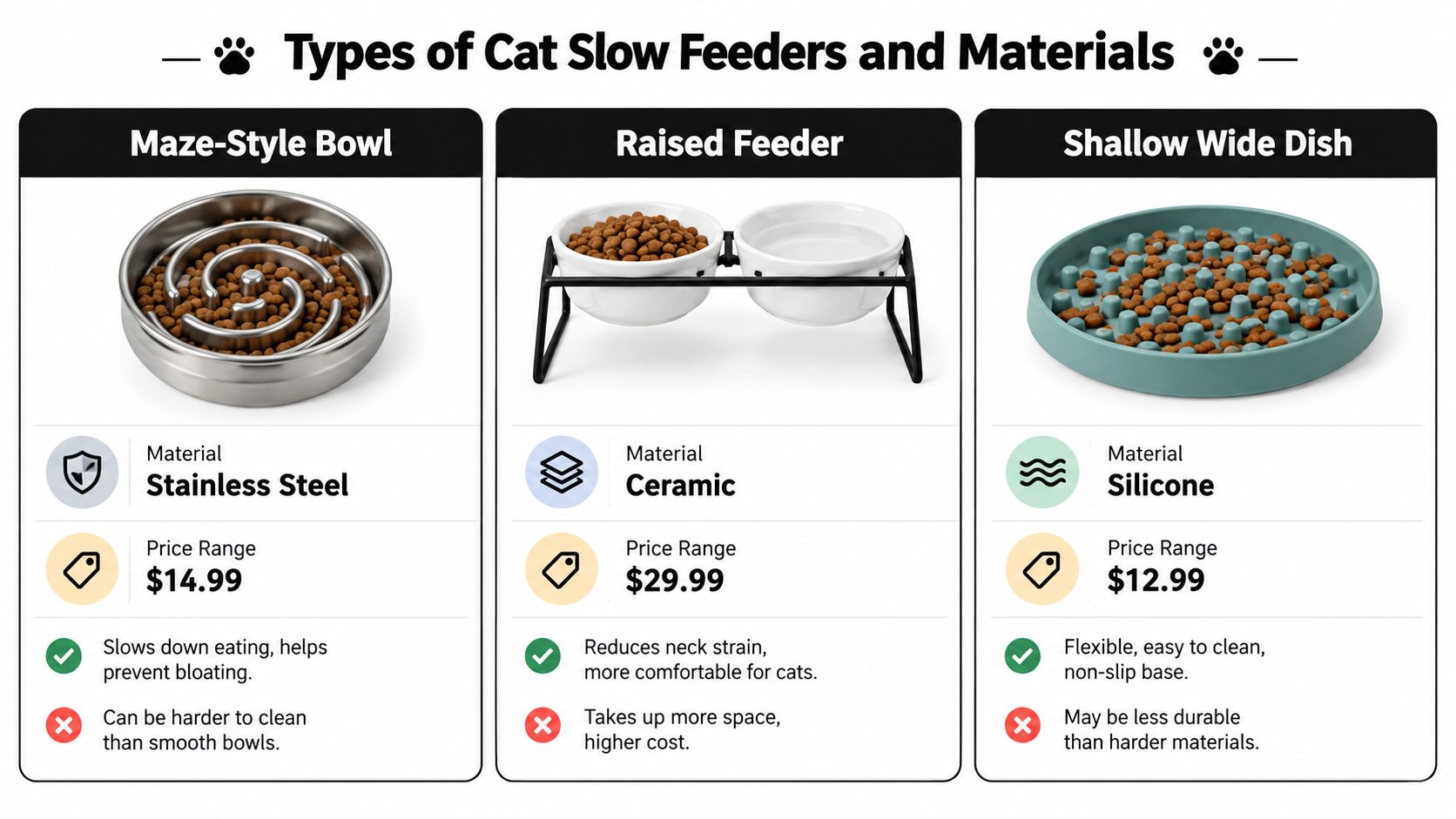
Maze-style bowls work through raised ridges or channels. They're often suitable for dry food and fast eaters because the cat must move around barriers. Look for rounded edges, broad access points, and a base that won't slide when the cat pushes with its nose.
Shallow wide dishes offer less obstruction but may be more comfortable for cats that dislike deep contact around the face. They're also easier to use with wet food, provided the ridges don't trap residue. A food bowl for pets should be judged by access, stability, food compatibility, and cleaning demands, not appearance alone.
Raised feeders change posture rather than necessarily adding substantial puzzle difficulty. They may suit a cat that eats more comfortably from a higher surface, but height isn't automatically better. The bowl still needs to allow relaxed access without forcing the cat to stretch or lean.
Food balls and foraging toys distribute access through rolling, pawing, or searching. Veterinary guidance supports foraging devices as part of meal feeding, portion control, and environmental enrichment, but the device should remain easy enough that the cat continues eating.
Material matters because food residue collects in every groove. Nonporous, washable surfaces are easier to inspect than scratched plastic. Stainless steel and glazed ceramic can be practical choices, while silicone can work well for flexible, shallow designs if it doesn't fold or move during use.
Don't overstate whisker-friendly claims
A study involving 38 cats found no significant difference in feeding time, amount eaten, or food dropped between regular and whisker-friendly dishes. About 63% of owners believed their cats preferred the wider dish, but that preference didn't translate into measurable intake improvements, according to the study comparing regular and whisker-friendly dishes.
That doesn't mean width is irrelevant. It means you should observe the individual cat. If your cat repeatedly presses its face into obstacles, spills food, paws excessively, or walks away, choose a wider or shallower design and reassess.
How to Choose and Introduce a Slow Feeder Safely
Start with the cat, not the product description. A young, food-motivated cat with previous puzzle experience may accept more complexity. A senior cat, a cat with reduced paw mobility, or a cat that has never worked for food needs a simple surface with generous access.
Use a gradual introduction
- Identify the immediate problem. Is your cat gulping dry food, vomiting after meals, pushing the bowl, competing with another cat, or just bored? Choose a feeder that addresses the observed behavior rather than every possible problem.
- Select low initial difficulty. Begin with a shallow maze, broad ridge, or open compartment. Food should come out with modest paw or muzzle effort. A controlled study of 17 neutered indoor cats found that cats ate significantly more from a freely accessible tray than from a food puzzle, with a statistically significant difference, as reported in the controlled food-puzzle access study. Excessive difficulty can reduce intake rather than merely slow eating.
- Keep the familiar bowl available. Place the new feeder beside the usual bowl and load only part of the meal into it at first. Your cat should be able to choose an easier route while learning the new action.
- Measure the full daily ration. Weigh the day's food with a gram scale before loading the feeder. Divide that measured ration across meals if appropriate. A puzzle doesn't guarantee fewer calories, so don't refill it just because the cat finishes the accessible portion.
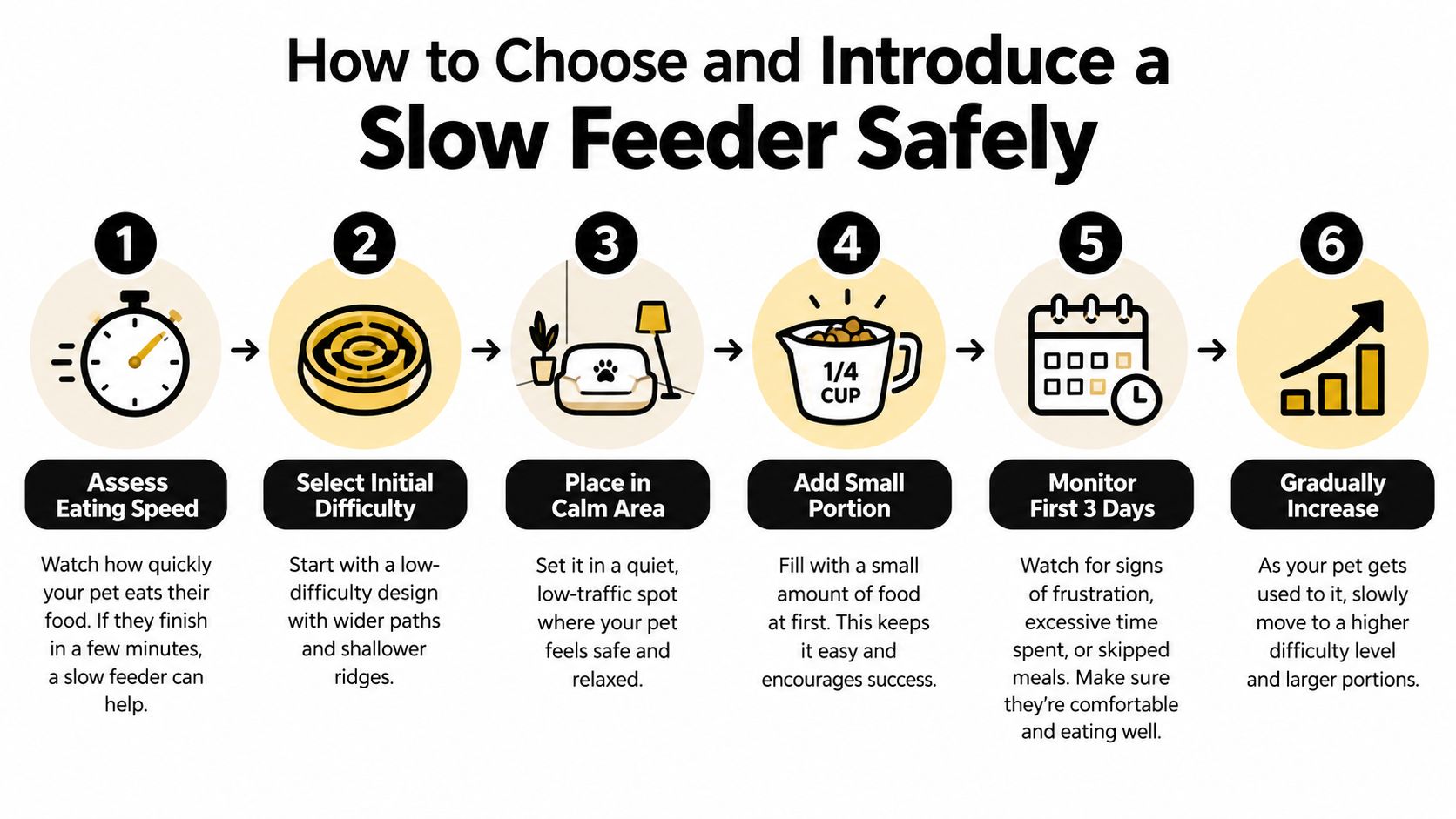
- Watch the first sessions. Look for calm retrieval, normal eating, and food remaining only when the cat appears satisfied. Repeated pawing without progress, vocalizing, walking away hungry, or refusing food means the challenge is too high or the format is wrong.
- Increase difficulty only after success. Add deeper compartments or more distributed access gradually. If the cat consistently retrieves food, you can test a slightly more engaging design. If intake drops, return to the simpler setup.
Wet food changes the equation. Deep grooves can hold smeared food and make access unpleasant, while a shallow, gently ridged surface is easier to eat from and clean. In multi-cat homes, separate feeding stations reduce competition and let you monitor whether each cat has eaten its own portion.
For kittens and newly adopted cats, predictable access matters more than novelty. A kitten starter kit can help organize the wider feeding and settling routine, but any new feeder should still be introduced at a level the individual kitten can manage.
Cleaning Tips and Common Slow Feeder Problems
A slow feeder only works as well as its hygiene routine. Choose one you can disassemble, rinse, brush, and dry fully. Nonporous materials with rounded channels are easier to inspect than narrow cavities that conceal wet food, saliva, or crumbs.
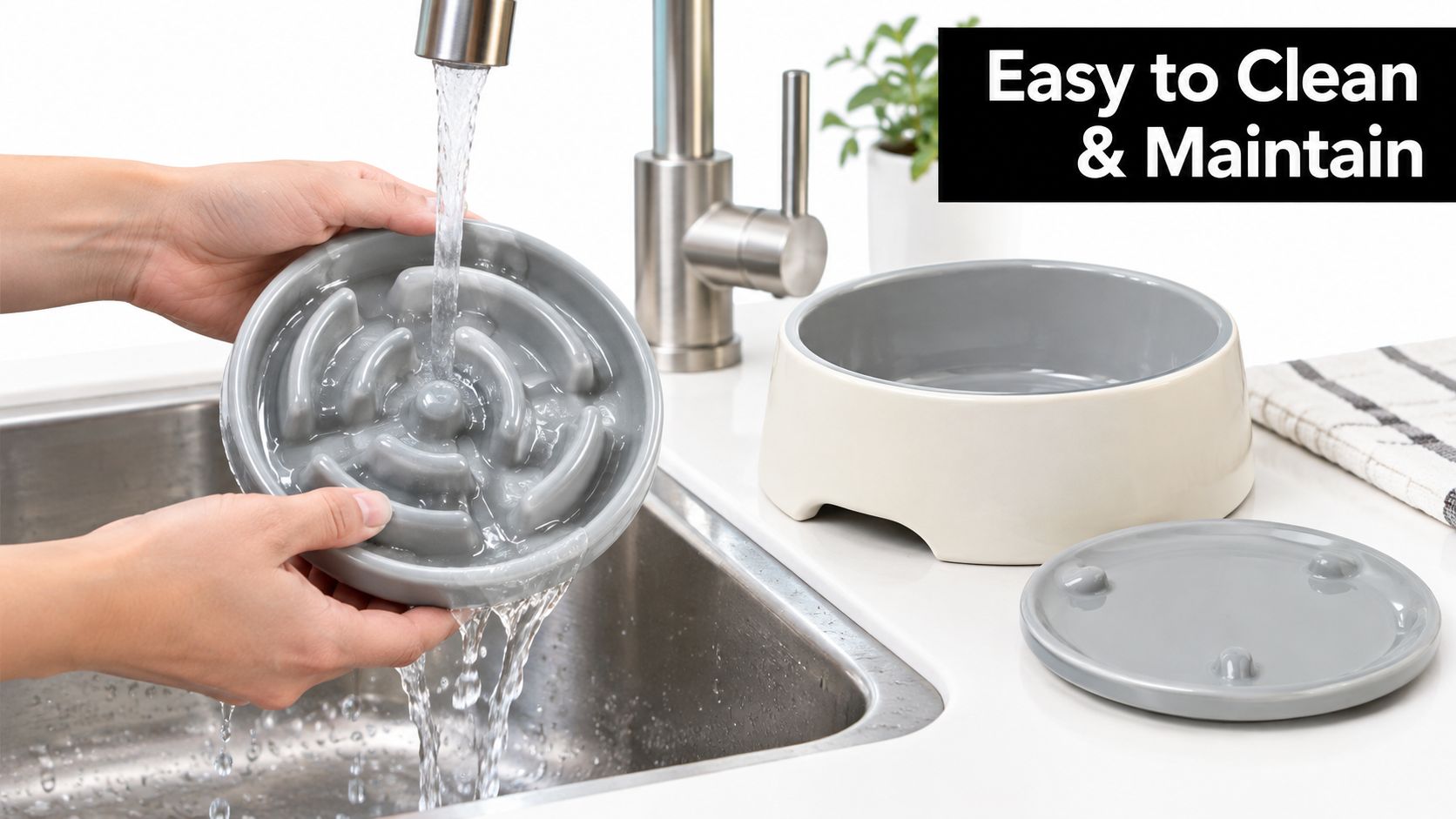
Use the bowl as a daily hygiene item
Remove residue soon after the meal. Separate removable parts, brush ridges and compartments with a soft brush, and allow every piece to dry before reassembly. A dishwasher setting does not guarantee that water reaches every recessed channel, so inspect those areas by hand.
A practical kitchen utensil safety guide covers useful principles for washing, sanitizing, and drying food-contact items. Apply the same care to pet-feeding equipment, while following the feeder manufacturer's instructions for its material.
Fix the problem you can observe
- Food refusal: Put the familiar bowl back or set it beside the feeder. Check whether food sits too low, the surface moves, or the cat cannot reach the portion comfortably.
- Excessive pawing: Make the setup easier and inspect the cat's paws. Repeated pawing without eating usually signals frustration, discomfort, or poor access rather than useful enrichment.
- Spillage: Try a heavier base, a non-slip mat, or a wider design. Some cats manage shallow access better than narrow channels.
- Uneaten food: Confirm that the cat can retrieve it, then consider appetite, mouth comfort, and general health. A feeder must not interfere with adequate nutrition.
- Multi-cat conflict: Provide separate stations with visual distance between them. Puzzle feeders can encourage exploration, but shared resources still need thoughtful placement so one cat cannot block another.
The feeder delivers food and enrichment, not guaranteed exercise. A design that slows eating while remaining comfortable is doing its job; extra paw movement does not justify difficult access or poor hygiene.
If your cat has a medical condition, needs a specialized diet, or stops eating, simplify the setup and contact your veterinarian. Enrichment has value only when the cat can reach and eat the food comfortably.
Making the Right Feeder Choice for Your Cat
Choose according to the outcome you want, then test whether your cat achieves it. For a fast dry-food eater, begin with a stable maze bowl that creates pauses without hiding food. For a cat that needs gentle novelty, use a shallow foraging surface or a simple food ball. For wet food, prioritize smooth access and cleaning over elaborate channels.
Temperament changes the decision. A curious, food-motivated cat may enjoy a feeder that requires searching. A cautious cat may view the same product as an obstacle between them and dinner. Age, mobility, previous puzzle experience, and household competition all affect whether a design feels rewarding or threatening.
A practical selection filter
Ask these questions before buying:
- What is the target behavior? Slower ingestion calls for controlled access. Enrichment calls for safe exploration. Neither goal automatically means increased exercise.
- Can the cat retrieve every bite? Openings should suit the cat's muzzle and paw use, with no need for forceful pushing or prolonged frustration.
- Will the material survive daily cleaning? Choose washable, nonporous construction with accessible surfaces.
- Does the feeder fit the food? Wet food needs shallow, cleanable contact areas. Dry food allows more variety in ridges, compartments, and rolling designs.
- Can each cat eat without competition? Separate stations are often more useful than one complex shared feeder.
- What will you monitor? Track whether the full ration is eaten, how calmly the cat approaches the feeder, and whether vomiting, spillage, or avoidance changes.
A slow feeder should make feeding more manageable, not turn every meal into a test. The evidence supports controlled access and environmental enrichment, while it does not support promises of automatic weight loss or guaranteed activity gains. Comfort, hygiene, stability, and successful intake are better indicators than the number of obstacles in the bowl.
Nandog Pet Gear offers thoughtfully designed feeding essentials alongside comfort-focused beds, toys, carriers, and everyday accessories for cats and dogs. Visit Nandog Pet Gear to find practical pet products that support calmer routines, easier care, and better everyday living.