


You bought a beautiful cat bed box, placed it in the living room, and your cat still sleeps in the cardboard shipping box beside the recycling bin. The bed looks right with the sofa, the cushion feels soft, and yet your cat walks past it without a glance. That isn't stubbornness. It usually means the box failed to match the cat's sense of safety, temperature, scent, or visibility.
A good cat bed box is behavior-responsive furniture. It should give the right cat the right balance of concealment, warmth, room awareness, and easy escape. Cats also spend a remarkable portion of their lives resting. Healthy adult cats typically sleep 12 to 16 hours per day, while broader summaries report that more than half sleep between 12 and 18 hours, and nearly 40% sleep more than 18 hours daily, according to independent cat sleep summaries. The bed isn't an occasional accessory. It becomes part of the cat's daily environment.
Why Most Cat Bed Boxes Go Unused
The most common mistake is choosing for the room before choosing for the cat. A low, open, sculptural bed may suit a minimalist interior, but a newly adopted cat can read it as an exposed platform. A deep cave may look inviting to you, yet a confident cat that likes watching household activity may reject it because the entrance blocks too much of the room.
Cats tend to use boxes for three practical reasons:
- Security: Partial enclosure limits the number of directions from which another animal, person, or sudden movement can approach.
- Thermal comfort: Cardboard and lined spaces hold warmth close to the body, which makes them more appealing during repeated naps.
- Familiar scent: A shipping box already smells like the home, the floor, and the cat's own environment. A new product may smell like packaging, manufacturing, storage, or fragrance.
The last point gets overlooked. You can buy a premium-looking bed, place it in a prominent spot, and accidentally make it less attractive by washing it with a heavily scented detergent before the cat has used it. Your cat doesn't care that the fabric complements the rug. The cat cares whether the space feels secure and familiar.
The shipping-box problem
A discarded box often wins because it has the right proportions, a single usable opening, firm walls, and a location the cat selected independently. Boutique beds commonly fail with oversized interiors, several openings, slippery bases, low walls, exposed placement, or cushions that move when the cat steps inside.
A simple cardboard hide can also be useful enrichment when it's made and used safely. For ideas that keep material choice and construction in mind, browse safe cardboard toys for cats before turning a random carton into a permanent sleeping space.
Practical rule: If your cat ignores the bed, assume the design or placement is wrong before assuming your cat doesn't like beds.
A hiding box has a real welfare function, not just a novelty appeal. In a controlled study of hospitalised cats, those given a cardboard hiding box had lower stress scores and better body-weight retention than cats without one, as reported in the feline hiding-box study. That evidence doesn't mean every cat wants the same box. It means concealment deserves more attention than decoration.
Sizing and Materials That Actually Work
Start with the cat, not a standard product size. Measure from the nose to the base of the tail while the cat is standing, then make the interior length roughly 1.5 times that measurement. An interior width of about 1.2 times the internal length gives the cat room to curl, shift position, and stretch without creating a cavernous space that loses its protected feel.
The entry should let the cat pass through without squeezing, but it shouldn't turn the box into an open tunnel. Use one main opening for a conventional sleep box. Multiple entrances can improve escape options in a play structure, but they often weaken the quiet, concealed character that makes a bed box appealing.
Material choices
For a weekend cardboard build, corrugated cardboard around 6 to 8 mm thick gives the walls useful rigidity. It is inexpensive and disposable, but moisture, scratching, and repeated use eventually weaken it. Treat cardboard as a replaceable product, especially if it becomes contaminated.
Birch plywood around 9 to 12 mm works better for a permanent structure. It takes more cutting, sanding, and finishing, but it can last for years when the edges are sealed and the cushion is removable. Solid pine is another durable choice, though its weight and grain can make clean cutting more demanding.
Build the layers with purpose:
- Structure: Corrugated cardboard, birch plywood, or solid pine.
- Insulation: Fleece, wool felt, or Sherpa for cold rooms. Untreated cotton suits warmer rooms and cats that prefer airflow.
- Base: Non-slip rubber dots or a silicone mat, particularly on hardwood floors.
| Style | Security | Warmth | Best For |
|---|---|---|---|
| Enclosed | High | High | Shy, anxious, newly adopted, or privacy-seeking cats |
| Semi-covered | Medium to high | Medium to high | Cats that want concealment but still monitor the room |
| Open box | Low to medium | Low to medium | Confident, social cats that prefer clear sightlines |
A bed box should fit the cat's posture and the room's temperature. If you want to compare ready-made options for indoor spaces, this guide to the best cat beds for indoor cats offers another way to think about support, placement, and daily use.
Don't make the interior excessively large. Cats often prefer a compact nook that supports curling and allows them to keep the entrance in view. A box that feels like furniture to you can feel like an exposed container to them.
Building a Cat Bed Box From Scratch
Measure the cat and the intended location before cutting anything. For an enclosed design, cut five structural panels, a base, two sides, a back, and a roof. A semi-covered version can use four panels with a partial roof or raised rear section, giving the cat some cover without removing its view.
Cut a single entry hole sized to the cat. A practical starting range is roughly 15 to 20 cm in diameter, but the cat's actual body size matters more than the number. The opening should have enough clearance for whiskers and shoulders, with no sharp corners that catch fur or skin.
Assemble before you commit
Dry-fit every panel first. This catches warped cardboard, inaccurate cuts, and joints that will force the box out of square. For cardboard, hot glue works quickly and creates a rigid seam. For plywood, use wood glue with brad nails, then reinforce interior corners with small triangular gussets. Those gussets matter because cats enter with momentum, lean against walls, and may knead the lining repeatedly.
Sand plywood edges flush, especially around the entry. Seal bare wood with a non-toxic water-based sealer, and allow it to cure fully before introducing the cat. Skip sealer on cardboard. It adds moisture and can leave an odor that undermines the familiar, low-stimulation character you want.
The soft layer should be removable wherever possible. Cut fleece or wool felt so it overlaps seams by 2 to 3 cm, then secure it with low-tack spray adhesive or friction-fit it beneath a removable cushion cover. A loose pad is easier to wash and replace than a permanently glued interior.
Build test: Push the finished box across the floor with one hand. If it slides easily, add a silicone mat or more substantial rubber feet before your cat enters it at speed.
Cardboard construction can take roughly 45 to 90 minutes, while a plywood version usually needs 2 to 3 hours, depending on cutting and finishing. Before use, check every surface. There should be no exposed staples, loose threads, sharp entry edges, unstable panels, or adhesive residue within reach. The finished box must also resist sliding and tipping.
A washable insert is more valuable than a complicated exterior. Cats can ignore ornate details, but they notice a cushion that shifts, a wall that flexes, or a strong smell that hasn't settled.
Design Styles From Minimalist to Cozy Cave
A cat bed box should solve a behavioral problem while looking intentional in the room. I'd divide the useful designs into three directions: minimalist, cozy cave, and insulated. Each has a clear strength, and each can be wrong for a particular cat.
The minimalist box is a clean rectangular structure in wood or low-profile cardboard with a single washable pad. It suits confident cats that like to rest near people and modern rooms where bulky pet furniture feels disruptive. The trade-off is obvious. You get better sightlines and easier visual integration, but less warmth and less concealment.
The cozy cave has a hood, reduced opening, soft lining, or high sidewalls. It is the strongest choice for shy cats, anxious cats, many seniors, and newly adopted cats that need a retreat rather than a display bed. Its weakness is airflow. Keep the interior breathable, avoid heavy fragrance, and make sure the cat can enter and leave without the hood collapsing.
The insulated box uses double walls, thick felt, or a thermal liner. It makes sense for short-haired cats, drafty floors, and cold homes. It also adds bulk, weight, and cleaning complexity. Don't use heavy insulation to compensate for a poor location.
| Style | Best For | Comfort Trade-off | Personality Match |
|---|---|---|---|
| Minimalist | Social rooms and confident cats | Cooler, more exposed | Curious and observant |
| Cozy cave | Quiet corners and nervous cats | Less airflow and visibility | Cautious, private, or easily startled |
| Insulated | Cold floors and short-haired cats | Heavier and bulkier | Heat-seeking and comfort-focused |
A cave is my default for a new adopter because control matters more than appearance during the adjustment period. In a multi-cat home, however, a fully hidden box can become difficult to monitor if one cat guards it. Open or semi-covered designs let cats maintain visual awareness while still claiming a defined resting surface.
For a polished room, study the proportions and materials used in modern cat bed design, then apply the same restraint to the box rather than adding decorative features the cat won't use. A hybrid often works best for cats with mixed preferences. Give one side a low opening and clear view, then add a hood or raised rear wall on the other side.
Cleaning and Long-Term Maintenance
A cat bed box that smells stale or stays damp stops functioning as a refuge. Choose the material with cleaning in mind. Porous cardboard is difficult to disinfect and can act as a fomite when reused, while non-porous plastic can be wiped and reused after proper cleaning, as discussed in this cat bed cleaning resource.
Discard cardboard after urine, vomit, or other contamination. Wiping it down does not remove trapped moisture or odor, and moisture also weakens the structure. Recycle the box and replace it instead of returning it to use.
For fleece and cotton covers, wash with hot water and skip fabric softener. It coats fibers and leaves fragrance behind. For fabrics and inserts that need frequent laundering, use this guide to choosing a cat bed washable option for material and care tips.
A workable care rhythm
For wooden or plastic boxes, replace liners every 1 to 2 weeks. Wipe hard surfaces monthly with an unscented, pet-safe cleaner, and replace foam inserts every 6 to 12 months, based on their condition and odor. Keep two washable liners in rotation so the cat still has a familiar bed while one is being cleaned.
Covered boxes need closer checks. Ammonia-like odor makes the space unpleasant, and dust in felt-lined caves may aggravate cats with respiratory sensitivity. Inspect zippers and seams before fraying creates loose threads.
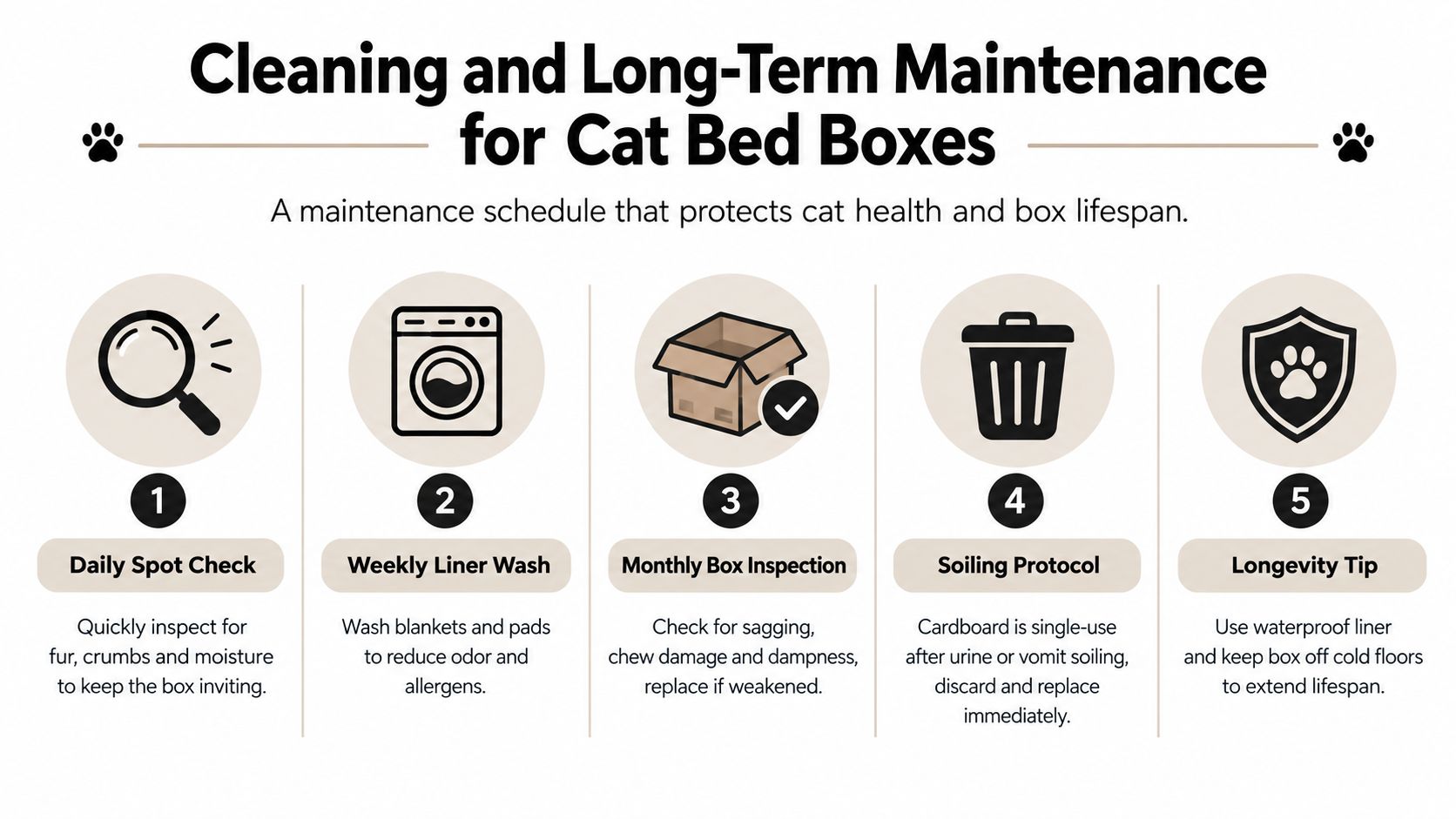
Use this monthly routine:
- Remove debris: Vacuum fur, crumbs, and loose litter from corners and seams.
- Swap the liner: Install a clean insert and wash the used one.
- Disinfect hard surfaces: Wipe non-porous material with an unscented, cat-safe cleaner, then let it dry completely.
- Check the structure: Look for sagging cardboard, chew damage, dampness, failed stitching, and unstable feet.
- Run a smell test: If you detect stale, perfumed, or ammonia-like odor, your cat likely detects it more strongly.
Replace any box that stays damp, smells contaminated, or becomes unstable. A clean, dry bed box earns repeat use. A neglected one gets ignored.
Fixes for Picky and Anxious Cats
A cat that ignores a bed box usually isn't rejecting comfort. It's rejecting a mismatch. Start with placement. A box beside a loud appliance, in a hallway, or against a wall with no clear exit feels exposed or risky. Move it into a quiet corner where the entry faces the room and the cat can monitor activity without feeling trapped.
Scent is the next suspect. Rub a soft cloth gently along the cat's cheeks, then place it inside the box. That transfers familiar facial scent without adding perfume. Some cautious cats respond to silvervine, but don't force any plant-based attractant if it makes the cat overstimulated.
Change one variable at a time
If you're replacing an old bed, place the new box beside it for 7 to 10 days rather than removing the familiar option immediately. Once the cat chooses the new box consistently, take away the old one. A sudden swap often creates a trust problem, not a furniture problem.
Match the form to the personality. An exposed minimalist box is a poor first choice for a skittish rescue. A fully closed cave can frustrate a confident adolescent that wants to watch the room. Never push the cat inside, block the entrance, or hover while it investigates. Keep the bed away from the litter box, and don't wash away every familiar scent after the first use.
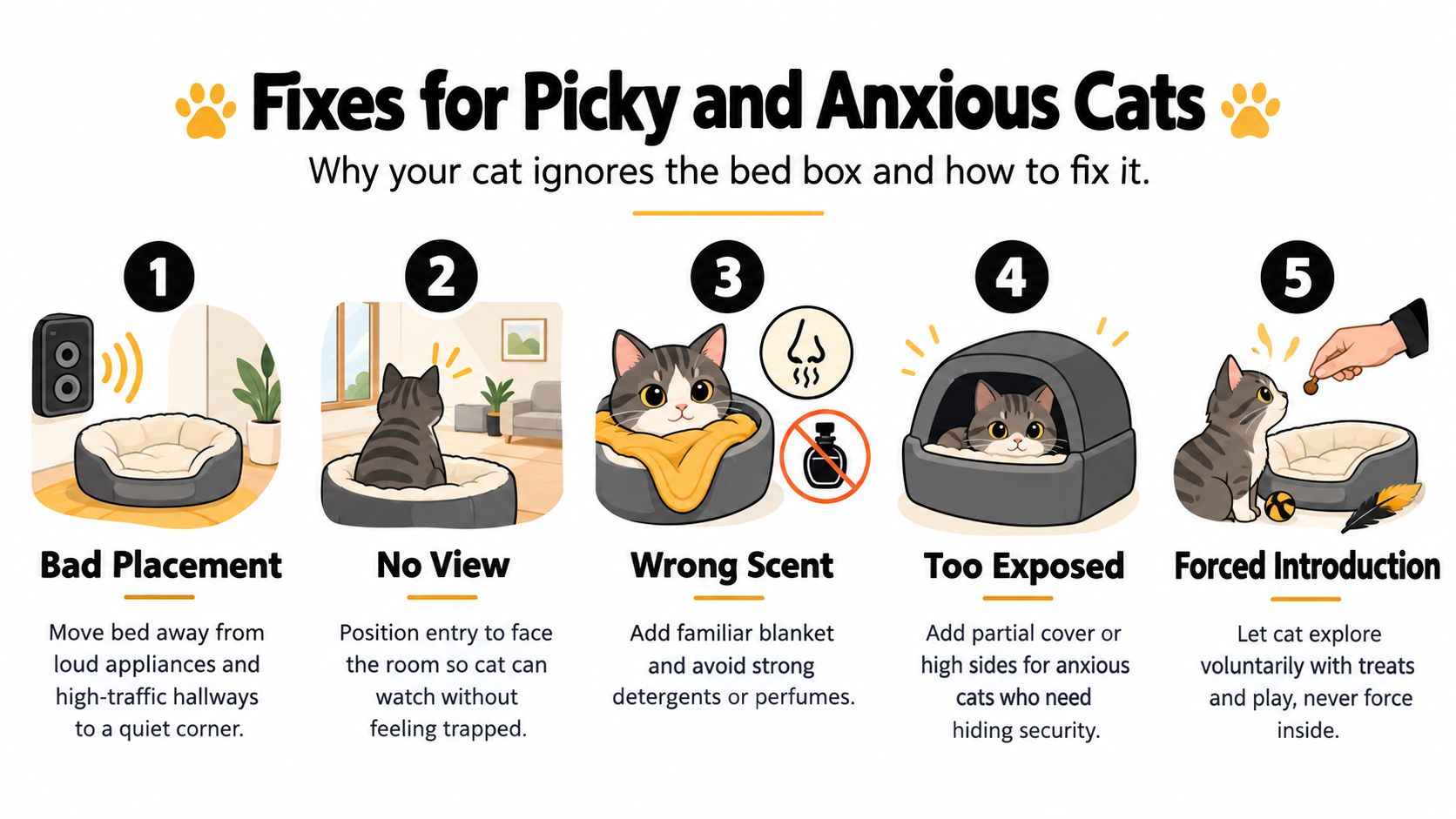
For a rescue cat, use a quiet reintroduction routine:
- First days: Place the box in the cat's chosen safe area and leave it untouched.
- Following days: Add familiar fabric and sit nearby without reaching into the opening.
- After exploration begins: Offer a treat near the entrance, then farther inside, but never place the cat there yourself.
- Once the box is accepted: Move it only gradually, preserving the same orientation and familiar liner.
For another tactile option in a quiet room, browse the cat nap wall quilt kit, especially if your cat prefers a soft, raised retreat instead of a floor-level cave.
Use the video below for a visual reminder that placement and voluntary exploration matter more than forcing a cat to interact.
Choosing the Right Setup for Your Cat
Match the form factor to the cat first, then fit it to the room. An anxious or senior cat usually needs a fully enclosed cave with one modest entry in a quiet, low-traffic corner. A confident social cat often prefers an open tray or low-wall box placed where people already gather. Kittens and active cats need sturdier construction, while multi-cat homes should provide one box per cat plus an extra, spread across different locations instead of lining them up.
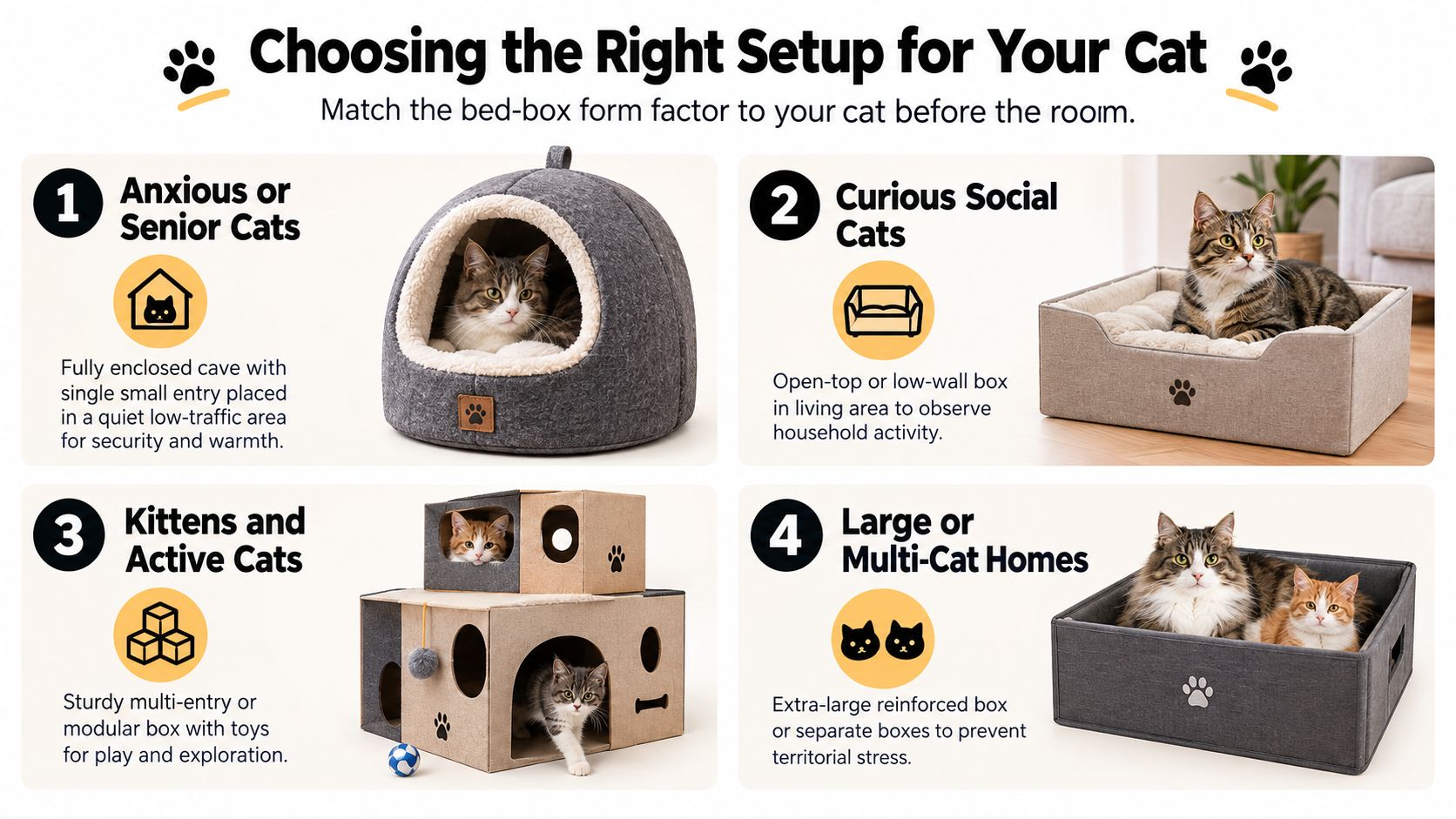
Use the room's heat profile as the final adjustment. Choose insulation for drafty floors, and choose a breathable open style near a radiator or sunny window. If your cat already claims a particular chair, shelf, corner, or patch of floor, build or buy a cat bed box that matches that exact location and preferred posture. The best decision rule is simple: copy the cat's existing choice, then improve its safety, support, cleanliness, and visual fit.
Nandog Pet Gear offers design-focused cat beds and cat-and-dog bed collections that can support a polished resting setup, with comfort-oriented materials and washable options suited to everyday use. Visit Nandog Pet Gear to find a bed that fits your cat's preferred posture and your home's design, then place it where your cat already feels secure.