


Your dog is ready at the door. You've got keys in one hand, coffee in the other, and a leash that somehow managed to knot itself around a tote bag strap overnight. The walk starts fine, then a scooter zips by, your dog surges forward, the leash clip twists, and suddenly a simple trip around the block feels clumsy.
That's the moment many owners realize a harness and leash set isn't just a cute matching accessory. It's a working system. It helps you guide your dog, absorb sudden movement, and make everyday walks feel calmer and more predictable.
For city owners, that matters even more. Sidewalks are narrow. Elevators are tight. Crosswalks get crowded. You need gear that's easy to put on, easy to hold, and shaped in a way that supports movement instead of fighting it.
A good set also solves a common shopping mistake. People often buy a harness first, then grab any leash nearby. Sometimes the clip is too bulky, the webbing feels mismatched, or the hardware adds awkward weight right where control matters most. A coordinated set tends to work better because the parts are chosen to function together.
Introduction to Harness and Leash Sets for Everyday Walks
A matched walking setup gives you more than visual consistency. It gives you a cleaner line of communication between your hand and your dog's body. When the harness fits well and the leash suits the dog's size, your cues feel clearer and your dog usually has an easier time understanding what you want.
That matters because walking gear sits inside a large, established category. The global dog collars, leashes, and harnesses market is estimated at US$6.8 billion in 2026 and projected to reach US$12.1 billion by 2033, reflecting an 8.6% compound annual growth rate from 2026 to 2033, with a reported historical growth rate of 7.4% during 2020 to 2025 according to Persistence Market Research's dog collars, leashes, and harnesses market analysis. That scale tells you this isn't a niche purchase. Owners replace and upgrade walking gear often because fit, comfort, weather, and daily routine all change over time.
Why sets feel easier in real life
Think of a harness and leash set like shoes and laces. You can mix random pieces and still get out the door. But when the parts are designed to work together, everything feels more balanced.
A set often helps with:
- Handling: The clip size, ring size, and leash weight are more likely to feel proportionate.
- Comfort: Matching materials can reduce rubbing, twisting, or stiff transitions at attachment points.
- Visual clarity: In busy environments, simple design helps you spot how the gear sits on your dog at a glance.
- Routine: The same setup day after day builds confidence for both of you.
Practical rule: If your walk feels chaotic, don't start by blaming your dog. Start by checking the system. Fit, clip placement, leash length, and hardware weight all affect control.
Some owners come to this topic because their puppy pulls. Others want something safer than a collar for a small dog. Some just want a set that looks polished enough for daily city life without sacrificing function. All of those are reasonable goals, and they can work together when you understand what each part is doing.
What a Harness and Leash Set Includes and How It Works
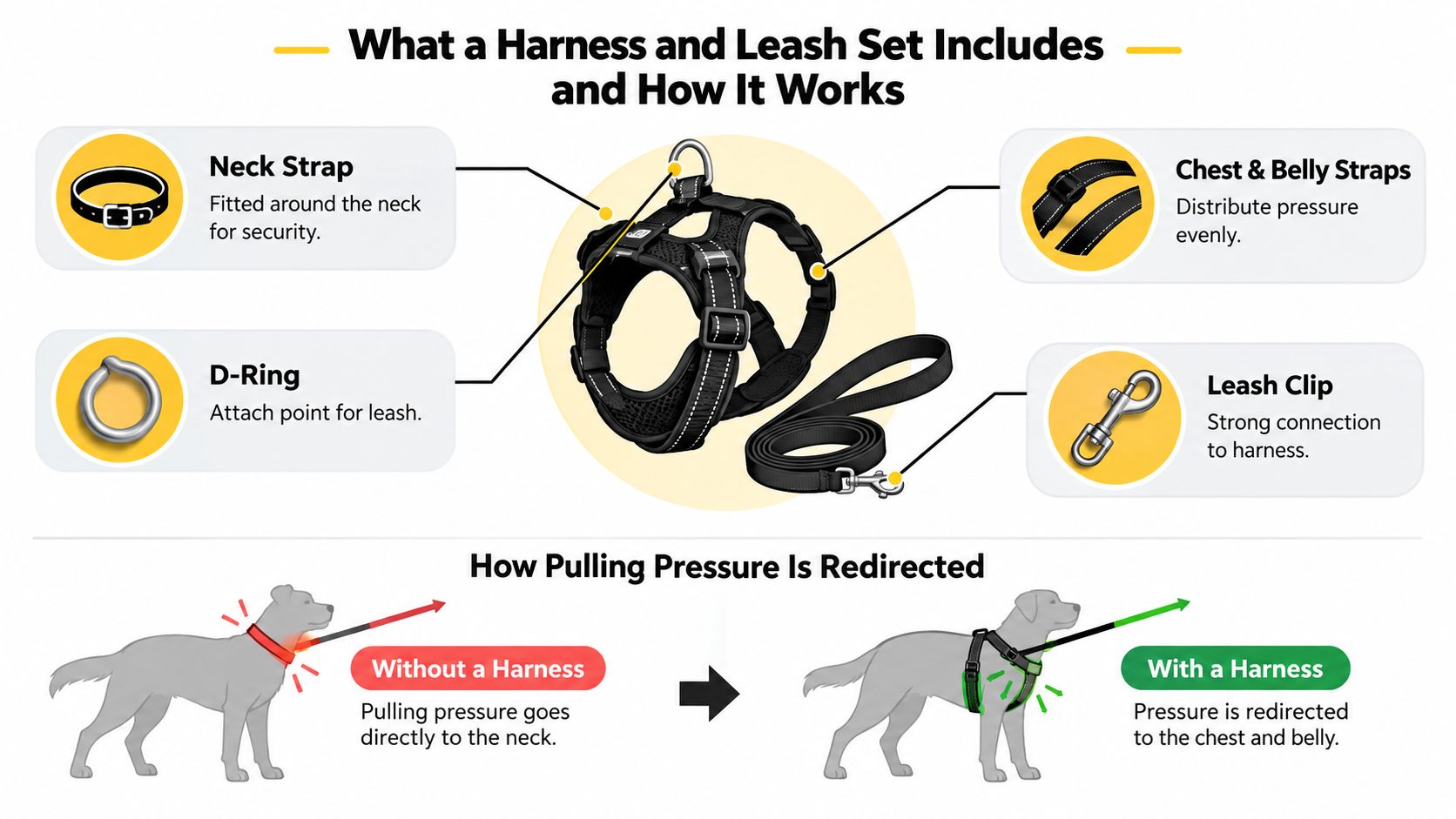
At its simplest, a harness and leash set includes a body harness, a leash, and the hardware that connects them. But those pieces do more than attach your dog to your hand. They manage force, direction, and feedback.
The harness part
A harness wraps around the dog's body, usually across the chest and rib area, with straps that secure around the neck and behind the front legs. Its basic job is to spread force over a broader area than a collar can.
That doesn't mean every harness spreads force well. Shape matters. Strap angle matters. Where the chest piece sits matters. A harness is not just fabric with buckles. It's a structure that channels movement.
The leash part
The leash is the flexible link between your dog's motion and your handling. Length, width, grip texture, and clip weight all change how responsive that link feels. A very heavy clip on a tiny dog can feel clunky. A thin leash on a strong puller can feel sharp in the hand and unstable during sudden movement.
The leash also influences your timing. A shorter fixed leash usually gives cleaner sidewalk control. An adjustable leash gives you more range for quiet moments and more restraint when you need it.
A harness redirects pressure away from the neck, but the leash still determines how quickly force reaches the harness and how clearly your dog feels your guidance.
The connection point
Most confusion happens at the ring where the leash clips on. That point acts a bit like a steering connection. Different attachment points can change how your dog turns, braces, or leans.
Here's a simple way to picture it:
- Your dog moves forward
- The leash tightens
- The ring transfers that force into the harness
- The harness spreads or concentrates that force depending on its shape
- Your dog feels either clear guidance or awkward pressure
Independent research supports why this system deserves attention. In one peer-reviewed study, dogs showed a median maximal leash tension of 0.62 kg-force (6.08 N), a median mean leash tension of 0.28 kg-force (2.75 N), and spent a median 23% of walking time pulling. The same review area also noted jumping during harnessing in 42.4% of harnessing sessions and pulling during 86% of leash walks in a shelter-dog study. At the human level, emergency department data attributed about 356,746 dog-leash injuries in the United States from 2001 to 2018, with 54.2% caused by pulling and 38.3% by trips or tangles, as summarized in this peer-reviewed review on canine restraint and leash forces.
Why matching matters
A set works best when the harness geometry and leash hardware are chosen as one handling tool, not as separate fashion items. Matching doesn't only mean color. It means the clip rotates cleanly, the ring doesn't crowd, and the leash weight suits the dog's build.
If you've ever seen a leash clip flop sideways and tap a dog's shoulder every step, you've seen a mismatch. Dogs feel that. Owners feel it too, usually as fidgeting, crooked walking, or little bursts of resistance.
Comparing Harness and Leash Types Materials and Pros and Cons
There isn't one perfect setup for every dog. A French Bulldog in a busy apartment building needs different geometry than a lanky adolescent doodle who likes to launch toward pigeons. The useful question isn't “Which type is best?” It's “Which trade-offs fit our daily life?”
Harness styles at a glance
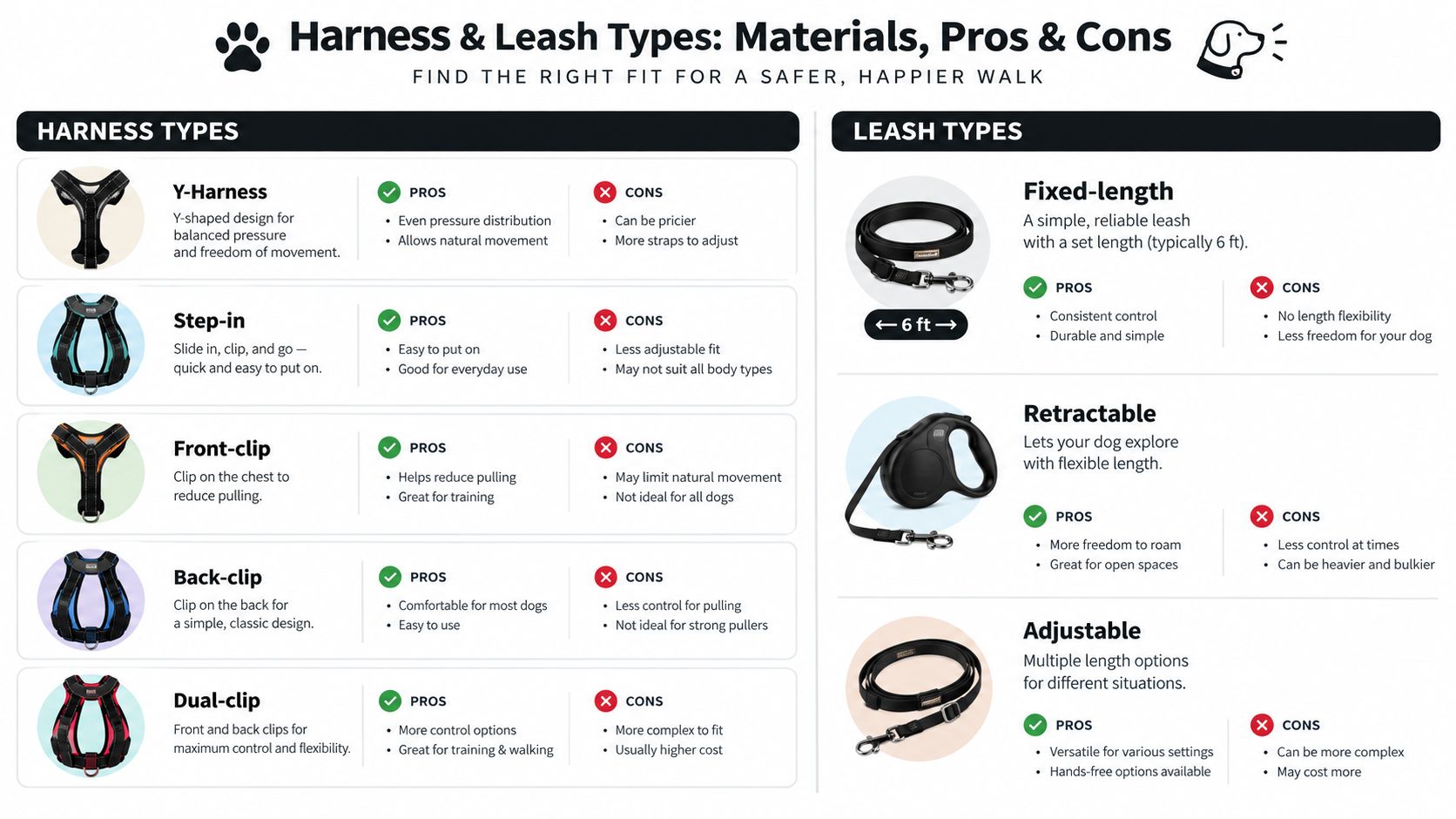
Y-harnesses usually suit owners who want a more open chest and shoulder area. They can look minimal and athletic, which many urban owners like.
Step-in harnesses can be convenient for dogs who dislike gear going over the head, but they can also be awkward on a wiggly dog if the body shape doesn't match the cut.
Front-clip harnesses can help redirect a dog that charges forward. They don't teach loose-leash walking by themselves, but they can make practice clearer.
Back-clip harnesses often feel straightforward for easy walkers. They're simple, tidy, and common, though they may give enthusiastic pullers more room to lean.
Dual-clip harnesses offer flexibility. Many owners like them because they can adapt the setup as training improves or environments change.
Leash styles and city trade-offs
A fixed-length leash is the easiest place to start for daily pavement walks. It gives predictable handling and fewer surprises at curb edges.
An adjustable leash works well if your route changes a lot. You can shorten it near traffic and lengthen it in open spaces.
A retractable leash creates a different safety equation. Buyers often focus on dog freedom, but the mechanism can still create control and injury concerns for the person holding it. That question comes up often because leash-related injury risk remains a real public-safety issue, and one consumer safety summary cited 16,564 hospital-treated leash injuries in one year in its discussion of retractable leash concerns in this article on retractable leash safety questions.
Materials and feel
Material choice changes both comfort and upkeep.
- Nylon webbing: Common, practical, and usually easy to clean.
- Neoprene-lined pieces: Softer against the body and hand. If you want a quick material primer, this overview of what neoprene material is helps explain why many owners like it for comfort-focused gear.
- Leather: Can feel refined and durable, but often needs more care and may not suit wet, high-mess routines.
- Poly-Flex and other coated materials: Useful when you want wipe-clean performance and a more weather-ready finish.
Harness and Leash Type Comparison for Urban Owners
| Type | Best For | Control Level | Comfort and Fit Notes |
|---|---|---|---|
| Y-harness | Daily city walks, dogs needing shoulder freedom | Moderate to high, depends on clip position | Look for clear chest shaping and room around the front legs |
| Step-in harness | Dogs sensitive to over-head dressing | Moderate | Check for twisting and make sure it doesn't rotate during turns |
| Front-clip harness | Pullers in training | High at the start of training | Needs careful fit so the front doesn't drag or sit too low |
| Back-clip harness | Calm walkers, simple routines | Moderate | Comfortable when well-fitted, but less redirecting for strong pullers |
| Dual-clip harness | Owners who want flexibility | High and adaptable | Slightly more hardware, so weight and placement matter |
| Fixed-length leash | Crowded sidewalks and crossings | High predictability | Clean handling, least likely to tangle |
| Adjustable leash | Mixed environments | Moderate to high | Versatile, but extra loops and hardware should stay organized |
| Retractable leash | Open spaces with low traffic | Variable | Requires extra caution with handler safety and distance control |
Style matters, but clean style usually comes from good proportions. A sleek harness that slides, rubs, or sits across the wrong part of the shoulder won't feel elegant on the dog or in your hand.
How to Size and Fit Your Harness and Leash Set Correctly
Fit is where most walk problems begin or end. A beautiful harness that's half an inch off in the wrong place can rotate, chafe, or limit stride. A plain one that fits well often performs better.
Start with the measuring basics, then trust what you feel when the dog moves.
Measure before you guess
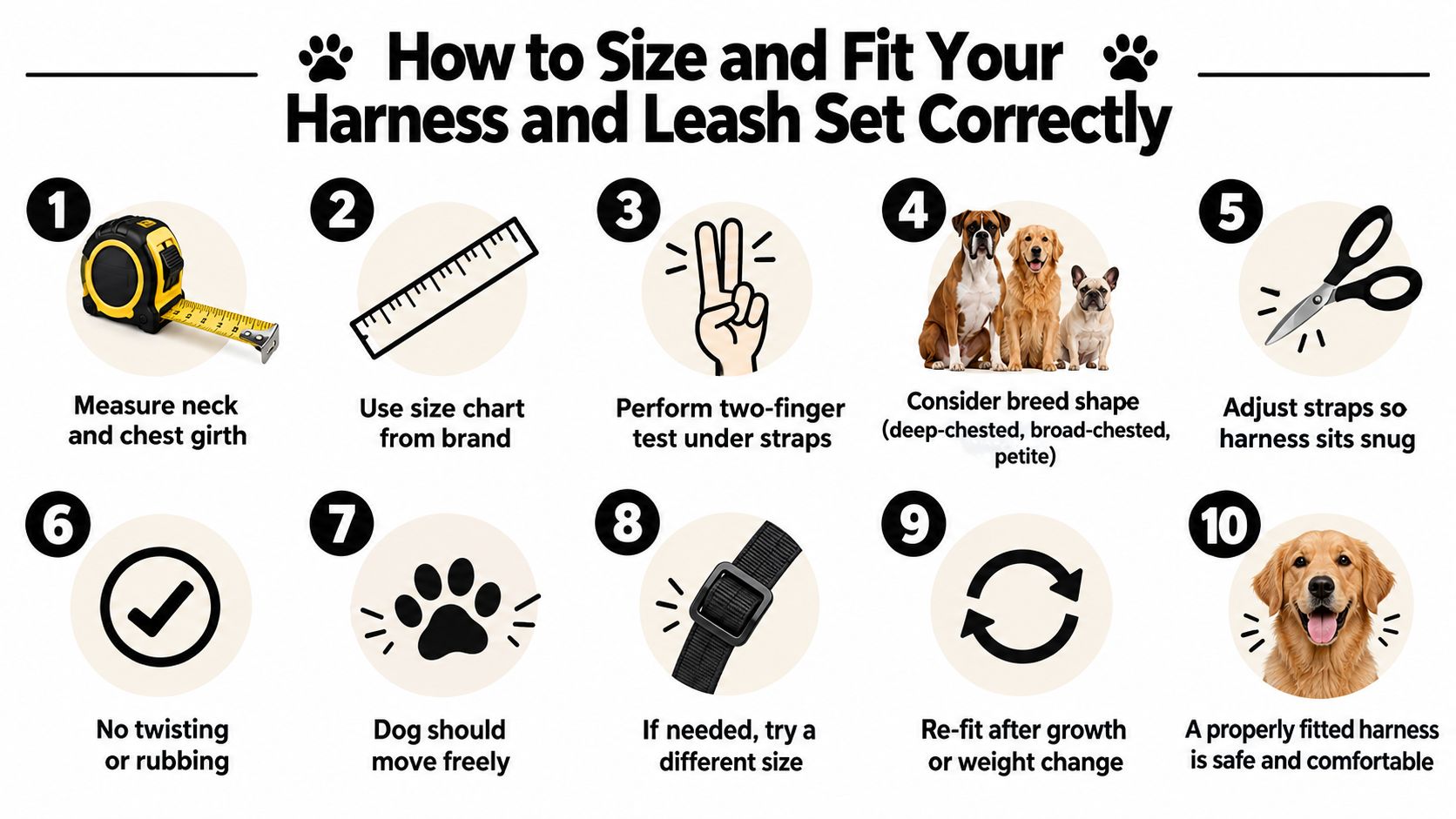
Use a soft measuring tape. Measure the lower neck where the harness sits, then the widest part of the chest behind the front legs. Write both down. Don't rely on breed labels alone because body shape varies a lot, even within the same breed mix.
A brand size chart matters more than the small, medium, or large label. If you want a visual walkthrough, this dog harness fitting guide is a useful reference for seeing how placement checks work in practice.
Do the feel checks
Once the harness is on, run your fingers under the straps. The familiar two-finger check is a good starting point, but don't stop there. Watch what happens when your dog turns, sits, and takes a few steps.
Look for these signs:
- Too tight: The straps leave deep impressions, bunch the coat, or press into the front of the shoulder.
- Too loose: The harness shifts side to side, rotates when the leash tightens, or gaps widely at the chest.
- Poor placement: The chest piece rides up toward the throat or the girth strap sits too close behind the front legs.
- Attachment issues: The leash clip crowds the ring, flips awkwardly, or knocks against the dog while walking.
This short video can help you compare what proper adjustment looks like on a real dog.
Check motion, not just stillness
A dog can look fine standing and still be restricted in motion. That's especially important because biomechanics research found harness design can measurably alter locomotion. In a controlled gait-analysis study of 66 dogs, researchers observed significant differences in stride length relative to limb length, front-versus-hind limb weight distribution, and humeral joint angles across three harness designs, with effects varying by breed type, according to this PubMed summary of the gait-analysis study.
That sounds technical, but the takeaway is simple. A harness changes how a dog moves. So fitting isn't only about escape prevention. It's about preserving a natural stride.
Shape matters
Different bodies need different adjustments.
- Deep-chested dogs: Watch that the chest section doesn't sit too high and press toward the throat.
- Broad-chested dogs: Make sure the front doesn't pinch inward or create rubbing at the shoulder base.
- Petite dogs: Keep hardware lightweight and check that the harness doesn't overwhelm the frame.
If your dog's front steps suddenly shorten after you put the harness on, treat that as information. The fit or design may be interfering, even if the harness doesn't look obviously wrong.
Puppies, seniors, and dogs with seasonal coat changes need regular rechecks. A harness that fit perfectly a month ago may not fit the same way today.
Safety Training and Walking Control Tips That Actually Work
Walking control is partly about gear, but it's also about timing, body position, and what happens in the first seconds of excitement. That's why two dogs can wear similar equipment and have very different walks.
One useful place to start is accepting that peak load matters. A walk might feel easy most of the time, then turn intense in one instant when a dog lunges toward a pigeon, a delivery cart, or another dog.
Why sudden pulls feel so dramatic
At-home leash-pulling research found that half of participating owners experienced leash tension of at least 125 N, and the largest pulling event reached 412.5 N with a loading rate of 2,868.7 N/s. The same study reported that leash walking increased gait variability and noted musculoskeletal injury risk both directly and through falls in this study on leash tension and peak pulling events.
That's why sturdy stitching, load-spreading chest panels, and secure hardware aren't luxury details. They're practical safeguards for the moments that don't look dramatic until they happen.
Small handling changes that help fast
Many owners try to solve pulling by holding tighter. That usually makes both ends stiffer. Instead, use your body and your setup more deliberately.
Try these habits on your next walk:
- Keep the leash short enough for context: In crowded areas, give your dog enough room to walk comfortably but not enough to build speed before reaching the end.
- Stand slightly ahead at doors and curbs: That position helps you guide rather than get yanked from behind.
- Pause before clipping on: If your dog jumps during harnessing, wait for stillness before fastening. Calm starts matter.
- Reward the soft moments: Mark and reward when the leash slackens, when your dog checks in, or when they pass a distraction without surging.
- Scan sidewalks early: Crossing the street before a trigger is often easier than trying to out-muscle a reaction at close range.
If you're training a young dog, this guide to leash training puppies can help you build those habits with simple repetition.
Urban safety without fear
Retractable leashes deserve extra thought in dense environments because the trade-off isn't just dog freedom. It's delayed feedback, more line to manage, and more opportunity for tangles around legs, bikes, benches, or other people. In quieter open areas, some owners still choose them. On busy sidewalks, many do better with a fixed or adjustable leash.
Seasonal conditions also change control. Wet pavement, cold fingers, and bulky gloves all affect grip and timing. If you walk in snow, ice, or slush, these winter weather pet portrait artist advice are a helpful reminder that weather changes your handling routine, not just your dog's comfort.
Calm walking isn't created by constant tension. It's built from many tiny moments where the dog learns that staying connected to you keeps the walk moving.
Care Maintenance and Style Choices for Design Conscious Owners
Good gear ages in two ways at once. It either softens into something you trust every day, or it slowly gets grimy, twisted, and unreliable because no one notices wear until a walk goes wrong. A simple care routine keeps your harness and leash set safe and good-looking.
Clean for function first
Dirt isn't only cosmetic. Grit trapped in fabric can increase rubbing. Dried mud can stiffen strap edges. Salt, rain, and city grime can dull hardware and make clips feel less smooth.
A practical routine helps:
- After wet walks: Air dry the set fully before storing it.
- After dirty outings: Spot clean high-contact areas first, especially the chest panel and handle.
- For soft-lined materials: Wash gently according to brand instructions so padding doesn't lose shape.
- For hardware: Check clips and rings for stiffness, residue, or rough spots.
If you use neoprene or coated materials often, keep an eye on folded edges and stitched joins. Those are the places that usually show fatigue first.
Inspect what style can hide
A polished set can still be worn out. Stylish color blocking or plush lining doesn't replace a close inspection.
Check these points regularly:
- Stitching: Look for loose threads near stress points.
- Clip action: The gate should close cleanly without sticking.
- Webbing shape: Watch for twisting that keeps returning after you straighten it.
- Surface wear: Fraying edges can become bigger problems under sudden load.
Nandog Pet Gear offers neoprene harnesses and waterproof Poly-Flex collars and leashes, which makes it one example of a design-forward option for owners who want softer-touch materials and easy-care surfaces in everyday accessories.
Style that supports daily use
Design-conscious owners often make the smartest long-term choices when they think in outfits and environments. A light neutral set can look clean indoors and in photos, but darker tones may hide city grime better. Reversible or coordinated accessories can help you keep a fresh look without overcomplicating your routine.
The nicest-looking walk setup is usually the one that still looks intentional after repeated use. Clean lines, balanced hardware, and colors that suit your home and daily route go a long way. So does gear that's easy to wash and pleasant to handle when you're carrying groceries, opening lobby doors, or waiting at a crosswalk in the rain.
Harness and Leash Set FAQ for New and Urban Pet Parents
How often should I re-measure a puppy?
Re-measure anytime the harness starts looking lower, tighter, or more crooked than before. Puppies change shape quickly, so regular checks matter. If the straps need frequent loosening or the chest piece keeps shifting, measure again rather than guessing.
Should my dog wear a walking harness in the car?
For car travel, use gear made for travel restraint or a properly designed car seat system rather than assuming a standard walking harness does the same job. Walking gear is built for control on foot. Travel safety needs a different design purpose.
What if my dog has sensitive skin?
Start with soft-touch materials, smooth edge finishing, and a shape that doesn't trap friction behind the front legs. Keep the gear clean, dry it well after wet walks, and check for rubbing after short sessions before using it longer.
What's the best choice for a heavy puller?
Look for a well-fitted design with thoughtful chest shaping and secure hardware. Then pair it with training, because equipment can help manage force but won't replace practice. If your dog pulls hard enough to throw off your balance, focus on setup, leash length, and controlled training reps in lower-distraction spaces.
My dog freezes or resists the harness. What should I do?
Slow down the routine. Let the dog sniff the harness, reward calm interest, and break dressing into tiny steps. Many dogs accept gear much more easily when you stop rushing the process.
Can I choose style first and fit second?
You'll be happier if you reverse that order. Find the shape that lets your dog move freely, then choose the finish, color, and texture you like within that category. A set only looks stylish when your dog moves comfortably in it.
Walks don't need to feel like a daily tug-of-war. With the right fit, practical handling, and a little patience, they become one of the easiest ways to build trust and rhythm together.
If you want gear that fits the design-forward, comfort-first approach described here, Nandog Pet Gear offers harnesses, leashes, and other everyday essentials made for real routines and modern homes. It's a good place to explore coordinated options when you want your walking setup to feel safer, cleaner, and more put together.