


You're standing in the pet aisle with two collar and leash sets open in your browser. They're the same size, the same general shape, and almost the same price. One has softer padding and the other has better-looking hardware. Your dog is waiting by the door, already excited for the city walk that will involve a crowded sidewalk, a vet lobby, and at least one wet patch of pavement.
The right choice isn't the set that matches your dog's coat or your sofa. A good set has to identify your dog, give you practical control, and stay comfortable and presentable through daily use. Style matters, but it should sit on top of safety rather than replace it.
Why a Matching Set Is More Than a Style Choice
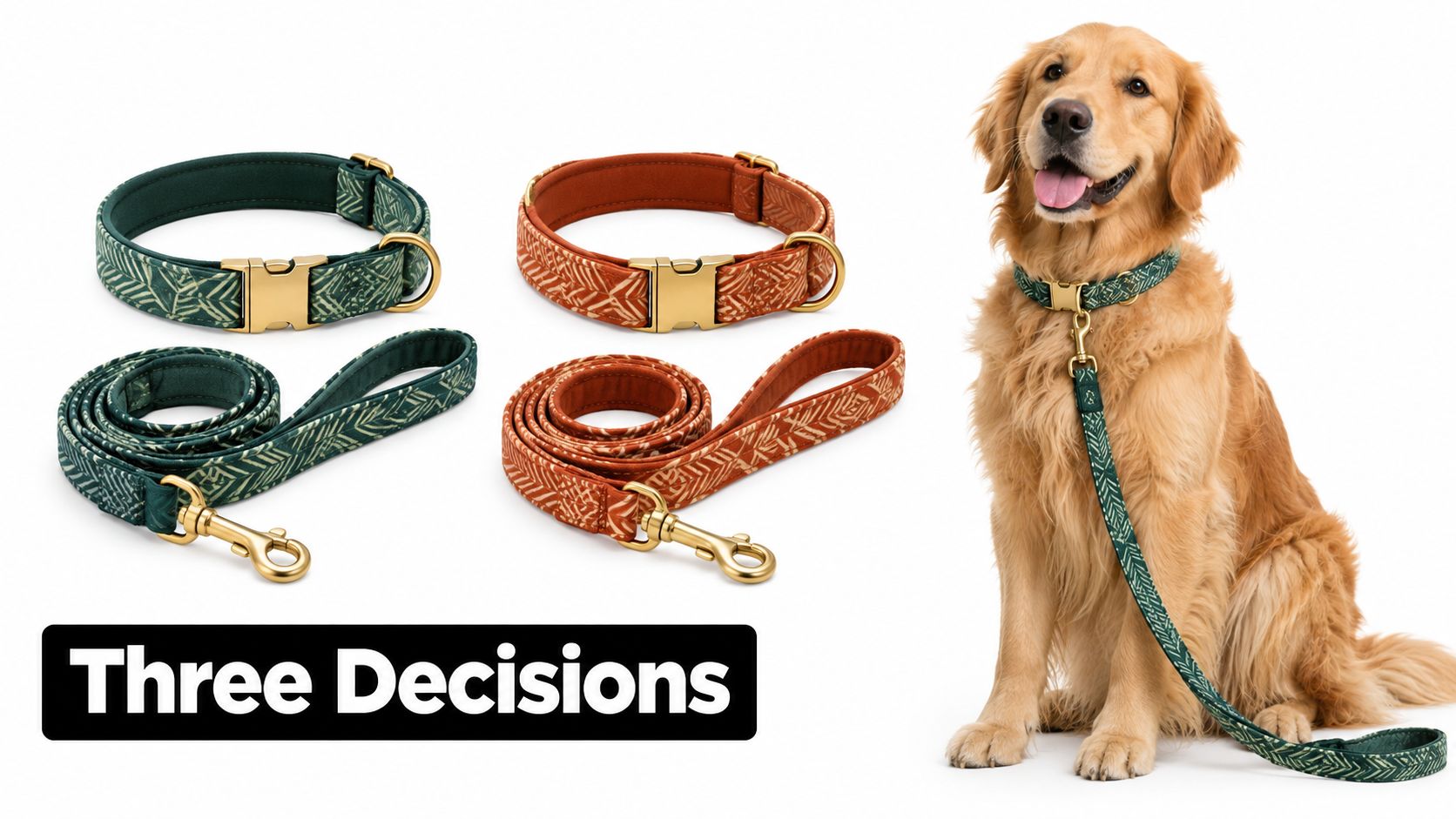
A collar and leash set makes three decisions at once. The collar handles visible identification, the leash connects your dog to public space, and the overall design determines whether the gear looks at home in your routine. If one of those jobs gets ignored, a coordinated color palette won't rescue the purchase.
Identification deserves more attention than it usually gets. A 2014 study in the Journal of the American Veterinary Medical Association reported that more than 5 million stray dogs and cats enter U.S. shelters each year, with fewer than half reunited with their owners. The same study found that lost pets with microchips were up to 21 times more likely to be reunited than animals without microchips, while a visible collar tag communicates ownership without requiring a scanner. The study's findings on pet identification support using both layers, not choosing between them.

The collar carries the visible message
A collar should leave room for an ID tag, sit securely at the dog's neck, and remain legible after ordinary wear. It's the piece someone can read immediately if your dog slips a gate or backs out of an open car door. Veterinary support for visible identification is strong. In the same survey, 93% of 1,086 veterinary clinics recommended identification collars for all dogs, while 85% recommended microchips. The practical gap was that only half of the clinics recommending collars stocked them for clients. The lesson is straightforward: make sure your own set is ready to carry current information.
The leash has a different job. It gives the handler physical control during a walk, a transfer, a clinic visit, or a crowded crossing. Leash rules also grew out of public safety and urban management. New York City's requirements evolved from nineteenth-century rules requiring dogs in public to be muzzled or led by a chain or string to a later requirement that dogs be restrained by a leash shorter than six feet. New York City's municipal history of leash regulation shows why a leash is more than a decorative accessory.
Practical rule: Choose the collar for identification and low-tension control. Choose the leash for the places, people, and situations you actually navigate.
The matching look belongs to the third layer, your home and personal taste. A refined set can coordinate with a hallway basket or living room without looking like a costume, especially when the design is modular or restrained. For ideas on balancing visual polish with function, see designer dog collars and leashes. Just don't let matching colors make you overlook a weak clasp, missing ID space, or a leash length that gives you no control at the curb.
Getting the Fit Right Before You Fall in Love With the Look
A beautiful collar that fits badly is a bad collar. Measure your dog's neck at the position where the collar will sit, not at the widest point of the head and not by guessing from breed labels. A useful sizing guide is how to measure dog collar size, but the final check still happens on the dog.
Use a repeatable fitting protocol
- Measure the wearing position. Keep the tape level and relaxed around the neck. Account for coat thickness without pulling the tape tight.
- Check the adjustment range. Pick a collar that leaves room for normal coat changes, weight changes, and growth. A collar sitting at the extreme end of its range gives you little margin.
- Fasten and check the space. Slide two flat fingers between the collar and your dog's neck. Two fingers should fit without forcing the collar away from the skin.
- Inspect the connection. Before attaching the leash, confirm that the buckle is fully seated, the D-ring is secure, the stitching is intact, and the clasp closes completely.
- Test at low force. Walk indoors or in a quiet area first. Watch for rubbing, coughing, escape attempts, hardware rotation, or a collar that shifts toward the jaw.
Recheck the fit after a noticeable change in weight or coat, and after seasonal grooming. A collar that fit in a short summer coat can become too tight over a dense winter coat. A loose collar can also become an escape route, especially when a dog reverses direction suddenly.
Know when the collar shouldn't be the control point
Correct sizing doesn't eliminate injury risk. Veterinary literature reports that all collars can contribute to strangulation or neck trauma, with unrestricted slip and choke designs presenting particular hazards. For a dog that pulls hard, a collar can turn every correction into pressure at the neck. For a brachycephalic dog, such as a French Bulldog, the concern is more immediate because respiratory anatomy leaves less room for error.
A controlled study of 24 healthy dogs found that collar use increased intraocular pressure during exercise in both brachycephalic and dolichocephalic groups, while exercise in a harness did not produce that effect. Stationary collar use also increased intraocular pressure in brachycephalic dogs. The veterinary evidence on collar and harness use supports a clear division of labor.
A flat collar is sensible for identification and gentle, low-tension outings. A properly fitted harness is the better primary attachment for strong pullers, short-nosed dogs, and dogs with respiratory sensitivity.
That French Bulldog at the park may look perfectly comfortable standing in a stylish flat collar. Once the dog leans into the leash, however, the collar becomes the point absorbing the force. Use the collar to carry identification, then let a suitable harness manage walking control.
Matching Materials and Hardware to Your Real Life
Material choice should follow your routine, not the product photo. A city dog walking through rain needs different construction from a trail dog dragging gear through sand, while a puppy needs adjustability that an established senior dog may not.
| Material | Best Environment | Hardware to Pair | Watch Out For |
|---|---|---|---|
| Nylon | Everyday urban walks and indoor-outdoor use | Standard buckle, reinforced D-ring, secure snap | Can retain moisture and odors if it stays wet |
| Polyester | Color-focused daily use and moderate weather | Metal D-ring and reliable swivel snap | Inspect weave and stitching for fraying |
| Leather | Dry city walks and polished everyday wear | Solid buckle and well-finished D-ring | Needs conditioning and dislikes prolonged wet exposure |
| Neoprene | Comfort-focused collars and harness partners | Rounded hardware and secure adjustment points | Softness doesn't decide whether the control point is safe |
| Coated webbing | Rain, mud, beach use, and quick-clean routines | Corrosion-resistant metal hardware | Wipe grit away so it doesn't work into moving parts |
Let the hardware do a specific job
The buckle should close positively and release without guesswork. The D-ring needs enough room for an ID tag without forcing the leash clip into an awkward angle. A swivel snap helps prevent twisting when your dog circles a tree, changes sides, or moves around your legs.
For city walks, I prefer a shorter lead with a traffic handle. It gives you a second grip when crossing a busy street or passing through a narrow vet waiting room. Trail users may prefer a longer line and a padded grip, but extra length only helps when you can manage the slack.
Breed size matters too. Medium and large dogs generally call for strong metal hardware and reinforced attachment points. Toy breeds need hardware that remains secure without becoming a heavy object at the end of the leash. Reflective accents are a practical addition for early and late walks, especially when dark clothing and wet pavement reduce visibility.
Puppy owners should prioritize adjustment range and easy cleaning over a permanent investment in delicate materials. Senior-dog owners should look for straightforward buckles, readable tags, and a grip that doesn't require a tight pinch. The best collar and leash sets are matched to the handler's hands and the dog's habits, not just to a color story.
How to Read a Durability Claim Like a Skeptic
A product page that gives you one breaking-strength number has not necessarily told you whether the set is safe or durable. The number may describe the webbing alone while ignoring the buckle, D-ring, clasp, bartacks, seams, or adjustment hardware. In actual use, the weakest component controls the outcome.
Follow the complete load path
A defensible test evaluates the assembled set, not a loose strip of webbing. The test plan should cover:
- Webbing and seams: Record dimensions, stitch counts, edge condition, and visible defects.
- Attachment hardware: Inspect the buckle, D-ring, swivel, and snap hook as connected components.
- Static loading: Apply a defined load using a documented fixture, loading rate, and pass or fail criterion.
- Cyclic loading: Repeat loading to expose stitch migration, slippage, and fatigue.
- Post-test movement: Measure whether the collar adjustment or leash hardware has shifted.
- Wet or corrosive exposure: Include this where rain, salt, sweat, or cleaning products are part of use.
- Final function: Confirm that the clasp still opens and closes correctly after testing.
ASTM has a work item intended to establish performance requirements for dog collars, harnesses, and leashes, which means a broadly applicable dedicated safety specification is still being developed rather than universally established. The current ASTM work item is a useful reminder that a universal strength claim needs context.
A statement such as “strong enough for large dogs” is weak without the method behind it. Ask whether the company tested a full assembled set, whether it used slow static force or sudden jerk loading, and how it defined failure. A clasp that opens under dynamic force matters more than a webbing sample that survives a controlled pull.
Treat guarantees as evidence, not magic
A warranty can reveal whether a company has thought seriously about defects, replacement, and customer support. It can't guarantee that a dog won't escape or that a handler won't fall. For a useful framework on how clear policies support confidence without overpromising, review this guide to building customer trust.
Read the fine print: A laboratory load rating isn't a guarantee against sudden dynamic forces, escape, injury, or misuse.
Replace the set when you see frayed webbing, stretched holes, bent hardware, loose stitching, corrosion, clasp deformation, or adjustment slippage. Those are practical failure signals you can identify at home, and they deserve more weight than a large number printed on a product page.
The Safety Layer Most Buying Guides Skip
“Padded” sounds like a safety feature, but padding isn't automatically safer. A 2025 review found that a double-weave padded collar produced the highest contact pressure and peak force among the tested collar types, suggesting that thicker construction can concentrate force over a smaller area rather than distribute it. The review also reported increased intraocular pressure in brachycephalic and dolichocephalic dogs walking in collars, even with a loose leash, and concluded that neck collars shouldn't be used for brachycephalic dogs. The review of collar pressure and canine anatomy is a strong reason to stop treating plush material as a safety verdict.
Comfort depends on distribution and control
Softness still matters. A rough edge can rub, and a stiff strap can annoy a dog during long wear. But width, adjustability, pressure distribution, and the dog's anatomy matter more than the word “padded.” A collar can feel luxurious in your hand while placing concentrated pressure on a sensitive neck when the dog pulls.
That's why I separate identification hardware from walking hardware. The collar can be flat, comfortable, visible, and ready for an ID tag. The harness can take the primary walking load when the dog pulls or has respiratory sensitivity. Matching colors are welcome, but matching function is not always appropriate.
The person holding the leash can get hurt too
The handler is the other half of the safety system. A 2024 review reported that dog-leash injuries increased approximately 2.6-fold from 2004 to 2017, with pulling, tripping, tangling, and upper-extremity injuries among the leading mechanisms. In two studies, trips or tangles accounted for 63.3% of incidents, while musculoskeletal injuries made up more than half of reported cases. The review of dog-walking injuries also notes that available studies often don't record the dog's size, breed, training, leash type, or weather, so no single set can promise a universal solution.
Use a handle that fits a closed grip. Don't wrap the leash around your hand or wrist. Manage excess lead before it becomes a loop around your ankles, and choose a length that matches your strength, surroundings, and dog's behavior. Add reflective detail for low-light walks and shorten your working lead near traffic or crowds.
The leash's second matching piece is designed for a human hand. That hand deserves as much attention as the dog's neck.
For broader pet-safety planning, it also helps to compare 2026 flea collar options separately from walking gear. A flea collar serves a different purpose and shouldn't be treated as a substitute for visible identification or controlled handling.
Care, Cleaning, and Keeping the Set Photo-Ready
A good set should survive a practical care routine, not demand a museum display. I'd rather own a design that can be wiped, rinsed, and hung than one that looks impressive but turns grimy after a week of ordinary walks.
Build care into the week
After a wet or muddy walk, rinse coated webbing with clean water and remove grit around the clasp and D-ring. Wipe the leash handle too. Wet debris left in a moving snap can interfere with closure, while grit can abrade webbing where you can't see it from across the room.
Machine-wash only when the care instructions and hardware allow it. A metal clasp banging around inside a washer can damage the machine and the set. If the item has removable fabric components, detach them before washing, then air-dry every part fully before use.
Leather needs different treatment. Wipe away surface dirt, let it dry naturally away from direct heat, and condition it periodically rather than waiting until it cracks. Don't saturate it and don't store it while damp.
Use a short reset routine
A Sunday reset takes only a few checks:
- Clean the contact surfaces: Wipe sweat, mud, food residue, and road film from the collar and leash handle.
- Rinse coated webbing: Flush away salt, sand, and fine grit after wet-weather or beach walks.
- Dry completely: Hang the set in an open area instead of leaving it compressed in a bag.
- Inspect the load path: Look at stitching, holes, adjustment points, D-rings, and snap gates.
- Store with shape intact: Use a hook or drawer where the leash won't be crushed under other equipment.
A rotating second set can reduce wear and keep your home looking intentional. It also gives you a clean option while one set dries. Reversible or modular designs extend the visual life of the gear without requiring a new control setup for every season.
Don't wait for a dramatic break to retire a set. Frayed edges, stretched adjustment holes, rust, cracked coatings, a clasp that feels different, or a tag that rattles against damaged hardware are enough reason to replace it. Good design includes a graceful exit, not just an attractive first impression.
Putting It All Together at the Register
Before you buy, run the set through three filters. Identification: Can the collar carry a readable tag, and will the tag stay attached securely? Walking control: Is the collar appropriate for low-tension use, or does your dog need a harness partner? Handler safety: Can you grip the leash, manage its length, and operate the clasp without fumbling?
Use this quick decision guide:
- City dwellers: Choose a shorter lead with a traffic handle for crossings, elevators, sidewalks, and vet waiting rooms.
- Trail users: Look for a longer line, a secure grip, and materials that tolerate mud, rain, and repeated rinsing.
- Multi-dog households: Use distinct colors or patterns so you don't grab the wrong leash during a rushed exit.
- Design-conscious homes: Favor reversible, modular, or easy-clean pieces that look deliberate on a hook by the door.
- Puppy owners: Prioritize adjustment range, washable materials, and hardware that won't become obsolete as the neck grows.
- Strong pullers and brachycephalic dogs: Keep the collar for identification and use a properly fitted harness as the primary walking attachment.
A matching finish can be useful when it makes the set easier to organize and more pleasant to live with. It's not a reason to accept a weak clasp, vague durability claim, poor grip, or unsuitable neck control. For a focused starting point, browse Nandog's collar and leash sets for dogs and compare each option against your dog's anatomy, walking behavior, and daily environment.
The most important checkout task happens after the package arrives. Engrave or verify the ID tag, attach it securely, and confirm that your dog's microchip registration and contact details are current. If you're also shopping for photography or presentation materials for a pet-focused home, the Liz by Design Photography store offers a separate design resource, but no photograph can replace a visible tag and a properly tested connection.
Nandog Pet Gear offers design-forward collar and leash options, including waterproof Poly-Flex sport collars and leashes, as well as leather collar and leash kits. Visit Nandog Pet Gear to choose a set that fits your dog's identification needs, walking habits, and the way you want your home and daily routine to look.