


You've vacuumed the living room, washed the blankets, and opened a window, but there's still a familiar doggy smell near the sofa. Your dog's favorite bed looks clean enough on top. Then you lift the cushion and wonder whether washing the cover will solve the problem, or just make the outside smell nicer.
Shopping for “dog beds washable” brings up plenty of reassuring labels. The useful question is more specific: Which parts can you clean, what will that cleaning remove, and can you get everything dry afterward?
Why Washable Dog Beds Matter
Your dog comes home from a damp walk, circles their bed, and settles in before you've found the towel. Another day, they bring a chew onto the cushion. Eventually, you're dealing with more than a patch of muddy fabric. You need a practical way to clean the place where your dog spends much of their downtime.
This familiar scene captures why appearance alone isn't a useful cleaning standard.

Cleanliness is more than a fresh smell
The CDC recommends cleaning pet beds, blankets, and habitats every week. For suitable soft items, its guidance includes washing with detergent and warm water using fabric-appropriate settings, then air-drying or tumble-drying; fragrance-free and dye-free detergent may be preferable for sensitive pets, according to its pet-supply cleaning guidance.
That makes washability a practical hygiene feature, not just a convenient selling point. A bed you can clean without an exhausting afternoon of dismantling and reassembly is easier to include in household laundry.
It also helps to separate different cleaning goals:
- Visible cleanliness: Removing fur, grit, mud, and stains.
- Allergen management: Reducing material that may trigger reactions in a sensitive household.
- Infection control: Using a suitable cleaning and, when necessary, disinfection process after contamination.
Think beyond the sleeping surface
Wiping a dirty cushion is like wiping a spill off a jacket without checking whether it soaked through. The outside may look better while the material underneath still needs attention.
A washable cover can be useful, but it doesn't automatically answer the question of how to clean the filling. Equally, a fully washable bed isn't automatically easy-care if its interior is difficult to dry.
Practical rule: Judge a bed by the cleaning process for its least accessible part, not just its most attractive surface.
The aim isn't to make your home sterile. It's to choose bedding you can maintain consistently, without sacrificing the comfort your dog already enjoys.
What the Research Says About Cleaning Habits
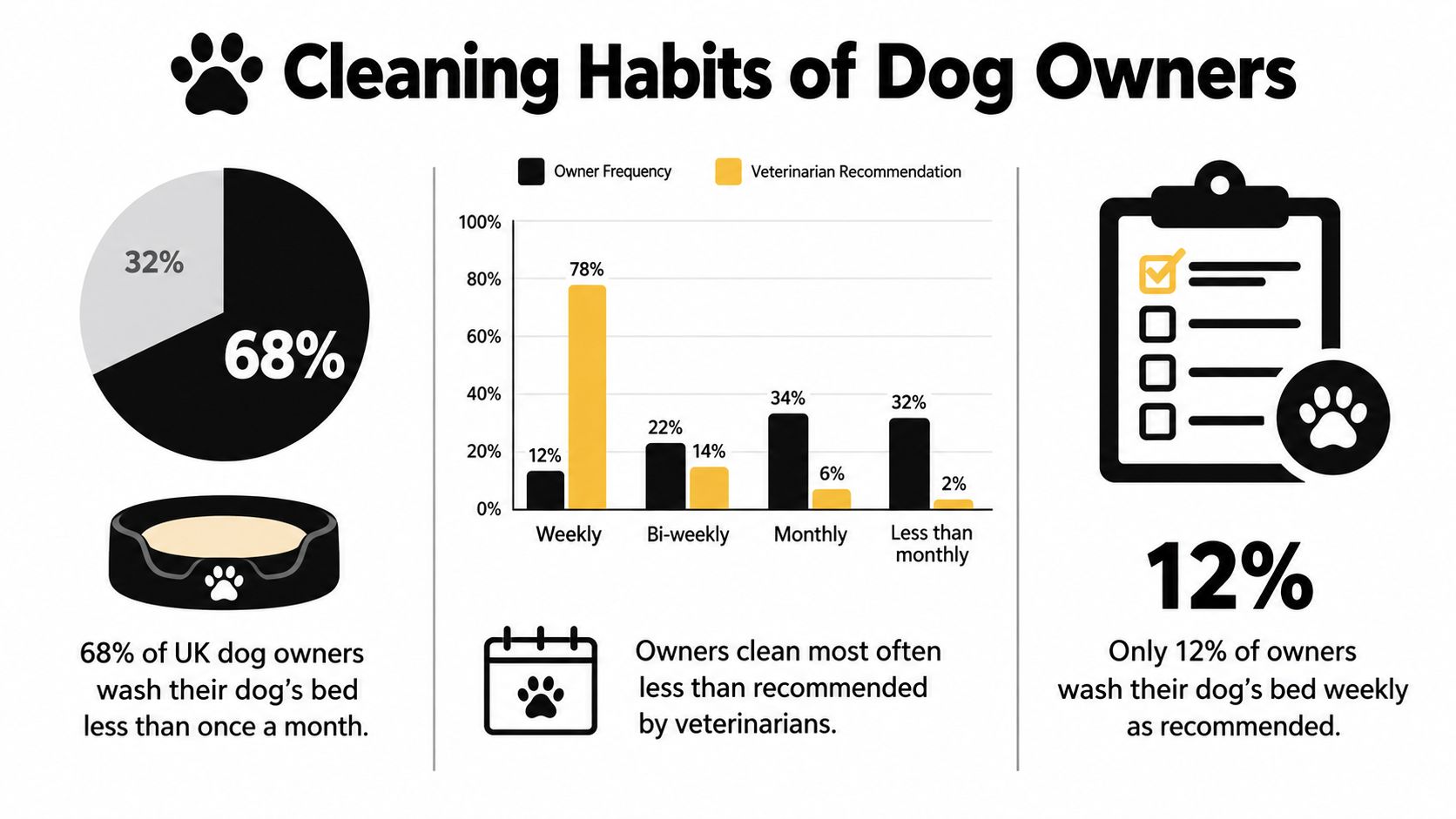
Owners' actual routines provide a more useful starting point than assumptions about what everyone else does. A peer-reviewed survey of UK dog owners published in 2023, involving 588 respondents, found that 67.2% washed their dog's bedding at least monthly, while 87.8% washed it at least once every three months.
The accompanying visual introduces the subject, but its frequency labels shouldn't be used as evidence. The survey figures above are the reliable reference.
What the findings tell us
The study shows that laundering dog bedding was already an established habit among many respondents. It doesn't show that all those owners followed the CDC benchmark described above.
There's an important distinction in the wording, too. “At least monthly” includes people who wash more often. You can't read that category as meaning everyone in it washes only monthly, and you can't calculate a weekly-washing rate from those figures alone.
| What the survey supports | What it doesn't establish |
|---|---|
| Many surveyed owners routinely washed bedding | The routine followed by every dog owner |
| Owners reported different cleaning intervals | Whether a particular bed was hygienically clean |
| The findings describe a UK sample | A worldwide estimate of washing behavior |
Make the routine easier to carry out
The practical buying lesson is straightforward: consider the work involved before choosing a bed. If cleaning requires wrestling a tight cover over an awkward cushion, you may reasonably find the job harder to schedule.
That's a design consideration, not proof that a particular product changes owners' behavior. The survey didn't test whether buying a fully washable bed caused people to launder more frequently or reduced illness.
For a visual companion to the washing process, consider this demonstration alongside your own product's care instructions.
A realistic routine also needs a place for your dog to rest while laundry dries. Before buying, think through the whole task: collecting the bedding, washing it, drying it, and returning it to use. A manageable routine is more useful than an ambitious one you keep postponing.
Materials and Design That Make a Bed Truly Washable
A washable dog bed is like a washable jacket. The fabric matters, but so do the lining, padding, seams, and care instructions. A reassuring word on the product page doesn't tell you whether every component can tolerate the same treatment.
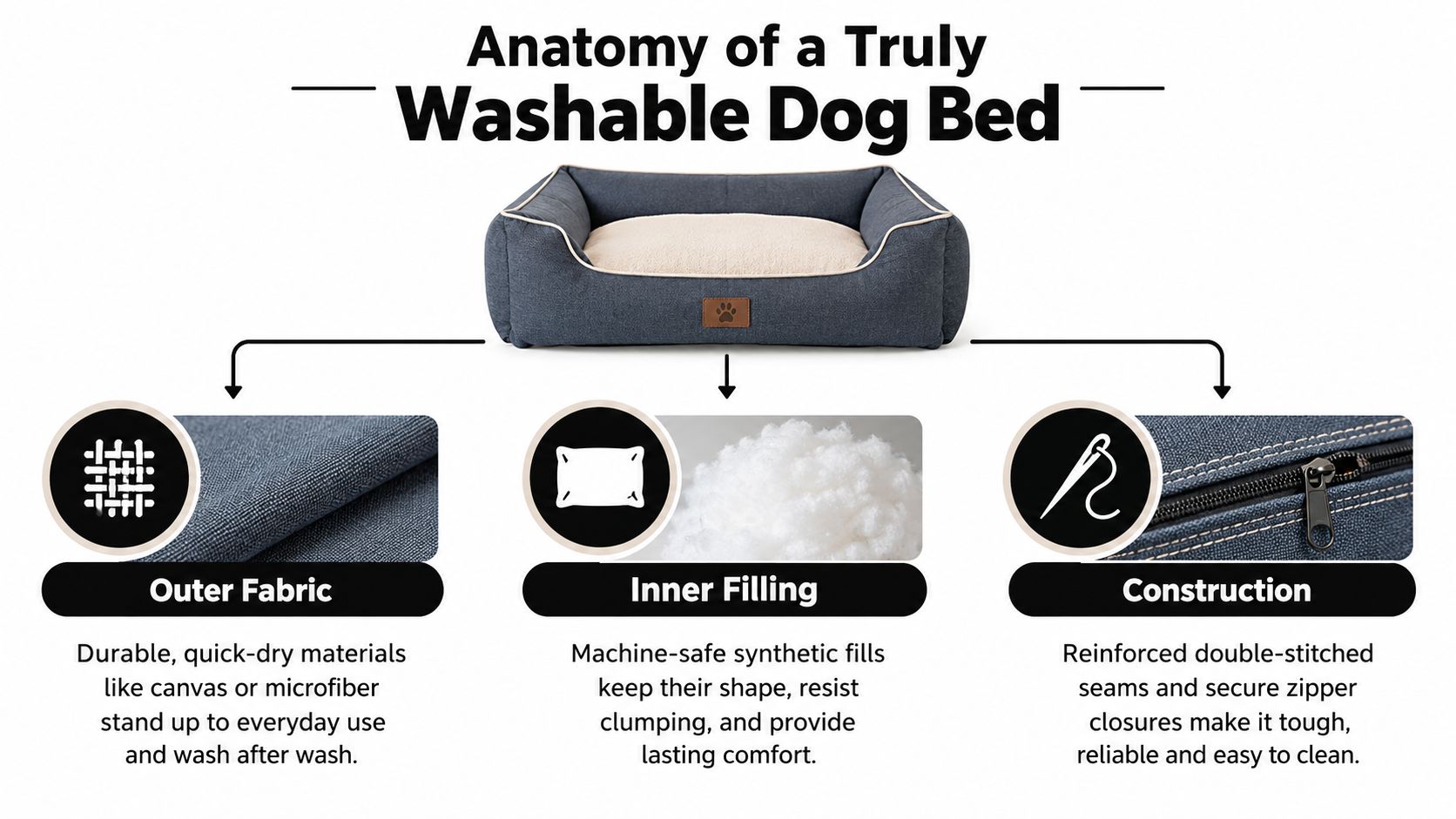
Use this diagram as a map of the components to investigate, rather than a guarantee about any particular fabric or filling.
Read from the outside inward
Start with the outer fabric. Ask whether its washing instructions match the cleaning you expect to do. A soft plush surface, woven cover, or coated base may each require different care, so don't infer washability from texture alone.
Next, investigate the filling. Does the manufacturer explicitly permit washing the entire padded item? Or does “machine washable” refer only to the cover? Those statements aren't interchangeable.
Then inspect how the components are held together:
- Seams: Look for even stitching and ask how the bed should be checked for damage before laundering.
- Internal construction: Ask whether the filling is secured and whether the manufacturer provides instructions for reshaping it.
- Closures: If components separate, check that you can reach and operate the fastenings comfortably.
- Care labels: Look for clear instructions covering both washing and drying, not just a machine-washable symbol in an advertisement.
Don't let feature names replace instructions
“Quick-dry,” “moisture-wicking,” and “waterproof” describe different intended functions. None, on its own, confirms that you can put the complete bed into a washer or dryer.
A reversible design gives you another usable surface, but turning it over isn't cleaning. Treat reversibility as a comfort and usability feature, not permission to postpone laundering.
The most useful product description answers ordinary questions in plain language: Can the whole bed be immersed? Which cycle is permitted? Can it be tumble-dried? What should you do if the interior becomes soiled?
Choose explicit care information over broad material promises. Even a fabric described as durable tells you little about how the complete assembled bed should be maintained.
Full-Bed Washing Versus Removable Covers
Neither construction wins automatically. The better choice depends on what gets dirty, which components you can clean, and how you'll manage laundry day.
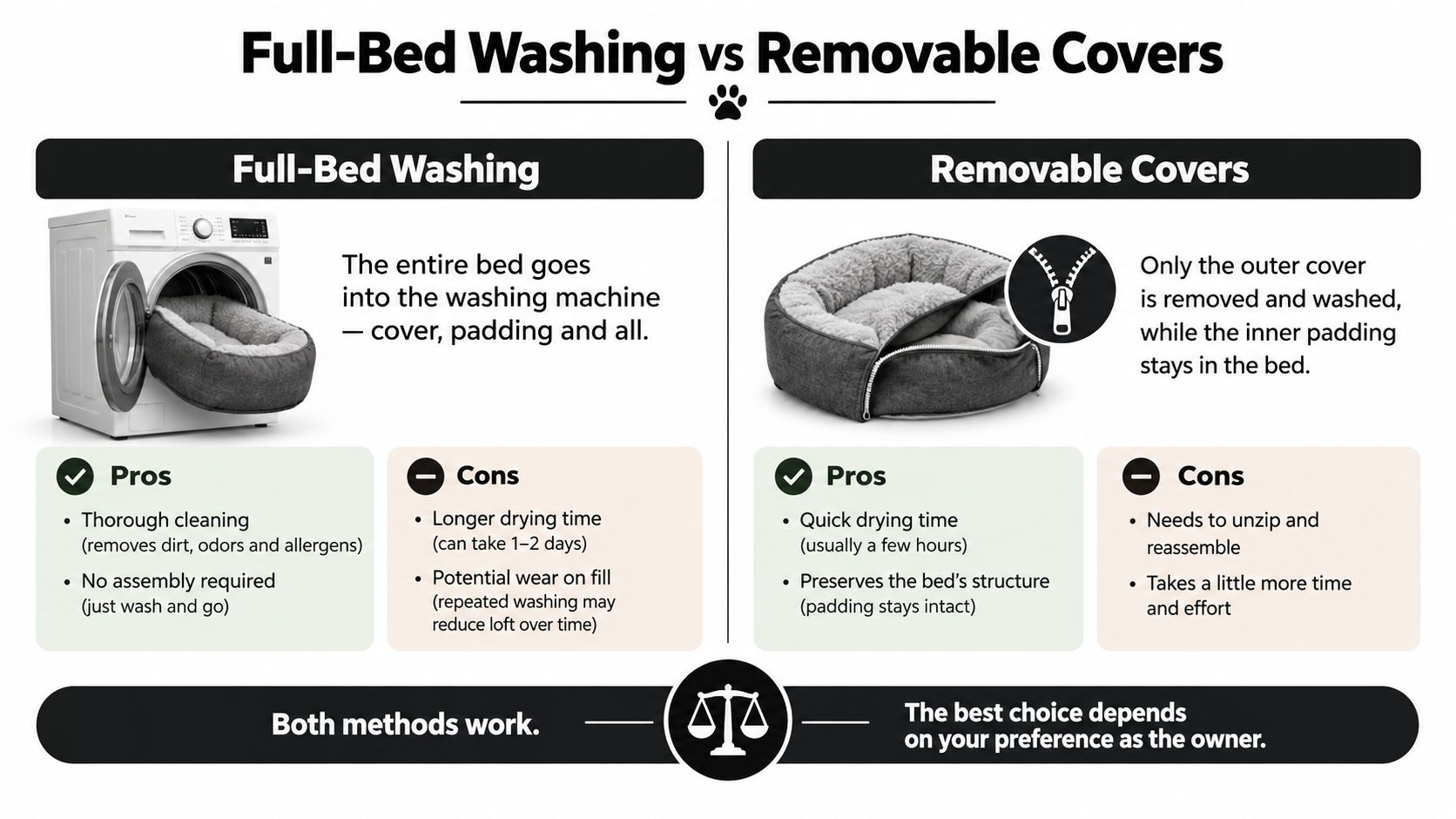
The comparison below outlines the practical trade-offs. Check the individual product instructions before treating either design as suitable for your household.
Match the design to the job
| Question | Fully washable bed | Removable washable cover |
|---|---|---|
| What goes into the machine? | The complete item, if expressly permitted | The cover, with separate care for the insert |
| What assembly is involved? | Usually no cover removal | Removing and replacing the cover |
| What needs checking afterward? | The entire padded structure | The cover and the condition of the protected insert |
| What's the main limitation? | Managing a bulky wet item | Cleaning contamination that reaches the core |
For a compact, machine-compatible bed, full-bed washing can remove the fiddly cover-changing stage. It may suit an owner who wants a straightforward routine and has suitable washing and drying equipment.
A removable cover can make sense when the sleeping support needs separate care. It also allows you to change the outer layer without laundering the whole structure. The guide to dog bed covers is a useful place to explore that arrangement.
Compare the awkward situations
Think beyond an ordinary refresh. If your puppy has an accident, what happens if liquid reaches the insert? If the complete bed needs washing, where will you put it afterward?
A clean cover doesn't prove the core is clean. A washed core doesn't prove it's ready to use.
Before choosing either design, rehearse the least convenient cleaning job you expect to face. Ask the seller what happens after contamination reaches the padding, not just how to remove everyday hair.
There's also no need to reject a supportive bed because its components need different treatment. A clear, workable care plan matters more than whether the bed comes apart.
How to Wash Different Types of Dog Beds
Start by reading every relevant care label, including any label on the insert. Don't assume the decorative cover, bolsters, foam, and waterproof layer share washing instructions.
Cleaning works through a combination of actions. Veterinary laundry guidance identifies removal of gross contamination, detergent, mechanical agitation, adequate wash time, thorough rinsing, and complete drying; it also identifies 60°C/140°F as a high-temperature option where the textile permits.
Prepare before choosing a cycle
- Remove solid contamination: Pick up feces, vomit, and other debris before laundering. Avoid shaking contaminated bedding.
- Check the permitted method: Separate components only as directed, and inspect for openings or damaged seams.
- Choose compatible detergent: Use the product's instructions and your dog's skin needs to guide the choice.
- Allow proper washing: Don't force an oversized bed into equipment that can't accommodate it appropriately.
Think of cleaning like washing a muddy food container. Turning up the water temperature doesn't replace removing the mud or allowing detergent and water to reach the dirty surfaces.
Adjust for the bed's construction
Plush and fiber-filled beds: If the whole item is approved for machine washing, use the stated cycle and temperature. After laundering, inspect the shape and filling distribution rather than assuming that a clean-looking exterior means the bed is ready.
Orthopedic and memory-foam beds: Treat the insert as a separate component unless its label explicitly says otherwise. Don't translate “washable orthopedic bed” into permission to machine-wash the foam. Consult the memory-foam dog bed cleaning guide alongside the manufacturer's directions.
Reversible beds: Check both surfaces and any internal padding. Different textures don't necessarily mean different wash settings, but the label should settle that question.
Beds with waterproof layers: Follow the stated limits for temperature, detergent, and drying. A protective layer needs its own care instructions, particularly when attached to a padded structure.
Drying and disinfection need separate decisions
The CDC guidance cited earlier allows a dryer's highest heat setting for 30 minutes as a disinfection method for suitable soft items. That isn't blanket permission to expose every dog bed to high heat. Only use that process when the product's drying instructions permit it.
For ordinary cleaning, use the approved drying method and check the interior before reuse. Thick areas deserve particular attention because the outside alone can't confirm the condition inside.
If your dog has a diagnosed infection, ask your veterinarian which bedding process is appropriate. Don't improvise a stronger chemical mixture or hotter cycle when the material can't tolerate it.
A Condition-Based Washing Protocol for Your Dog
Use the earlier public-health benchmark as your starting point, then adjust for what's happening with your dog. A calendar reminder is helpful, but it shouldn't override an accident, a health problem, or visible contamination.
PetMD's dog-bed washing guidance supports considering shedding, outdoor exposure, allergies, and bed use when setting a routine, with twice-weekly cleaning suggested when relevant risk factors are high.
Match the response to the situation
| Your dog or household | Practical adjustment |
|---|---|
| Healthy dog with mostly indoor activity | Follow the baseline routine and inspect between washes |
| Heavy shedder or frequent outdoor explorer | Remove loose hair between washes and consider a more frequent schedule |
| Puppy or dog with incontinence | Clean after accidents rather than waiting for the scheduled wash |
| Dog with parasites or skin disease | Coordinate bedding care with veterinary treatment |
| Allergy-sensitive household | Focus on removing allergen-containing material, not just visible dirt |
For recurring accidents, consider how a protective layer and a clean replacement sleeping surface would fit your routine. The guide to waterproof dog beds for incontinence addresses that buying situation.
Removing allergens isn't the same as destroying them
An allergen is material that can trigger a reaction. A cleaning process may carry that material away without destroying every organism associated with it.
Evidence summarized in veterinary guidance reports that water or detergent washing removed about 84% of measured dust-mite allergen, while detergent plus bleach removed up to 98%. Those findings concern measured dust-mite allergen, not a guarantee for dog allergens or every padded pet bed.
The practical lesson isn't to bleach everything. Bleach may be unsuitable for the product, and a routine detergent wash can still have value without being a disinfection treatment. Never mix bleach with other cleaning products.
Allergy-care distinction: Removing a trigger and killing a microorganism are different goals. Choose the process for the problem you're addressing.
For households where dogs also use human sleeping areas, Protect-A-Bed's practical UK bedding care guide offers a related resource for planning mattress-protector care. Keep those instructions separate from your dog bed's label, and ask your veterinarian about persistent itching rather than assuming laundry alone will resolve it.
What to Look For When Buying an Easy-Care Bed
Buy for the cleaning job you'll do, not the ideal laundry setup you wish you had. A beautiful bed isn't easy-care if you can't fit it into suitable equipment or follow its drying instructions.
Before ordering, compare the product's care requirements with your home. Ask for missing information rather than interpreting “washable” generously.
Use a practical buying checklist
- Exact scope of washability: Confirm whether the claim covers the entire bed, the cover, or selected components.
- Complete care directions: Look for permitted wash settings, drying methods, and restrictions on cleaning products.
- Equipment compatibility: Check the bed's dimensions and the manufacturer's advice against your washer and dryer.
- Access for inspection: Make sure you can examine the parts most likely to become soiled.
- A backup sleeping arrangement: Plan where your dog will rest while the bed is unavailable.
- Clear support information: Ask what to do if padding shifts, seams open, or contamination reaches a nonwashable component.
Consider the surrounding space
If the bed sits on a rug, include that surface in your maintenance plan. Rubber Ducky Rug Cleaning Birmingham's Rubber Ducky's easy-clean rug choices is a related resource to consult when considering the floor around your dog's resting area.
Also assess comfort separately from washability. A bed may be straightforward to launder yet unsuitable for how your dog likes to lie. Watch whether your dog stretches out, curls up, or rests against an edge, then compare the usable sleeping area rather than judging by the outside silhouette.
The strongest buying decision balances comfort with a maintenance process you can complete. Don't accept an attractive feature list as a substitute for answers about ordinary washing and unexpected messes.
The Link Between Clean Beds and Better Sleep
A clean sleeping space is a sensible part of caring for your dog's comfort. That doesn't mean a washable bed has been shown here to improve sleep duration, mood, or health. The evidence discussed concerns cleaning practices and hygiene, not a measured sleep benefit.
What you can do is remove avoidable obstacles to a pleasant resting place: soiled fabric, leftover detergent, damp padding, or a bed that no longer holds its intended shape. Pay attention to whether your dog willingly settles there, while recognizing that reluctance to rest may need veterinary attention rather than another wash.
Choose a bed you can keep ready for rest, not merely one you can make look clean.
The useful goal is modest and practical: suitable support, a manageable cleaning routine, and a fully prepared sleeping surface when your dog wants to curl up.
Nandog Pet Gear offers comfort-focused dog beds, including fully machine-washable designs and orthopedic options with separately washable covers. Visit Nandog Pet Gear to compare styles, then check the individual care instructions against your dog's needs and your laundry setup before choosing.