


A cat car seat harness is often sold as a simple answer to a complicated safety problem. It can help you handle your cat, but a harness alone doesn't establish that your cat will be protected in a collision. The safer question is not just which harness to buy, but how the cat, restraint, carrier, vehicle attachment, and placement work together.
That distinction matters because comfort, attractive padding, and easy installation don't prove crash performance. A Center for Pet Safety pilot study examined dog harnesses, not cat products, and found serious performance problems among several restraints marketed with crash-protection claims, including products that failed catastrophically during testing. Its findings underline why a cat car seat harness should be judged as part of a complete restraint system, not assumed to be crash protection on its own (CPS harness study summary).
Rethinking Cat Car Seat Harness Safety
The popular advice that a harness makes car travel safe is incomplete. A walking harness is designed to help you manage a cat on foot. A vehicle restraint has a different job: it must connect to the car in a way that controls movement under sudden force. A snug fit may reduce the chance of escape during handling, but that doesn't show how the harness, tether, or anchor would perform in a collision.
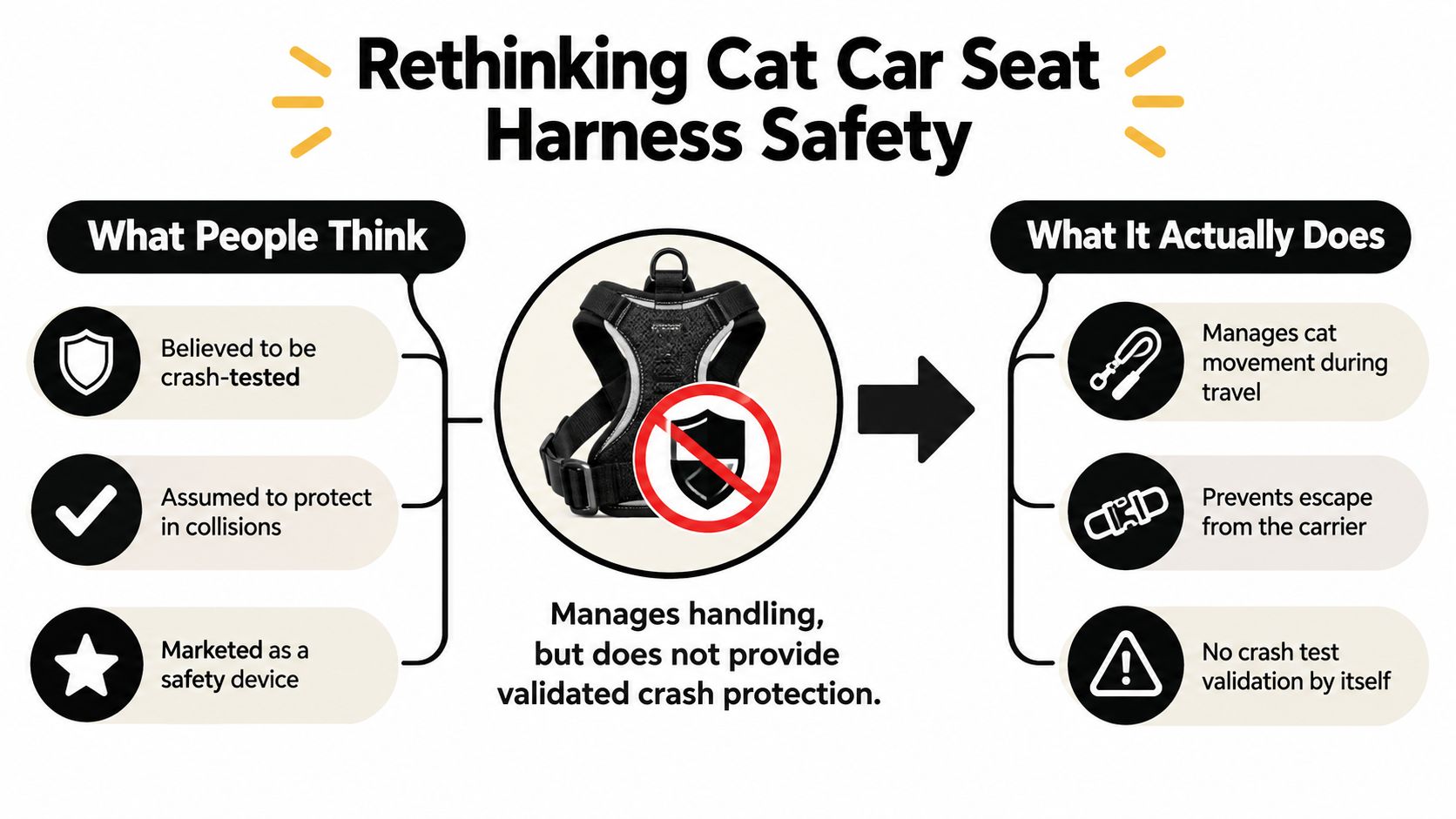
A padded travel seat can be comfortable and help keep a cat in one place. It still isn't automatically crash protection. In a separate study of pet travel habits, many respondents recognized carriers and seat-belt harnesses as appropriate options, while reported use was lower. The same survey found that many owners allow pets to roam in the vehicle, illustrating the gap between knowing about restraint and using it consistently (Progressive's survey and pet-travel safety overview).
Think in connected parts, not product labels
A safer setup depends on several pieces working together:
- The cat: Can the cat breathe normally, remain in a natural posture, and stay inside the restraint?
- The harness or carrier: Does it fit and hold its shape, and is it being used for the job it was designed to do?
- The connection: Does the restraint attach to an intended vehicle anchor or securement route, rather than a collar or improvised clip?
- The placement: Is the cat away from an active airbag, with the carrier or seat secured so it can't shift into the cabin?
- Escape prevention: Can the cat slip out when frightened, twist into a dangerous position, or pull free at a stop?
The important distinction is between handling security and crash performance. A harness may help you move your cat from home into a carrier or keep the cat attached to you in a safe stopping area. That doesn't mean it's suitable as the primary restraint while the vehicle is moving.
Practical rule: Use the harness for controlled transitions when it helps. For travel in motion, prioritize a properly secured carrier, and treat every attachment as part of the system.
A cat car seat harness isn't a safety guarantee. The useful question is what role it plays, how it connects, and whether the complete arrangement has credible performance evidence.
Choosing Between a Harness and Carrier
A harness and tether can help you control a cat during handling. A carrier keeps the cat inside an enclosure while the vehicle is moving. Those purposes aren't interchangeable. Veterinary guidance discussed by Preventive Vet favors keeping a cat in a secure carrier during travel, while using a harness as a handling aid rather than the main restraint (Preventive Vet's guide to traveling by car with cats).
| Approach | Primary job | Common setup | Main limitation | Best use |
|---|---|---|---|---|
| Harness and tether | Helps manage the cat during controlled handling | A fitted harness connected to a restraint point | A walking harness and tether don't establish crash protection | Moving between home, carrier, and a safe stopping area |
| Secured carrier | Keeps the cat inside an enclosure during travel | Carrier placed and secured using a suitable vehicle setup | Ordinary carriers and their attachment paths aren't automatically crash-tested | Routine journeys when the carrier can be securely positioned |
Choose for the journey, not convenience alone
If you're moving your cat from your home to the car, a harness can provide an extra point of control while you transfer the cat into the carrier. At a stop, it may also help during a carefully managed transition, provided the surroundings are safe and the cat is accustomed to wearing it. Don't leave the cat loose in the vehicle just because a harness is attached.
For the drive itself, the carrier is generally the more conservative choice. It needs to be appropriate for travel and anchored in a way that doesn't let it slide or become a projectile. A belt routed over a soft carrier doesn't prove that the carrier can withstand the force, and fastening a carrier that isn't designed for that routing could damage it. For practical carrier features and setup considerations, see this guide to a pet carrier for car travel.
| Situation | Sensible choice |
|---|---|
| Moving a cat from the house into the car | Harness as a handling aid, then place the cat in the carrier |
| Driving between locations | Cat inside a suitable, secured carrier |
| Brief stop outside the car | Harness may support a controlled transition if the cat is trained and the area is safe |
| Carrier or seat shifts when tested while parked | Correct the securement before driving |
| The setup relies on a collar, long extension tether, or improvised clip | Don't use it as a travel restraint |
Keep the carrier in a suitable back-seat position or another manufacturer-approved location, and never place the cat in front of an active airbag. If your trip includes flights as well as driving, the requirements change; this overview of international pet flights with Haute Jets can help you plan for that separate mode of travel.
Finding the Right Fit and Construction
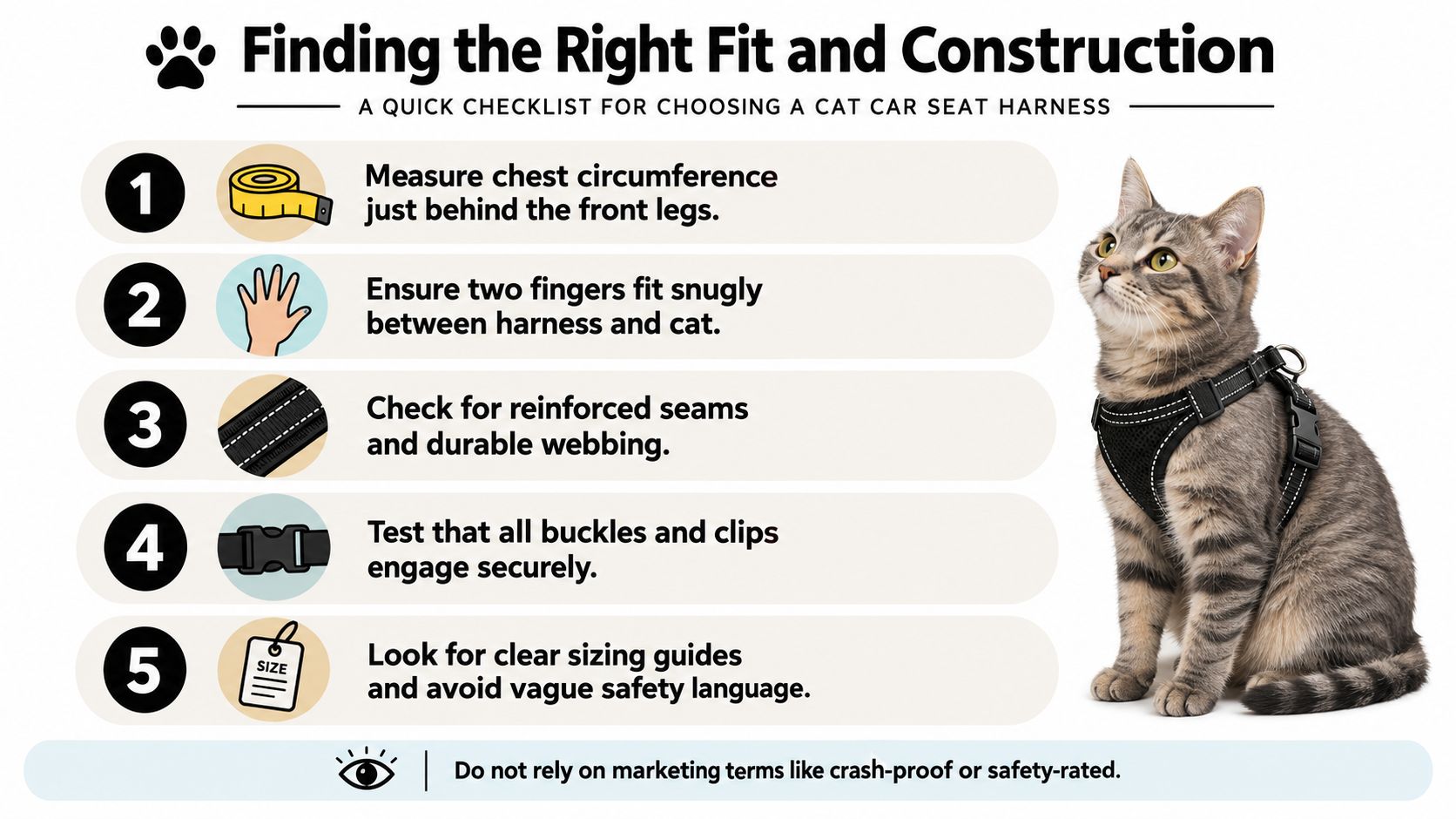
A harness that looks sturdy can still fit poorly. Start with your cat, not the product photo. Measure the chest circumference just behind the front legs, then use the manufacturer's sizing guidance to choose a close fit that allows normal breathing. The shoulders and forelegs shouldn't be able to slip through the openings.
Check the fit before judging the hardware
Try the harness on at home, when your cat is calm. Check whether it rotates, gaps away from the body, presses on the throat, or restricts the chest as the cat moves. If the harness shifts toward the neck when you gently guide it, adjust it or choose a different size or design. A fit that seems fine while the cat is still may change when the cat crouches or turns.
Inspect the points that bear tension, not just the soft lining. Look closely at the stitching, webbing, buckles, adjustment points, and tether attachment. Each buckle should engage fully, each adjustment should hold its position, and no seam should appear loose or frayed. A convenient clip is not automatically strength-rated for use in a vehicle.
For a broader visual guide to checking a harness fit, Nandog's dog harness fitting guide covers useful fit checks, but cat-specific sizing and escape resistance still matter.
Ask for test details, not reassuring labels
“Crash-tested” doesn't tell you enough on its own. Ask the seller for the exact test standard, test speed, restraint configuration, dummy size, attachment geometry, and complete pass-or-fail results. If the seller can't explain how the product was tested, don't treat the label as proof of performance. You can also review PetSafe's guide to traveling with a dog for a general discussion of travel restraint considerations, while remembering that a dog product or test result doesn't validate a cat harness.
The available crash evidence also explains why normal handling tests aren't enough. In a Center for Pet Safety pilot study of dog harnesses, all tested harnesses failed; the study reported a 100% failure rate, with one test involving near-90% decapitation of the test dog. That research doesn't establish how a cat harness would perform, but it makes one practical point clear: a harness that resists escape at home isn't thereby proven safe under collision forces (CPS 2011 pilot study).
Installing and Securing the Restraint System
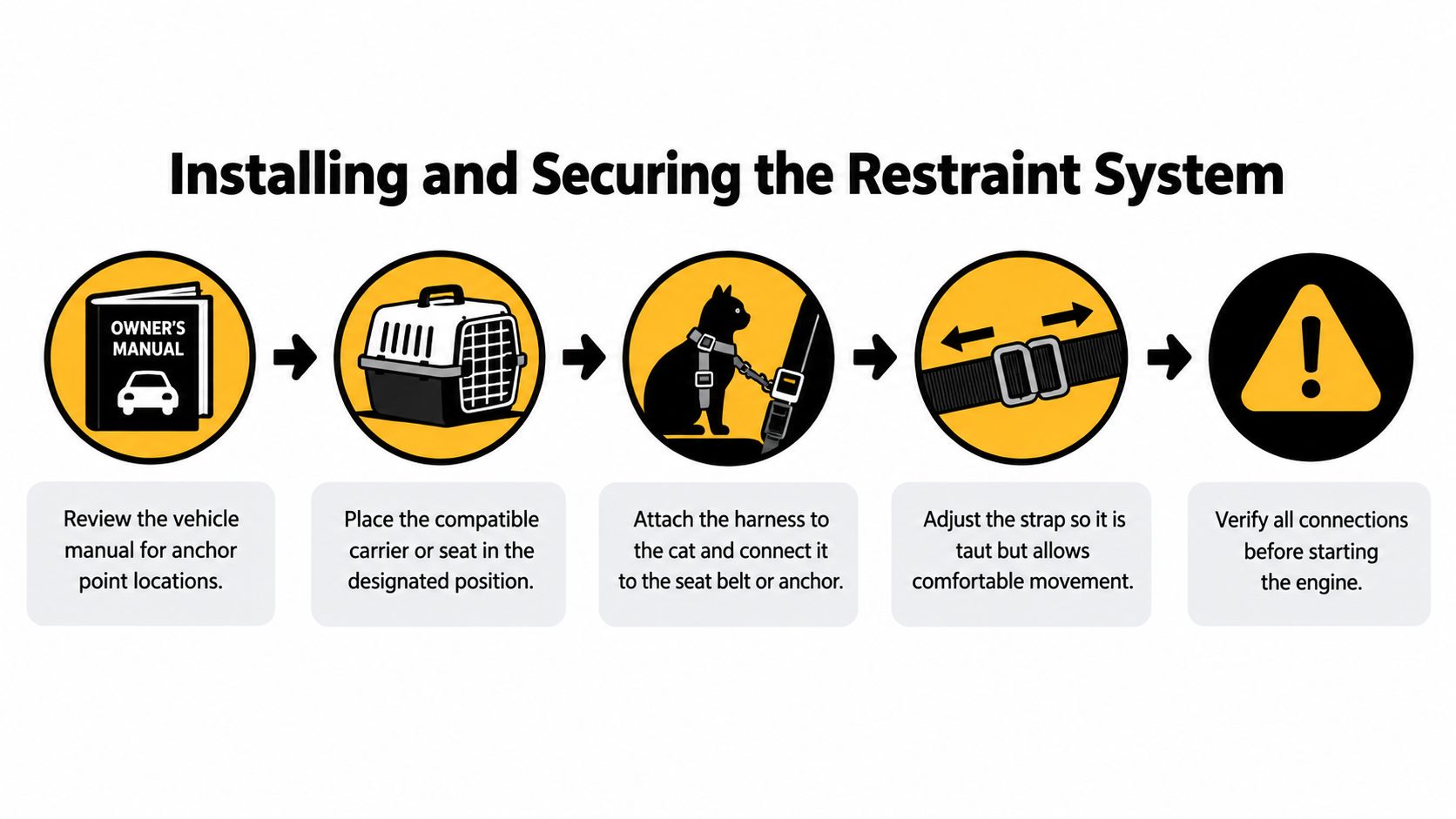
A sound installation starts with the car, not the cat. Read the vehicle manual to identify suitable anchor points and any restrictions on seat placement. Check the carrier or travel seat instructions too. If the product doesn't explain how it should connect to the vehicle, don't improvise a route and assume it's secure.
Secure the structure before adding the cat
Place the carrier or seat in its intended position and secure it using the method specified for that product and vehicle. Pull on it while the car is parked. If it slides, tips, or shifts, fix the connection before bringing the cat over. A carrier's handle or a strap loop isn't necessarily designed to serve as a vehicle anchor.
Fit the harness separately, then inspect its contact points. It shouldn't slip over the head, dig into the neck, or stop the cat from sitting, turning, and lying naturally. If the harness is intended to connect to a tether, use only the attachment method and restraint point specified by the product instructions. Don't substitute a collar, a long leash-like extension, or an improvised clip.
Test the whole arrangement while parked
With the vehicle off, put the cat inside the carrier or seat and watch how the system behaves. Confirm that the carrier stays in place, the cat remains contained, and straps don't tighten across the throat or tangle around the legs. A restraint that feels secure when empty may shift once the cat moves.
A parked test checks installation and escape resistance, not collision safety. If anything loosens, rotates, or creates pressure when the cat changes posture, take the cat out and correct the problem before driving. Keep the harness unclipped from the car restraint when it isn't intended to carry the load, especially if the cat is already secured inside a carrier.
Start with a brief, controlled drive only after the setup passes those checks and your cat tolerates the carrier. Keep your attention on driving. If the cat's position or the restraint changes, stop somewhere safe before adjusting anything. Never reach into the carrier or rearrange a tether while the vehicle is moving.
Training Cats for Calm Car Travel
A secure setup won't automatically make a cat comfortable. A kitten may hide when the carrier appears; a newly adopted cat may freeze at an open car door; an older cat may pant during a short ride. Those reactions call for patience and, if distress is severe or persistent, advice from a veterinarian. Don't respond by tightening the harness or pushing through a longer trip.
Research on feline transport found that gradual carrier training reduced behavioral signs of stress during car rides and shortened later veterinary assessments. A veterinary review also identifies familiarizing cats with carriers at home as a reproducible way to reduce transport stress (review of feline transport and carrier training).
Make the carrier ordinary before making it mobile
Leave the carrier open in a familiar room. Add comfortable bedding, let the cat investigate freely, and reward calm approaches with food or play. Don't push the cat inside or shut the door as soon as it enters. The aim is to make the carrier a place the cat can choose to visit.
Introduce the harness separately. Let the cat sniff it, then practice brief wear sessions at home while rewarding relaxed behavior. Once the cat tolerates the harness and carrier independently, try a short stationary session in the parked car. Progress to the engine running without moving, then to a brief drive. For more general preparation ideas, see these tips for traveling with pets.
Some cats settle better with partial visual cover; others prefer to see their surroundings. Either way, keep ventilation clear and make sure the cat can sit, turn, and lie naturally. If the cat hides, pants, struggles, or refuses food, reduce the challenge. Return to the last stage the cat handled calmly, reward small steps, and build up at the cat's pace rather than insisting on a long trip.
Troubleshooting Common Travel Problems
Troubleshoot what you can observe. Don't keep driving with a connection that feels loose or a carrier that shifts. Center for Pet Safety research highlights how inadequate carrier structure or attachment strength can compromise protection, so movement in the parked car is a warning to correct the setup, not a minor inconvenience.
The harness slips or rotates
A harness that moves toward the throat or lets a shoulder slip through may be too loose, poorly shaped for your cat, or adjusted incorrectly. Recheck the chest measurement and fit it again. If it still rotates or opens an escape route, stop using that model for car travel.
The cat squirms free
Don't solve an escape problem by clipping the tether to a collar. Check the harness size, buckles, and adjustment points, then practice wearing it at home. If your cat can still back out, rely on a secure carrier during the drive and use the harness only for controlled transitions.
The attachment or carrier feels loose
A connection that shifts when pulled gently while parked needs attention before the engine starts. Follow the vehicle and product instructions, replace damaged or improvised connectors, and confirm that the carrier is held in its intended position. Don't assume a belt placed over the outside of a soft carrier will secure it safely.
The cat is near an active airbag
Move the carrier to a suitable position away from the active airbag, following your vehicle's guidance. Do not put the carrier in the front seat because it is easier to monitor the cat. If the carrier cannot be positioned and secured appropriately, rethink the travel setup before leaving.
The cat is highly distressed
Panting, frantic struggling, or repeated attempts to escape can make a moving restraint more hazardous. Stop somewhere safe if you're already driving, keep the cat contained, and return to stationary acclimation before trying again. Ask your veterinarian for advice if distress is severe or continues despite gradual training. Don't turn a brief necessary drive into an extended test of endurance.
A Final Travel Safety Checklist
A safer decision happens at three points: when you buy, when you prepare to leave, and while you're in the car. The word “harness” doesn't settle whether the setup is suitable. Fit, construction, attachment, carrier choice, and the cat's behavior all matter.
Before buying
- Confirm the fit: Measure your cat and check that the harness allows normal breathing without letting the shoulders or forelegs slip through.
- Inspect construction: Look at the stitching, webbing, buckles, adjustments, and tether attachment. Skip products with hardware that doesn't engage securely.
- Ask for specifics: If a seller claims crash testing, request the test standard, configuration, dummy size, and complete results. Don't treat a vague label as validation.
- Plan the complete setup: Check that the harness, carrier or seat, vehicle anchor, and placement are compatible with one another.
Before leaving
- Anchor the carrier or seat: Check that it stays in place and isn't positioned in front of an active airbag.
- Put the cat inside the enclosure: For travel in motion, use the secured carrier as the primary containment choice when appropriate. Don't rely on an unclipped harness to restrain a loose cat.
- Remove unsafe substitutions: Don't use a collar-only attachment, long extension tether, or improvised connector as a stand-in for a complete system.
- Run a stationary check: Confirm that the cat can maintain a natural posture and that nothing slips, rotates, or catches.
During the drive
- Keep attention on the road: Don't reach into the carrier or adjust a moving tether while driving.
- Stop if something shifts: Pull over safely and correct the connection before continuing.
- Respect the cat's limits: If travel triggers severe distress, return to training and ask your veterinarian for guidance.
Nandog Pet Gear offers car seats with secure safety hooks and easy installation, but those features don't establish crash-test validation. Treat any travel seat as one part of the setup, follow its instructions, and pair it with a suitable harness and secure vehicle connection.
Choose the restraint for the journey, not the product name. A harness can help with controlled handling, while a properly secured carrier is generally the more conservative choice for keeping a cat contained during a drive.
Nandog Pet Gear offers comfort-focused car seats and travel accessories for pets, alongside products for rest and everyday care. If you're choosing a setup for your cat, visit Nandog Pet Gear to explore its options and check how each product fits into your complete restraint system.