


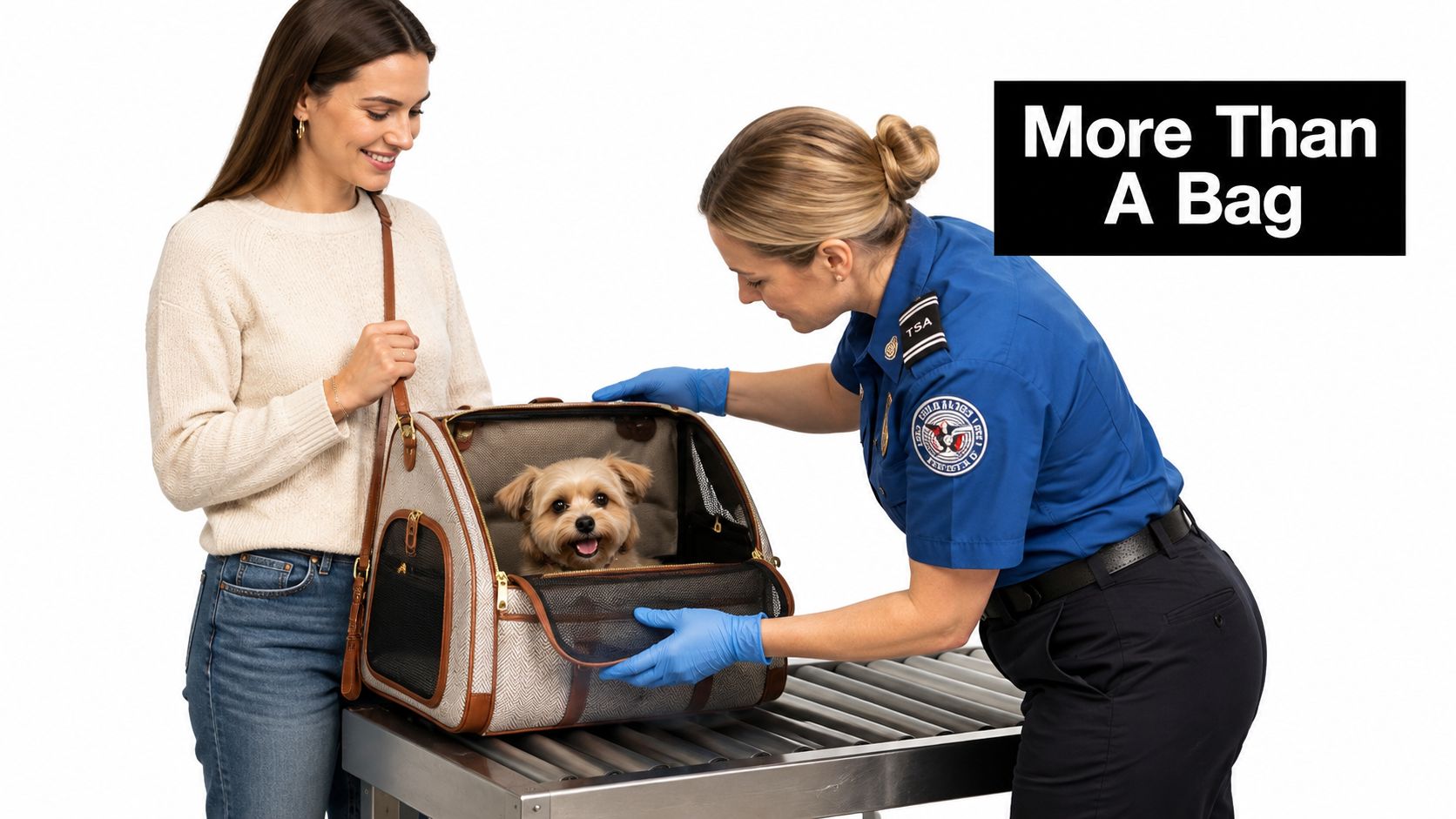
You're at the airport with a small dog tucked into a polished-looking bag, and security asks you to take the dog out while the carrier goes through the X-ray. The zipper sticks, the base folds, and suddenly the bag that looked perfect online feels like the wrong tool for the trip.
That's the difference between a pretty tote and a real pet carrier handbag. The right one has to look at home on your shoulder while containing your pet securely, maintaining airflow, and holding its shape through the parts of travel that aren't photogenic.
What a Pet Carrier Handbag Really Is
A pet carrier handbag is travel equipment with an accessory's silhouette. A regular tote may have room for a small dog, but that doesn't make it a carrier. It needs a stable base, ventilation that stays unobstructed, secure closures, and carry options designed to support the animal's weight without putting the pet or the person carrying it at risk.
A rigid or semi-rigid base helps the floor stay level instead of sagging beneath your pet. Mesh panels allow air to circulate, while a secure zipper or latch helps prevent an anxious animal from pushing its way out. Handles, shoulder straps, or both should attach firmly to the body of the bag, not just to decorative trim.
The design has to work for the pet, too. Your dog or cat should be able to move into a natural resting position, with enough room to turn and sit upright. A soft interior can feel inviting, but plush fabric shouldn't block vents or make the carrier too warm.
My buying rule: If the bag doesn't hold its shape when you set it down and gently press the base, don't trust it to carry a pet.
Good-looking construction and safe function aren't competing goals. They're both part of the job. Quilting, thoughtful colors, and polished hardware can make a carrier feel like a handbag, but they can't substitute for strong seams, reliable closures, and clear airflow.
How Carrier Handbags Became a Category
Pet carrier handbags took shape around a practical constraint: a small animal traveling in the cabin has to stay contained beneath the passenger seat. The history of air travel with animals predates the fashionable carrier. A 1973 Civil Aeronautics Board estimate recorded approximately 3,700 animals traveling daily on U.S. domestic flights, according to this Los Angeles Times account of early pet air travel.
The safety framework developed alongside that demand. The U.S. Animal Welfare Act was amended in 1976 to address the safety of animals transported by air. That same practical problem later inspired TWA flight attendant Gayle Martz, who designed the Sherpa Bag in 1989 after looking for a way to bring her Shih Tzu into the airplane cabin. Its soft, portable handbag form was paired with the structure needed to contain a pet, and it became widely recognized as a standard style for in-cabin pet bags.
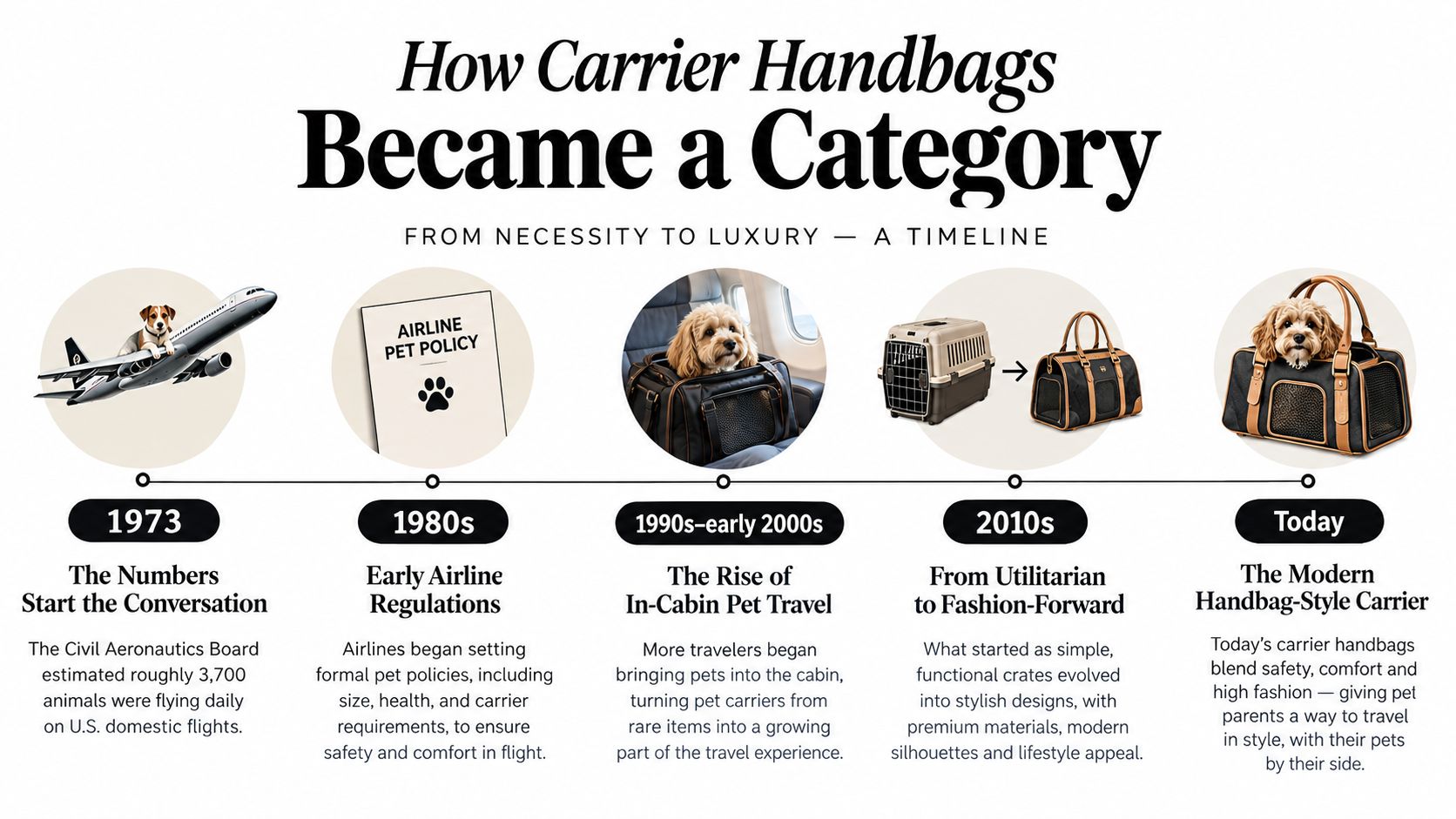
International guidance added another layer. The International Air Transport Association began adopting animal-transport safeguards in 2006 and issued more stringent crate-design guidance in 2008, emphasizing escape prevention and injury reduction. Those milestones help explain the familiar priorities of today's carriers: under-seat proportions, secure closures, ventilation, and reinforced construction.
The history offers a useful filter while shopping. The category didn't begin as a handbag trend; it grew from the need to transport an animal safely in a specific setting. A design can be elegant, but it still has to respect the constraints that shaped it.
Popular Styles and What Each One Does Best
The best silhouette depends on your routine, not the trend of the moment. A tote can look polished for a short café walk with a cat, while a hands-free backpack may make a long public-transit commute easier. Each style involves a tradeoff, so choose based on where you'll carry your pet.
| Style | Best For | Key Limitation |
|---|---|---|
| Tote | Everyday errands, vet visits, and short outings | Can strain one shoulder, and some styles have limited structure |
| Crossbody sling | Brief walks with a small pet close to your body | Often offers less room and support for longer trips |
| Backpack | Commuting or outings where you need both hands free | Must fit your pet's posture and keep vents clear against your back |
| Structured duffel | Weekend trips where extra interior room is useful | Can be bulky, and larger proportions may not fit under an airplane seat |
| Rolling carrier | Longer walks through terminals or other places with smooth floors | Less practical on stairs, crowded transit, or uneven ground |
A tote is the obvious choice for people who want an accessory-like shape, but inspect the base and handles before choosing one. A sling can feel convenient for a short outing, yet it shouldn't compress the pet or leave you without enough support. Backpacks free your hands, but a pet needs airflow and room to settle rather than being pressed tightly against your back.
A duffel can be the practical answer for a short trip if it has a dependable structure and suits the transport rules. Rolling carriers reduce the weight on your shoulder, but the wheels don't solve obstacles such as stairs or a crowded platform.
Choose for your most demanding regular journey, not your best-looking photograph.
If you want one bag for multiple routines, start with a structured tote or duffel that's easy to carry and clean. Don't assume it's right for every mode of transport. A handbag suited to walking may not be appropriate as a car restraint, and a roomy design may still fail an airline's under-seat requirements.
Sizing Your Pet the Right Way
Ignore labels like small, medium, and large until you've measured your pet. Those labels don't tell you whether your dog can stand, turn around, sit upright, and lie naturally inside the actual carrier.
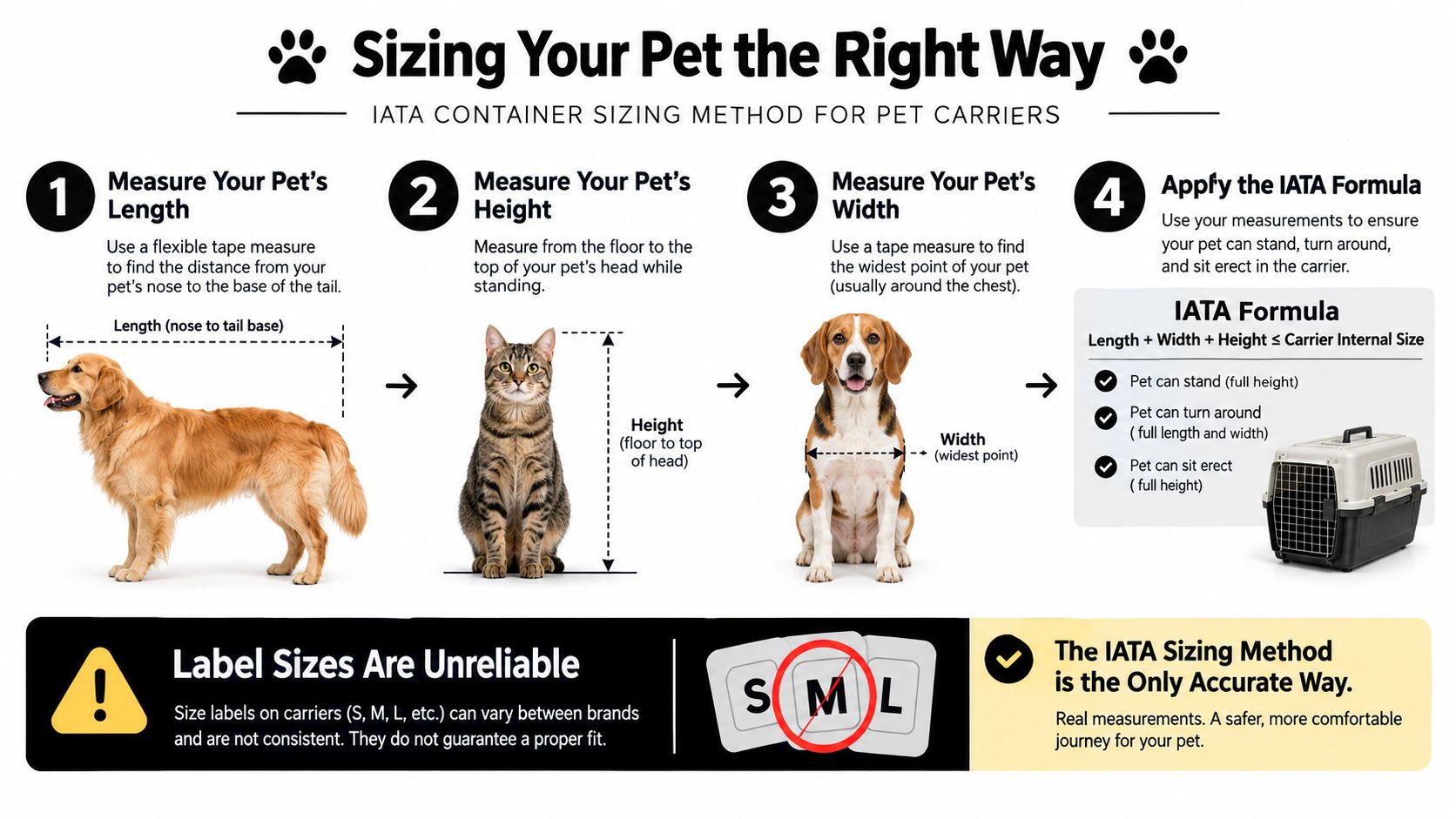
The IATA sizing formula starts with the animal, not the product chart. Its container-measuring guidance uses these internal dimensions:
- Length: Measure the animal's body length, then add half the foreleg length.
- Width: Measure shoulder width and multiply it by two.
- Height: Measure standing height and add the thickness of the bedding.
Measure your pet standing naturally, and check that the carrier's usable internal space matches the result. Bedding takes up room, so include it in the height calculation. Don't let thick padding or a narrow base reduce the floor space your pet needs to turn and lie comfortably.
Ventilation belongs in the sizing decision, not as an afterthought. IATA guidance calls for airflow on at least three sides, with most ventilation in the upper portion, and a total ventilated area of at least 16% of the four-side surface area. Mesh panels that become covered by bedding, your clothing, or the seat aren't doing their job.
For air travel, compare the finished carrier with the operating airline's published cabin dimensions. Soft sides may compress, but don't count on being able to squeeze an overlarge bag beneath a seat or force the zipper closed around your pet.
Safety Features That Matter
A pet carrier handbag has one job before any other: keep the animal contained and stable when things go wrong. The American Veterinary Medical Association advises that transport enclosures should suit the animal's species and size, provide adequate ventilation, and maintain appropriate climatic conditions. A quilted shoulder bag still has to meet that standard, and many don't.
The parts worth inspecting are the ones that bear weight and hold the animal in:
- Base: It should stay level under your pet's full weight. A base that buckles lets the animal slide into a cramped, twisted position, and a small dog rarely complains loudly enough for you to notice.
- Seams and handles: Check the attachment points, not just the stitching visible on the outside. Handles should spread the load across the bag's structure rather than pull on a small patch of fabric.
- Closures: Zippers and latches need to resist a determined nose or paw. A decorative snap over an open top does nothing to keep a pet inside.
- Ventilation: Keep mesh panels positioned above the bedding and near the animal's head. Interior hardware should be covered or removed so it can't snag fur or rub skin raw.
- Lining: A washable, leak-resistant base and absorbent bedding make cleanup easier. Neither should block airflow or raise the floor so high your pet loses headroom.
Before buying, set the empty bag on a flat surface and press down on the base. If it folds under light pressure, walk away. Then inspect where the handles and shoulder strap join the carrier and work the closure a few times. For a bag you already own, check for stretched seams, loose fasteners, torn mesh, or a softened base before each major trip.
Fabric carriers can be perfectly safe when the frame underneath was designed properly. A bag with no stable floor, weak strap points, and a single zipper fails as a restraint no matter how good it looks on your shoulder.
Getting a Carrier Through an Actual Flight
Airline approval isn't a universal label. It depends on the airline, route, aircraft, and whether the loaded bag fits beneath the seat while staying closed. In a 2023 Forbes Advisor survey of 10,000 U.S. dog owners, 33% said they'd flown with their pets, and 37% identified being unable to bring their dog on a plane as their biggest travel-related annoyance. Delta has reported transporting roughly 500,000 pets per year, excluding service animals.
Use this checklist before you book:
- Check the operating airline's policy. Don't rely on a retailer's “airline approved” claim. Confirm the limit for each flight segment and aircraft, plus any booking, documentation, or cabin availability rules.
- Measure the loaded carrier. Put your pet and usual bedding inside, close the bag, and check its outer dimensions. If the sides are flexible, make sure they can compress beneath a seat without pressing into the pet or covering vents.
- Compare the dimensions with the actual route. American Airlines lists a 46 × 28 × 28 cm soft-sided limit on all flights, while Southwest requires the pet to remain fully inside, stand up, and move around comfortably. Check current airline rules before departure because policies can vary.
- Prepare for airport screening. TSA generally requires the pet to leave the carrier while the empty bag goes through the X-ray. Follow screening instructions and ask about alternative screening if needed.
- Budget and confirm the booking. Typical one-way pet fees range from approximately $95 to $200, depending on airline and route. Airlines may also limit the number of animals in the cabin and require vaccination records or a veterinary health certificate.
For help planning ground logistics around a flight, this guide to flight tracking and curbside pickup can help you coordinate the airport handoff. For a practical overview focused on dogs, see Nandog's dog carrier for air travel.
A larger bag isn't automatically a better flight bag. If it won't fit under the seat or remain securely closed, extra interior space won't help.
Car Travel Rules Most Owners Skip
Sliding a carrier onto the seat and looping a belt through its handles is one of the easiest mistakes to make. As noted earlier, the AVMA's motor-vehicle guidance recommends securing an animal in the back seat in a properly restrained crate, carrier, or harness. A soft bag that merely rests on upholstery can slide under braking, tip into the footwell, or collapse around the pet.
Treat the carrier as part of a restraint system that has to control motion, heat, and airflow. A “crash-tested” claim is a starting point. Follow the manufacturer's installation instructions exactly, and reject any setup that makes the carrying handles or shoulder strap responsible for restraint. Those parts are built for carrying, not for absorbing vehicle forces.
Keep the bag out of the front seat. An airbag can injure a pet even when the animal is inside a crate. Before leaving, push the secured carrier from both sides. It should stay upright and in place rather than rocking or wandering across the seat.
| Car check | What to look for | Dealbreaker |
|---|---|---|
| Position | Back seat, installed as directed | Front-seat airbag exposure |
| Restraint | Belt or anchor routed where the maker specifies | Improvised handle or strap tie-downs |
| Stability | Carrier stays upright after a firm side push | Tipping, sliding, or collapsing |
| Airflow | Mesh remains clear of clothing and seats | Blocked vents and heat buildup |
Warmth can build inside a plush carrier when mesh presses against your clothing or the seatback. On longer drives, stop periodically, check your pet for distress, and restore airflow if the bag has shifted.
A handbag carrier can be excellent for carrying and still be the wrong choice for vehicle use. If it lacks a defined restraint method, choose a carrier, crate, or harness designed for the job. Nandog's pet carrier for car travel offers more detail on vehicle-ready setups. Style earns its place after these checks pass.
Care, Maintenance, and Smart Buying Habits
A carrier that turned heads on day one can look shabby by the third trip, and cleaning habits decide which way it goes. Match the method to the material. Quilted micro plush and neoprene forgive gentle hand-washing, while coated canvas and vegan leather usually want a wipe-down with a damp cloth. Read the care label before any detergent touches the bag, and spot-clean structured carriers rather than sending them through a machine cycle that can warp the base, weaken seams, or rattle hardware loose.
Some pet products are built for easier washing. Nandog notes that most of its beds are fully machine washable without removable covers, and many designs are reversible. That easy-care principle applies to travel gear too: look for carriers with removable, washable bedding and a wipeable base, provided the construction supports the cleaning method. A carrier you can clean is one you will keep using.
Inspect the bag the way you would inspect luggage before a long trip. Run the zippers end to end, tug the strap attachment points, press on the base, and hold the mesh up to light to spot thinning.
A soft floor or a stretched seam is a safety problem, not a cosmetic one.
Retire the bag or repair it before your pet finds the weak point mid-stride. For related fabric-care ideas around pet hair and upholstery, these cleaning tips for pet sofas offer practical context.
For broader trip preparation, Nandog's guide to preparing pets for travel is a helpful companion. Before any outing, confirm the carrier is clean, fully dry, and still structurally sound. Replace it on a schedule set by wear, not by sales.
Quick answers before you head out
How can I tell if a bag is airline approved? Treat that phrase as a product claim, not a guarantee. Compare the loaded carrier's dimensions with the operating airline's rules for your itinerary, and confirm that your pet can remain inside with the bag closed.
Does my pet have to come out at security? TSA generally asks travelers to remove the pet while the empty carrier is screened. Follow the instructions of the screening officers at your airport.
What if the carrier arrives with pet hair or an odor? Follow the manufacturer's care instructions, remove bedding for separate cleaning when possible, and let the carrier dry fully before using it again. Don't mask a persistent odor without checking for trapped moisture or soiling.
How do I balance style with safety? Start with the base, closures, ventilation, and fit. Choose the color, texture, and hardware after the carrier passes those checks.
Nandog Pet Gear offers tote carriers and travel accessories alongside its comfort-focused pet essentials, giving design-conscious owners options to consider for everyday outings. Explore Nandog Pet Gear and choose a carrier that suits your pet's size, your routine, and the journey ahead.