


You clip the leash to your dog's collar or harness, take a few steps, and then the walk turns into a tug-of-war. A squirrel sends your dog lunging forward, your shoulder twists, your knuckles tighten around the handle, and your shoes scrape across the pavement while you try to stay upright. You love your dog, but you've started calculating whether the next walk will be worth the strain.
That late-night search for a dog leash for pulling can quickly become confusing. Front clips, back clips, head halters, martingale collars, padded handles, and “no-pull” promises all sound like solutions. The useful question isn't which product claims to stop every dog from pulling. It's where the equipment sends force, what behavior it supports, and whether it fits your dog's body and walking context.
The Walks That Started This Search
The problem often begins with a small moment. Your dog spots movement across the street, leans forward, and suddenly the leash goes tight. You hold still, but your dog keeps moving. The leash becomes a straight line between your hand and your dog's chest or neck, and your body absorbs the result.
Afterward, you may shorten the route, avoid busy sidewalks, or grip the leash with both hands. Your dog still wants to sniff, greet, chase, or investigate, and you still need a way to manage that enthusiasm without turning every outing into a physical contest.
That concern is reasonable. A study of routine dog walking found that half of participants experienced leash tension of at least 125 N, while the largest observed pulling event reached 412.5 N. The researchers also observed changes in stride-time variability and balance-related gait measures when people walked with dogs, linking leash tension to measurable stability concerns for handlers (biomechanics study on leash tension and human gait).
The broader injury picture is also worth keeping in proportion. Researchers estimated 356,746 emergency-department visits related to dog leashes in the United States between 2001 and 2018, with an overall rate of 63.4 injuries per 1,000,000 people. The annual rate increased from 25.4 per 1,000,000 in 2001 to 105.5 per 1,000,000 in 2018, although leash-related injuries still represented only about 0.04% to 0.06% of all emergency-room injuries in 2018 (JAVMA analysis of dog leash-related injuries).
The right approach treats pulling as both a mechanical problem and a learning problem. First, you need to understand why tension keeps appearing. Then you can choose equipment that gives you safer control while training creates a lasting change.
Why Dogs Pull and Why Gear Alone Is Not the Answer
Pulling becomes easier to understand when you separate force from motivation. Your dog moves toward something interesting while you remain behind. The leash tightens along the direction of travel, and your hand becomes the anchor. If the dog eventually reaches the tree, scent, person, or dog that caused the interest, forward pressure has produced a useful result.
That creates a simple learning loop:
- The dog wants access. A scent, movement, greeting, or open path creates forward drive.
- The dog leans into the leash. The leash carries tension from the dog to your hand.
- The dog still reaches the goal. Pulling has paid off, even if you didn't intend to reward it.
- The behavior becomes more persistent. The dog tries the same strategy on future walks.
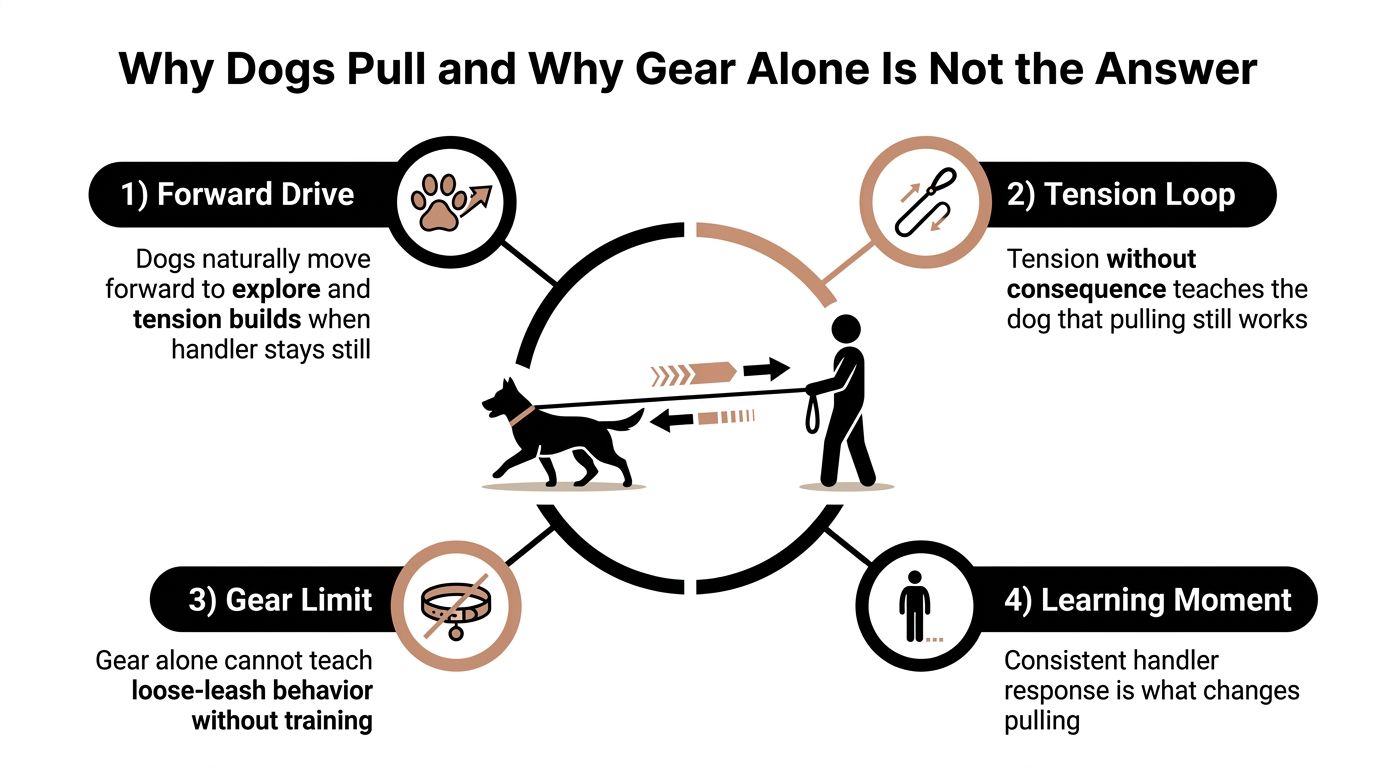
Not every pull means the same thing. An excited dog may be trying to reach a smell or playmate. A reactive dog may be attempting to create distance from another dog or person. Some dogs pull because they've learned that leash pressure predicts opposition, so they push harder as soon as they feel restraint. The same harness can manage these situations differently because it changes the direction and location of force, but it doesn't remove the underlying reason for the behavior.
Practical rule: Equipment can change leverage. Consistent training changes what pulling achieves.
A back-clip harness may let a strong dog brace comfortably and drive forward. A front-clip harness can turn the chest when the dog moves ahead. A head halter can influence direction through the dog's head. None of these tools teaches loose-leash walking without a clear response from the handler.
The same principle applies to distractions unrelated to walking mechanics. If you encounter an unfamiliar insect or animal near the path, you may want to identify it before letting your dog investigate. A resource such as this guide to a caterpillar with black spikes can help you make a calmer choice about what's safe to approach. Your leash provides management in that moment, but your dog still needs practice looking to you rather than rushing toward every novel object.
The useful question is therefore not, “Which tool stops pulling?” It's, “Which tool redirects force in a way that gives me enough control to teach a different walking habit?”
The Main Leash and Harness Types Compared
Different equipment places the leash connection at different points on the dog's body. That connection changes the mechanical advantage, turning ability, comfort, and the amount of handling skill required.
Standard flat collar
A flat collar sends leash tension around the neck. It's simple, lightweight, and familiar, but a determined dog can put substantial pressure into it. It may suit a dog that already walks politely, yet it offers limited mechanical help when the dog is strong, highly aroused, or prone to sudden lunges.
Back-clip harness
A back-clip harness distributes pressure across the torso instead of concentrating it at the neck. That can make walking more comfortable for some dogs, but the location can also give a pulling dog a strong forward brace. Controlled testing found that dogs wearing a back-connection harness pulled harder and more steadily than when restrained by a neck collar, demonstrating that comfort and pulling control aren't always the same goal (review of leash and restraint effects).
Front-clip harness
A front-clip harness places the leash connection near the chest. When the dog moves ahead, the leash can guide the chest to one side rather than allowing a straight, powerful drive forward. This often improves handling, but a poorly designed or poorly fitted model can interfere with shoulder movement or twist around the body.
For a broader look at available designs, compare the features and trade-offs in this guide to best no-pull dog harnesses, then evaluate the individual fit rather than relying on the label alone.
Head halter
A head halter directs the dog's nose and head, which can provide strong directional influence with less physical effort from the handler. It also requires careful acclimation. A dog that paws at it, freezes, or repeatedly tries to remove it hasn't accepted the equipment yet, and forcing a walk can create resistance rather than cooperation.
Retractable leashes aren't included as a primary pulling tool because they provide line when the dog moves forward. For loose-leash practice, a fixed-length leash gives clearer information about slack and tension.
| Tool | Force Redirection Point | Main Benefit | Main Drawback |
|---|---|---|---|
| Flat collar | Neck | Simple and familiar | Limited leverage for strong pullers |
| Back-clip harness | Back and torso | Reduces direct neck pressure | Can support forward bracing |
| Front-clip harness | Chest and shoulder direction | Redirects forward movement | Can twist or restrict movement if poorly fitted |
| Head halter | Nose and head direction | Strong directional control | Needs gradual acclimation and careful handling |
No tool wins for every dog. Size, age, anatomy, walking environment, trigger profile, and handler strength all matter.
How to Fit Each Tool So It Actually Works
A useful fitting check happens while your dog is standing and moving. Static comfort isn't enough. Straps can shift when the dog turns, trots, lowers its head, or leans into the leash.
For a standard collar, place two fingers between the collar and the top of the neck. It should feel secure without pressing into the skin, and it shouldn't slide over the ears when the dog backs away. Walk ten steps, turn, ask for a sit, and check whether the collar rotates or rides toward the throat.
A back-clip harness needs a stable chest and rib-cage fit. Adjust the chest strap so it sits about two finger-widths behind the front legs, then check that your dog can sit, lie down, and take a full step without the strap cutting into the armpits. During the movement test, look for rubbing, twisting, or a back ring that shifts sharply to one side.
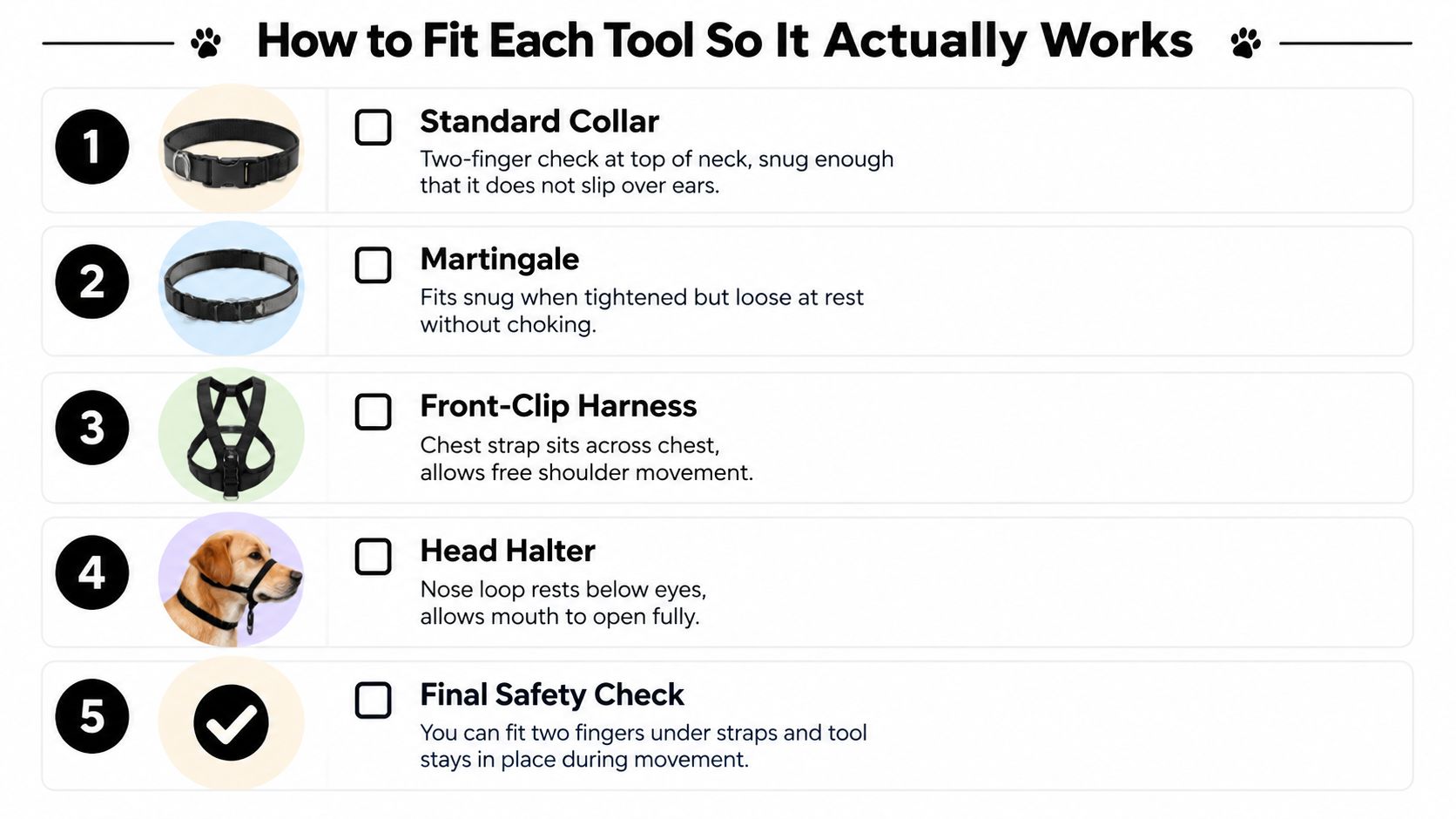
A front-clip harness should keep its chest connection at the sternum, not against the throat. The same chest fit applies, but the shoulder blades need room to rotate through each step. Walk, turn, and watch the front strap from the side. If it climbs into the neck or blocks the front legs, adjust it before adding training pressure.
A head halter demands an even more specific check. The nose loop should sit high on the bridge while remaining clear of the eyes, the cheek straps should stay away from the eyelids, and your dog must be able to open its mouth, pant, drink, and take treats. Begin indoors, pair the halter with food, and only progress when your dog can move comfortably.
The dog harness fitting guide offers another useful reference for checking strap placement and movement. Fit should be reassessed as your dog's coat, weight, or equipment changes.
Movement test: Walk ten steps, turn, ask for a sit, and inspect the skin and gait before taking the tool into a busy setting.
Here's a practical fitting demonstration to watch alongside your hands-on checks:
What No-Pull Gear Can and Cannot Do
A front-clip harness can change the immediate mechanics of a walk. When your dog moves forward, the leash connection near the chest can turn the body away from a straight-line drive, reducing the pulling power available for a full-body pull. That can make a strong dog easier to guide while you work on the behavior.
It doesn't teach the dog that a tight leash pauses access to the environment. Your dog may still want the squirrel, scent, or greeting just as intensely. The harness changes the route force takes through the body, while training changes the consequence of pulling.
A head halter offers a different kind of management. Because the handler influences the dog's head, small directional movements can affect the dog's path. The trade-off is that the dog must be introduced to the sensation gradually, and the handler needs to avoid sudden jerks or using the halter during rough play.
| Gear Type | What It Reduces | Time to First Result | What Still Needs Training |
|---|---|---|---|
| Front-clip harness | Straight-ahead leverage | Often immediate mechanical redirection | Loose-leash habits and calm responses |
| Back-clip harness | Direct neck pressure | Immediate change in pressure location | Reduced forward bracing and handler focus |
| Head halter | Unwanted head direction and sudden steering difficulty | Directional control after acclimation | Comfortable wearing, calm responses, and gentle handling |
| Flat collar | Equipment complexity | No special redirection effect | Nearly all pulling behavior |
Claims that a product “stops pulling” confuse management with behavior change. A better expectation is that equipment may reduce the intensity or ease of pulling during early walks, giving you more opportunities to reward slack. The dog still learns through your repeated responses.
The right result is not a dog that fears tension. It's a dog that discovers that staying near you keeps the walk moving and produces access to useful rewards.
Pairing Your Leash With Simple Training Steps
Start where your dog can think. A quiet indoor space, driveway, or low-distraction path gives you more chances to reward the behavior you want before squirrels, traffic, and unfamiliar dogs compete for attention.
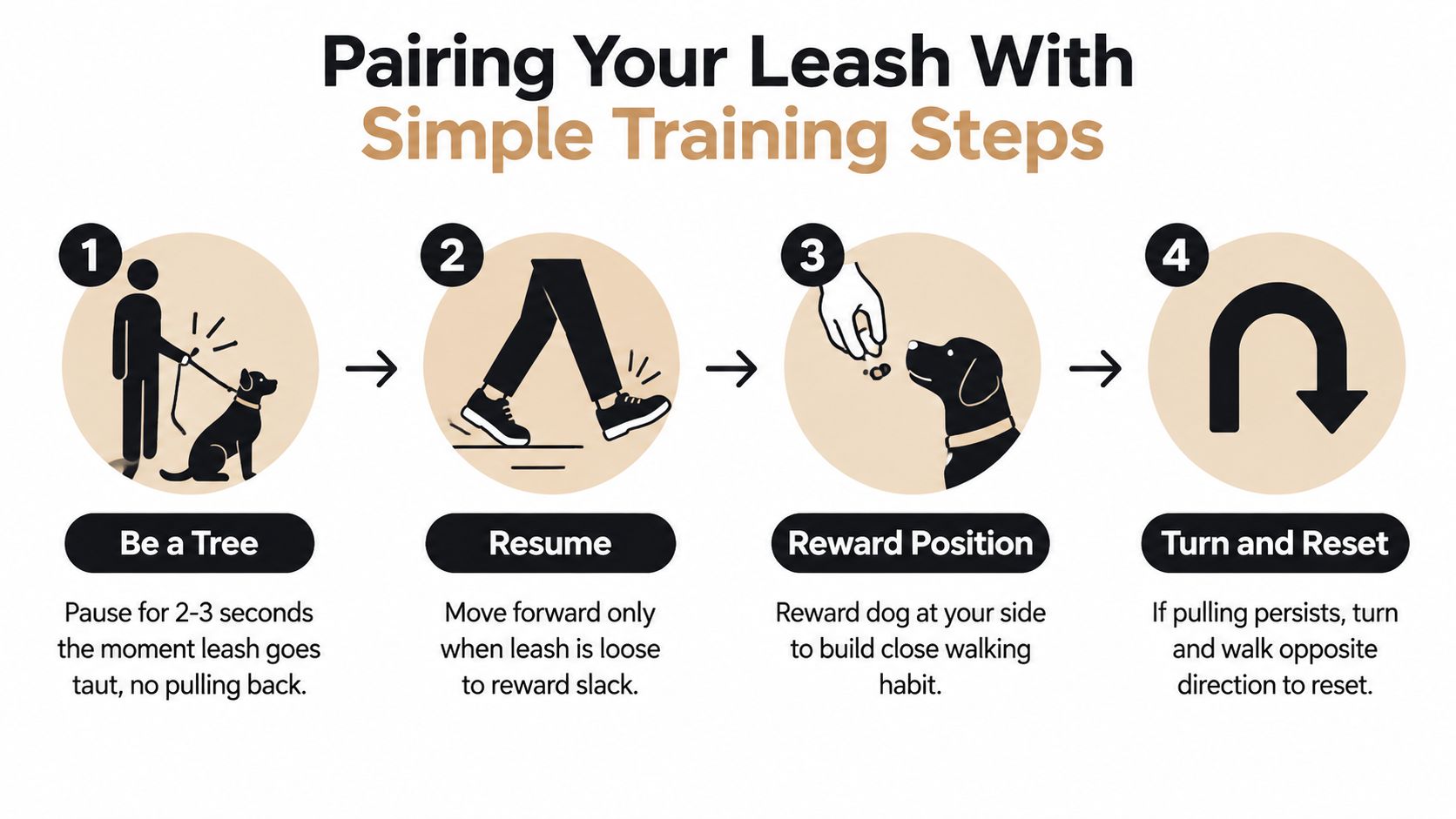
The first rule is simple: a tight leash pauses forward movement. The moment the leash becomes taut, stop without pulling backward. Wait briefly, keeping your hands quiet. As soon as your dog creates slack, looks back, or steps toward you, mark that moment and resume walking.
Build the walking pattern
Reward before the leash reaches its limit whenever possible. If your dog glances back, matches your pace, or walks beside your knee, use a marker such as “yes,” then deliver the treat close to your leg. Feeding near you helps make your position valuable without demanding a rigid heel.
Add direction changes every five to ten paces as a practice range, not a rule your dog must perform perfectly. Turn smoothly, invite your dog to follow, and reward the choice to stay connected. Frequent, gentle changes teach your dog to monitor your movement instead of locking onto the path ahead.
Handle triggers before they create a lunge
Use “find it” when a trigger appears at a manageable distance. Say the cue, scatter food on the ground near you, and let your dog search while the trigger passes or becomes less relevant. If your dog is already lunging, increase distance first. Food won't work well when the dog is too aroused to process information.
Keep sessions short enough that your dog can succeed. The leash training guide for puppies can help you adapt the same principles for a young dog whose attention and impulse control are still developing.
As pulling decreases, phase out the special prompts gradually over a couple of weeks. Keep rewarding unexpectedly, especially near difficult triggers, rather than removing every reward at once.
Reward timing matters: Mark the loose leash or voluntary check-in as it happens, not after your dog has surged ahead and returned.
Safety and Comfort for Both Ends of the Leash
A safer setup protects the handler's hands and joints as well as the dog's skin and movement. Use a padded handle or wrist loop as designed, keep your working hand low and relaxed, and never wrap the leash around your fingers. A sudden lunge can tighten the line before you have time to release it, causing burns or serious hand injury.
Check the dog's equipment after the walk, not only before it. You should be able to fit two fingers under each strap, but the tool shouldn't shift enough to rub the armpits, throat, or chest. Front-clip chest plates deserve special attention in long-coated dogs because trapped hair can mat against the material.
Match the setup to the setting
A quiet residential route gives you room to stop and reward. Crowded sidewalks, slippery pavement, and narrow paths reduce your margin for error. In traffic or dense pedestrian areas, a standard fixed-length leash of about four to six feet can provide more predictable control than a line that continually changes length.
Avoid retractable leashes in crowds, and don't leave a head halter on during off-leash play. Carry a quick-release backup collar with identification attached so you have a second connection if a harness shifts or a dog slips free.
The handler's body gives you useful feedback. If your shoulder, wrist, or back hurts, don't solve the problem by gripping harder. Pain usually signals that the leash is carrying too much repeated tension, the equipment is redirecting force poorly, or the route is too difficult for the dog's current training level.
Comfort is part of control. A dog that moves freely and a handler who can release tension calmly create a safer walking partnership.
Quick Answers Before You Head Out the Door
Does a front-clip harness stop pulling?
Not by itself. It redirects the dog's chest when the dog moves ahead and can reduce forward pulling power, which may make the walk easier to manage immediately. Your dog still needs to learn that a loose leash keeps the walk moving and that checking in with you earns useful rewards. Pair the harness with quiet pauses, timely reinforcement, and gradual exposure to distractions.
How long does progress take?
There's no honest universal schedule because dogs differ in motivation, history, physical strength, age, and trigger sensitivity. Some dogs show a change in handling as soon as the equipment fits correctly, while behavior change requires repeated practice. Track whether your dog creates slack sooner, recovers faster, and checks in more often. Those small changes matter more than a promised deadline.
Are head collars safe for short-nosed breeds?
A head halter needs careful fitting and gradual acclimation for any dog. Short-nosed dogs may have less room around the muzzle, so the nose loop must never interfere with breathing, panting, drinking, or taking treats. Ask a qualified veterinary or training professional to assess the fit if you're unsure, and don't use the tool with sudden leash corrections.
Should you use a choke or prong collar?
Force-free alternatives are the safer starting point for most walking problems. Choke and prong collars add aversive pressure, and that pressure can create fear or negative associations around the people, dogs, or places present when the collar tightens. A well-fitted harness, fixed-length leash, reward-based training, and professional guidance provide a more constructive way to build control without relying on pain.
A calm walk usually comes from a modest mechanical advantage repeated through patient practice. Choose equipment that fits your dog, teach what leash slack earns, and make the route easy enough for success.
Nandog Pet Gear offers everyday options such as durable sport leashes, waterproof leashes, collars, and harnesses for owners who want practical equipment with a polished design. Visit Nandog Pet Gear to explore walking accessories that can support a comfortable, well-fitted setup while you continue teaching loose-leash skills.