

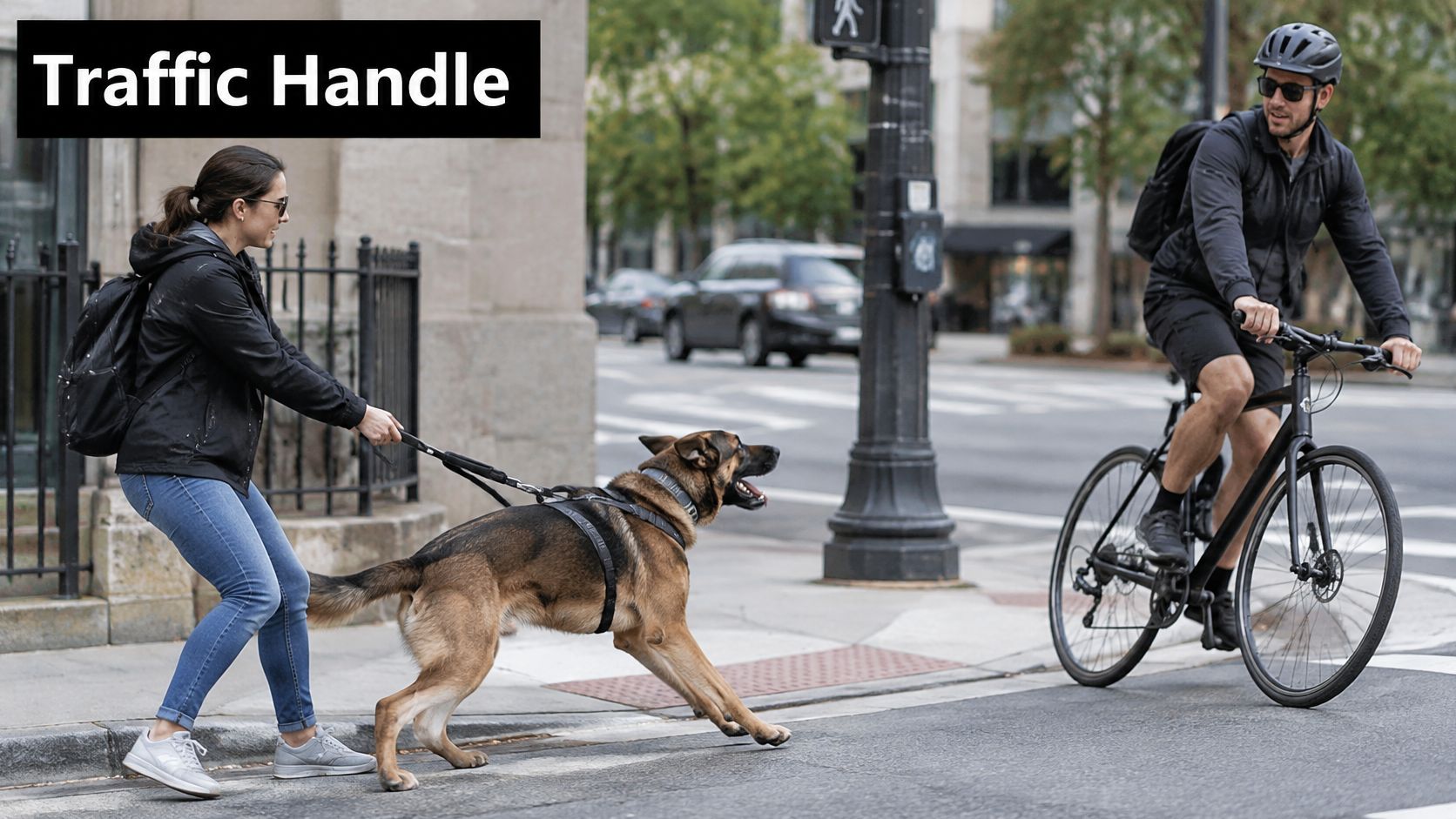
You're at a busy corner, one hand on a coffee, when a cyclist cuts close and your dog lunges. The long leash goes slack, then snaps tight, and you need the dog beside you before the light changes. A dog leash with traffic handle is built for that second. The main lead stays long enough for a normal walk. A short loop near the clip lets you bring the dog in without wrapping the whole leash around your hand.
That two-distance setup is simple, and it is easy to buy the wrong length, the wrong width, or a handle that was never meant to take a hard pull. What follows is how the handle works, how to match it to your dog and your streets, how to hold it, and when it is the wrong tool.
What a Traffic Handle Is and Why It Matters
A traffic handle is a short padded loop or grip sewn onto the leash near the clip. You grab it when you need the dog close. You don't shorten the whole lead, and you don't slide your hand down to the collar. The handle sits in your hand zone, a short reach from the clip, so the dog's head stays near your leg.
Think of the main leash as the open road. It gives ordinary walking room. The traffic handle is the merge lane you use when traffic gets close, then you let it go.
Three moments show the two distances.
Crossing a street. On the long section the dog can walk a step ahead. At the curb you take the traffic handle, and the working length drops to the space between your hand and the clip.
A crowded sidewalk. A long leash sweeps ankles. The short grip keeps your dog in a narrow lane beside your knee until the crowd thins.
An elevator or lobby. Doors and tight walls leave no room for a long arc. You gather the handle before you step in, and you release it on open pavement.
Close control matters because leash walking already sends many adults to emergency departments. A 2023 analysis of the National Electronic Injury Surveillance System, covering 2001 through 2020, estimated 422,659 adult injuries associated with leash-dependent dog walking, about 21,113 cases a year, in the study indexed on PubMed. The yearly estimate rose from 7,282 injuries in 2001 to 32,306 in 2020. Falls caused by being pulled or tripped by the leash accounted for 55% of cases.
Those figures do not prove that a traffic handle prevents injury. They show why fast, close control matters when a dog pulls, lunges, or changes direction in a tight space.
Name the two working distances before you shop. One is the full leash for a normal block. The other is the short handle for the curb, the crowd, and the elevator. If your walks include those moments, the second distance is what you are buying.
Sizing Your Leash by Dog Size and Walk Type
Find your dog's weight row first. Length and webbing width follow from that row, not from a generic "one size" label.
| Dog Size | Typical Weight | Leash Length | Webbing Width | Handle Note |
|---|---|---|---|---|
| Small (Chihuahua, Yorkshire Terrier, Pomeranian) | Up to 15 lb | 4 to 5 ft | 3/4 in | Light handle, avoid bulky hardware |
| Medium (Beagle, Pug, French Bulldog, Shih Tzu) | 15 to 30 lb | 5 to 6 ft | 1 in | Padded handle with secure clip |
| Medium-large (Border Collie, Cocker Spaniel) | 30 to 50 lb | 6 ft | 1 in | Padded handle with load-rated clip |
| Large (Labrador Retriever, German Shepherd) | Above 50 lb | 6 ft | 1 in or wider | Load-rated hardware and reinforced seams |
| Strong or pulling dog of any size | Any weight | 5 to 6 ft | 1 in or wider | Pair with a well-fitted harness; handle is not a restraint |
Why weight is only the start
Heavier dogs usually make more leash tension, and they often pull less often. Smaller dogs can still load a leash hard. Load-cell research found that larger, heavier dogs generally generated greater leash tension but pulled less frequently, while smaller dogs in some studies produced mean forces as high as 122% of their body weight, as reported in work published on PubMed Central. A light dog still needs a solid clip. A bulky metal handle on a 10-pound dog just drags.
The same research found that back-connection harnesses can produce stronger, more sustained pulling toward food than neck collars, with a median maximum tension of 6.08 N and a median mean tension of 2.75 N under the tested conditions. If your dog pulls toward food or other dogs, put the traffic handle on a well-fitted harness, not on a neck collar you use to yank them back.
Length by the walk you actually take
Use 4 to 5 feet for tight urban blocks, elevators, and narrow sidewalks. Use 6 feet when the route has more room and you want a normal sniffing pace between crossings. Trail days add another check. Park rules can limit length and where a dog may be off leash, and the guide to dog rules in Texas state parks is a clear example of reading the site rules before you pack a long lead.
Three-point fit check
- Weight row. Match the dog to the table, not to a breed photo on the box.
- Seller range. Confirm the listing states an intended dog-size range, webbing width, and hardware material.
- Handle rating. Confirm whether the traffic handle is load-bearing or only a handling aid. Treat it as a handling aid unless the full assembly has been tested.
A broad, low-abrasion grip, reinforced seams, and a corrosion-resistant clip belong on every row. The handle should share the leash's rated webbing and primary attachment point. It is not a second leash unless the maker tested it that way.
Features to Compare Before You Buy
Five current listings show how far "traffic handle" can stretch, from a full walking leash to a short grip-only lead. Read the table from the top, then use the checks under it. Cells marked not listed were not on the product page, so confirm them with the seller before you pay.
| Product | Length | Width | 2026 Listed Price |
|---|---|---|---|
| Ruffwear Front Range Traffic Handle Dog Leash | 5 ft | 3/4 in | $17.49 on sale (list $24.99) |
| Frisco Traffic Leash with Dual Padded Handles | 6 ft | 1 in | $14.99 |
| PetSafe Comfort Traffic Handle Dog Leash | 4 ft | 1 in | $19.99 |
| Leash Boss Traffic Handle Short Dog Leash | 12, 18, or 24 in | 1 in | Not listed |
| Ruffwear Roamer Bungee Dog Leash with Traffic Handle | Not listed | Not listed | $49.99 on sale |
How to read those rows
In 2026, Chewy's Front Range listing showed the Ruffwear Front Range at $17.49 on sale against a $24.99 list price, 5 feet long and 3/4 inch wide. That narrower webbing fits smaller dogs. The same year, Chewy's Frisco page listed the 6-foot Frisco Traffic Leash with dual padded handles at $14.99, with 1-inch webbing and 35 centimeters from the shorter handle to the clip. Two grips help if you pass the leash between hands.
Chewy's PetSafe page listed the PetSafe Comfort at $19.99, 4 feet long and 1 inch wide, which suits close urban walks. In 2025, Chewy's Leash Boss page listed short handle leashes at 12, 18, and 24 inches, each 1 inch wide, with no price on that listing. Those are close-control tools, not everyday sniffing leashes. In 2026, Ruffwear listed the Roamer Bungee with a traffic handle at a $49.99 sale price. Length and width were not on that page.
Shop checklist
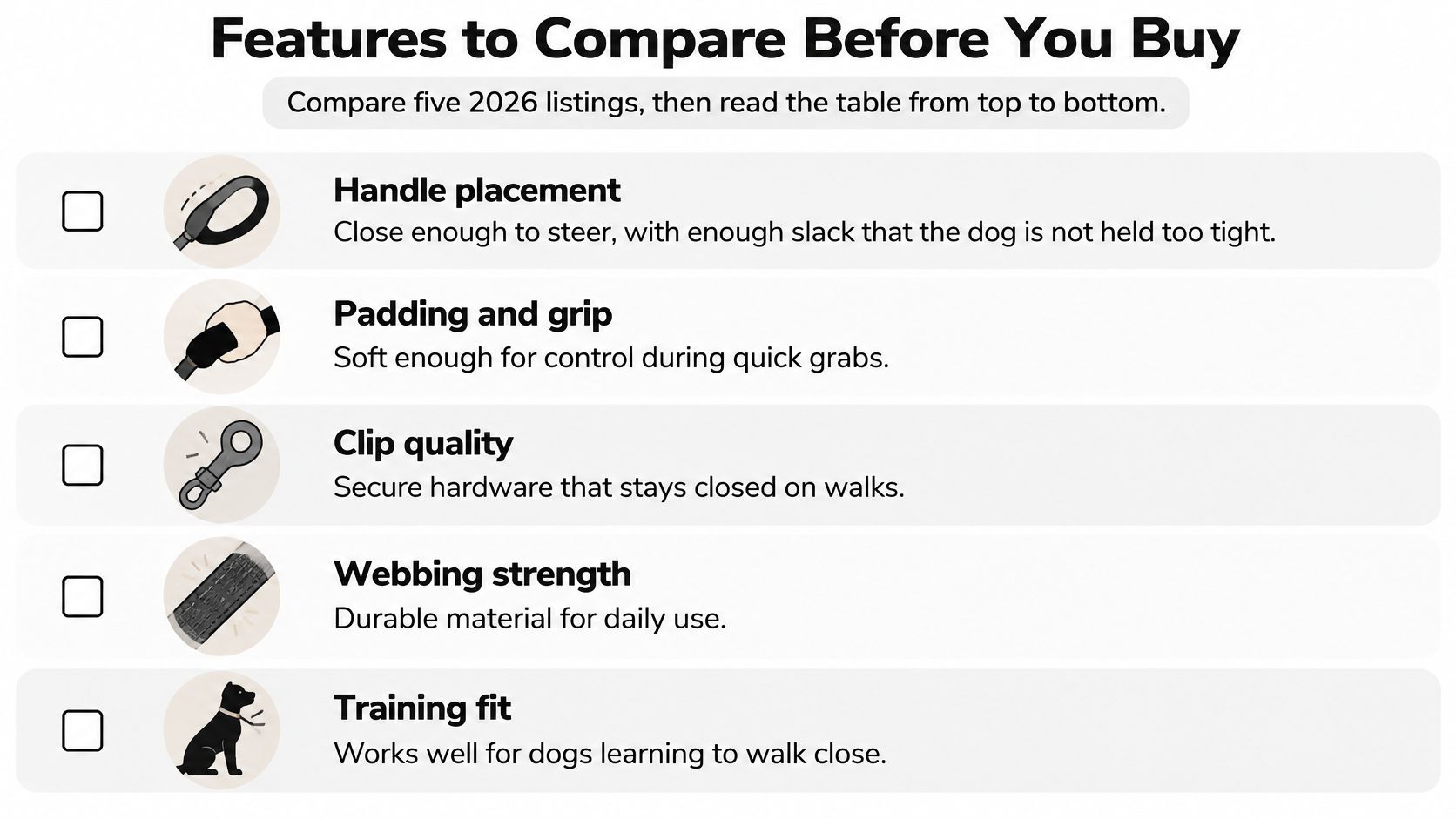
- Length and width. Match the printed numbers to your weight row.
- Handle placement. Close enough to steer, with enough slack that the dog is not held tight the whole block.
- Grip. Broad padding that does not invite you to wrap the webbing.
- Hardware. Corrosion-resistant swivels and a locking or double-latch clip that stays shut.
- Load note. If the page never says the handle is load-bearing, assume it is a handling aid.
- Night walks. Reflective trim helps drivers see the leash, not just the dog.
A bungee section softens a sudden load. It does not replace webbing strength or a tested seam. For a wider look at materials and hardware, the premium dog leashes notes are a useful companion while you compare listings.
When a Traffic Handle Helps and When It Does Not
The strongest use is a dog who already walks calmly, on routes with repeated close calls. Street crossings, busy intersections, elevators, lobbies, crowded markets, and training walks full of distractions are the jobs this grip does well. You already have a standard leash. You add a second, shorter hold for the ten seconds that matter.
It does not replace training, a properly fitted harness, or professional help for serious reactivity. It is a poor main fix for a dog who pulls hard on every block. A yard problem is a different problem. If the dog bolts at the door, compare fence options for dogs before you treat a short handle as containment.
Risk in proportion
Absolute risk is low, and the injuries that do happen can still be serious. An AVMA-published analysis reported about 105 leash-related injuries per million people in 2018, about one in 10,000, and only 0.04% to 0.06% of all emergency-department injuries, in the JAVMA paper. Risk is uneven. That Johns Hopkins study found that 75% of injured adults were women, 47% were ages 40 to 64, and adults 65 or older had higher odds of fracture and traumatic brain injury.
A calm handler with good balance gets more from a traffic handle than a handler who cannot brace a sudden lunge.
Four questions, three verdicts
Answer these for your real walks. Dog behavior: calm, pulls, or reactive. Your strength and balance. The route: quiet suburb or dense city. Whether you can release the leash quickly if you are pulled off your feet.
Useful. The dog is calm on a standard leash, and you cross streets or thread crowds often. The handle is a convenience you will grab.
Useful with training. The dog lunges at cyclists or pulls at intersections. Fit a harness, teach a gather cue, and only then add the handle. A dog leash for pulling is the better starting point if tension is the whole walk.
Not the right tool. The dog is strong or reactive and you cannot brake safely. Get hands-on help first. A shorter grip will not invent balance you don't have.
How to Hold the Traffic Handle Safely
A traffic handle gives you a second, closer grip for a crossing, a passing bike, or an elevator door. It works like a handrail on stairs: the rail helps you steady yourself, but it does not stop the stairs from moving. The loads on a leash are not a gentle steady pull. An instrumented study recorded a maximum pulling event of 412.5 N at a loading rate of 2,868.7 N/s, and half of the handlers felt at least 125 N during routine walks, according to the Annals of Biomedical Engineering paper.
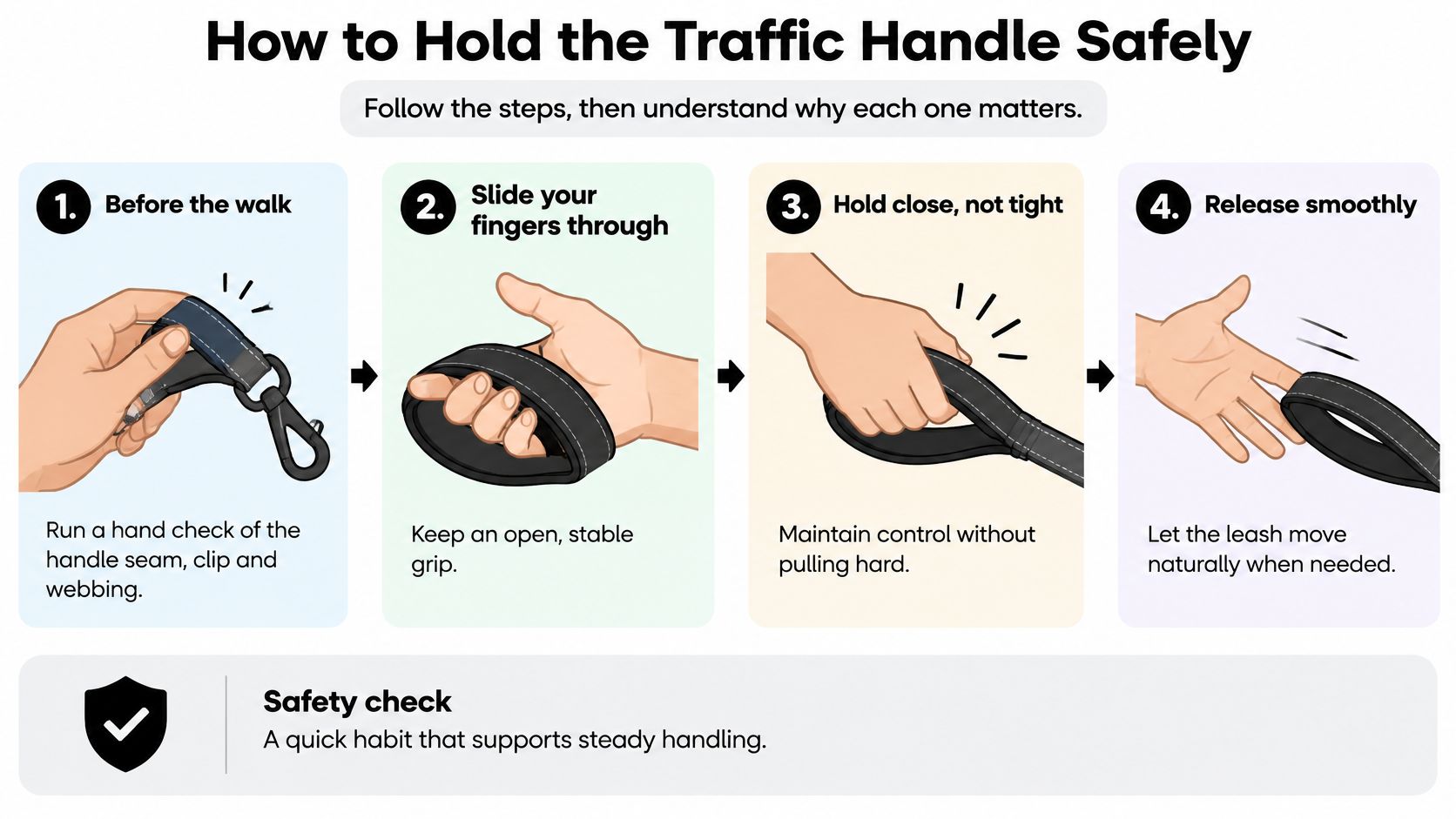
That closer grip has a trade-off. You shorten the distance between your hand and the dog, which improves reaction time and steering. You also put your hand closer to the source of a sudden lunge, so the grip must be one you can release, not one you lock down.
Grip steps
- Check the gear. Before you leave, run a hand over the handle seam, the clip, and the webbing. A frayed stitch or a sticky gate fails at the worst moment, not on the couch. This is the pre-flight check, and it takes ten seconds.
- Take an open grip. Slide your fingers through the handle, palm up or sideways, and keep your wrist neutral. An open hand can release. A clenched wrap cannot.
- Keep the leash off your wrist. Never wrap webbing around fingers or the wrist. Sudden force twists joints, and the wrap turns a leash into a loop you cannot shed.
- Gather before the hazard. At the curb or the elevator, take the handle and keep the dog's head at your side. You are shortening distance, not hanging on the dog.
- Brace with your body. If a pull comes, set your feet and hips. Don't catch the whole load with one arm. The handle should share the force with your stance.
- Recheck after the jolt. Look at the seam and the hardware before you walk on. A stretched stitch is a reason to finish on the main handle only, or to go home.
If someone else walks your dog, teach this grip instead of assuming they know it. Leave a reminder on the leash hook so a substitute doesn't wrap the lead "for a better hold." The same handoff matters when you arrange in-home pet care in Birmingham: a sitter who understands the open grip will not turn the handle into a fixed loop.
What to ask a seller
A fair product test is dynamic, not a single static hang. Ask whether they run repeated impulse loads at the handle-to-leash seam, inspect for stitch stretch and bent hardware, and test wet or dirty webbing. Position should steer the dog without holding them tight the entire walk. The handle is still not a substitute for training or the right harness.
How to Train Your Dog to Walk Close on the Handle
Start where the dog can think. A quiet room beats a corner full of bikes.
Cities have asked owners for close control for a long time. New York City records show that by 1859, dogs in public streets had to be muzzled or led by a chain or string, and in 1934 the sanitary code required a leash shorter than six feet, a change the Municipal Archives ties partly to easier enforcement and fewer bites. A traffic handle keeps that close option without cutting your everyday leash down to a constant short lead.
Six steps
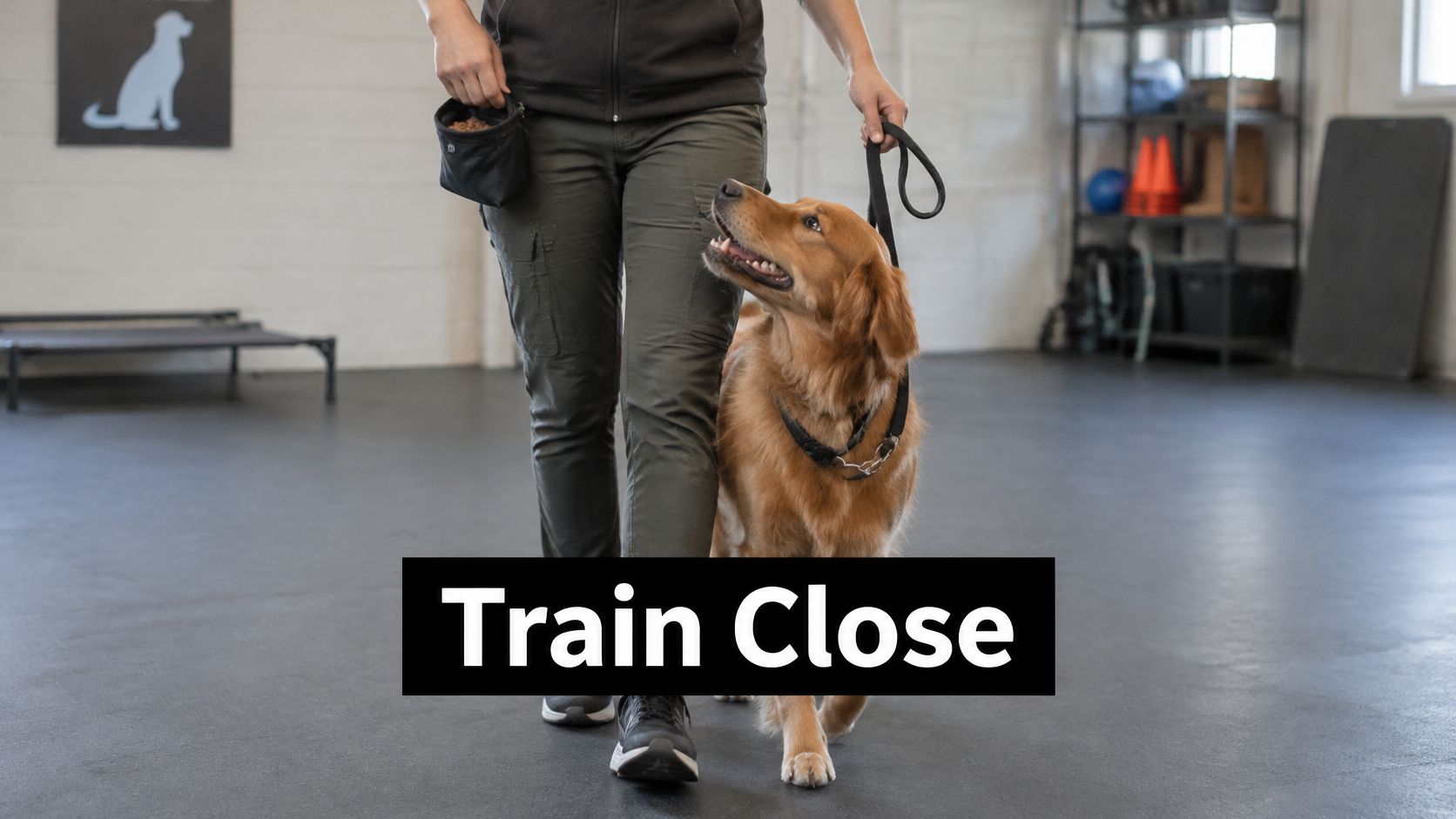
- Build the zone. In a quiet room, hold treats at your side and pay the dog for standing next to your leg. You are teaching a place, not a correction.
- Add a cue. Say "close" the moment the dog arrives, then treat. The word has to mean the place, or it becomes noise.
- Practice a short gather. Lightly collect the handle, pause for two seconds, release, and reward. The gather should feel boring, not like a trap.
- Change the floor. Move to a quiet sidewalk, then add a curb, a driveway, and a parked car. One new thing at a time.
- Add real life. Passing cyclists come before elevator doors. Doorways are a separate drill, because the dog wants to rush the threshold.
- Thin the food. Once the dog holds position through three distractions in a row, treat sometimes, not every step.
Puppies need the same order at a slower pace. A leash training puppies plan keeps early sessions short so the handle never becomes the only reason the dog stays near you.
If the dog pulls
Use a harness when the dog lunges, not a neck collar you haul on. When the leash goes tight, stop. Don't force a halt by yanking the traffic handle. The handle is a backup that works after the dog already answers the cue.
Watch a short heel pattern, then copy the reward timing rather than the handler's speed.
Keep sessions to about ten minutes, three times a week. One step per session. If the dog pants, scans, or shuts down, take a rest day before you add the next step.
Care, Durability and Common Problems
Hardware usually fails before the pretty webbing does. A stuck clip can cost you the second you needed to release.
Routine care
- After salt, mud, or a wet walk. Rinse with fresh water. Grit in the weave wears any coating, even on a leash labeled waterproof.
- Drying. Hang the leash away from heaters and direct sun. Trapped moisture stiffens fibers and feeds rust.
- Monthly. Pinch the handle seam, open and close the clip, and twist the swivel. Replace any leash with cuts or fraying next to the handle.
- After a hard fall or a big lunge. Recheck that seam the same day, not next month.
| Symptom | Likely Cause | Fix | Time to Fix |
|---|---|---|---|
| Handle stitching frays or stretches | Repeated load at the seam or abrasion on pavement | Retire the leash; inspect the seam before each walk | Replacement |
| Clip or swivel rusts or sticks | Salt, mud, or wet walks without rinsing | Rinse and dry; lubricate, or replace the hardware | Minutes, or replacement if still stuck |
| Webbing stiff or gritty after rain | Trapped grit wearing the weave or coating | Rinse with fresh water, then air dry fully | About a day |
| Handle slides down the leash | Loose attachment or handle placed too far from the clip | Re-secure the attachment; reposition closer to the clip | Minutes |
| Dog lunges through the handle | Handle used as the only control | Add a fitted harness and handle-based training; do not rely on the handle alone | Ongoing training |
When to retire it
If a seam shows any stretch, or the handle has taken a hard fall, retire the leash. Home sewing does not restore the original stitch pattern or the tested load path. A sliding handle that you can reposition in a minute is a maintenance job. A handle that has already elongated is not.
Lubricate a sticky swivel only after it is clean and dry. Oil on grit makes a paste that wears the gate faster. If the gate still sticks after a rinse and a drop of lubricant, replace the hardware or the whole leash. Don't walk on a clip you have to thumb twice.
Choose the Right Traffic Handle Leash and Answer Common Questions
Decide in three moves. Match length to the walk, 4 to 5 feet for tight urban space and 6 feet when you want more room between crossings. Match webbing width to the weight row, not to the color you like. Confirm the handle sits within an easy reach so you never wrap the leash to "make it shorter."
Run the hardware and seam checks before you buy. You want a locking clip, a swivel that turns freely, and a handle attachment that doesn't slide. Our leashes use a double-latch, and Nandog Pet Gear dog leashes are waterproof, so rain is a rinse-and-dry job rather than a soaked-webbing problem. Questions can go to store@nandog.com, +1-323-433-4390, or chat on the site.
Do you need a traffic handle
Use the three verdicts. It is useful for a calm dog and frequent crossings or crowds. It is useful with training if the dog lunges and you already have a fitted harness and a gather cue. It is the wrong tool if you cannot brake the dog safely.
Can the handle hold a pulling dog
No. Pair it with a fitted harness and training. The grip helps you steer for a moment. It is not a brake for a dog who loads the leash on every block.
Is the handle load-bearing
Ask before you trust it. Treat the handle as a handling aid unless the complete assembly has been tested. A padded loop can feel strong and still be stitched as a comfort grip only.
A traffic handle leash is worn daily, so pick colors and materials that match the rest of your walking kit, including a design-forward look if that is what you enjoy carrying.
Measure your dog's weight, pick the matching sizing row, and run the seam and hardware check before the first walk. Then practice the gather in a quiet room, not at the busiest corner you know.
Nandog Pet Gear makes design-forward walking gear, including waterproof leashes with a double-latch, for owners who want close control without giving up a normal walking length. If you are matching a traffic handle setup to city blocks, elevators, and everyday training, browse the leash and harness styles at Nandog Pet Gear and choose the length and width that fit your dog before the next busy crossing.