


Your dog steps into bed, turns to settle, and pushes the whole cushion across the hardwood. You straighten it, only to find it halfway toward the doorway after the next nap. Adding a heavier blanket won't necessarily help, because the problem is usually traction, not a lack of padding.
To keep a dog bed from sliding, match the underside to your floor, make sure your dog's paws have purchase, and secure the walking space around the bed. A grippy mat can help, but it won't solve slippery paws or an unstable approach.
Why Your Dog Bed Slides and the Fix for Your Floor
Friction decides whether a bed stays put. When your dog pushes off sideways to turn or rise, that force has to be absorbed by the contact between the bed's underside and the floor. Three things weaken that contact: a slick floor finish, contamination like dust or water, and a smooth fabric bottom. Grip depends on the pairing, so read the table below as a practical starting point, since each combination behaves a little differently.
| Floor | Grip Risk | First Fix | Note |
|---|---|---|---|
| Polished tile | Very high | Full-coverage rubberized base | Wet paws and spills make it worse |
| Hardwood | High | Full-coverage rubberized or PVC-dot base | Check performance after normal damp-paw entries, without deliberately wetting the floor |
| Laminate | High | Full-coverage textured base | Avoid adhesives on the finish |
| Polished concrete | Very high | Full-coverage base plus a traction runner | Check the approach as well as the bed |
| Low-pile carpet or flat rug | Low | Keep the bed flat with no bunched edges | Lift and inspect loose rug corners before testing |
A smooth fabric underside offers little resistance when a dog pushes sideways while turning. A bed can also move because its cover folds beneath it, leaving only part of the bottom in contact with the floor. A plush top doesn't tell you anything about grip underneath.
The material under the bed is only one part of the traction system. The route your dog walks to reach it sets the speed and angle of entry, and a fast approach on polished tile hands the bed more sideways force than most undersides can absorb.
Stability matters beyond appearance
Joint discomfort makes an unstable resting area more consequential. Osteoarthritis is common in dogs, particularly as they age, and stiff joints turn a small slide into real work. Seniors, overweight dogs, and dogs already showing joint discomfort benefit most from predictable footing. When a cushion shifts during rising or turning, the dog has to reset its paws and push again to finish the movement.
Bed fit matters, too. Use this dog bed selection guide to weigh sleeping position and usable space, rather than choosing an oversized cushion solely for its appearance.
If your dog comes inside from a patio, check the handoff between surfaces as well. Tiles Mate Pty Ltd's guide to safe outdoor flooring for Melbourne weather gives useful context for assessing that outdoor stretch, though indoor testing still decides the final setup.
Start with observation: Find your floor in the table, then watch whether the cushion actually moves when your dog gets up. Fix the movement you can see, rather than buying grip accessories blindly.
When the Dog's Paws Cause the Slide
A stationary bed can still be difficult to use. If your dog's front paws slide outward while the cushion stays put, attaching more rubber underneath won't address the main problem.
Watch a normal approach, turn, and rise without encouraging your dog to jump. Compare the bed's position with a floorboard seam or grout line, and pay attention to where the paws lose purchase. Hesitation before stepping onto the bed can also reveal an uncomfortable transition.
Vital Vet's home traction guidance identifies nail length, paw maintenance, and reduced mobility as relevant contributors to slipping. Long nails and overgrown fur between the pads deserve attention before you assume the bed is defective.
| Symptom | Likely Cause | First Fix |
|---|---|---|
| Bed slides only when the dog jumps on | Fast approach on slick floor | Add a route runner and encourage a slower entry |
| Paws slip when rising | Long nails or matted paw fur | Trim nails and clear excess fur between pads |
| Dog avoids the bed | Unstable approach or stiff joints | Add approach traction and arrange a veterinary check |
| Paw pads cracked or sore | Dry skin or worn pads | Ask about pet-safe pad moisturizer; see a vet for cracks or soreness |
| Bed moves after washing | Damp or distorted underside | Dry fully, reshape, and repeat the push test |
These are troubleshooting clues, not diagnoses. For example, a dog avoiding a bed might dislike its location, but avoidance combined with stiffness warrants a health assessment rather than repeated bedding changes.
Fix the dog's footing before adding hardware
Start by inspecting the paws while your dog is relaxed. Look for nails that need trimming, tangled fur covering the pads, and damaged skin; use a groomer or veterinary team if you're unsure how to handle those safely.
Then provide a secure landing area beyond the cushion's edge before securing the cushion itself. This order lets you distinguish a paw-traction problem from a bed-traction problem instead of changing everything without knowing what helped.
- Nails: Trim gradually and avoid cutting into the quick.
- Paw fur: Have excess hair tidied without digging scissors into the spaces between pads.
- Pads: Don't apply household lotions or improvised treatments to sore skin.
- Mobility: Seek veterinary assessment for limping, reluctance to rise, difficulty climbing, or worsening slipping.
A bed that doesn't move isn't automatically a safe bed area. Your dog needs purchase while approaching, turning, lowering its body, and standing again.
For a post-operative dog, follow the treating veterinarian's movement restrictions. Don't use a successful traction test as permission to resume jumping or unrestricted activity.
Install a Non-Slip Base That Holds Through a Full Session
A good underlay must grip both the floor and the bed. If it stays on the floor while the cushion slides across its top, you've only secured half the setup.
Use this installation sequence before deciding that a material works.
- Identify the surface. Treat polished tile, hardwood, laminate, and polished concrete as demanding applications. Check the floor-care instructions for restrictions on rubber, plasticized materials, and adhesives.
- Clean and dry both contact surfaces. Vacuum hair and grit, clean away residue, and let the floor dry completely. Inspect the bed underside as well, especially after laundering.
- Fit the base and flatten the bed. Cover the support area without leaving exposed flaps for paws or teeth to catch. Smooth folded fabric and curled corners so the underside sits evenly.
- Push from the usual entry side. With the dog elsewhere, apply a controlled sideways push and watch which interface moves. Repeat from the same position rather than changing the direction and force each time.
The process begins with preparation, not adhesive strength.
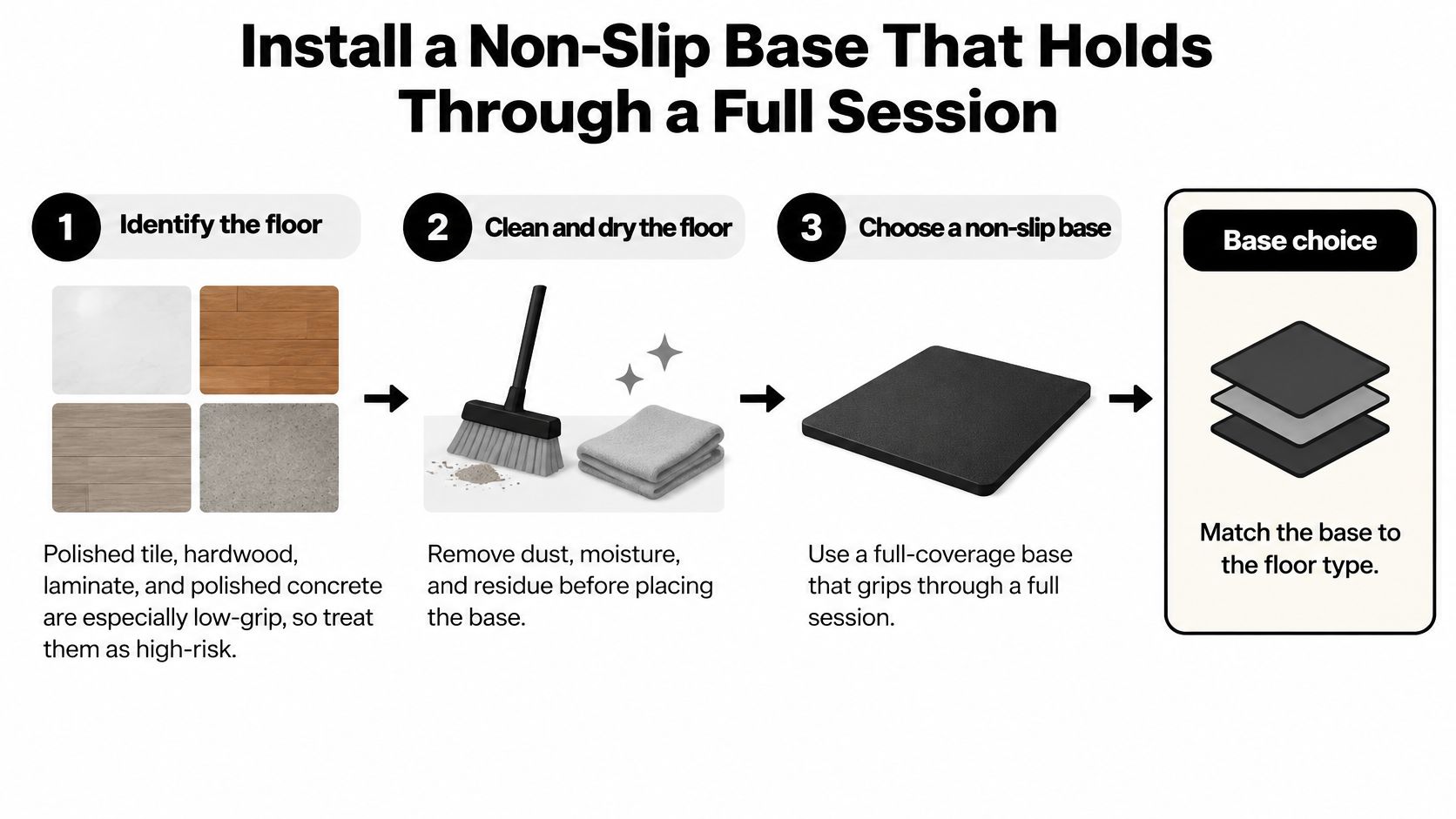
Choose coverage before extra cushioning
StridePaw's hard-floor stability guide uses movement of more than approximately 2 inches during a use session as a practical failure threshold, not a veterinary safety standard. You should still correct smaller movement if it visibly unsettles your dog.
Full-coverage rubberized, PVC-dot, and textured thermoplastic bases provide contact throughout the loaded area. Perimeter-only strips and scattered dots leave more of the center unsupported by grip material, so their performance deserves closer checking.
| Base Type | Coverage | Best For | Washable-Bed Check |
|---|---|---|---|
| Full-coverage rubberized mat | Entire underside | Hard floors and heavier beds | Confirm the bottom fabric tolerates contact |
| PVC-dot or thermoplastic base | Entire underside | Tile, hardwood, and laminate | Check backing care instructions and inspect for distortion |
| Silicone grip dots | Spot pattern | Light beds on smooth floors | Can leave marks; test first |
| Anti-slip tape or adhesive strips | Perimeter spots | Temporary fixes only | Residue risk on finished flooring |
| Rubber shelf liner | Single sheet | Small, light beds | Check for odor and curling after cleaning |
| Rug pad | Full area | Hard floors beneath thick cushions | Can bunch; not a walking traction zone |
I would start with a removable, full-area underlay, provided it's compatible with the floor finish. It's easier to inspect, clean, and replace than adhesive attached directly to a washable cover.
Don't confuse a moisture barrier with a grip layer. This pet waterproof mat guide can help you consider spill protection separately; a waterproof surface still needs its own traction check.
If you're replacing flooring rather than adapting an existing room, Flacks Flooring's guide to choosing slip-resistant vinyl flooring offers broader selection context. New flooring doesn't eliminate the need to test the particular bed and underlay together.
Test compatibility and ordinary use
Place a sample of the proposed material against an inconspicuous part of the bed underside and, where permitted, the floor. Leave it through normal household conditions, then inspect for discoloration, tackiness, odor, or fabric distortion before committing to full coverage.
A washable bed doesn't make every accessory washable. Remove separate underlays before laundering unless their care instructions explicitly allow otherwise, and don't assume adhesive dots will tolerate the same cleaning cycle as the cover.
Avoid permanent adhesives on finished floors. Shelf liner can be a useful trial material, but remove it if it curls, smells strongly, transfers residue, or attracts chewing.
Pass condition: The bed remains settled, the underlay stays flat, and neither contact surface creeps during an ordinary approach, turn, and rise.
Don't stop after an empty-bed push test. Supervise normal use, including the period after a walk, and inspect any dampness before letting your dog continue.
Common failures include spanning a rug edge with half the cushion, relying on cushion weight alone, and testing only under unusually pristine conditions. A thin rug pad belongs beneath the bed, not exposed as a loose walking surface. If either layer migrates or bunches, change the fit or material instead of stacking more loose layers.
Securing the Route Your Dog Walks Every Day
Follow your dog's usual walk toward the sleeping area. Notice where it slows, turns beside the cushion, steps in, and places its paws when leaving. Those spots define the traction layout more usefully than the bed's outline alone.
Place the bed against a wall or in a corner, but leave an unobstructed approach. A wall can limit travel in one direction; it doesn't secure the open sides or provide footing for a dog turning nearby.
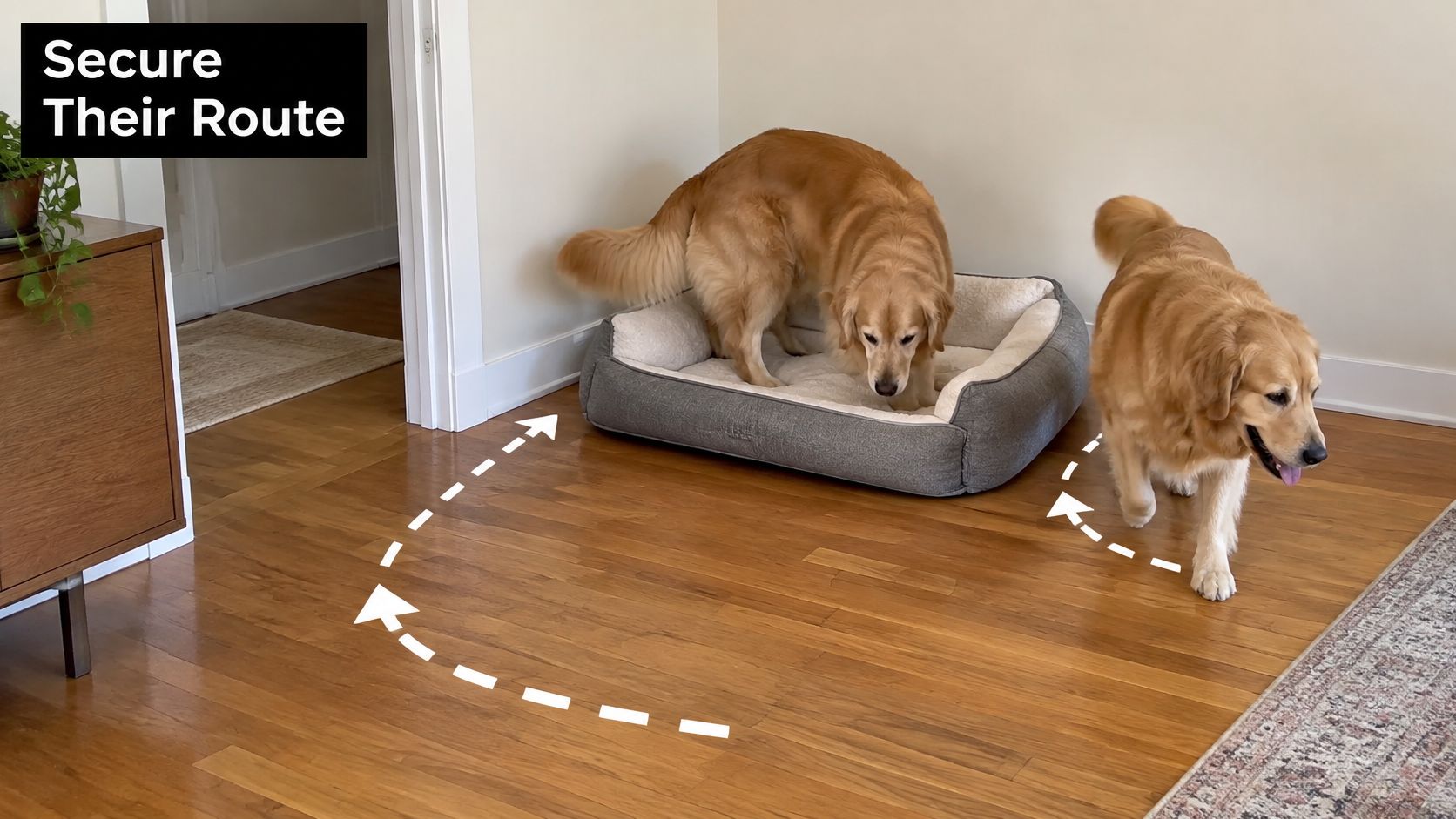
Connect the places your dog actually uses
The Dog Aging Project's mobility guidance recommends traction along frequently used household routes, including sleeping areas, hallways, doors, feeding areas, and furniture. Dogs with arthritis, IVDD, weakness, or post-surgical restrictions may struggle during these transitions even when the bed itself stays fixed.
Use a low-profile, securely anchored runner or rubber-backed mat that provides several steps of footing on the approach and exit. A tiny patch directly beside the cushion can leave the dog stepping onto slick flooring just as it turns.
- Approach: Provide a straight, clear path rather than a tight turn around furniture.
- Bedside turn: Leave enough grippy space for the dog to reposition without stepping off the mat.
- Exit: Account for the direction your dog leaves, not just the direction it enters.
- Connected spaces: Address nearby food bowls and doorways if the same route includes them.
There's a real design trade-off here. A large rug may provide useful coverage but visually dominate a room; a thinner, well-anchored runner may suit the space better, provided its edges stay flat and the dog has enough usable footing.
Avoid loose rugs that gather under paws and mats with raised borders across the walking line. Inspect for chewing damage, and reassess the layout after cleaning, laundering, or furniture changes. Don't encourage running or jumping onto the bed to demonstrate that the arrangement works.
Confirm the Setup Before Your Dog Relies On It
Judge the finished arrangement by an ordinary rest cycle, not by how firmly the cushion resists a hand tug. Your dog should be able to approach, settle, and leave without scrambling or hesitating.
A correctly fitted bed that stays put is more useful than a larger, softer cushion that creeps across the room. Extra bulk can also crowd the clear walking space you've worked to create.
Make the final inspection practical
- Floor ready: Confirm that the surface is clean, dry, and compatible with the chosen backing.
- Base seated: Check that the support area is covered and no underlay protrudes as a loose flap.
- Push test passed: Look for movement at both interfaces, then supervise normal use.
- Route clear: Confirm that approach and exit mats remain anchored with flat edges.
- Dog comfortable: Check paw care, watch the rise from rest, and act on new hesitation or gait changes.
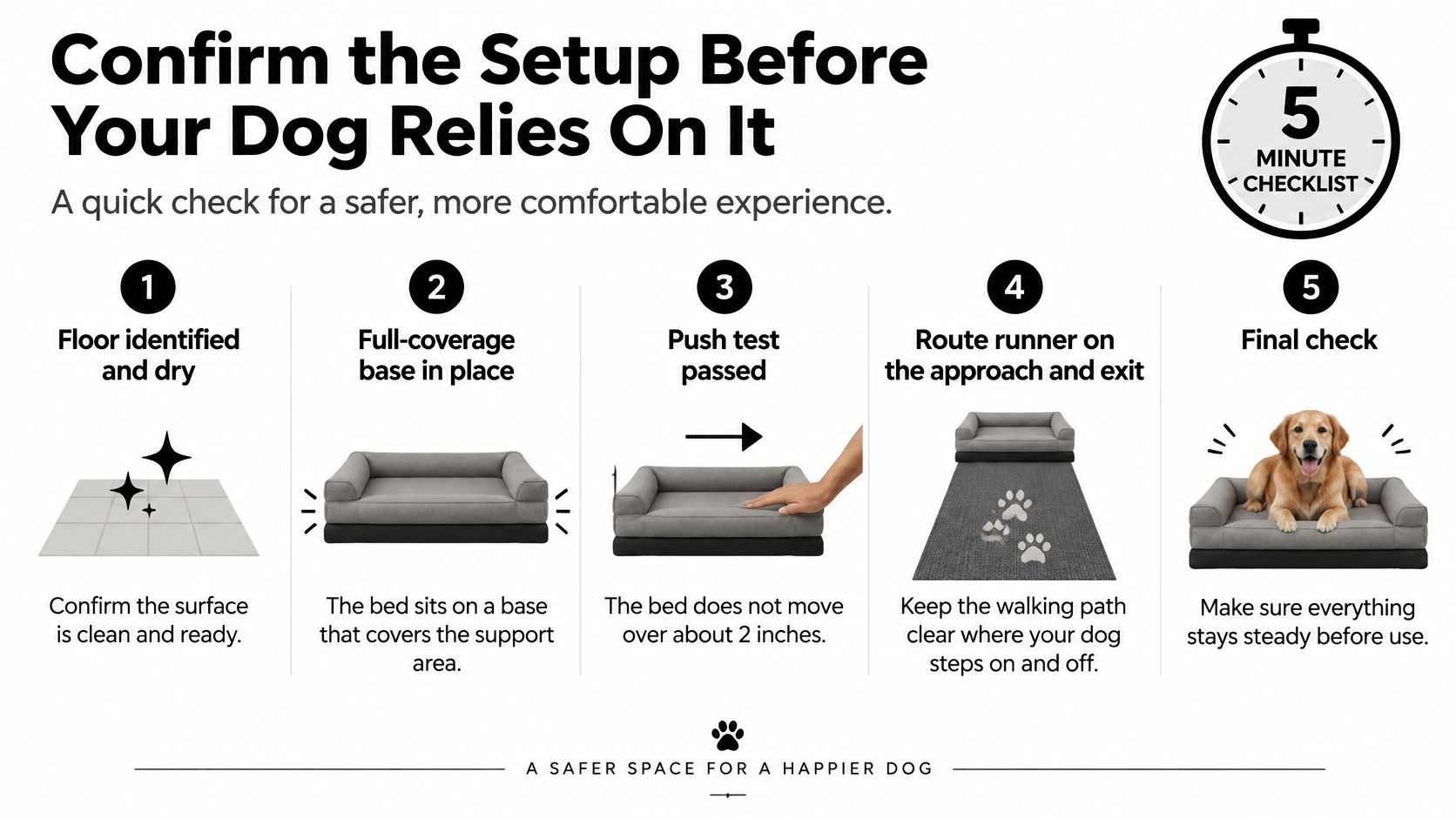
Make inspection part of resetting the sleeping area after every wash or furniture move. Add a calendar reminder to examine the backing after sustained heavy use, and check sooner whenever your dog's movement or willingness to use the bed changes.
Our beds and their covers are washable, so keeping the sleeping area clean doesn't require abandoning easy care. Dry the relevant components completely and restore their shape before putting the arrangement back into service.
Apply the same practical thinking at the feeding area. A non-slip dog bowl setup helps address another place where your dog stops, shifts weight, and turns on the daily route.
This week, test the bed on the floor where it will stay. Fix any creeping layer, unstable edge, or slippery landing area before asking your dog to rely on it again. Persistent or sudden mobility changes need veterinary attention, not another accessory.
Nandog Pet Gear offers washable beds in styles including Cloud, Signature Reversible, and Orthopedic, and all our beds come with a 100-night sleep trial. Visit Nandog Pet Gear to choose a bed suited to your dog's resting position and your room, then pair it with a floor-compatible traction setup.