

A 100% failure rate is a sobering place to start shopping for a dog car seat booster. In the Center for Pet Safety's 2011 pilot study, none of the tested canine harnesses adequately protected both the dog and human occupants under the test conditions. That historical result doesn't mean every current restraint fails. It means a soft cushion, a raised view, and an attached clip aren't evidence of crash protection.
A booster can still have a useful job: giving a small dog a defined place to ride instead of wandering toward your lap. The important distinction is between positioning the dog comfortably and restraining the dog during a collision. Shop for those functions separately, then check whether they can work together.
Why Unrestrained Dogs Make Every Stop Riskier
63% of canine companions traveling in cars were not restrained, according to a paper published in 2018, which also reported approximately 89.7 million dogs in the United States in 2016. Those figures describe a substantial everyday travel problem, not just a niche concern for owners taking long road trips.
Say your dog is standing on the passenger seat when traffic stops unexpectedly. The dog slides toward the footwell, scrambles for purchase, and looks to you for help. You glance down just when you need to watch the vehicle ahead.
Nothing has to break for that situation to become distracting. A dog moving between seats, climbing over the console, or slipping off a cushion creates competing demands on the driver's attention.
Practical rule: Choose a travel arrangement that doesn't require you to reposition your dog while you're driving.
A bounded seat is only part of the answer
A dog car seat booster offers a raised resting place with surrounding walls. For a small dog who settles readily, that can make the passenger compartment feel less open and give the owner a predictable place to secure the dog.
But the paper also describes private crash-test observations involving failed restraint straps and test dummies thrown around. Clipping a dog to something isn't the same as proving that the connection will hold.
Treat the purchase as a system decision: the dog, the harness, the seat, and the vehicle attachment must work together. If your journey also includes flying, Approved Jets' private aviation guidance for pet owners is a separate planning resource for that part of the trip, not a substitute for evaluating the car setup.
Use the claims table below to separate a useful everyday feature from a protection claim that needs stronger evidence.
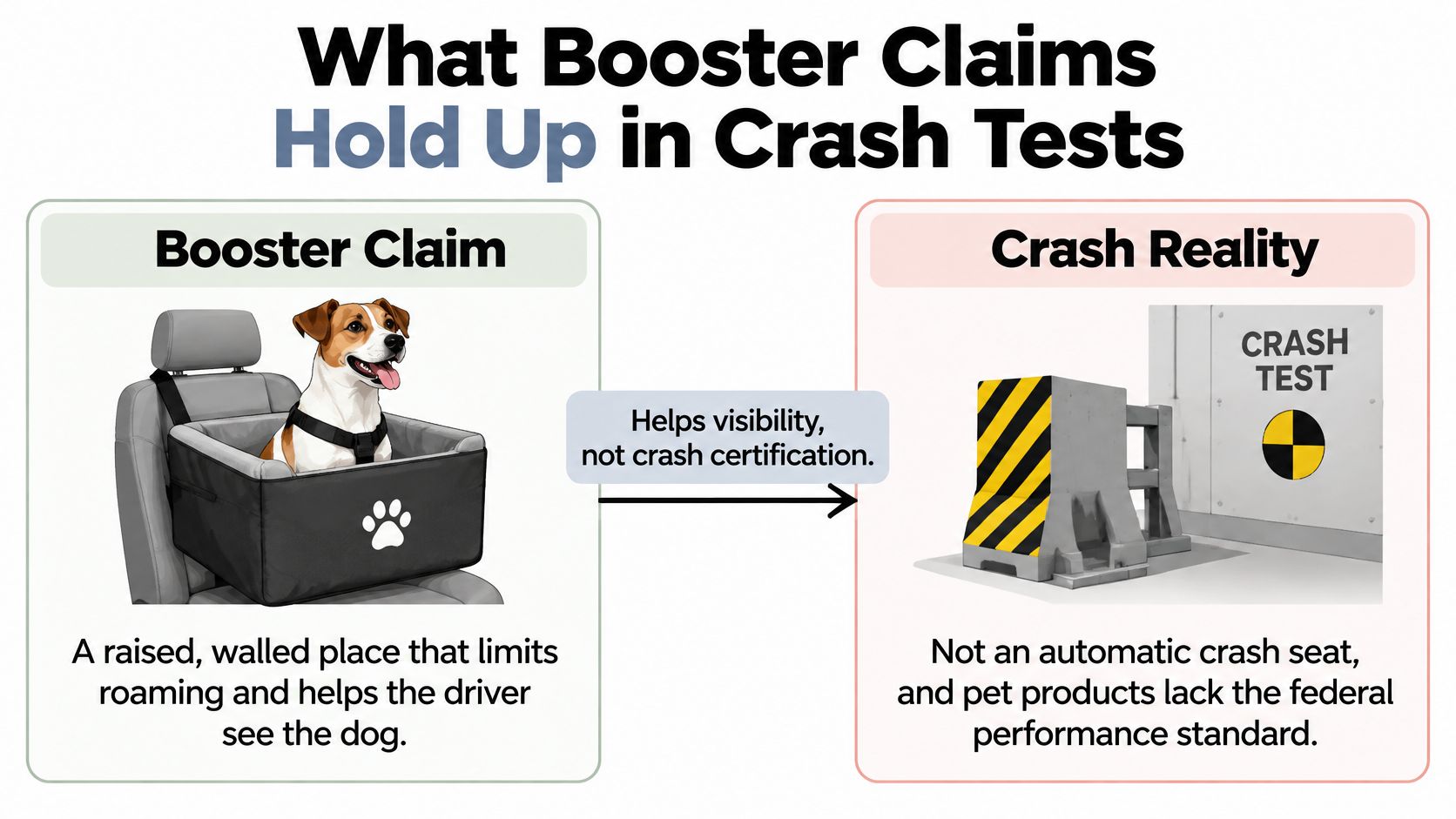
What Booster Claims Hold Up in Crash Tests
What a dog car seat booster can and cannot claim
| Risk | Realistic booster role | Do not assume | Evidence to require |
|---|---|---|---|
| Driver distraction | Raises the dog and discourages lap climbing during normal driving | Walls alone stop a determined jumper | Appropriate fit plus a short, supervised trial ride |
| Sudden braking | Side walls and a tight belt path can limit sliding off the cushion | Foam density equals restraint | Minimal permitted slack and the belt routed as designed |
| Collision forces | Provides positioning within a complete restraint system | The seat itself is crash protection | Independent dynamic testing, surrogate weight, and excursion data |
| Injury to people | Keeps the dog away from the driver during ordinary travel | A failed product stays put | Rear-seat placement plus documented attachment performance |
| Escape or roaming | Provides containment alongside a harness connection | A collar clip or soft loop is enough | A crash-capable harness connected to the vehicle belt as tested |
A booster raises a dog and gives it a bounded place to sit. That may improve visibility and discourage wandering during ordinary driving. These positioning benefits do not show how the seat or its attachments will perform in a collision.
An attachment point is a construction detail, not a crash certification. A belt path or harness hook can help secure a setup, but the presence of either does not establish that the complete arrangement has passed independent dynamic testing. Comfort, positioning, and crash protection are different claims.
What meaningful crash evidence looks like
Early harness testing adapted child-restraint conditions and used a purpose-built canine surrogate. The practical lesson is that a restraint that appears secure during an ordinary ride may respond differently under crash forces.
Later pet-travel-seat pilot testing described in the Subaru safety report, conducted at MGA Research Corporation, found that the tested travel seats did not provide effective crash protection. Some failures could allow the seat or dog to become a projectile. Those findings apply to the products and arrangements tested, not automatically to every seat available now.
Ask for evidence about the complete setup, not just one component. A harness, seat, and vehicle attachment work together, like links in a chain. If one connection fails, the rest cannot establish that the dog was restrained.
- Test surrogate: What dog mass and body form did the laboratory use?
- Impact setup: What conditions did the test reproduce?
- Excursion: How far did the surrogate move forward?
- Attachment results: Did the belt path, straps, and connection points remain intact?
- Pass criteria: What counted as acceptable performance, and who assessed it?
A static statement about how much weight a strap can hold does not answer these questions. A polished video is not enough either, unless a report explains the test conditions and outcome.
Keep the everyday claims modest
The CDC's pet-travel guidance advises keeping dogs in the back seat with an appropriate harness attached to the vehicle's seat-belt system. Keep the dog's head inside the car rather than letting it hang out of the window.
For more context on separating everyday convenience from safety claims, read this guide to whether dog car seats are safe. Use the table as a filter when comparing products: a booster can help position a dog, while collision protection requires its own evidence.
Matching Weight Shape and Seat Size
Booster size bands by weight and build
| Band | Typical exterior | Weight ceiling | Example animals | Pass check |
|---|---|---|---|---|
| Small | Check the specific seat's exterior and usable interior | The manufacturer's stated small-seat limit | Yorkshire Terrier, Chihuahua, Pomeranian | Shoulders and hips stay inside the walls |
| Medium | Compare the internal base with the dog's resting footprint | The manufacturer's stated medium-seat limit | French Bulldog, Pug, Beagle, Shih Tzu | Chest isn't compressed and chin can rest |
| Above booster range | Not a raised seat | Any weight above the selected product's limit | Larger hounds and retrievers | Choose a suitable back-seat harness or secured crate |
| Cat or tiny companion | A compatible small seat | The product's stated limit | Harness-trained cat | Harness fitted, collar clip never used |
There isn't a universal booster sizing chart. A Small from one manufacturer needn't match a Small from another, and exterior dimensions don't tell you how much space remains after padding and bolsters.
Start with a flexible tape measure and your dog's actual posture. Measure body length and shoulder width, then compare those measurements with the usable interior. Put the travel harness on before assessing fit, because straps and chest panels occupy space too.
Weight screens the choice, shape confirms it
A long-backed dog can be light enough for a seat but still need more floor length. If the hindquarters fit only when the shoulders press against the front wall, choosing by weight alone has missed the problem.
A compact, broad-chested dog presents a different challenge. The base may be wide enough while the front bolster presses against the chest or leaves nowhere comfortable to rest the chin. Don't solve that by loosening the harness.
Use these physical checks:
- Seated posture: The hips and shoulders remain supported without balancing on a wall.
- Resting posture: The dog can settle naturally rather than staying braced upright.
- Harness clearance: The seat doesn't push straps into the armpits or force hardware against the body.
- Head position: The dog can rest without hanging the nose awkwardly over the front edge.
Breed examples are starting points, not promises. Individual dogs within the same breed can have very different proportions.
Reject a fit that encourages climbing
A seat that fits the dog's weight but not the dog's body is still the wrong seat.
Recheck growing puppies whenever their posture or harness adjustment changes noticeably. For a cat, harness training and calm acceptance matter more than whether the animal physically fits inside the cushion.
Finally, assess the whole arrangement in a parked car. If the dog can stand and step over the wall with the restraint adjusted as instructed, reject that configuration. Don't shorten a tether until the dog can't sit or lie comfortably just to rescue an unsuitable purchase.
Materials and Features to Check Before Buying
Start underneath the cushion. A plush interior can hide a base that folds, tips, or shifts when the belt is tightened. Press the base and examine the belt path before judging the fabric.
A firm base supports positioning, while a non-slip underside can help resist movement across smooth upholstery. Neither replaces the designed vehicle attachment. Likewise, tall walls may discourage casual climbing, but they aren't a reliable barrier for a determined dog.
A hands-on shopping checklist
- Press the base. It should support the dog without collapsing around the attachment route. Check it on a surface shaped like your vehicle seat, not only on a flat shop floor.
- Inspect the belt path. Look for clear routing instructions and enough clearance for the specified belt arrangement without folded webbing or a buckle trapped against a hard edge.
- Assess the walls. They should support the dog's resting posture without crowding the chest or blocking comfortable head placement.
- Identify the hook's purpose. Ask whether it provides everyday containment or belongs to a documented crash-tested configuration. A metal appearance alone doesn't establish a load rating.
- Read the cleaning instructions. Find out what can be removed, washed, and dried, including whether the base or internal structure needs separate care.
Choose materials for the mess you expect
Foam density describes cushioning, not crashworthiness. A deep cushion may feel inviting but leave a stiff dog struggling to climb into position. A firmer surface may provide a more predictable platform.
A hard shell offers a wipeable surface, but it still needs suitable padding and a stable installation. Water-resistant fabric can make muddy paws and minor spills easier to manage; check seams and creases where moisture can collect.
Buying check: You should be able to identify every load-bearing strap without guessing which part is decorative.
Avoid adding loose pillows or thick aftermarket liners that obscure the belt path or change the harness geometry. The most useful features are the ones that support a repeatable setup, not the ones that make the seat look most substantial in a photograph.
How to Install the Seat and Harness
Install the equipment in a parked car with the instructions for the vehicle, booster, and harness available together. If they specify incompatible routing or positioning, don't improvise a combined arrangement.
A booster mustn't change a crash-tested harness installation in a way its manufacturer hasn't approved. Sometimes the appropriate decision is to use the harness without the booster.
A parked-car installation routine
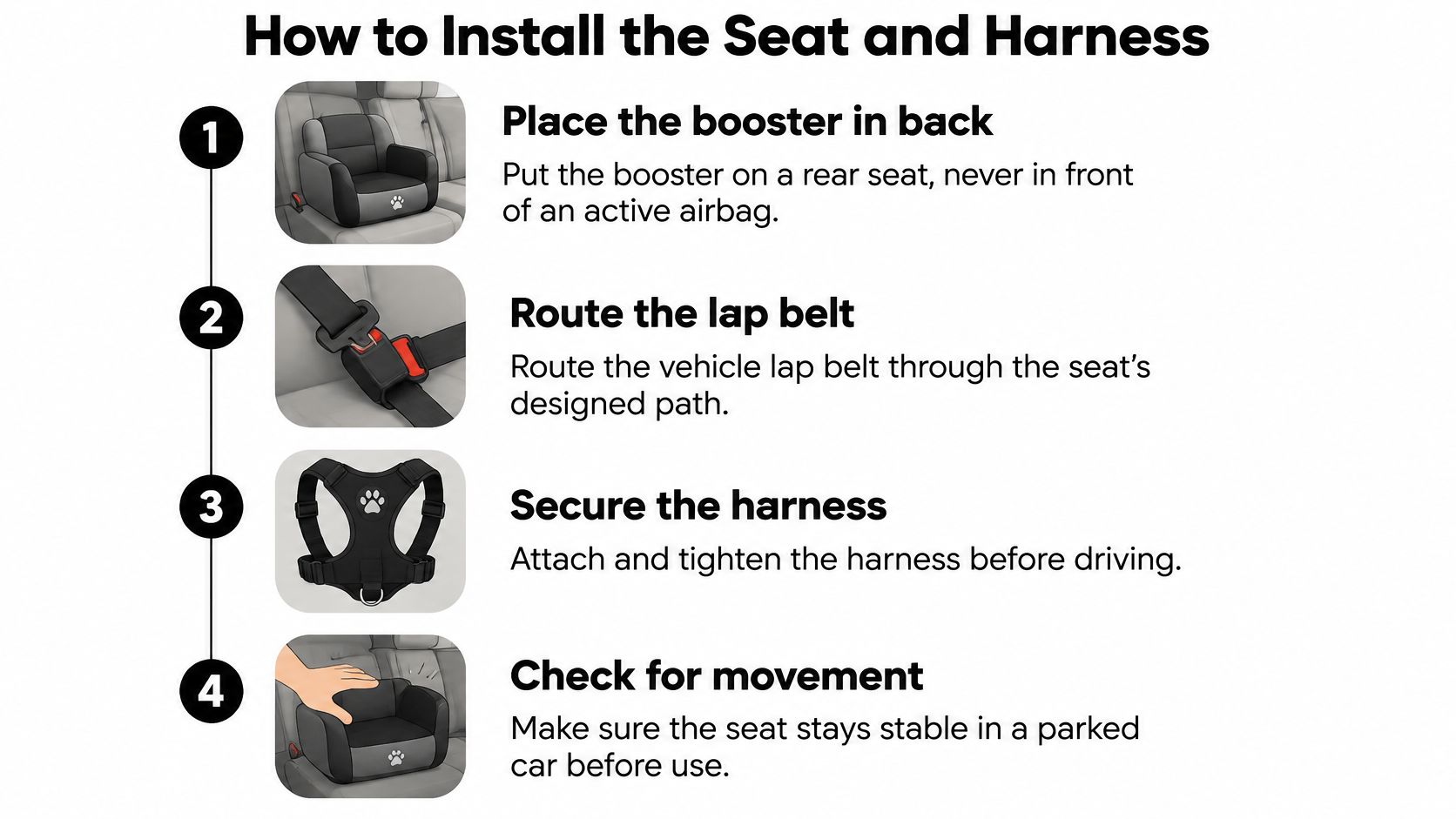
- Place the booster on a rear seat. Choose a position permitted by the product and vehicle instructions, away from the front passenger airbag zone. Make sure the base rests evenly rather than bridging a steep cushion contour.
- Route the vehicle belt through the designed path. Use the lap portion where specified, buckle it, and remove slack using the prescribed method. Don't substitute a headrest strap for a required belt attachment or invent a route around the cushion.
- Fit the travel harness. Adjust its chest and body straps before putting the dog into the booster. Our dog harness fitting guide helps with checking fit, but the travel harness's own instructions determine its vehicle setup.
- Connect the harness as its tested design requires. Use the specified vehicle-belt connection and hardware, with only the permitted slack. A failed connection can leave the dog unrestrained, as documented in the WebVet summary of booster crash testing; don't treat a sewn-in comfort loop as equivalent protection.
- Check the dog's movement and alignment. The dog should be able to adopt the permitted resting positions without reaching the driver, stepping out, or hanging sideways from the connection. Reassess both seat size and restraint compatibility if you can't achieve that balance.
- Make a gentle, brief movement check. Once the dog accepts the stationary setup, move slowly in a safe private area, stop gently, and park before inspecting it again. This checks ordinary settling and slack, not crash performance.
This visual summarizes the main installation tasks.
Understand what the connection must manage
Crash loading increases with the dog's mass and how sharply the vehicle slows. A collar concentrates loading around the neck, while excess tether length permits more movement before the restraint engages. An off-center connection can also rotate the body.
That's why a marketing label saying crash-tested isn't enough. Look for a published report naming the surrogate mass, impact conditions, forward movement, and failure criteria, with independent oversight clearly identified.
After muddy or nauseous travel, remove debris before cleaning. Wash or wipe only the permitted components, let everything dry fully, and inspect webbing, seams, and hardware before reinstalling. Cleaning shouldn't leave hidden straps twisted or the belt path obstructed.
Rides for Carsick Anxious or Senior Dogs
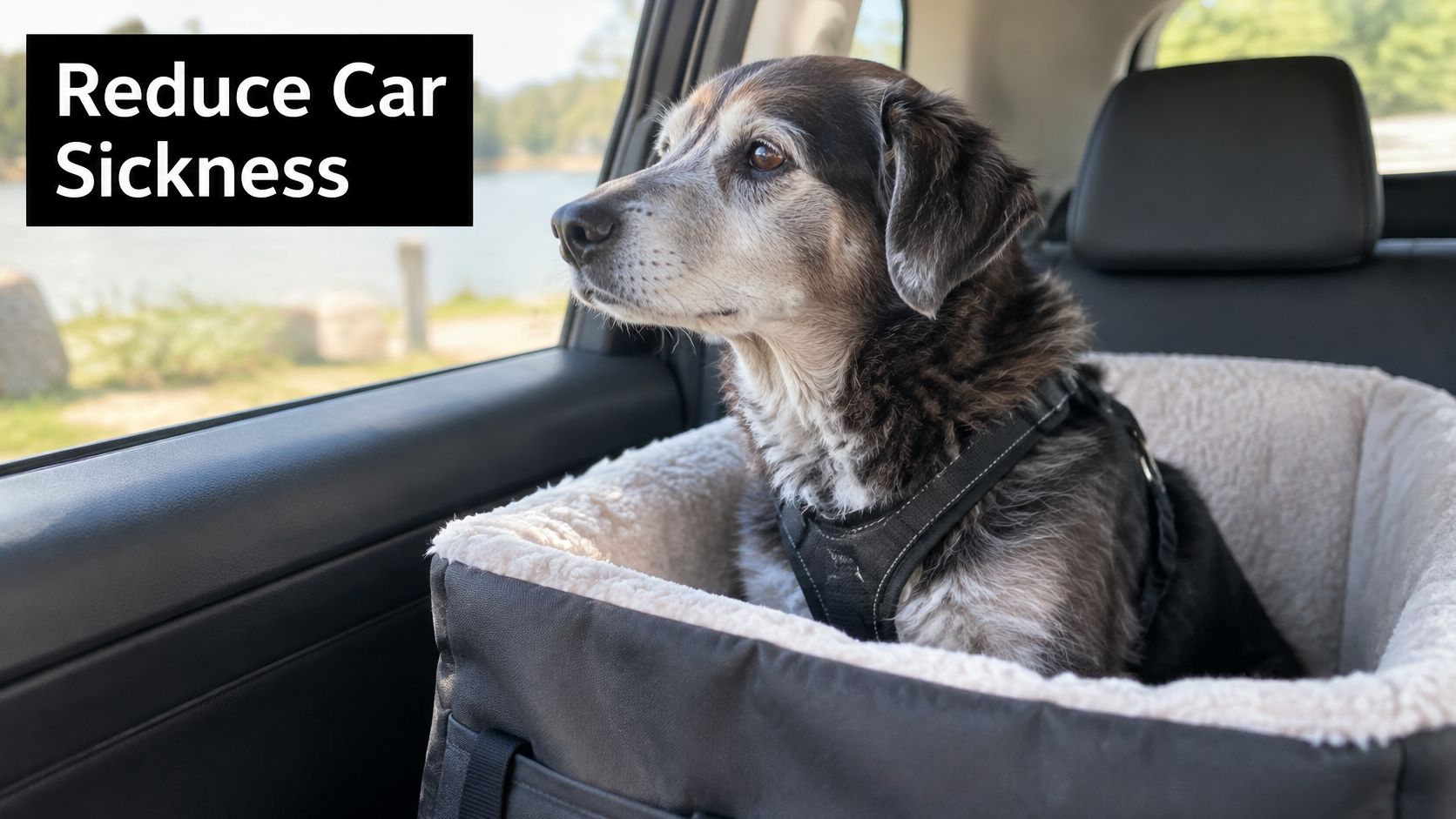
Elevation can backfire. Some dogs settle when they can see outside; others become more alert to passing traffic or less comfortable on a raised platform. Don't interpret a better view as a treatment for nausea.
The MSD Veterinary Manual's guidance on motion sickness in dogs explains the role of inner-ear stimulation and describes signs including drooling, vomiting, whining, uneasiness, and diarrhea. Fear and unpleasant travel associations can complicate the picture.
A relaxed-looking seating position is the goal, not just a higher one.
Build acceptance before adding distance
Progress at the dog's pace rather than completing every stage in the same session.
- Begin beside the parked car. Reward calm approach and allow the dog to move away before becoming distressed.
- Introduce the stationary seat. With the engine off, reward relaxed sitting or resting. Don't force the dog to remain while struggling.
- Add the complete setup and engine sound. Secure the familiar harness and briefly idle outdoors, never in an enclosed garage.
- Try a quiet, short drive. Have a passenger observe the dog if possible, then stop before discomfort escalates.
- Extend to an ordinary errand. Add duration only when the dog remains comfortable with the earlier stages.
If the dog becomes tense, return to an easier stage. Persistent vomiting isn't a training challenge to push through.
For another travel visual, you can watch the video below.
Adapt the setup to the dog
Keep the cabin comfortably cool and ventilated without allowing head-out window riding. Clean vomit promptly, both for hygiene and to avoid leaving the travel area unpleasant.
Flat-faced dogs need particular attention to breathing, heat, and chest clearance. For senior or mobility-limited dogs, a stable surface and easy assisted entry may matter more than deep cushioning. Ask your veterinarian how to lift or support a dog with pain rather than pulling on the harness.
The manual recommends carriers for small animals and a rear-seat harness arrangement for larger dogs, so a booster isn't the default answer for every anxious traveler. Our tips for traveling with pets can help with broader preparation.
If nausea or fear persists, contact your veterinarian. Passpaw's explanation can help you prepare to discuss travel sedatives with your vet, but medication selection belongs to the clinician, not the shopping cart.
Pick the Right Booster and Try It at Home
Choose a booster when your dog fits comfortably, accepts the arrangement, and can use it without compromising the restraint installation. Skip it when achieving that fit requires improvised straps, restricted breathing, or an unapproved harness position.
A dog who is too large for the selected seat needs a different travel plan, not a larger pile of cushions. A dog who panics during the first stationary trial needs slower conditioning or veterinary help, not an immediate road test.
Make the purchase serve a defined purpose
For owners choosing a comfort-and-containment seat, our Nandog Pet Gear car seats have a harness hook and belt straps and must be used with a harness. The Small measures 20 x 16 inches outside and fits dogs up to 15 pounds; the Medium measures 22 x 18 inches outside and fits dogs up to 30 pounds. These are product fit limits, not crash ratings, and exterior measurements don't replace the body-shape checks.
Our car seats are also fully washable and safe to clean in a washer and dryer. That's a practical benefit after muddy walks or motion sickness, separate from how the restraint performs.
Before committing to a longer journey, make a home trial deliberate:
- Check the empty installation: Confirm the prescribed routing is achievable in your actual vehicle.
- Observe the resting dog: Look for relaxed posture rather than constant bracing, climbing, or leaning against the connection.
- Plan the alternative: Be ready to use an appropriate harness-only arrangement or secured travel crate if the booster doesn't suit the dog.
Decide before departure
Choose the arrangement your dog can use correctly, not the one you most want to make work.
Keep the instructions with your travel equipment so another driver can reproduce the setup. If someone else transports your dog, demonstrate the connections while parked rather than relying on a quick verbal explanation.
The purchase is successful when it solves the job you chose it for: a comfortable, predictable place to ride alongside an appropriate restraint plan. You don't need to call the cushion crash protection to value that role.
Nandog Pet Gear offers harness-required car seats with belt straps, washable construction, and small and medium sizing for everyday travel comfort. Visit Nandog Pet Gear to compare the fit with your dog's measurements, then plan a parked-car trial before your next journey.