

You're halfway home, your shoes are wet, and your dog stops at every puddle like it's news. The collar that looked fine on a dry morning is now dark, damp, and starting to smell like the inside of a gym bag. That's usually when owners start looking at a waterproof dog collar with buckle and wonder what waterproof really promises, and what it doesn't.
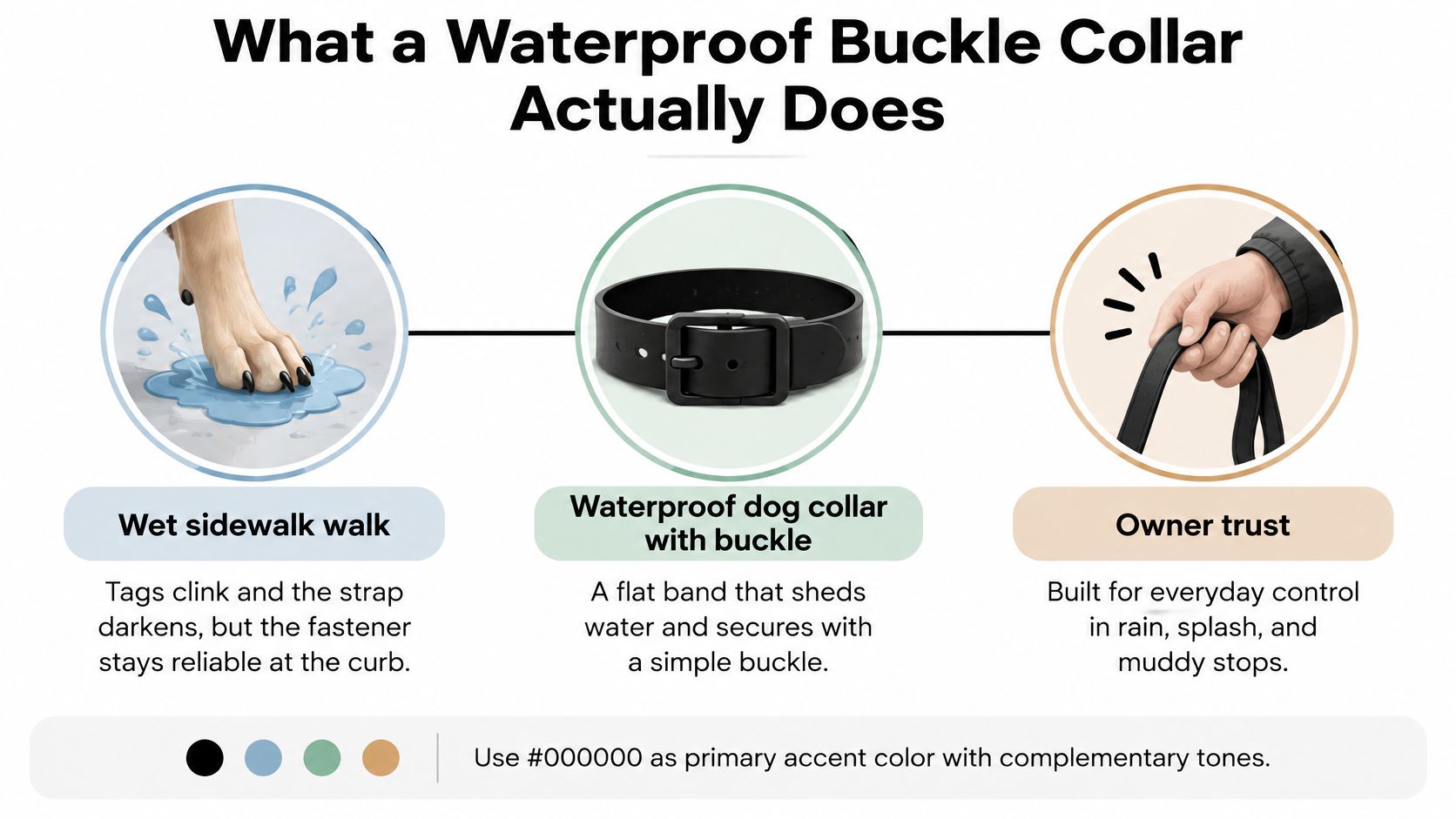
What a Waterproof Buckle Collar Actually Does
You're at a curb in steady rain. Tags clink against the D-ring, the strap darkens under your fingers, and the thing you're trusting is a small fastener you can open with cold hands. That scene is the job in miniature.
A waterproof dog collar with buckle is a flat band that sheds water, carries identification, and closes at one adjusted length. It doesn't cinch tighter when your dog leans into the leash. That's different from a slip lead or a martingale, which tightens by design and works as a control tool rather than a fixed, everyday collar.
Three Levels of Wet You Will Actually Meet
Owners get confused because waterproof sounds like one test. In daily use, it's three different exposures.
- Puddle splash: A wet sidewalk, a shake in the lobby, a damp strap for ten minutes.
- Rain commute: A full walk in rain, wet grass, and a collar that has to dry before the evening outing.
- Repeated soaking: Swimming, hose-downs after mud, or weekly beach trips where hardware sits in salt or chlorine.
A coated strap helps most by not acting like a sponge. It won't hold as much water against the coat, and it's less likely to stay musty after a day tossed in a tote. That makes it everyday gear, not specialty trail kit, which fits the scale of ownership. The U.S. dog population reached 89.7 million in 2024, according to the American Veterinary Medical Association.
Before you notice colors or brand names, decide which level of wet your normal week includes. The material comes next.
Materials and Buckles Compared Side by Side
Start with the strap and hardware together, because a good coating can't rescue a weak buckle, and a strong buckle can't make a sponge dry faster.
| Material or hardware | Water behavior | Typical buckle | Best use | Limit |
|---|---|---|---|---|
| Coated nylon or poly-flex webbing | Sheds rain and wipes clean; stays flexible | Plastic or metal side-release | Daily urban walks, rain, and mud | Coating can crack if chewed or folded hard |
| BioThane-style coated webbing | Almost no soak; wipes dry; stiffer hand-feel | Metal or heavy side-release | Swimming, beaches, and working dogs | Stiffness and sharp edges can rub |
| Neoprene sleeve over webbing | Water tolerant and cushioned; slow to dry | Side-release beside or under the sleeve | Sensitive necks on short wet outings | Holds moisture against skin if not dried |
| Leather | Light drizzle only; absorbs a real soak | Classic metal buckle | Dry-city style, not swim days | Stains, stiffens, and takes longer to dry |
| Stainless or coated metal hardware | Resists rust better than bare steel | Pairs with any coated strap | Ocean, pool, and winter road salt | Heavier; the keeper must still lock |
How to Read the Strap Rows
Coated nylon or poly-flex webbing is the rain-first compromise most city dogs need. It bends easily around the neck, wipes clean after mud, and doesn't feel like a board in cold weather. Its weakness is mechanical damage. Teeth, a hard crease under a heavy bag, or repeated folding at the same hole can split the coating and expose the webbing underneath.
BioThane-style coated webbing absorbs almost nothing and wipes dry in seconds. Owners who swim their dogs often prefer that clean surface. The trade-off is feel. A stiff strap with a square edge can rub a short-coated neck, especially if you buy wider than the dog needs because wider looks stronger.
A neoprene sleeve adds cushion, which helps a sensitive neck on short, wet outings. If you're weighing that option, it helps to understand what neoprene material is and how it behaves when wet before you assume cushion equals dry. Neoprene tolerates water, but it dries slowly and can hold moisture against skin if you leave it on for hours after a walk.
Leather belongs in a different category. It handles drizzle and looks polished on dry streets, but a real soak stains it and leaves it stiff as it dries. Don't buy leather as a swim collar and then blame the buckle when the strap is the problem.
How to Read the Buckle Choices
A plastic side-release is light and easy to open with one hand, which matters when the other hand holds a leash and a coffee. A metal side-release resists a determined paw or nose better and usually feels more solid when it clicks. A center-bar buckle with a keeper won't pop open from a squeeze, but it takes two hands and a moment longer at the door.
Hardware finish matters once salt enters the picture. Road salt in winter, pool chlorine, and ocean water all attack bare metal at the D-ring and buckle spring. Stainless or coated metal costs and weighs a bit more, but it's the right pairing for repeated soaking.
Selection rule: Match the collar to the wettest day of a normal week, not to a single beach photo from last summer.
How to Size the Collar on the Neck
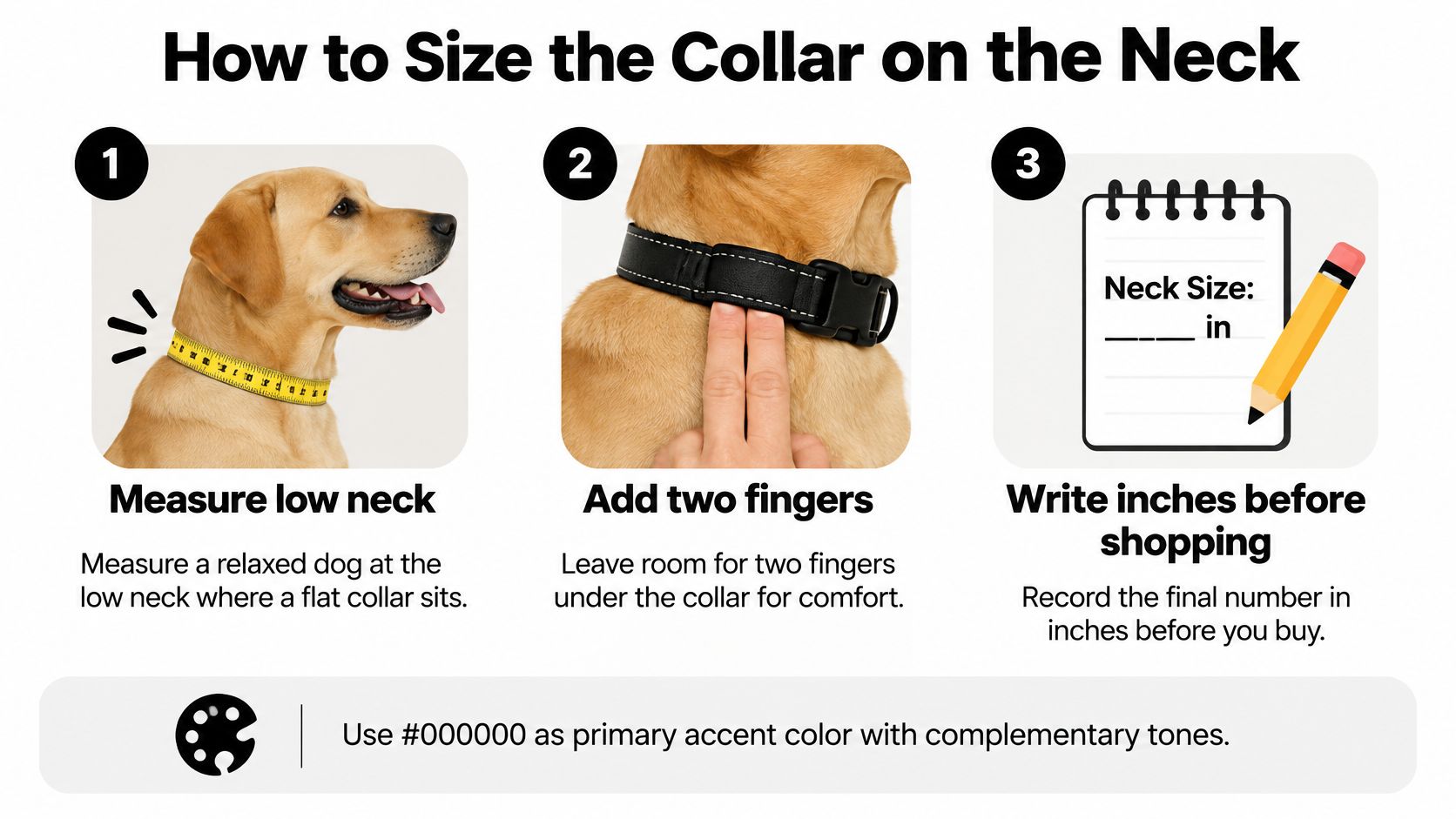
Measure before you shop, while your dog is relaxed and standing. Wrap a soft tape low on the neck where a flat collar naturally sits, not up behind the ears and not down on the shoulders. Add room for two fingers, then write the final number in inches. If you want a walkthrough before you measure, use this guide on how to measure dog collar size and keep that number in front of you while you compare size ranges.
Use the chart as a starting band only. A deep-chested dog and a compact dog can share a weight and need different neck sizes.
| Dog size | Strap width | Buckle to prefer |
|---|---|---|
| Toy, under 20 lb | 5/8 in | Plastic side-release |
| Small, 20–40 lb | 3/4 in | Plastic or metal side-release |
| Medium, 40–60 lb | 1 in | Metal side-release or center-bar buckle |
| Large, 60–90 lb | 1 in | Metal buckle with a keeper |
For context with a tape, toy dogs often fall around 8 to 12 inches, small dogs 12 to 16 inches, medium dogs 14 to 20 inches, and large dogs 18 to 24 inches. Dogs over 90 lb may need 22 to 28 inches and a strap up to 1.25 inches wide. Wider isn't automatically safer. A wide, stiff strap can press and rub the throat on a short neck, even when the circumference is correct.
Four Fit Checks on the Dog
- Fasten without forcing it: Use the loosest setting that still stops the collar slipping over the ears when you tug gently forward.
- Test the gap: Slide two fingers flat between strap and neck under the jaw. One finger means it's too tight. A whole hand means it's too loose and can catch or slip.
- Check the release position: Turn the buckle and keeper so your dog can't easily nose or paw the release open, and confirm tags don't wedge into the mechanism.
- Recheck as the dog changes: Check again after the coat dries, after a puppy growth spurt, and after a winter weight change. A wet, flattened coat can hide a fit that's wrong an hour later.
Fit isn't a comfort detail you handle after safety. A 2026 review of dog-worn equipment reported that all collars may be associated with strangulation injury, with the ventral neck and laryngeal region identified as especially vulnerable, and unrestricted choke-style collars were considered the highest-risk category. That review doesn't name one universally safest standard collar. A flat, non-tightening buckle stays in the lower-risk approach only when the gap is real, the collar is inspected, and walks are supervised.
Where Waterproof Collars Actually Fail
Waterproof is a hygiene and corrosion claim. It isn't a strength rating. Owners mix those up because a strap that still looks dry and clean feels new, even when the parts that carry load are wearing out underneath.
A collar fails as a system. The buckle tongue or side-release can crack or stop latching fully. The adjustment slider can creep looser during a walk. Stitching at the D-ring can lift, and coated webbing can split at a fold. Any one of those ends the collar's useful life, even if the outer surface still beads water.
What Pulling Does to a Neck
In a canine-neck model cited in research on collar pressures, lead forces of 40 N (firm pull), 70 N (strong pull), and 141 N (jerk) produced collar pressures ranging from 83 to 832 kPa, with significant effects from both collar type and applied force. No tested collar reduced pressure enough to eliminate injury risk during pulling.
Read those numbers as a plain warning. A dog that hauls into a collar puts serious pressure on a small area, and changing from one flat collar to another doesn't solve that. Buckle strength keeps the collar closed. It doesn't make neck pulling safe.
Treat a waterproof buckle collar as identification and light control, not as equipment built to absorb repeated lunges.
Choose hardware with that limit in mind. You want a buckle and slider that don't creep, rounded edges that don't dig in, and flexible coated webbing that reduces abrasion when the strap shifts. Then put the load where it belongs. If your dog pulls hard, especially a brachycephalic dog or a dog prone to tracheal collapse, clip the leash to a well-fitted harness and let the collar carry tags.
Wet use makes wear less obvious, not less real. Water carries grit into the release, repeated flexing stresses stitched load points, and a week of wet, dry, wet again is harder on the assembly than a new collar feels in a shop. Sand in a side-release can stop it latching with a full click. Salt can stiffen a spring. Mud packed under a slider can let it walk a fraction looser each block.
Retire the collar when you see the early signs, not after a snap on the street.
- Keeper no longer holds: The loose end flaps or the adjustment moves between walks.
- Stitching lifts at the D-ring: Threads fray, lift, or show gaps when you tug by hand.
- Coating splits at a fold: Cracks open at the buckle hole or adjustment bend and expose webbing.
- Buckle feel changes: The click gets soft, gritty, or inconsistent after cleaning.
How to Clean After Rain Salt and Pools
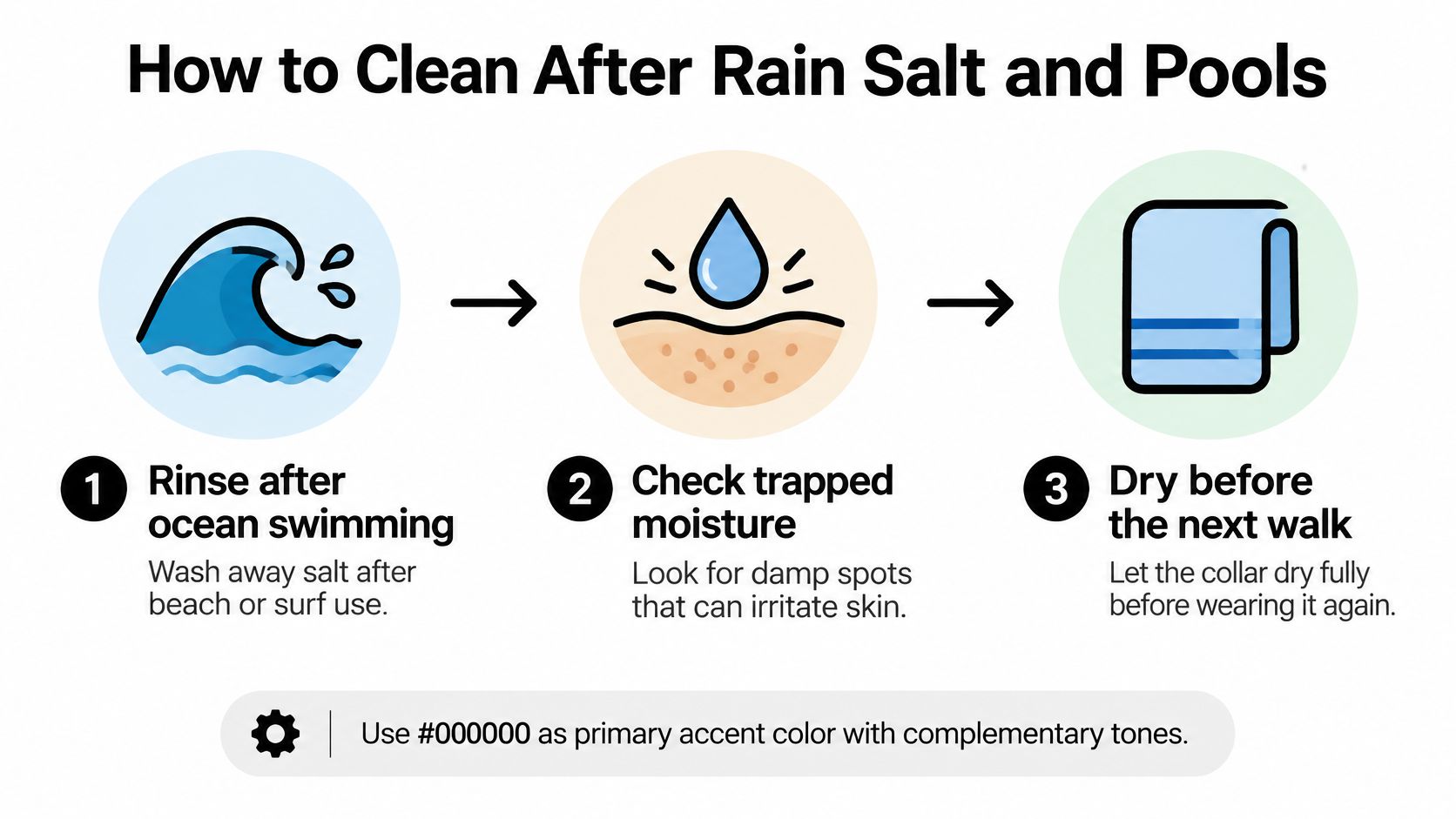
Waterproof doesn't mean maintenance-free. It means the strap gives you a surface you can clean quickly, if you match the routine to the exposure. Brief rain needs a wipe and time to dry. Saltwater and chlorinated water always need a freshwater rinse.
That distinction matters because the questions owners ask aren't about the label. They ask whether they should rinse after the ocean, whether trapped moisture can irritate skin, and whether a coating stays flexible after sun, chlorine, and salt. Recent market reporting summarized by Dataintelo's global dog accessories market report identifies nylon as a leading accessory material because of moisture resistance, durability, affordability, and ease of cleaning, while stainless steel is especially valued in water-exposed settings. Material alone still doesn't protect seams and hardware. You have to inspect them.
The Rinse and Inspect Routine
- Rinse the whole collar in fresh water: After the ocean, a pool, or salted streets, run water under the buckle and around the D-ring, not just over the visible strap.
- Clear grit from the release: Open and close the buckle under water or wipe it with a soft cloth so sand can't block the latch. This is also the core habit in any practical guide on how to clean a dog collar.
- Dry collar and neck: Towel the strap and dry your dog's neck before the next long wear, so moisture doesn't sit trapped against skin.
- Air-dry flat away from heat: Keep it off radiators and hot dashboards, since high heat can stiffen coatings and make them crack sooner.
- Inspect monthly: Tug-test stitching by hand, look for green or white corrosion on bare metal, and check that the slider hasn't walked from your setting.
A dry-looking exterior can hide a failing stitch. That's why your hands matter more than your eyes during the monthly check. Flex the strap at the buckle holes, press the release several times, and pull the D-ring firmly while watching its base.
On sustainability, don't assume a recycled label settles the question. Compare longevity, repairability, hardware replacement, and end-of-life recyclability together. A long-lived collar with a sound buckle usually beats a recycled collar that cracks in one wet season and goes straight to landfill.
If the coating is already split, cleaning won't restore it. Replace the collar rather than scrubbing harder.
Choosing a Poly-Flex Collar for City Life
Decide by your actual weeks, not by the most adventurous day you can imagine. Most urban dogs rotate through three situations, and they don't all ask for the same collar.
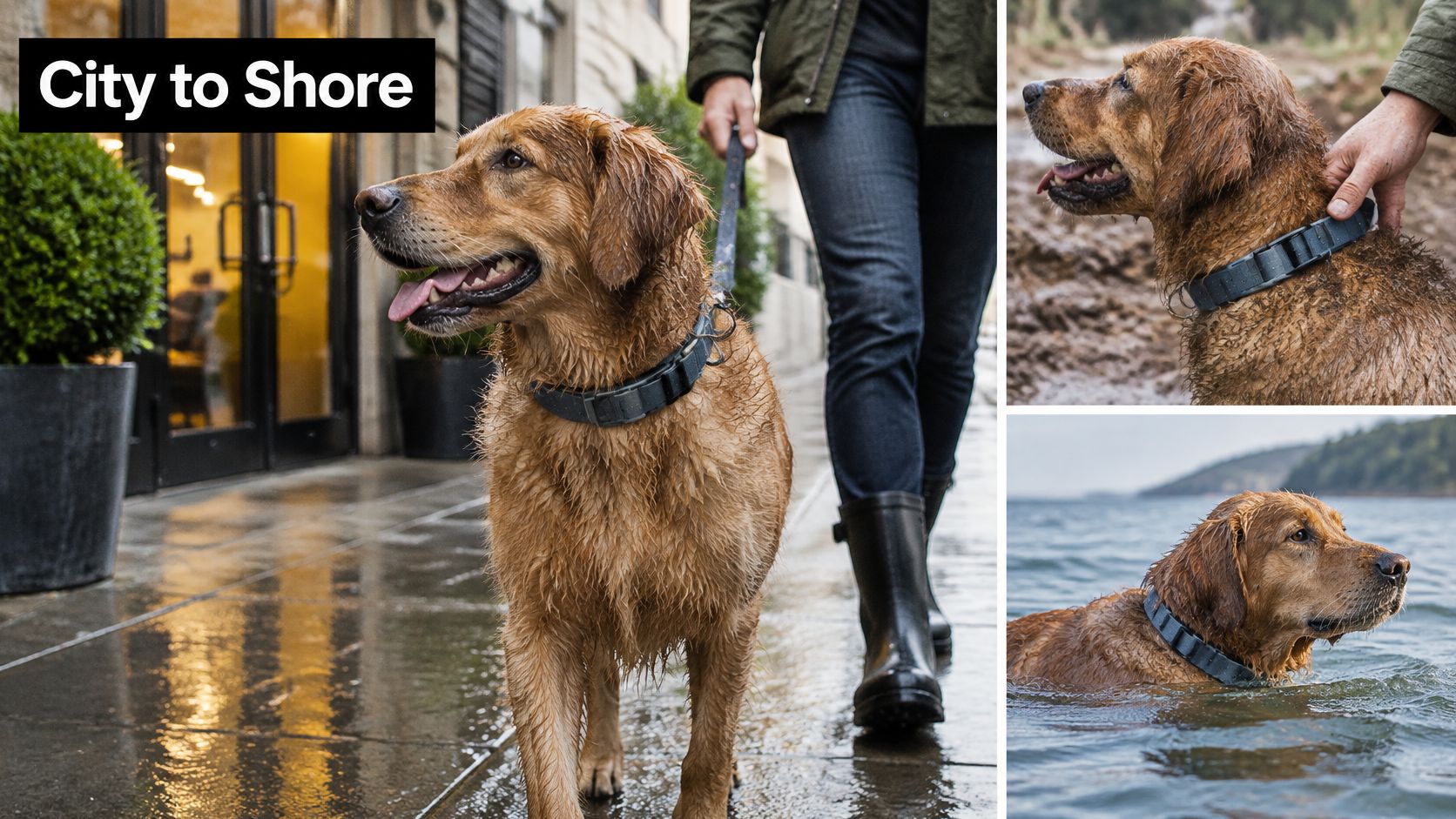
The photo below shows the transition many city dogs make in a single weekend, from pavement to open water.
Three Weeks, Three Different Demands
The city commute is puddles, wet lobby floors, and a collar that has to look clean again by morning. Flexibility and a fast wipe matter more here than maximum stiffness. A coated poly-flex style strap fits this week well because it's lighter and softer than stiff coated webbing, carries tags comfortably, and doesn't stay soggy between walks.
The dog-park hour adds mud, wrestling, and a buckle you may need to open with one muddy hand. A side-release you can operate without looking earns its place, provided it still clicks positively after you rinse grit out. If another dog grabs collars during play, supervision matters more than any buckle claim, and many owners remove collars for rough off-leash wrestling where park rules allow it.
The weekend lake or beach is full soaking, plus salt or algae. Hardware finish and your rinse habit decide how long the collar lasts. A poly-flex collar can handle occasional swims. A dog in the ocean most weeks is a better match for stiffer coated webbing with stainless hardware, rinsed every time.
Appearance isn't trivial for gear worn this often. Approximately 45% of dogs frequently wore accessories such as collars, harnesses, or sweaters in 2023, according to IMARC's pet accessories market research. A clean edge and a color you don't mind seeing daily are reasonable wants. They just don't change the safety job.
The short video below is useful for seeing buckle handling and strap flexibility in motion, which still photos don't show well.
Where Poly-Flex Is the Wrong Solo Tool
If your dog lunges for squirrels at every corner, keep the poly-flex collar for identification and clip the leash to a harness. Buying a heavier buckle won't fix neck pressure. If your dog chews gear left within reach, store any coated collar out of reach between walks, because teeth defeat coatings faster than rain does. If your dog swims in the ocean weekly and you won't rinse afterward, even good hardware will corrode early. Be honest about the routine you'll maintain.
Here's the verdict by situation.
- Rain-first city dog with occasional swims: Choose a flexible poly-flex style collar with a reliable side-release or latched buckle.
- Dog in water most weeks: Choose stiffer coated webbing and corrosion-resistant metal hardware.
- Dog that rarely gets wet: Leather can work for style on dry days, with a coated backup for wet weather.
- Dog that pulls hard: Any of the above for tags, plus a harness for the leash.
Your Four-Step Checkout Check
- Measure the neck: Confirm your written number in inches and the two-finger fit.
- Pick the width: Use the size band for your dog's weight and neck length, not the widest option available.
- Choose for the wettest normal week: Rain only, mud and parks, or repeated swimming lead to different hardware needs.
- Confirm the adjustment range: Order only if your measurement sits comfortably inside the collar's range, not at its very end.
As one concrete example of the rain-first category, Nandog Pet Gear, a Los Angeles pet-lifestyle brand, sells waterproof, ultra-resistant collars with a double latch, sold as a comfortable fit and easy to clean after muddy walks. Its Poly-Flex Collar comes in Black, Aqua Blue, Purple Lilac, and Neon Green, each from $27.00. Confirm the current neck range at nandog.com against your tape measurement before you order, because the right model in the wrong range still fits badly.
Buy for drying, hardware, and neck fit in that order. If those three are right, the waterproof claim finally means something on a wet Tuesday, not just on the product page.
Measure your dog tonight, check the two-finger gap, and then compare that number against the Poly-Flex Collar in Black, Aqua Blue, Purple Lilac, or Neon Green, each from $27.00, with a double latch built for wet, muddy walks. Visit Nandog Pet Gear to confirm the current neck range and choose the size that sits comfortably inside it.