

Can a ceramic dog bowl be called lead free just because the label says so, or does the claim need to show what can migrate from its glaze into food and water? The distinction matters: a bowl's appearance, price, and “non-toxic” wording don't establish how it performs in food contact.
To choose lead-free ceramic dog bowls with confidence, look for evidence tied to the specific bowl and its finish, then keep checking the surface as it wears. A bowl that meets a test when new still needs an intact, cleanable interior to remain a good everyday choice.
FDA Lead Limits and What They Mean for Dog Bowls
The FDA sets action levels for leachable lead by vessel type. There isn't one universal FDA definition of “lead free”; these figures are enforcement thresholds based on lead extracted under specified laboratory testing.
| Vessel type | Action level (µg/mL) | Relevance to a dog bowl |
|---|---|---|
| Flatware | 3.0 | Plates and saucers, not a bowl category |
| Small hollowware other than cups and mugs | 2.0 | Most small dog bowls fall here |
| Large hollowware other than pitchers | 1.0 | Large serving or mixing bowls |
| Cups and mugs | 0.5 | Stricter level, not typical for dog bowls |
| Pitchers | 0.5 | Stricter level, not typical for dog bowls |
These categories help put a bowl on the right scale. A typical small dog bowl is a food-contact hollowware item, so the 2.0 µg/mL action level for small hollowware is the closest fit. A large serving or mixing bowl falls into the large-hollowware category, with a lower 1.0 µg/mL action level. The FDA's ceramicware guidance lists the thresholds by vessel type and explains that they apply to extractable lead, not the total amount of lead in the glaze.
That difference is easy to miss. A test result describes how much lead moves out of the tested item under the specified conditions. It doesn't measure all the lead that may be present in its materials, and a result can't be interpreted without knowing the test method and the bowl category.
For example, a result of 2.0 µg/mL for a small bowl is at the action level for small hollowware. The same result for a large hollowware bowl would exceed its 1.0 µg/mL action level. A number without the vessel category can therefore lead to the wrong conclusion.
Practical rule: Match the test result to the bowl's size category, and ask what test conditions produced it.
The FDA has also reported traditional pottery labeled “lead free” that contained extractable lead comparable to lead-glazed pottery, with some items exceeding action levels. That's why packaging language isn't a substitute for a report or supplier documentation. Judge the claim by the evidence, the finished bowl tested, and its actual vessel category.
Why Glaze Chemistry Puts Lead in a Dog Bowl
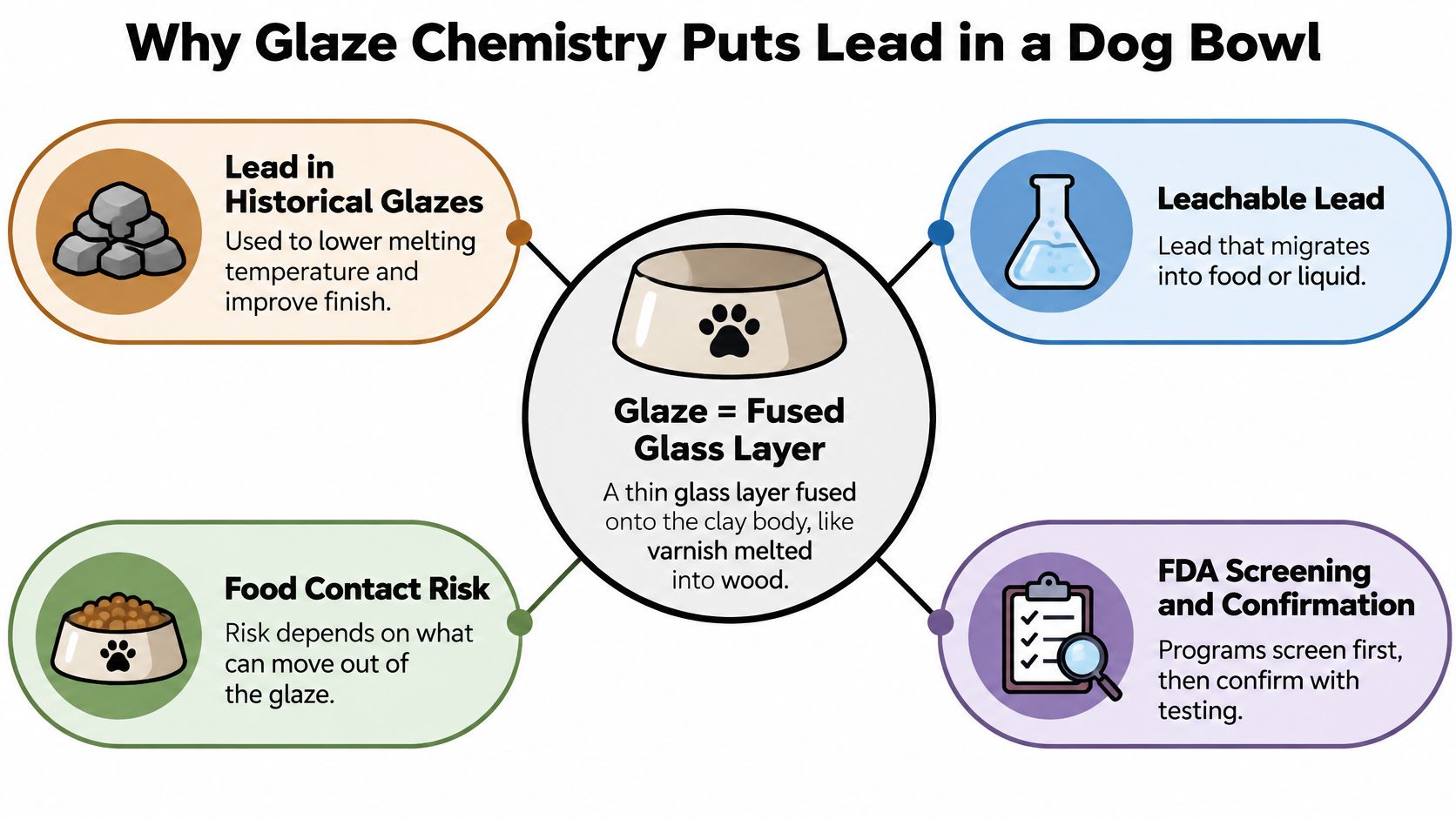
Think of glaze as a thin glass layer fused onto clay, like varnish that has melted into wood rather than sitting on top of it. Historically, lead could act as a flux, helping glaze melt at a lower temperature and produce a glossy finish. If a lead-containing formula is used, the finished surface may release lead into food or liquid; if firing doesn't fuse the glaze as intended, the bowl's performance may also be affected.
That glass-and-wood comparison helps explain why manufacturing matters. The glaze must be formulated and fired consistently across the bowl, including its rim and decoration. A bowl that looks smooth and shiny doesn't, by appearance alone, reveal its recipe or how well the finish was controlled.
Imagine a water bowl left full beside a feeding station. Water sits against the glazed interior for hours, just as wet food or an acidic food could; the relevant question is whether anything can migrate from that surface into the contents. Even an empty bowl can hold a thin film of moisture or food residue, so “it was only water” doesn't answer whether the glaze is suitable for repeated food contact.
Lead exposure doesn't come only from bowls. The EPA's historical account of lead exposure describes improperly glazed pottery as a route for lead to enter food; it also notes that pets can bring lead-containing dust or soil into the home on their fur or feet. A bowl is one possible food-contact route within a wider environment.
Imported, vintage, or artisan pottery deserves the same evidence-based assessment as any other piece. The country of origin or handmade appearance doesn't establish glaze composition. Bright red, orange, and yellow decorations also merit attention to cadmium, another metal monitored in ceramic foodware.
Lead free is a manufacturing decision, made in the glaze formulation and controlled during production. The finish can't verify its own chemistry, so the next step is to examine what documentation supports the claim.
How to Verify a Lead-Free Claim and Buyer Checklist
A bowl may contain lead in its glaze, but the key food-contact question is leachable lead, the amount that can migrate into food or liquid under a test. The FDA uses screening followed by laboratory analysis, with methods that can measure lead and cadmium at concentrations as low as 3 parts per billion, according to its information on lead in food and foodwares. A home swab is a screening signal, not a migration test: a negative result doesn't prove that the bowl releases safe amounts under food-contact conditions.
For a useful comparison, the European ceramic-foodware framework requires a manufacturer or importer declaration supported by migration testing. Its analytical requirements set detection limits no higher than 0.1 mg/L for lead and 0.01 mg/L for cadmium, and quantification limits no higher than 0.2 mg/L for lead and 0.02 mg/L for cadmium. Those figures describe laboratory method sensitivity, not a claim that every compliant bowl releases those amounts. The EU summary of ceramic objects in contact with food also makes clear why buyers should seek results for both metals.
| Evidence | What it proves | What it does not prove |
|---|---|---|
| Marketing claim on a product page | Seller intends the bowl to be lead free | Any measured lead or cadmium migration |
| Supplier declaration of compliance | Manufacturer states limits are met | Which glaze, batch, or decoration the declaration covers |
| Third-party leach test report | Lead and cadmium migration under stated test conditions | Results for batches that weren't tested |
| Home lead swab | Possible lead on the surface as a screening signal | Safe leaching levels, since a swab doesn't measure migration |
| Country of origin | Where the bowl was made | The glaze composition or its lead content |
A useful point of comparison when reading certification language is NSF/ANSI 58 and 372 explained. Those standards concern water-treatment products, not ceramic dog bowls, but the distinction between a product's materials and what testing establishes is helpful. For more on evaluating food-contact bowls generally, see Nandog's guide to food-safe dog bowls.
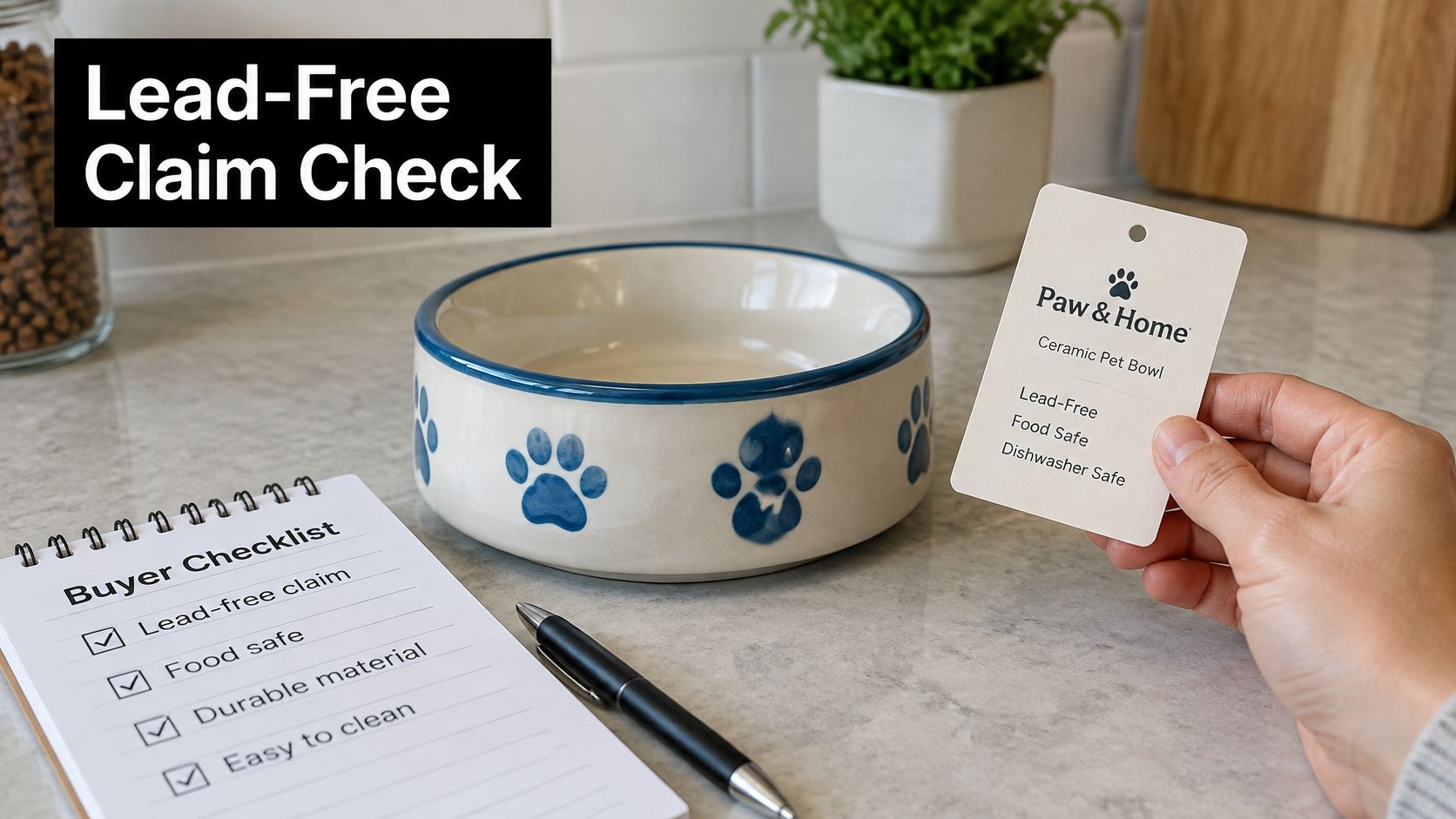
Use this verification pass before buying:
- Request a model-specific report. Ask for the exact model and glaze name, along with the laboratory, test date, and test conditions. A report for another product in the same collection may not cover the bowl you're considering.
- Confirm both metals are included. A lead-free claim doesn't answer the cadmium question. Look for results for lead and cadmium.
- Check what was tested. The report should cover the finished bowl, including its rim and any decoration that can contact food or water.
- Look closely at bright decorations. Confirm that red, orange, or yellow areas have been assessed for cadmium.
- Match the result to bowl size. The test's vessel category matters when interpreting the FDA action level.
- Choose a smooth interior. A surface you can inspect and clean easily is more practical for everyday feeding.
- Read the care instructions. Follow the maker's dishwasher guidance and avoid assuming that abrasive cleaners are suitable.
- Keep the receipt. It's useful if the bowl arrives damaged or the documentation doesn't match the product.
Nandog Pet Gear also offers a Bowls category. Its Bowl Multi-Pack starts at $40.00 and comes in Ash Gray, Terracotta Brown, Blush Pink, Jet Black, and White. Free returns are available for eligible products bought directly from Nandog Pet Gear.
Buy only when the documents match the specific bowl and finish. If the surface later becomes damaged, the original test report won't make that damaged bowl suitable for continued use.
Cleaning and Care Routine That Protects the Glaze
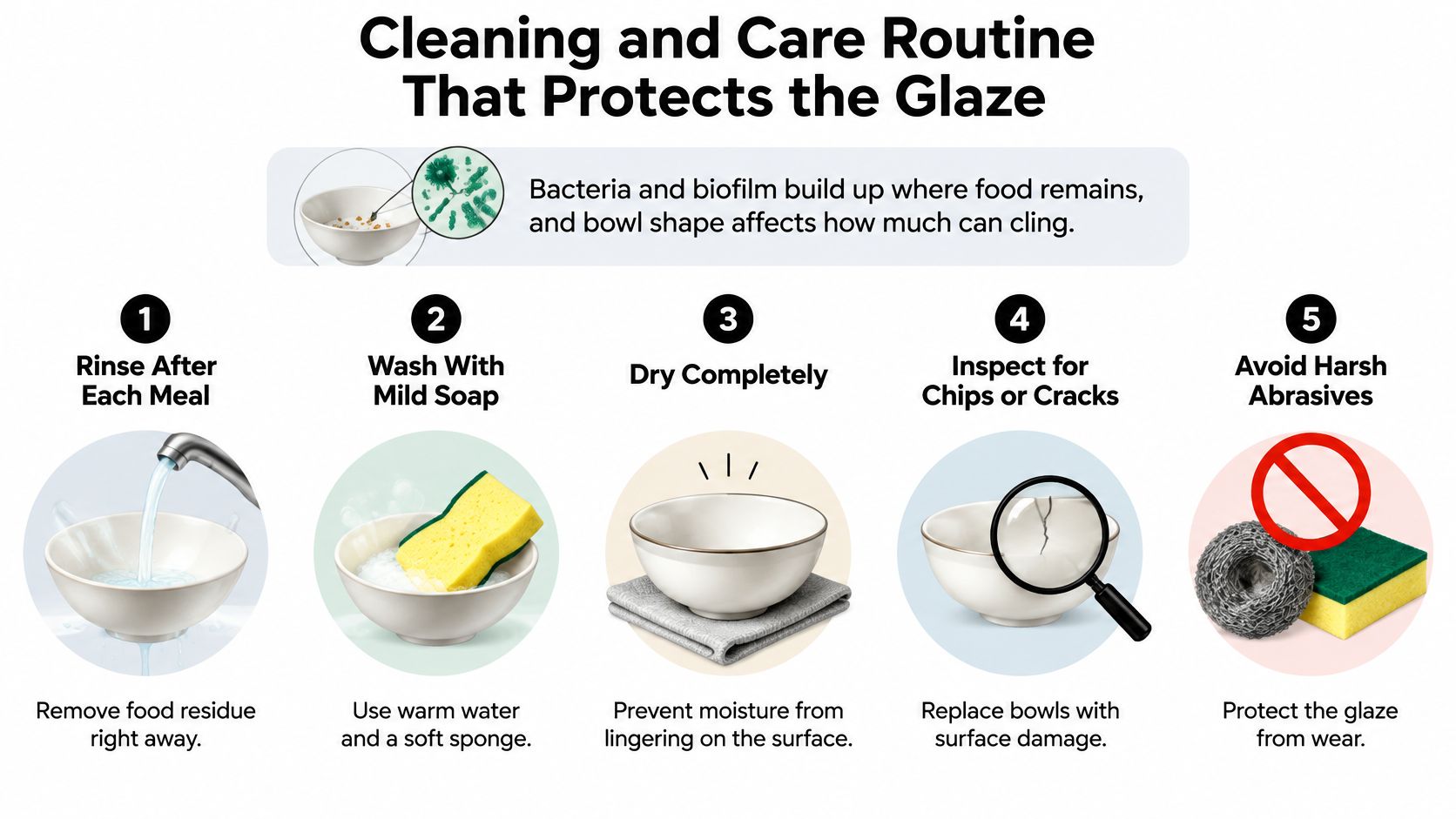
Food residue gives microorganisms something to cling to, and bowl shape affects how much residue can remain in place. A dog-bowl study reports that surface characteristics, food remnants, the surrounding environment, and whether a bowl is new or old all influence microorganisms and biofilm. Its findings, published in a peer-reviewed study on dog bowls and microbial contamination, support a simple habit: clean the bowl promptly and pay attention to the interior's condition.
- Rinse after each meal. Wash away food particles before they dry onto the glaze.
- Wash it the same day. Use warm water, mild unscented dish soap, and a soft, non-abrasive sponge.
- Skip harsh scrubbers. Steel wool, abrasive pads, and scouring powders can wear the finish.
- Use the dishwasher only when allowed. Follow the maker's care instructions for the specific bowl.
- Dry it completely. Don't refill a bowl while water is still standing in it.
- Loosen stubborn residue gently. A diluted white-vinegar soak can help; rinse thoroughly afterward.
- Check the interior daily. Run a fingertip over the food-contact surface. If it catches on a rough spot, chip, or crack, stop using the bowl and assess whether it needs replacing.
The finish's shape matters as much as the washing routine. A smooth interior is easier to wipe clean than a rough or irregular one, where small bits of food can remain. A new bowl and an older bowl with worn glaze also present different cleaning challenges, so a bowl's original test result doesn't answer every question about its condition today.
For a practical guide to care instructions, see Nandog's article on dishwasher-safe dog bowls. If the manufacturer doesn't say the bowl is dishwasher safe, don't assume a cycle is suitable. Use the gentler hand-washing routine instead.
Build the fingertip inspection into the daily wash, rather than waiting until damage is obvious. A clean, intact interior is easier to monitor, and prompt cleaning helps prevent dried residue from becoming a recurring problem.
Damage Signs That Mean It Is Time to Replace a Bowl
Run a fingernail over the interior. If it catches on a chip or rough edge, the surface is compromised, even if the bowl still looks usable from a distance. A bowl can pass a leach test when new and still become a poor food-contact surface after wear.
| Sign | Risk | Action |
|---|---|---|
| Chip or crack on the interior | Crevice that traps bacteria and may expose the body | Retire the bowl |
| Crazing with residue in the lines | Glaze integrity is lost and food can lodge in cracks | Retire the bowl for food use |
| Worn or dull glaze patches | Surface is harder to clean and may affect leaching | Retire it if the inside is affected |
| Rough or textured interior decoration | More places for residue and biofilm to remain | Choose a smooth interior next time |
| Odor that persists after a thorough wash | Biofilm or residue may remain despite cleaning | Deep clean, then replace if the smell returns |
Crazing is a web of fine lines in the glaze. If food residue sits in those lines, stop using the bowl for food rather than trying to scrub the cracks clean. Decoration worn on the outside is less concerning than damage on the food-contact interior, but any interior patch that has become rough, dull, or exposed deserves attention.
A bowl can also be damaged when it's dropped on a hard floor, even if the glaze looks intact. An impact may leave a crack in the ceramic body that isn't easy to see. If you suspect a drop caused damage, inspect the whole bowl closely and don't keep using it if you find a fracture or an area that feels different.
When an odor remains after a thorough wash, wash and inspect the bowl again; if the smell returns, replace it. When the surface can't be trusted or cleaned well, retire it. A repaired edge or glaze patch won't have the original safety documentation behind it.
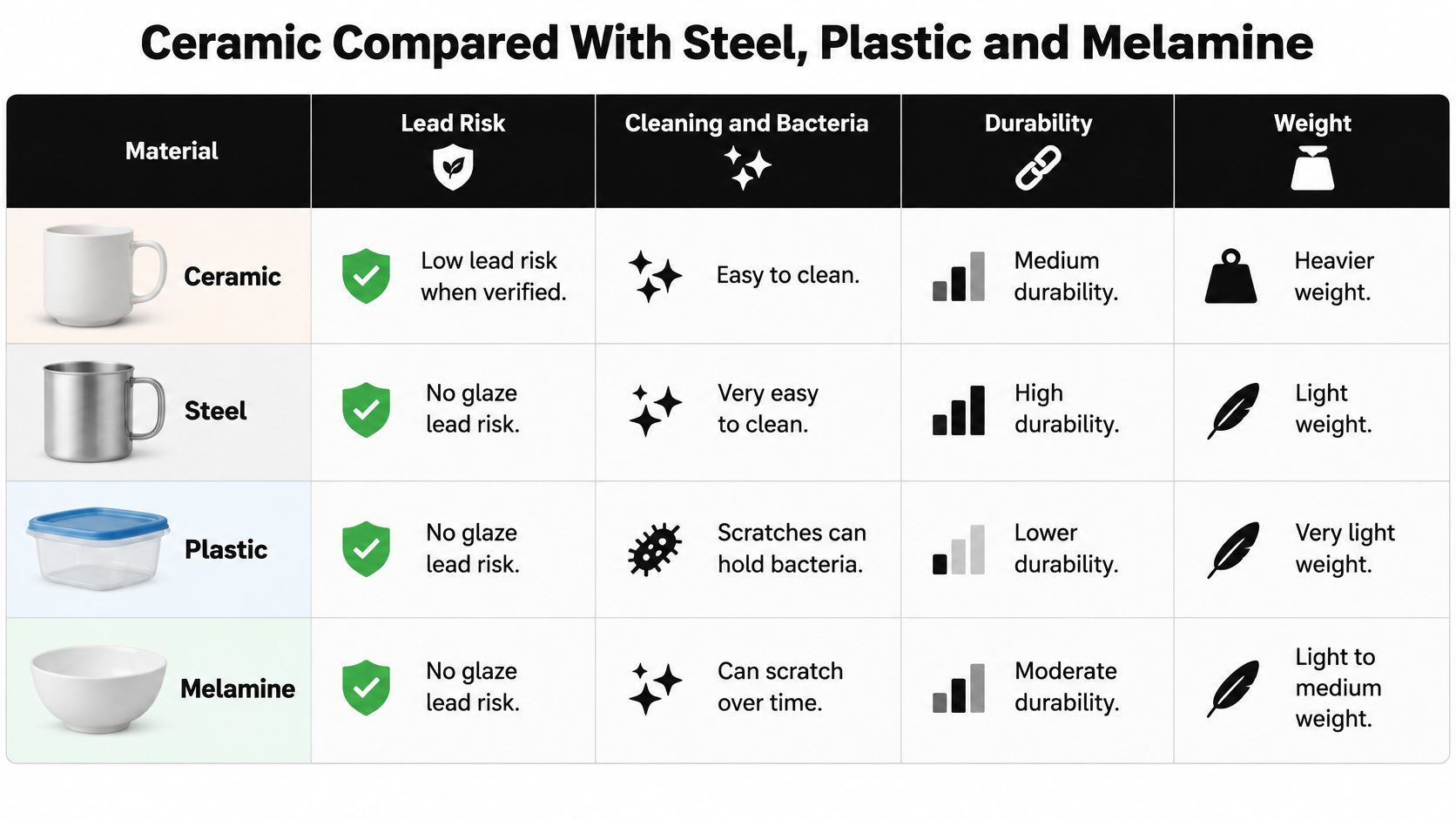
Ceramic Compared With Steel, Plastic and Melamine
| Material | Lead risk | Cleaning and bacteria | Durability | Best fit |
|---|---|---|---|---|
| Lead-free ceramic with verified glaze | Low when documented by testing | Smooth glaze cleans well; chips can harbor bacteria | Breaks if dropped | Heavy, stable bowl for daily feeding |
| Stainless steel | No glaze, so no glaze-related lead | Smooth and easy to clean | Dent-resistant and won't break | Busy eaters and travel |
| Plastic | Check food-grade labeling; scratches can be a concern | Scratches can trap bacteria | Chews and scratches over time | Budget or temporary use |
| Melamine | Depends on manufacturer testing | Scratches can trap bacteria | Light and won't shatter | Outdoor use, not hot food |
A verified ceramic bowl suits a dog who eats calmly in a fixed spot and benefits from a heavy, stable dish. It's also a choice for owners who want a styled feeding area, provided the glaze is documented and the bowl stays intact. Its drawback is physical damage: if it's dropped or chipped, it can't be treated like an unbreakable everyday dish.
Stainless steel removes the glaze-related lead question. Its smooth surface is easy to clean, and it's a practical option for travel or a dog that pushes bowls around. The trade-off is that it can be noisy and may not suit someone looking for a ceramic finish in the home. For ideas on selecting tableware by practical fit and appearance, Everti's guide to choosing plates and bowls offers a useful perspective on balancing function with style.
Plastic is light and inexpensive, but scratches can leave places for residue to collect. It may work as a temporary option, though a scratched or chewed bowl is harder to clean well. Melamine is lightweight and won't shatter, making it useful outdoors, but its suitability depends on the manufacturer's testing; don't use it for hot food.
A dog that knocks bowls around the kitchen may be better served by steel. A dog that eats calmly at a set feeding spot may suit a verified ceramic bowl. For more feeding setup ideas, see Nandog's guide to choosing a food bowl for pets. The best material depends on the dog, the setting, and the owner's ability to keep the bowl clean and in good condition.
Frequently Asked Questions for Dog Owners
Does an empty bowl left overnight still matter?
Yes. A bowl that holds water for hours still has prolonged contact between liquid and glaze, so the same verification matters even when no food is in it. Keep the bowl clean and don't treat water-only use as proof that the glaze is suitable.
Is a more expensive bowl automatically lead free?
No. Price doesn't establish glaze composition or migration results. Before paying a premium, look for documentation that identifies the specific model and finish tested.
Is ceramic safe for a puppy that chews?
A puppy that chews or bites the bowl is more likely to wear the glaze or cause a chip. Stainless steel is usually a more practical choice for a persistent chewer because it avoids the risk of broken ceramic.
Can I repair a chipped bowl at home?
No. A sanded edge or glaze patch can't be verified as lead free or suitable for repeated food contact. Retire a chipped bowl rather than repairing it for feeding.
Use the verification checklist whenever you're considering a new bowl: match the report to the product, check both metals, and make sure the finish is easy to inspect.
Nandog Pet Gear offers bowls and other everyday pet essentials, including a Car Seats category for travel. If you're choosing a feeding setup, compare the product details with the documentation and care criteria in this guide, then visit Nandog Pet Gear to explore its offerings.