


The popular advice to buy a quick-release leash because it's automatically safer leaves out the most important question: what happens after it opens? Freeing yourself from a dragging dog may prevent an injury, but releasing control beside a road can create another emergency. A useful quick release leash for dogs needs more than a fast clasp. It needs secure retention, manageable activation force, suitable attachment points, and a handler who knows when to use it.
Choose the mechanism for your actual walks, not the name on the packaging. A release that's easy to demonstrate on a shop counter may behave differently when the line is tight, twisted, wet, or dirty.
Quick Release vs Breakaway vs Standard Clip Compared
A handler-side quick-release leash frees your hand or body attachment from the leash, while a breakaway frees the dog from its restraint, and the two have opposite safety priorities.
Manufacturers don't always use these terms consistently. Check where the mechanism sits and what remains attached after activation. A quick-opening dog-side clip isn't necessarily a handler-release system, and a plastic buckle isn't automatically a breakaway.
Clip types compared by function and risk
| Clip type | What it disconnects | Best use | Main risk |
|---|---|---|---|
| Quick-release clasp | Handler from the leash | Emergency separation after a fall or snag, with the leash still attached to the dog's collar or harness | Accidental opening if the trigger is vulnerable or contaminated |
| Breakaway system | Dog from its restraint | Specialized situations where escape from a snag is the priority | Unintended escape in traffic or unsecured areas |
| Standard bolt snap | Dog-side attachment when the spring gate is operated | Everyday walking with straightforward attachment | Awkward to unclip under tension; doesn't free a trapped hand |
| Locking carabiner | Attachment point after unlocking and opening the gate | Secure attachment where compatible hardware and load ratings support it | Slow emergency removal and possible finger pinching |
What the comparison means on a walk
A standard bolt snap can often be operated with one hand when slack, but that doesn't make it an emergency release. Under tension, you may need to unload the connector before opening it. A locking carabiner adds a deliberate release action, which favors retention rather than speed.
A handler-side release should be identifiable by touch and usable with your walking gloves. It should also resist incidental contact from clothing, a swinging bag, or your dog's paw.
The Journal of the American Veterinary Medical Association review of dog-walking equipment discusses how equipment design and leash forces affect both dogs and handlers. That's why connector strength alone isn't a complete buying criterion.
Practical rule: Identify what disconnects before deciding whether faster opening is useful.
For the handling skills that accompany any connector, the on-leash advice from Denver Dog is a useful companion to hardware selection. Look at your current clip, operate it with the leash slack, and decide whether its function matches the way you walk.
Pros and Cons of Quick-Release Leashes
A suitable quick-release leash lets you separate from the line through a deliberate action rather than struggling to remove a loaded attachment. That can be useful when you've lost your footing or equipment has become trapped. It doesn't mean you should release whenever your dog lunges.
Where the design helps
- Accessible operation: A well-positioned trigger can be easier to reach than a connector buried beneath a wrist loop or waist attachment.
- Cold-weather handling: A generously shaped control may remain usable with gloves, provided you can distinguish it from nearby buckles.
- Normal walking retention: The release should remain closed throughout ordinary handling, rather than relying on the owner to avoid touching a vulnerable trigger.
- Setup flexibility: A handler-side mechanism can be combined with suitable dog-side equipment without changing where the dog wears its restraint.
- Deliberate emergency planning: Practicing with the release encourages you to consider snag points, escape routes, and how you'll recover control.
Where it adds problems
- More moving parts: Springs, pivots, latch faces, and guards need attention that a simple strap doesn't.
- Accidental detachment: An exposed or poorly protected actuator can turn ordinary contact into an uncontrolled-dog event.
- Purchase complexity: You need to compare operating instructions and load information, not just strap color. Don't assume a higher price proves better emergency performance.
- False reassurance: A release doesn't teach your dog to walk without pulling or correct an unsuitable harness.
- Dexterity demands: Limited grip strength doesn't automatically make every quick-release design easier. Some controls require a firm pinch or coordinated movement.
Best for: owners who have a clear emergency-separation need and can reliably operate the particular mechanism. Strong pullers and reduced hand strength justify closer assessment, not an automatic purchase.
For a calm dog on a quiet route, a straightforward leash may be the better choice. On busy streets, secure retention deserves especially careful attention because the consequences of opening are greater.
How the Release Mechanism Works Under Load
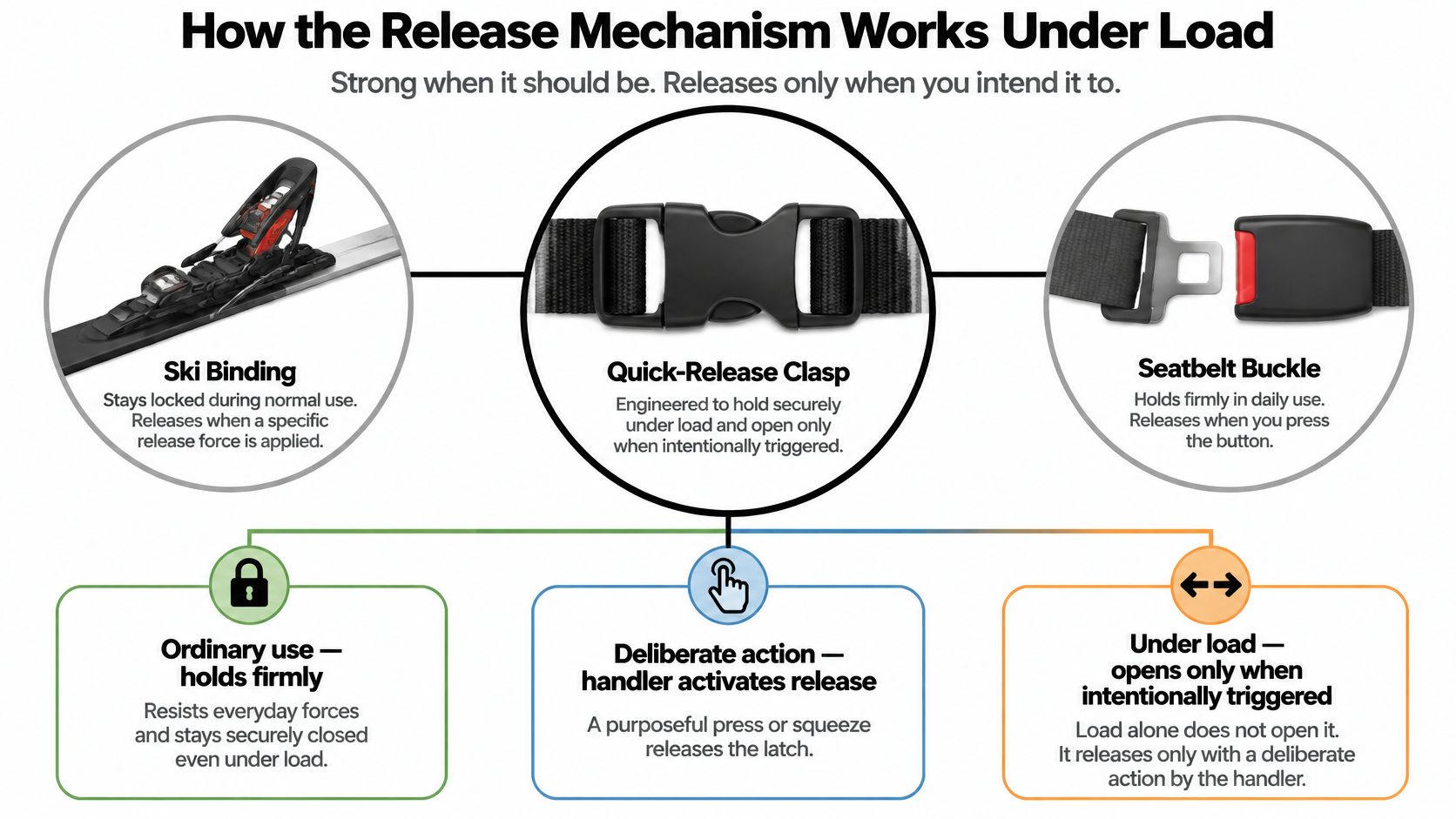
A manual quick-release clasp resembles a seatbelt buckle in its intended behavior: it holds during ordinary use and opens when the handler deliberately activates it. The comparison with a ski binding is more limited, because a ski binding may release automatically under particular loads. Don't assume a leash has automatic overload release unless its instructions explicitly say so.
The diagram illustrates the difference between holding and deliberate activation.
In canine neck-model testing described by Phys.org's report on collar pressure testing, applied forces of 40 N for a firm pull, 70 N for a strong pull, and 141 N for a jerk produced potentially injurious neck pressures across every collar style tested, including padded and wide designs.
Those are model-test forces, not safe release settings for a leash. They don't establish a universal threshold for your dog, and they don't prove that a manual release will operate before an initial impact.
Why a counter demonstration isn't enough
When a dog reaches the end of a rigid line abruptly, the stopping force arrives over a short interval. A modestly compliant section can lengthen deceleration, but excessive stretch lets the dog travel farther before you regain close control.
The release also has its own mechanics. Tension can press latch surfaces together, twisting can change their alignment, and dirt can obstruct movement. A clasp that opens easily without load may become difficult to activate when you need it.
For the buyer, meaningful validation should include:
- Gradual tension: Does activation remain manageable as the line tightens?
- Shock loading: Does the connector stay intact and retain its intended release function afterward?
- Twisting: Can the mechanism operate when the line isn't perfectly aligned?
- Wet contamination: What happens after exposure to water and grit?
- Repeated cycling: Does the latch close positively after repeated use?
The following video provides an additional visual reference for leash handling and equipment use.
Read the operating specification
Look for the intended dog-weight range, connector working load, overload behavior, and whether the release is resettable or single-use. Breaking strength isn't the same as a working-load rating, and neither tells you how hard the trigger becomes to operate under tension.
For a lunging dog, brachycephalic dog, or dog with tracheal disease, choose an appropriately fitted harness with veterinary guidance where needed. Check shoulder clearance and movement as well as strap security. A release can stop continuing tension after activation, but it can't undo force already transmitted through a neck collar.
Why Leash Injuries Happen and Who Is Most at Risk
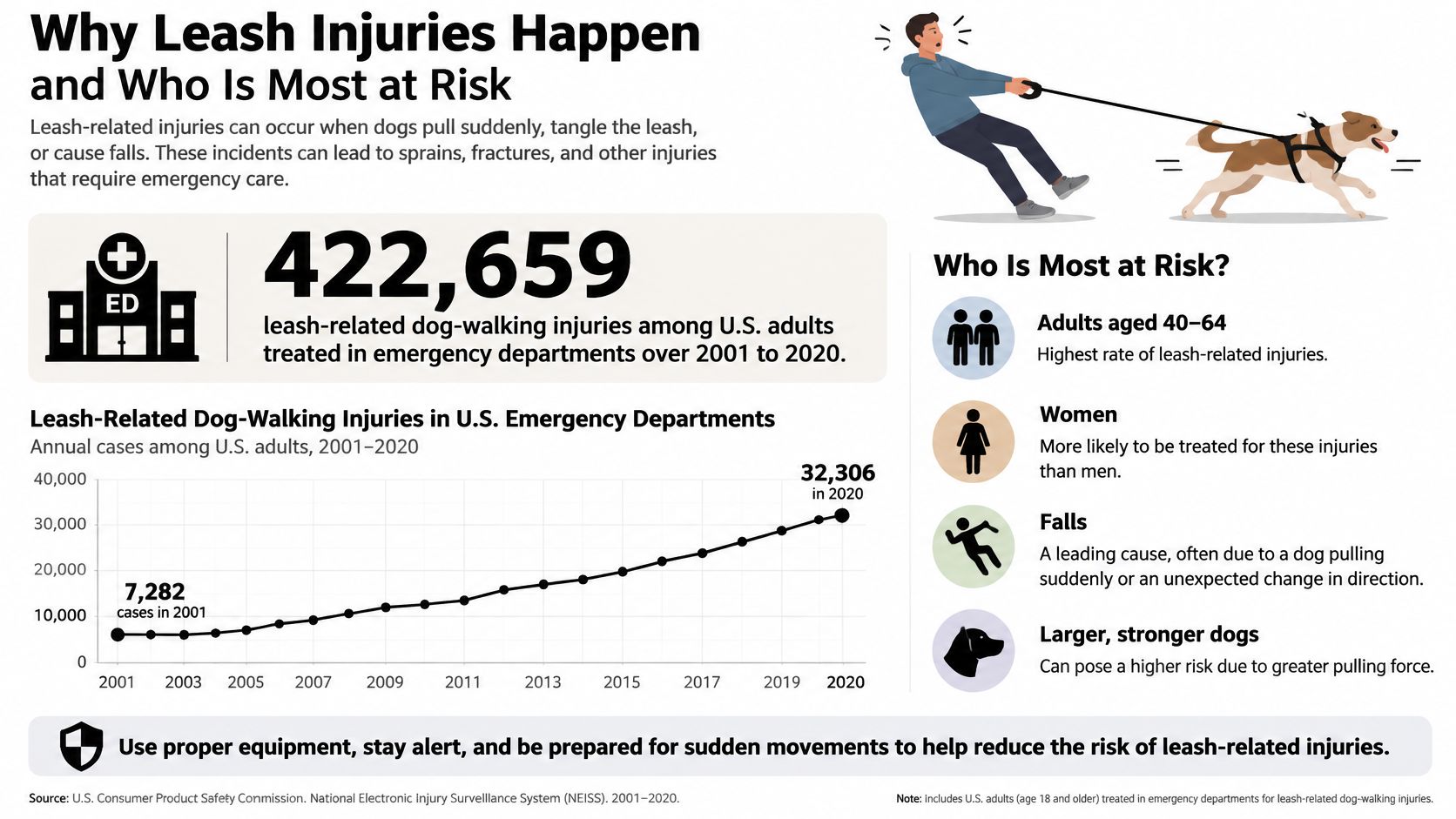
Researchers estimated 422,659 leash-related dog-walking injuries among U.S. adults treated in emergency departments between 2001 and 2020, according to the peer-reviewed analysis of National Electronic Injury Surveillance System records. The annual estimate rose from 7,282 cases in 2001 to 32,306 in 2020, a statistically significant increase.
These are emergency-department injury estimates, not a count of every mishap or a measure of the risk of an individual walk. They also don't demonstrate that a particular release mechanism would have prevented those injuries.
The infographic summarizes the study's scope and trend.
How the force reaches the handler
A dog doesn't have to be aggressive to cause trouble. A sudden stop to sniff, a sideways chase, or a change of direction around a street fixture can catch the handler off balance. The line's position matters as much as the dog's forward strength.
Watch for these practical warning signs:
- A stretched arm: You're walking with little room to absorb an unexpected change of direction.
- Leash crossing your path: Your dog can turn an ordinary step into a trip.
- A constantly tight line: You're managing sustained force rather than occasional corrections.
- Attention split between tasks: Carrying bags or using a phone can delay your response.
Choose equipment for the pull you may need to manage, not just the dog's weight while standing still.
Keep the risk in proportion
The absolute risk remains relatively low, but the consequences deserve attention. Harvard Health's discussion of leash-related injuries reports an estimate of about 1 in 10,000 people injured in 2018 and notes that adults aged 65 and older had more than twice the fracture risk of younger adults in the U.S. injury study.
Someone with balance concerns, fragile bones, or an existing shoulder problem should assess the entire walking arrangement. That may mean changing the route, choosing a more suitable handler, or addressing persistent pulling before relying on new hardware.
The guide to choosing a dog leash for pulling can help frame that equipment decision. The design objective is secure everyday attachment with an accessible emergency exit, not a promise that a clasp prevents falls.
When to Release, Hold On and Use It Safely
A systematic review of dog-walking injuries covering 491,400 injuries identified 110,722 hand- or wrist-specific fractures and soft-tissue injuries. Protecting the handler deserves as much attention as freeing the dog.
Hold the handle, manage excess line, and never wrap the leash around your hand, wrist, or body. Keep enough slack for normal movement without leaving loops where people can step through them.
Make the decision by situation
Faster release isn't automatically safer. The veterinary review of collar and harness risks notes that evidence remains insufficient to identify universally best equipment designs and practices. Choose the action that removes the immediate danger without unnecessarily creating another one.
Release or hold by situation
| Situation | Release the clasp? | Reason |
|---|---|---|
| Traffic or near a road | Hold control unless attachment is pinning or dragging you or the dog into immediate danger | An uncontrolled dog can enter traffic |
| Crowded sidewalk | Retain control and shorten excess line | Prevent crossing, contact, and tangling |
| Stairs or elevator | Keep dog and handler together with the line clear of doors | Separation across closing doors or a stair pull can be dangerous |
| Dog park | Use release for a genuine trapping emergency, not as a conflict-management shortcut | Opening doesn't necessarily separate fighting dogs |
| Open field | Release only when needed and assess boundaries first | Open ground doesn't guarantee containment |
| Fence or snag | Release the attachment that actually removes the trapped tension | A handler-side release may leave the dog snagged |
| Two entangled dogs | Release the relevant connector if safe, while keeping hands away from mouths | Opening the wrong attachment may not free either dog |
| After a fall or while being dragged | Activate the release if continuing attachment is causing immediate harm | Stop ongoing dragging force where possible |
A handler release won't necessarily remove a collar caught on fencing. Likewise, releasing your hand from tangled leashes may leave both dogs connected. Identify the trapped component rather than pulling harder.
Fit and recovery matter
For pulling dogs, check restraint fit using the dog harness fitting guide. Don't equate thicker padding with better force distribution, particularly around a vulnerable neck.
Our leashes are waterproof and all feature a double-latch mechanism. Those features don't establish automatic breakaway behavior or a specific emergency-release rating; check the individual product's intended operation. Returns are free for eligible products purchased directly from Nandog Pet Gear, so assess suitability while keeping return eligibility in mind.
For routes where wildlife encounters are a concern, planning for nonlethal protection on neighborhood trails from Counter Assault is a separate precaution, not a reason to let your dog pursue wildlife.
After release, regain control without chasing into danger. Re-clip only when the dog is calm, the attachment is accessible, and you can confirm that the latch closes properly.
Choosing Length, Width and Hardware for Your Dog
Use the chart as a selection guide, not a load-rating chart. A strap's width doesn't certify its strength, and no universal dog-weight-to-webbing formula replaces the connector's stated working load.
Leash width and length by dog weight
| Dog weight | Typical webbing width | Typical length | Best fit |
|---|---|---|---|
| Small, lightweight dogs | Narrow, lightweight webbing | Short enough for close urban handling | Small breeds and light pullers |
| Medium-weight dogs | Moderate width that sits comfortably in your hand | Everyday walking length with manageable slack | Daily walks and controlled jogging |
| Large, heavy dogs | Broader webbing with appropriately rated connectors | Enough room for movement without losing control | Large dogs, stronger pullers, and trails |
| Giant, very heavy dogs | Substantial webbing matched to a documented working load | A manageable fixed length rather than unnecessary reach | Giant breeds with a suitable harness |
Hardware mass matters for small dogs. A large connector can hang awkwardly from a lightweight harness, while a miniature clasp may be difficult for the handler to manipulate. Pick a combination that suits both ends of the leash.
Choose for the route and your hands
On crowded streets, use a length that lets your dog walk beside you without gathering bulky coils. For ordinary neighborhood walks, allow comfortable sniffing room while keeping slack clear of your feet. Trails may justify more reach, but narrow paths and blind corners still call for close management.
Check these hardware details before choosing a material:
- Reachable trigger: You can locate and activate it without changing to an insecure grip.
- Positive closure: The latch seats fully rather than merely appearing shut.
- Protected actuator: Ordinary contact doesn't press directly on the release.
- Suitable metal and finish: Inspect for rough edges, corrosion, and snag-prone projections.
- Compatible connection: The clip and harness ring move freely without forcing the gate against surrounding hardware.
Material choice affects daily handling. Nylon and polyester webbing are practical washable options; examine the weave and edge finish rather than assuming all webbing feels alike. Neoprene padding can cushion the handle but may retain moisture, while leather needs appropriate care after getting wet.
Rope can be comfortable in a relaxed grip yet abrasive if it slides rapidly through your hand. Coated straps are easy to wipe down, but assess how securely you can hold them when wet.
Compare construction details in the premium dog leash guide, then confirm the dog-weight range and rated working load for the specific product. Don't buy on appearance or strap thickness alone.
How to Clean, Inspect and Replace the Leash
Inspect the leash where you can see and operate the whole mechanism, with your dog safely contained elsewhere. Testing a release on an excited dog isn't a useful maintenance check.
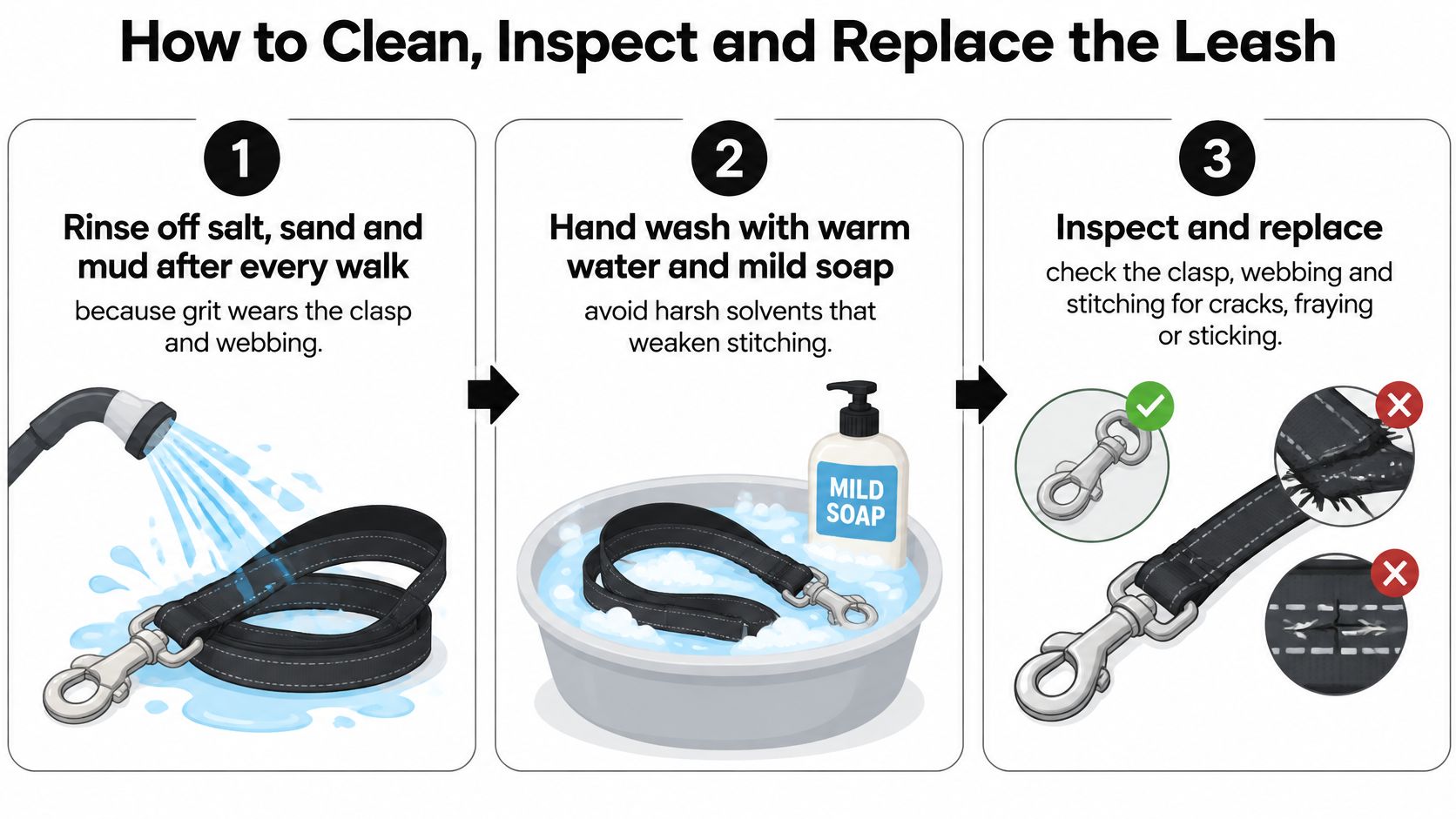
The maintenance graphic highlights the basic cleaning and inspection sequence.
A practical maintenance routine
- Remove contamination after walks. Rinse away salt, sand, and mud when present, paying attention to latch recesses. Don't force gritty moving parts back and forth before removing loose debris.
- Wash gently. Use warm water, mild soap, and a soft cloth or brush for washable components. Avoid harsh solvents, and use leather-specific care where the leash includes leather.
- Let everything dry naturally. Leave the latch accessible so trapped moisture can escape. Keep the leash away from radiators, dryers, and other direct heat sources.
- Operate the release with walking gloves. Open, reset, and close it repeatedly without the dog attached. Look for consistent movement and full engagement, not merely an audible click.
- Examine every load-bearing part. Flex the strap to expose fraying, cuts, loose stitching, and damaged coatings. Check connector bodies, gates, pivots, and attachment rings for cracks, distortion, or corrosion.
- Check ordinary retention gently. With the connector secured to a suitable stationary test point, apply controlled hand tension in a safe direction and confirm that it stays closed. Don't jerk the line, use your body weight, or treat this as proof of its rated strength.
- Remove questionable equipment from service. Replace a leash with damaged webbing, a sticking trigger, or unexplained opening. After a severe shock load, stop using it until its condition and the manufacturer's replacement guidance have been assessed; replace it when damage is present or safe reuse can't be established.
Before the first walk
Confirm the intended dog-weight range, connector working load, and whether activation requires resetting or replacement. If those details are absent, don't assume the leash is suitable for emergency release under load.
Buying check: A returnable leash is easier to reconsider than unsuitable equipment is to manage during an emergency.
Run the glove-operation and gentle retention checks before putting the leash into service. Make sure anyone else walking your dog can identify the actuator, reset the mechanism, and recognize when it hasn't fully closed.
Nandog Pet Gear offers waterproof leashes with double-latch mechanisms, alongside collars and harnesses for everyday walking setups. Visit Nandog Pet Gear to compare the walk range, then choose equipment whose fit, attachment, and operating instructions match your dog and your route.