


More than 80% of drivers recognized the dangers of traveling with an unrestrained pet, yet only 16% used pet restraints, according to a 2010 American Automobile Association survey reported by the American Veterinary Medical Association. That gap should change how you shop for pet carriers for large dogs. The right purchase isn't the plushest enclosure or the one with the highest weight rating. It's the one that fits your dog, works for your trip, and can be secured correctly.
Start with a tape measure and your transport requirements, not a color chart. A carrier can hold your dog's weight and still leave them crouching, slide across a cargo floor, or fail an airline's acceptance check.
Four Carrier Types and Where Each One Works
Choose the transport function before the carrier shape. The everyday choices fall into soft carriers, rigid crates, car restraints, and rolling or tote designs. Airline crates deserve a separate buying category because acceptance requirements can override the features you'd choose for local travel.
A carrier that's awkward to load or difficult to attach encourages shortcuts. Before buying, rehearse the practical sequence: open the door, guide your dog inside, close it without catching fur, and reach the restraint points.
Large-dog carrier types by use and trade-off
| Carrier type | Best for | Large-dog fit | Travel mode | Main trade-off |
|---|---|---|---|---|
| Soft-sided carrier | Car rides, vet visits, short trips | Check the maker's stated weight limit; many models suit smaller dogs | Car; cabin only if the airline allows and the dog fits | Soft walls can sag and provide little impact protection |
| Hard-sided crate | Car travel, home use, cargo flights | Choose by usable interior dimensions and total-load rating | Car, cargo, home | Heavier and bulkier to store |
| Car seat or restraint system | Daily driving for calm dogs | Check weight rating and seat compatibility | Car only | Doesn't work for air travel or walking |
| Rolling or tote carrier | Urban transit, stairs, short lifts | Usually suits smaller dogs; check usable interior length | Transit, short walks | Limited interior room and load capacity |
| Airline-approved crate | Checked or cargo flights | Must match the airline's listed dimensions and construction requirements | Air cargo | Bulky; needs a careful check before booking |
The most common mismatch is buying a soft enclosure as though it were a protective vehicle crate. Fabric can provide useful containment, but a padded wall doesn't establish impact protection. Use this guide to soft crates for large dogs to distinguish folding convenience from the structural features your trip needs.
Another mistake is treating wheels as proof of large-dog suitability. A rolling bag may be easy to move while empty but cramped or unstable with a dog inside. Check its base, handle, loading opening, and occupied balance.
Finally, don't assume a home crate is ready for cargo handling. A familiar enclosure still needs to meet the operating airline's requirements.
Buying rule: Pick the type for your most frequent trip. Then reject any model that fails the interior-fit or installation check, however attractive its other features are.
Measuring Your Large Dog for the Right Interior
Two dogs with the same body weight can need very different carriers. A long-backed dog needs floor length; a tall dog with upright ears needs headroom. Treat weight as a load check. Use body measurements for sizing.
For air-transport sizing, IATA's pet travel guidance specifies minimum internal length as A + ½B, width as C × 2, and height as D plus bedding, with a carrier 10% larger for snub-nosed breeds. Use that body-based approach as a planning baseline, then check the requirements for your particular journey.
Measurement worksheet for a large-dog carrier
Stand your dog naturally on a flat floor. Use a flexible tape without wrapping it around the body when you need a straight-line measurement, and repeat each measurement to catch positioning errors.
| Measurement | How to measure | What it sets in the carrier |
|---|---|---|
| A: nose to tail root | Straight line, dog standing relaxed | Internal length = A + half of B |
| B: ground to elbow | Floor to elbow, dog standing | Adds half of B to the length |
| C: widest point | Across shoulders or widest part of the body | Internal width = twice C |
| D: standing height | Floor to top of head or ears, whichever is higher | Internal height = D plus bedding |
| Snub-nosed breeds | Apply the breed adjustment after measuring A to D | Add the larger-carrier allowance stated above |
Keep the dog's posture honest. Raising the head with a treat inflates D and can push you toward a taller shell than the dog uses. Let the dog settle, ask a helper to keep them comfortably standing, and record each figure with its letter so the worksheet still makes sense when you compare models.
The interior must support natural standing, sitting, turning, and lying. Watch the turn as closely as the final resting position. A dog that can lie curled up but has to scrape its shoulders around the doorway is telling you the usable shape is wrong.
Check the space the dog can actually use
External dimensions include walls, frames, door hardware, and other parts your dog can't occupy. Ask the seller for usable internal dimensions, including the narrowest point and the height beneath any roof supports. A carrier can look generous on the product page and still lose room where the door recesses or the frame slopes inward.
Bedding also takes space. Test the proposed liner inside the enclosure rather than assuming a thick cushion can be added later without changing the fit. If the liner raises the floor enough to pinch ear clearance or shortens the effective turn circle, use a thinner pad and keep the interior geometry intact.
For a cargo-bound crate, use Precious Pets Transport crate sizing advice as a cross-check against your A-to-D worksheet, the carrier's stated interior dimensions, and the operating airline's crate rules before you pay.
Write down your dog's measurements before shopping. If a seller publishes only an exterior size and a breed list, ask for the missing interior measurements before paying. If they cannot supply them, that model is the wrong answer for a large dog, whatever the weight rating claims.
Weight and Size Limits for Each Travel Mode
Airline cabin limits can rule out a carrier before its comfort features matter. The U.S. Department of Transportation's flying-with-pets guidance explains that airline policies differ; the listed American Airlines example limits a soft-sided carrier to 18 × 11 × 11 inches (46 × 28 × 28 centimeters) and pet-plus-carrier weight to 20 pounds (9.07 kilograms). The same travel guidance notes the U.S. State Department's distinction that animals weighing 100 pounds or more, including the cage, are generally charged as cargo even when traveling on their owner's aircraft.
Those examples describe separate constraints. A dog might meet a weight allowance but fail the space requirement. A carrier might fit the dog but be unacceptable for the service you've booked.
Size and weight rules by travel mode
| Travel mode | Size limit | Weight rule |
|---|---|---|
| Airline cabin, soft-sided, American Airlines listed example | The published cabin dimensions stated above | Pet and carrier must meet the combined allowance stated above |
| Cargo threshold, U.S. State Department | Not a size limit | The combined animal-and-cage threshold stated above affects cargo charging |
| Car travel | Fit the dog and the intended vehicle location; no universal carrier size | Respect the carrier's load rating and secure the occupied enclosure |
Read the travel-mode requirements first, then the product specifications. Starting with a carrier you like and searching for a service that will accept it is the wrong sequence.
For air travel, weigh the complete setup rather than the dog alone. Include the enclosure and whatever equipment the airline requires inside it. Ask how the airline classifies the journey, what it accepts on the specific route, and whether there are additional handling restrictions.
For car travel, there isn't a universal large-dog size label that settles the purchase. Your dog's body measurements establish the interior requirement; the vehicle opening, floor shape, and anchoring arrangement establish whether that enclosure can be installed.
Multi-dog trips need separate planning. Measure each dog individually and don't assume that a wider shared crate is acceptable just because both animals can fit inside. Confirm the applicable individual-crating requirements before choosing a shared enclosure.
A higher weight rating doesn't grant more interior space, and a larger interior doesn't grant airline eligibility.
How to Secure a Large-Dog Carrier in the Car
An unsecured dog and carrier can become projectiles during sudden braking. The American Veterinary Medical Association's vehicle guidance recommends a comfortably sized carrier, secured against movement and positioned as near the vehicle's center as possible, away from an active airbag.
Use the installation method specified for both the enclosure and your vehicle. A carrying handle isn't automatically a restraint point, and an ordinary cargo loop isn't automatically suitable for every attachment system.
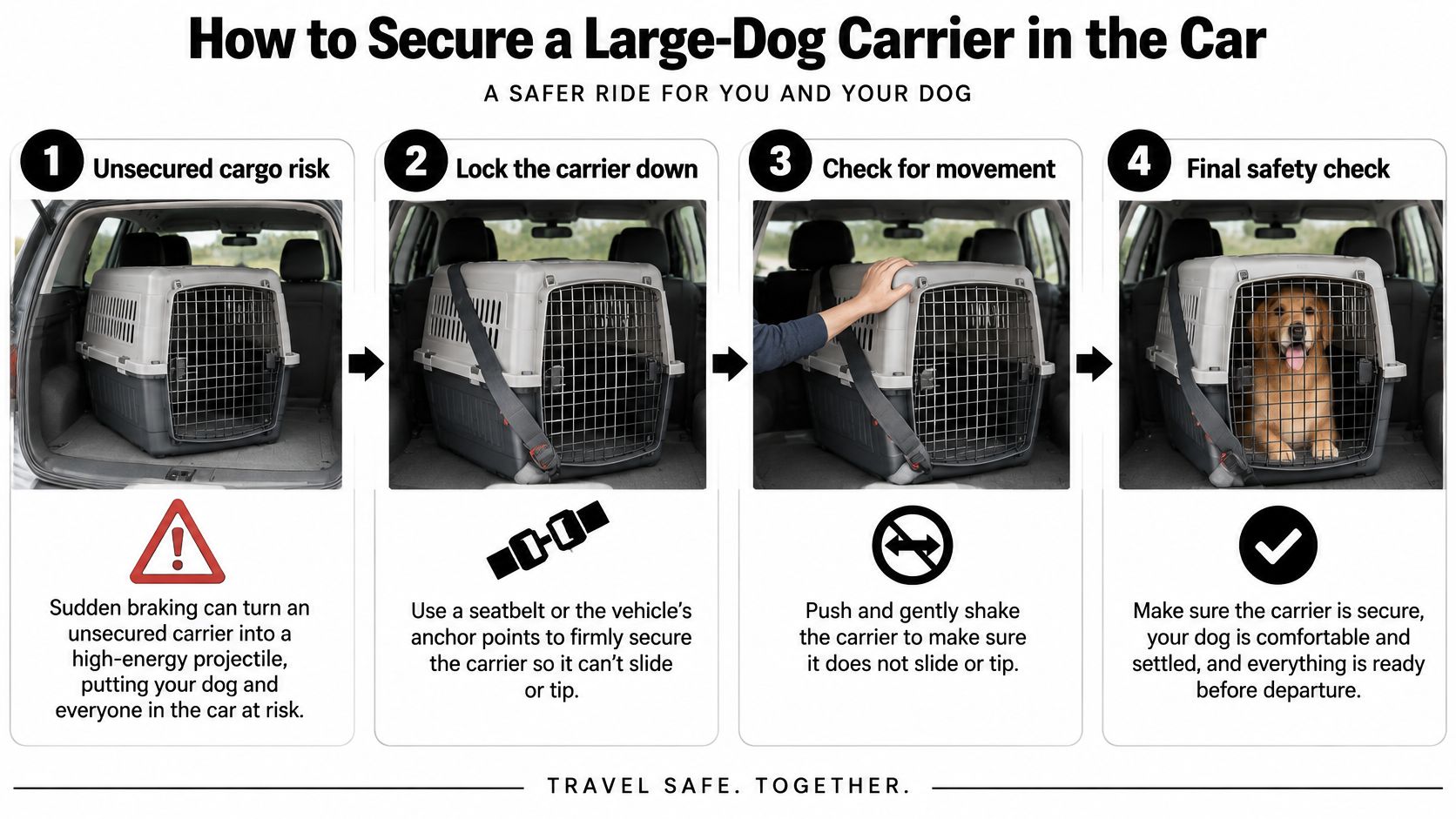
Install it before loading for departure
- Choose a supported position. Use a suitable rear-seat or cargo-floor location as near the vehicle's center as practical. Avoid active-airbag exposure, and don't balance a wide base across a sharply sloped seat.
- Check occupied clearance. Confirm your dog can use the enclosure naturally with the intended bedding installed. A carrier that fits through the hatch can still lose ventilation or door access once pushed into place.
- Use designated attachment points. Follow the manufacturer's restraint instructions with compatible straps or hardware. Don't improvise by looping a belt through a handle that wasn't designed for that purpose.
- Test for unwanted movement. Push and pull the installed enclosure at its base and upper corners. Look for sliding, tipping, rotation, strap slippage, or attachment hardware pulling out of alignment.
- Clear the ventilation openings. Move luggage, blankets, and cushions away from the air paths. Packing bags tightly against mesh can undo an otherwise careful installation.
- Recheck after your first stop. Inspect strap tension, buckles, and carrier position once the load has settled. Don't assume the original setup stayed unchanged because the drive felt smooth.
For a broader look at restraint choices, consult this guide to securing a dog in a car.
Know what the movement check proves
A push-and-pull check exposes obvious installation problems. It does not demonstrate crash performance. If a manufacturer claims crash testing, ask for documentation covering the model, size, restraint arrangement, and intended vehicle placement.
Reject an installation that rocks on the seat, obstructs essential vehicle functions, or requires makeshift fastening. Sometimes the right answer is another mounting location or a different enclosure, not tighter straps.
Checking Whether a Large Dog Can Fly in the Cabin
Can your dog fly in the cabin at all? Answer that before buying an air-travel carrier. A larger bag can't solve a service restriction.
The Federal Aviation Administration's pet-travel guidance leaves cabin-pet permission to individual airlines and explains that an accepted carrier must fit under the seat, avoid obstructing the aisle, and remain stowed during taxi, takeoff, and landing. That makes many large-dog carriers unsuitable for ordinary commercial cabin travel, regardless of their premium construction.
Use this checklist before committing to a ticket or carrier.
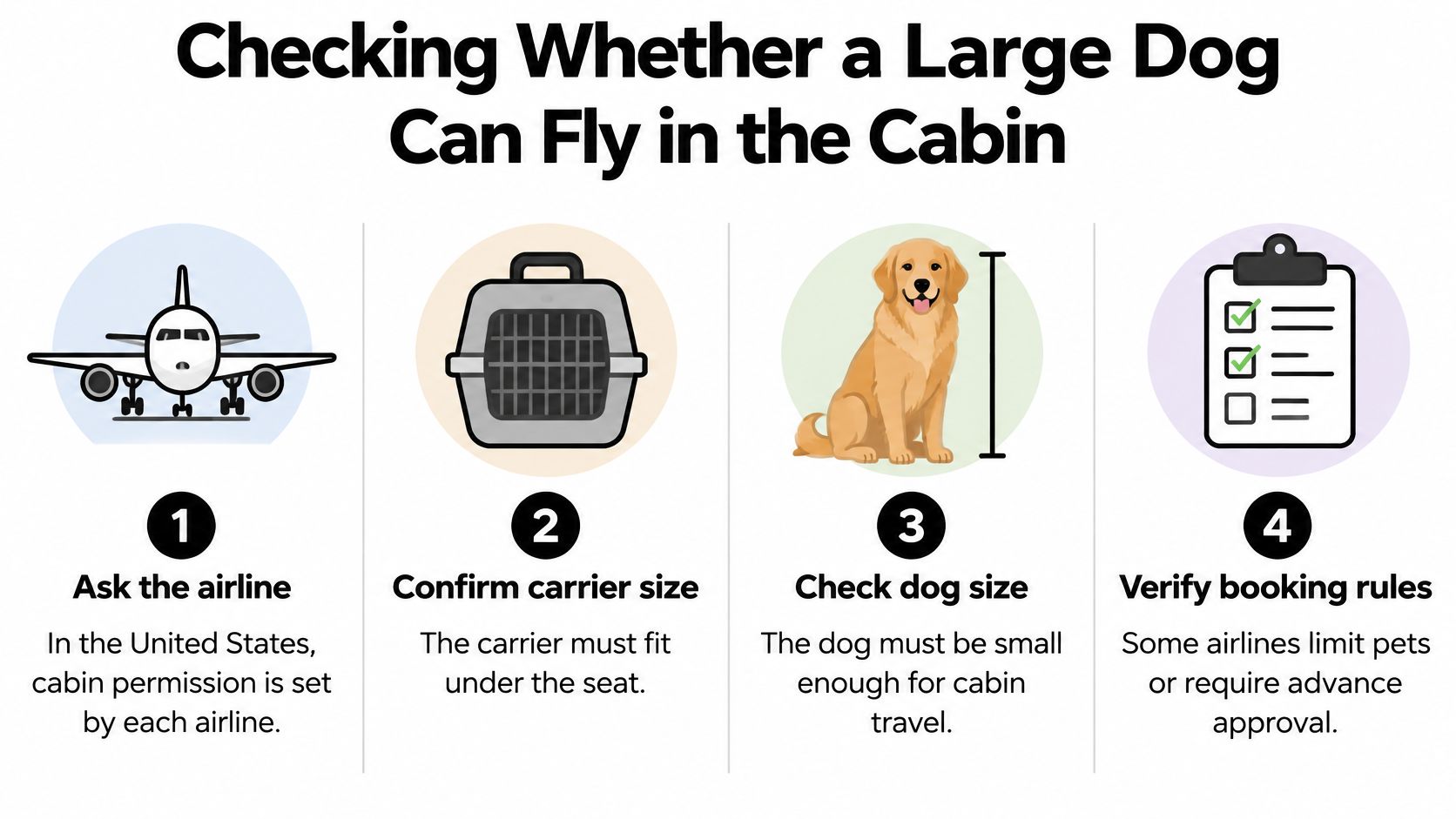
Get acceptance before spending
- Ask about the actual itinerary. Obtain written confirmation of whether your dog can travel in the cabin on the operating airline and route. Don't rely on a general customer-service answer about pets.
- Describe the dog accurately. Provide current measurements and weight rather than just a breed name or a previous travel history.
- Confirm the available space. Compare the accepted carrier envelope with your dog's required interior room. Compressible fabric doesn't make a tall dog shorter.
- Treat compatibility labels as claims to verify. A seller's airline-compatible description isn't permission from your airline.
- Check the booking record. Make sure any required pet reservation or acceptance is attached to the itinerary, then reconfirm during check-in and boarding.
- Prepare an alternative. If the dog or carrier doesn't qualify, investigate ground travel or an appropriate checked or cargo service before departure day.
Expandable panels deserve particular skepticism. They can offer resting space where opening them is permitted, but they don't change the carrier's required stowed footprint. Don't buy an expandable model expecting the expansion to rescue a poor cabin fit.
The air-travel dog carrier guide can help organize product comparisons after you've established eligibility.
For many large dogs, the honest recommendation is a different transport plan, not a larger soft carrier.
If an airline answer is ambiguous, resolve it before booking. Turning up with a carefully styled carrier and hoping for discretion isn't a travel strategy.
Ventilation, Materials and Cleaning for Durable Carriers
Ventilation deserves more attention than the number of mesh windows. For applicable air-transport containers, IATA's container requirements specify a total ventilated area of at least 16% of the four sides, nose- and paw-proof openings, and individual crating for dogs over 14 kilograms.
Assess the open area and its distribution, not the decorative outline around a panel. Handles, pockets, liners, and nearby luggage can reduce the airflow available in use.
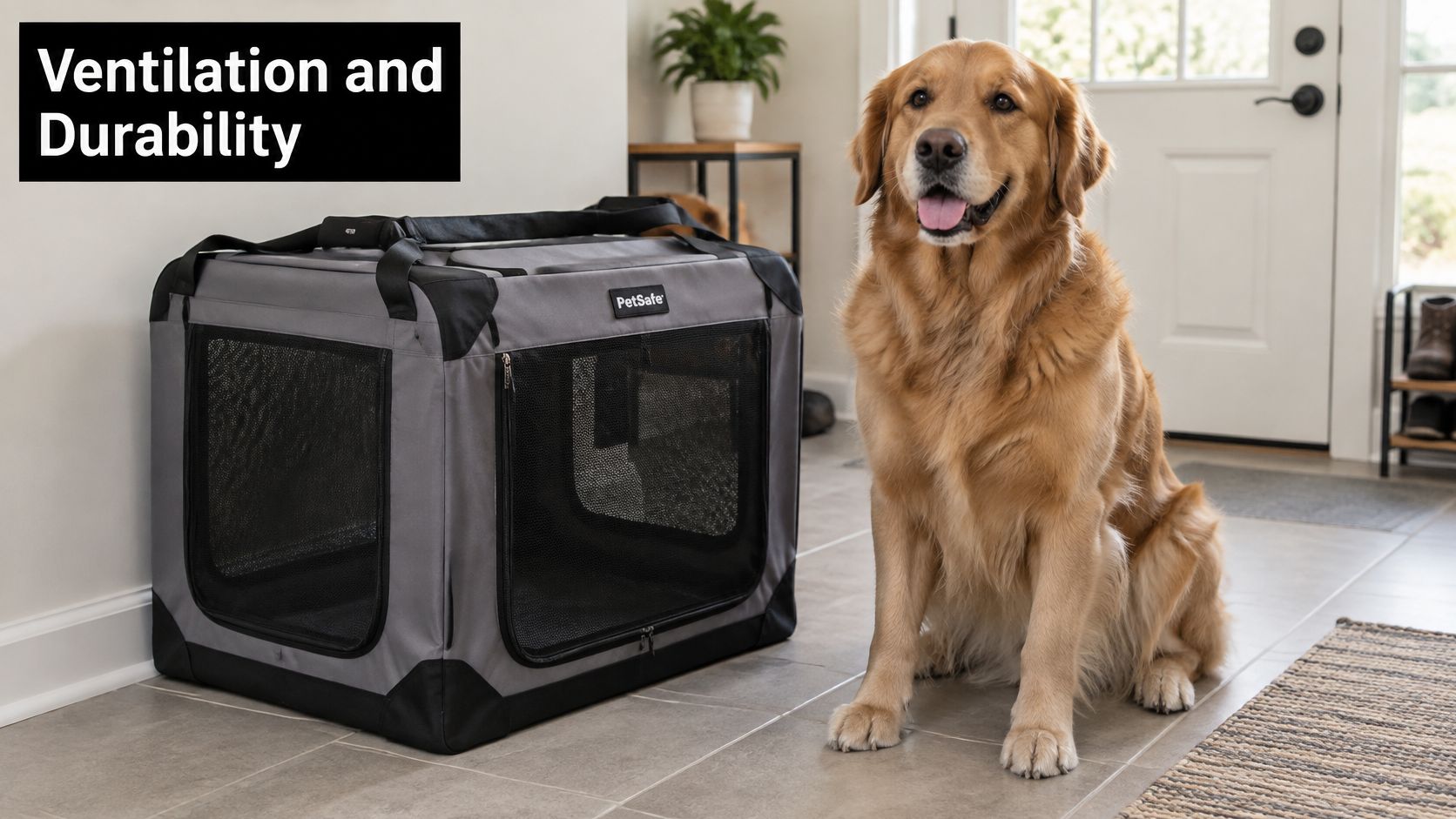
Carrier materials and features compared
| Material or feature | Strength | Trade-off |
|---|---|---|
| Heavy nylon or ballistic fabric | Resists abrasion and wipes clean | Mesh panels can retain odor and require thorough cleaning |
| Molded plastic | Rigid shell with accessible surfaces for washing | Often heavier and less compact than folding fabric |
| Aluminium frame | Can support a lightweight, collapsible structure | Frame thickness reduces usable interior room |
| Wire panels | Open construction supports airflow | May need shielding from direct sun or visual stimulation without obstructing ventilation |
| Plush liner | Adds cushioning and comfort | Needs removable, washable construction for practical hygiene |
Material names aren't performance guarantees. Examine where fabric joins the frame, how the door closes, and whether the floor bows under the intended load. A sturdy shell with a weak latch is still a weak enclosure.
Don't automatically cover wire panels in the car. A cover may help manage visual stimulation, but it can also obstruct airflow. Positioning and ventilation come first.
Clean the hidden contact points
Remove loose hair and debris before washing. For accidents, use a material-compatible enzyme cleaner according to its directions, then rinse washable surfaces as instructed and let every component dry completely before storage.
Pay attention to zipper tracks, lower seams, and the space beneath the floor insert. Those areas can retain moisture even when the visible surface feels dry. Wash liners according to their care labels rather than assuming every plush insert tolerates machine washing.
Never use a sun-exposure test with a dog inside to judge heat safety. A hand on the lining doesn't establish a safe environment, and ventilation doesn't make a closed parked car an acceptable waiting place.
Finish your inspection with smooth seams, a stable base, and secure closures. Run your hand along the interior for exposed hardware, check for rocking on a level surface, and operate the zipper or latch under normal occupied tension without forcing it.
Style and Portability Features for Urban Owners
A sleek carrier that slips into a hallway closet may be too cramped for the dog expected to occupy it. Urban convenience matters, but it should describe the complete journey, including the lift, curb, station entrance, and stairwell.
Before buying, walk that route mentally with an occupied carrier. Where will you set it down? Can you open the building door while keeping it level? Can you manage it if the lift is unavailable?
Judge convenience with the dog aboard
- Folding frames save storage space. Check the locking mechanism after unfolding, not just the compact folded shape. A frame that needs fiddling at the curb will become frustrating quickly.
- Wheels help on smooth surfaces. Look for a stable wheelbase and a handle that doesn't pull the enclosure into a steep angle. Rough paving and stairs still require a lifting plan.
- Totes suit manageable loads. Refined styling doesn't make a large dog comfortable to carry. Check whether the base stays level rather than folding around the dog.
- Backpack designs need careful fitting. Load distribution can help the person carrying the dog, but the dog's posture and the owner's balance still need assessment.
- Washable liners simplify city travel. Choose an interior you can clean after wet pavements, muddy paws, or an unsettled journey. Access beneath the liner matters as much as its surface texture.
- Finishes are personal, not structural. Choose a color you like only after checking the frame, floor, closures, and attachment system.
Test handling before admiring the finish
Ask whether the manufacturer permits lifting the enclosure while occupied and which handles are intended for that job. Don't assume a shoulder strap is suitable because it clips onto the bag.
Place a tape measure inside the carrier and compare the usable space with your dog's recorded measurements. Then assess the occupied lifting weight realistically. A carrier that looks right in a showroom but fails either check is the wrong purchase for a large dog.
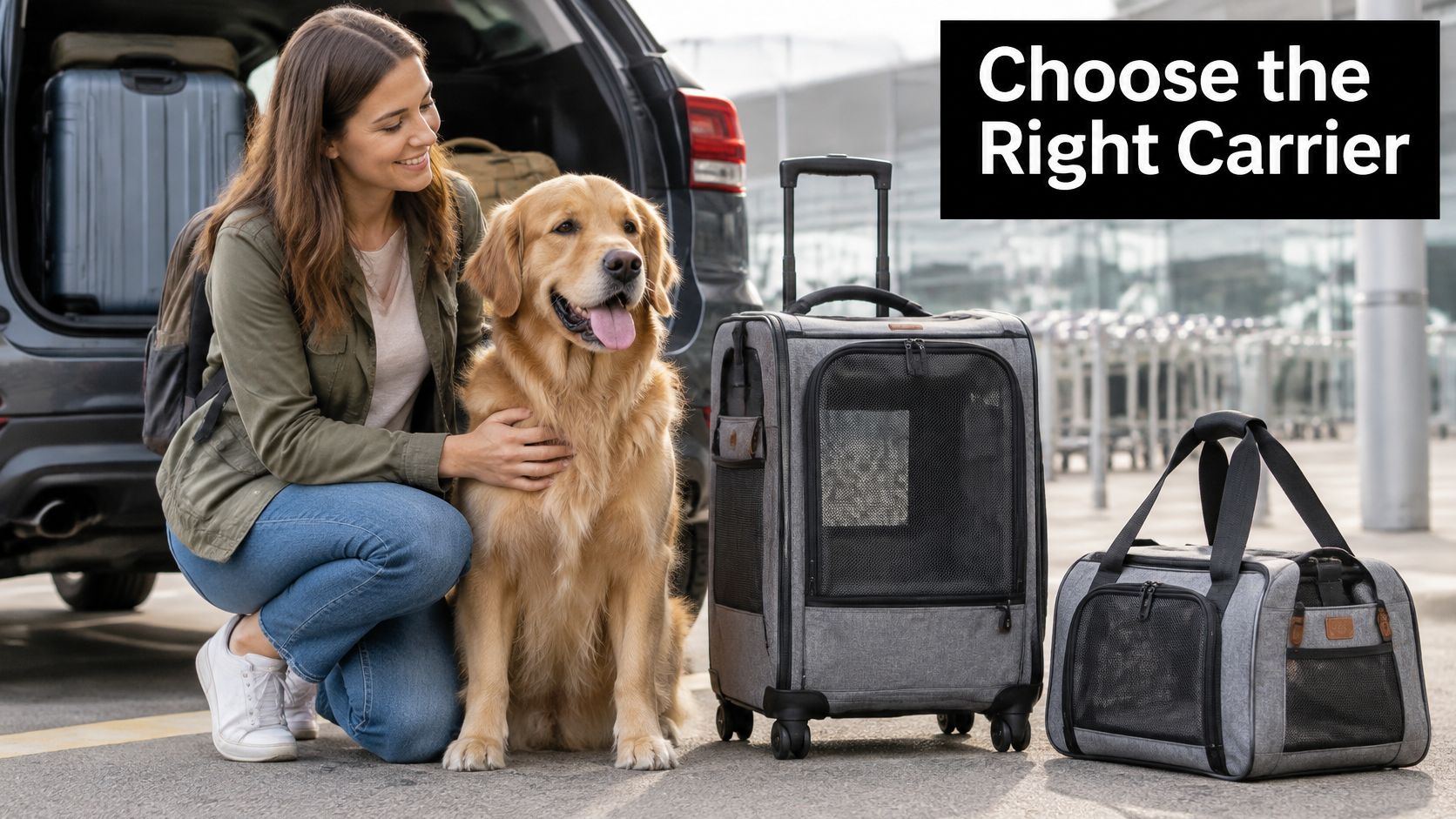
Choose Your Carrier by Travel Situation
Choose the simplest setup that meets the trip's requirements without compromising fit or restraint. Compare the complete arrangement, not just the enclosure.
- Daily city errands. Choose a rolling or tote carrier only when the dog fits and you can manage the occupied load. Otherwise, walk where appropriate or arrange suitable vehicle transport.
- Regular road trips. Prioritize a vehicle-compatible rigid crate or properly secured car carrier with a documented installation method.
- Cabin flights. Buy only after the operating airline confirms acceptance for your dog and itinerary.
- Checked or cargo flights. Select a crate against the airline's current construction and handling requirements, not a marketing badge.
- Vet visits and local trips. A soft carrier can work for a dog that tolerates it, provided its load rating, interior, and vehicle installation are suitable.
- Calm dogs on routine drives. A correctly fitted vehicle restraint or suitable car seat may be more practical than an enclosure. Neither substitutes for an air-travel crate.
Use the video as an additional visual reference while comparing travel arrangements.
Measure first, verify the transport rules, and assess the installation before buying. Comfort features belong on the shortlist only after those checks pass.
Nandog Pet Gear offers car seats, tote carriers, harnesses, and everyday comfort accessories for life with your dog. Visit Nandog Pet Gear with your dog's measurements and travel requirements in hand, and compare each product's interior room, load rating, and installation instructions before choosing.