

The most common advice about buying a silicone dog food mat is incomplete: choose food-grade silicone, look for raised edges, and check that it's dishwasher safe. None of those labels tells you whether the finished mat has suitable food-contact documentation, whether its corners trap dinner, or whether it fits the bowls you already own. The better buying question is how much spill control you need without making cleaning harder.
A mat belongs underneath the feeding setup, not in charge of it. Start with your bowls and floor space, then judge the surface, construction, and care instructions.
Mat Size Chart by Dog Weight and Bowl Setup
Typical Silicone Dog Food Mat Sizes by Dog Weight
| Dog weight starting point | Bowl capacity | Typical mat sizing rule | Best fit |
|---|---|---|---|
| Under 10 lb, toy and small breeds | Use the capacity of the dog's existing bowl | Compact footprint with a clear border around the bowl | Single bowl in a tight corner |
| 10 to 25 lb, small breeds | Measure food and water bowls separately | Wide enough for both bowl bases and their spacing | Single food bowl plus a water bowl |
| 25 to 50 lb, medium breeds | Use the actual bowls, not a weight-based estimate | Rectangular footprint enclosing the combined setup | Food and water side by side |
| 50 to 90 lb, large breeds | Check the water bowl's outside diameter | Broad footprint with additional splash space | Large bowls or a separate water station |
| Over 90 lb, giant breeds | Measure the largest bowl or feeder stand | Full feeder footprint plus exposed catchment space | Oversized bowls, a stand, or separate mats |
These weight bands are shopping prompts, not validated sizing recommendations. Body weight alone doesn't reliably determine bowl or mat size, and converting weight into bowl capacity would create false precision. A wide, shallow bowl can need more mat space than a deeper bowl with greater capacity, so the bowls in front of you beat any chart.
Retail size names aren't enough either. Small, large, and extra-large only help when you confirm the seller's actual dimensions and whether they describe the outside edge or usable interior.
Measure the setup your dog actually uses
Place the food and water bowls where your dog normally eats. Include their usual separation, then measure the full outside footprint with a tape measure. For a raised feeder, measure the stand's feet as well as any bowl overhang, because a stand that hangs past the mat edge puts drips back on the floor.
Leave exposed mat around that footprint rather than letting the bowl bases nearly touch the rim. As a hypothetical layout test, mark a border about three inches wide around the setup with painter's tape, then adjust it after watching where your dog drops food or splashes water. That's a practical starting experiment, not a tested containment standard. A dog that lifts its head to drink will need more border behind the water bowl than beside it.
Side-by-side bowls need room for both outside diameters, the gap between them, and the surrounding catchment area. Doubling one bowl's width alone can leave too little room at the edges.
Practical rule: Measure the combined bowl footprint, allow a usable spill border, and choose the next larger listed size when the fit looks tight.
Bigger is better for spill control and worse for cleaning. A larger mat catches more mess but needs somewhere to wash and dry, so check that it fits your sink or approved dishwasher position without folding, and that you can store it without permanently curling the corners. If the water station sits away from the food bowl, two separate mats are often easier to handle than one oversized sheet that never quite fits the sink.
What Food-Contact Proof a Silicone Mat Should Show
Food-grade isn't a safety certificate. It's a claim that needs supporting documentation for the material and its intended use.
For repeated-use rubber articles in the United States, 21 CFR 177.2600 is a relevant regulatory basis, while the FDA's guidance on determining the regulatory status of food-contact components explains that compliance depends on the substances expected to migrate and their authorized uses and conditions. A seller should be able to explain how that framework applies to the finished mat, rather than displaying an FDA logo.
A plain-looking mat still needs documentation.
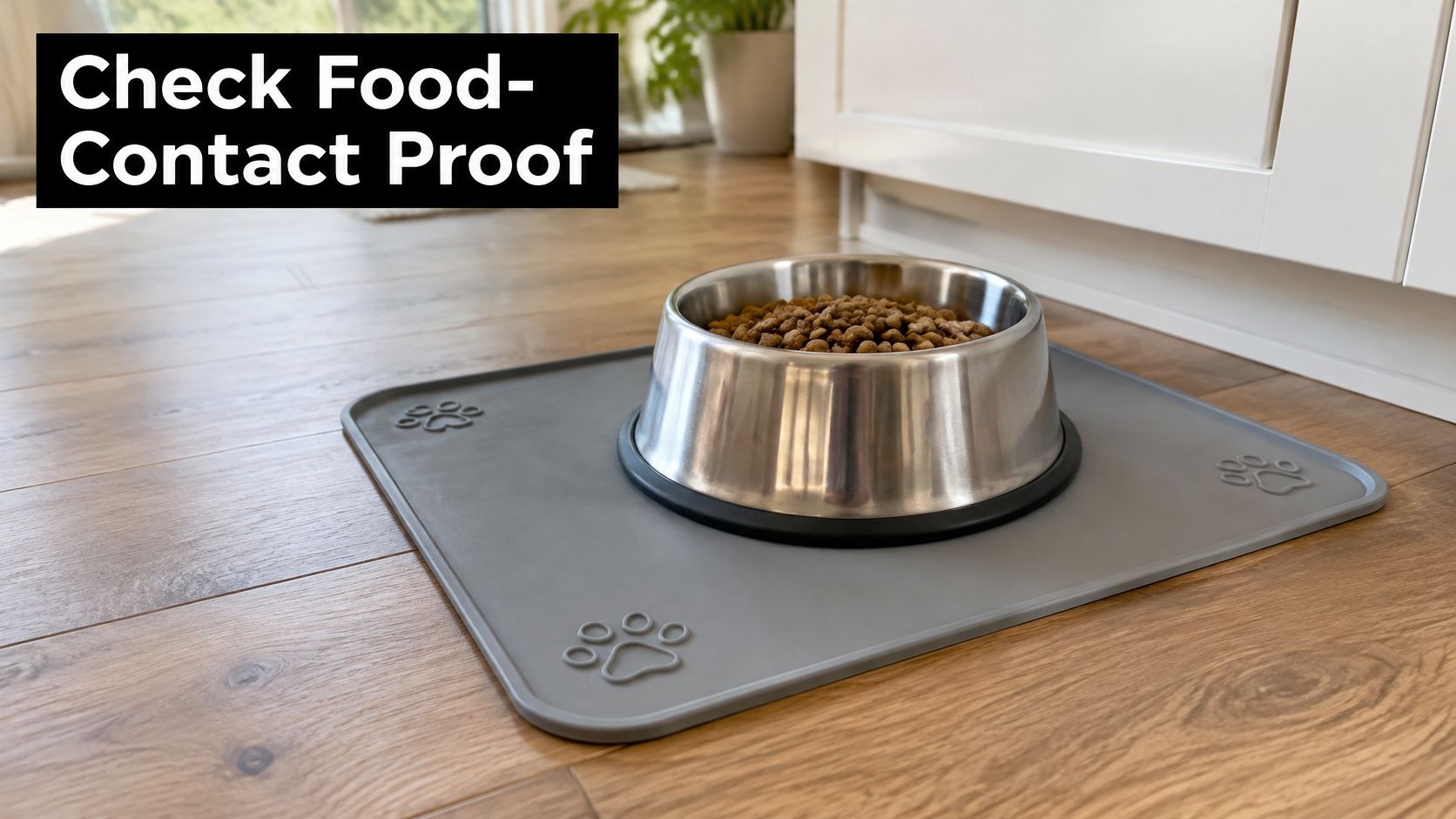
Ask about the finished product
The base silicone isn't the whole article. Pigments, fillers, coatings, and manufacturing residues also matter, so a certificate for raw silicone doesn't automatically establish the suitability of a colored, printed, finished mat.
That doesn't mean bright colors are unsafe or gray silicone is safer. It means the documentation should cover the formulation you're buying, including its color and any added surface treatment.
Common Label Claims and What to Request
| Label claim | What it actually shows | What to request from the seller |
|---|---|---|
| Food-grade | Not a guarantee on its own | Written statement identifying the silicone and intended food-contact use |
| FDA approved | Doesn't establish that FDA approved the finished mat | Applicable regulatory basis and explanation of compliance |
| Non-toxic | No meaningful test information by itself | Finished-product migration or extractables testing details |
| BPA-free | Addresses one substance, not the whole formulation | Statement covering the formulation, pigments, and additives |
| Dishwasher safe | Describes a cleaning claim, not food-contact compliance | Approved washing method and maximum care temperature |
A useful seller response should identify the product or model, intended contact with food, applicable testing or regulatory basis, and care limitations. Ask whether the supporting report covers the finished article or only an ingredient supplied to the factory.
You don't need the manufacturer's confidential recipe. You do need enough traceable information to connect its claim to the mat in your cart. The same purchasing discipline applies when choosing food-safe dog bowls, especially if your dog eats dropped food directly from the mat.
If the seller can't provide a meaningful answer, treat the claim as unverified. Attractive packaging and a higher price don't replace documentation.
Non-Slip Bases, Raised Edges and the Cleaning Trade-Off
Spill control and cleanability aren't the same feature. A tall rim may contain water well while making its inside corners awkward to scrub. Deep texture may steady a bowl while leaving food behind after a quick rinse.
The feature comparison makes that trade-off easier to inspect.
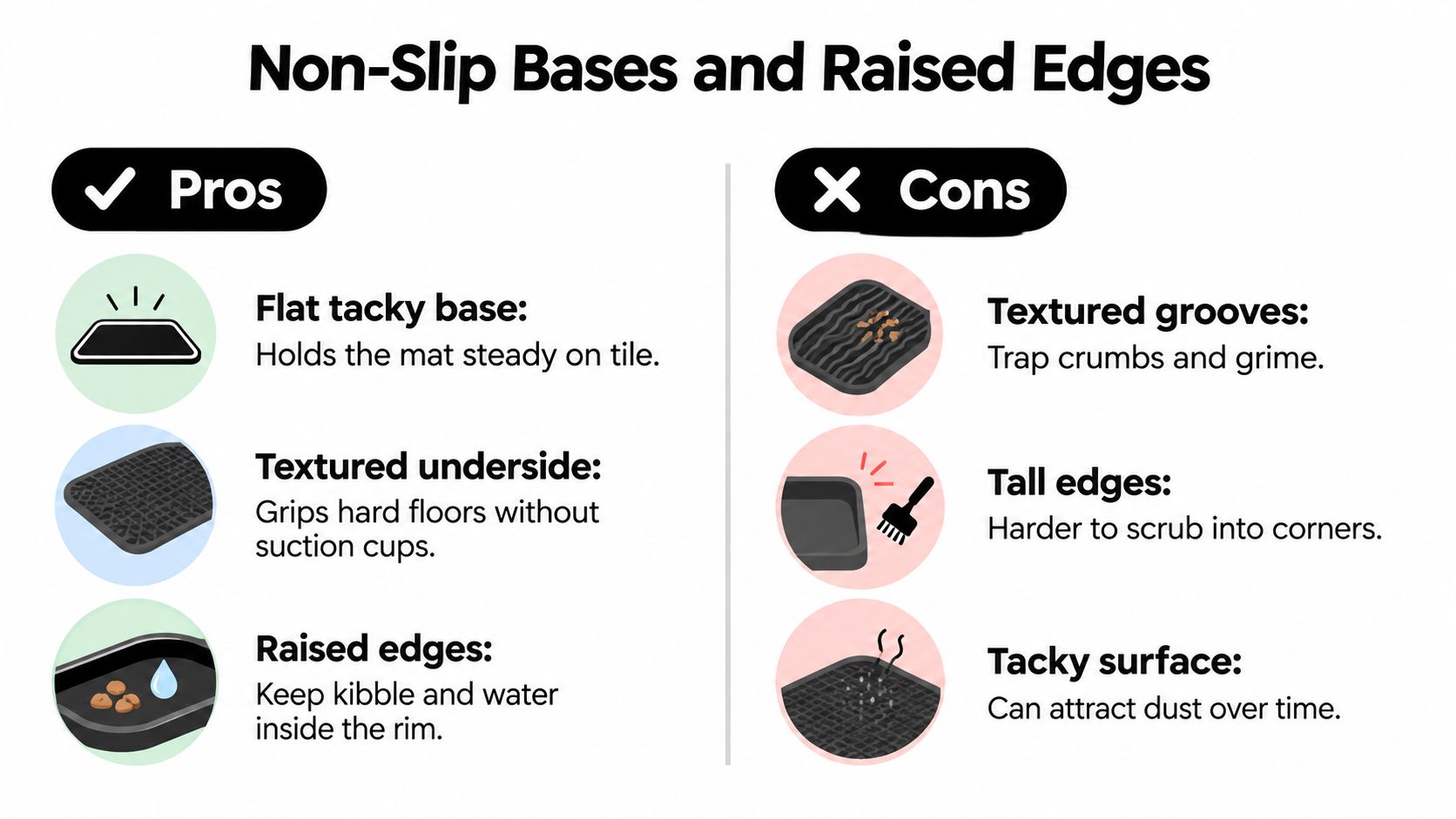
Test grip and containment separately
Grip comes from the underside's contact with your particular floor. A flat, slightly tacky base or shallow underside texture can work well, but dust, moisture, curled corners, and floor finish can change the result. Don't assume a product labeled non-slip will behave identically on every surface.
Test an empty mat on a clean, dry floor. Press it flat, tug a corner, then place the bowls and push them gently sideways. If the bowl moves but the mat stays, you may need a better bowl base rather than a more elaborate mat; this guide to a non-slip dog bowl addresses that separate problem.
For containment, inspect the rim's shape and its junction with the floor of the mat:
- Wet-food mess: Choose a raised rim with a smooth interior and rounded, accessible corners.
- Mostly tidy kibble feeding: A low-profile mat with minimal texture can be simpler to wipe and wash.
- Heavy water splash: Prioritize exposed catchment space, not just a taller wall around tightly packed bowls.
- Separating edges: Reject gaps or lifting joins that create inaccessible food pockets.
A peer-reviewed PLOS ONE study of dog-owner feeding practices found that prescribed hygiene protocols reduced bacterial counts on food dishes compared with controls. It evaluated dishes, not silicone mat designs, so it supports consistent cleaning rather than a claim that any particular mat prevents bacterial buildup.
Choose features you can reach with a brush. A groove that hides crumbs also hides unfinished cleaning.
Flex the rim gently before committing to the mat. A continuous molded junction is easier to inspect than an attached edge that's beginning to separate.
How to Wash and Dry a Silicone Mat After Every Meal
Wash before food dries into the rim and texture. Dried wet food and slobber take far more brush work than a fresh spill, and the raised edges bought for containment are exactly where residue hides. Keep a soft-bristled dish brush, dish detergent, and a drying space near the sink so the routine doesn't stall waiting on supplies.
The sequence below is the version worth keeping within reach of the faucet.
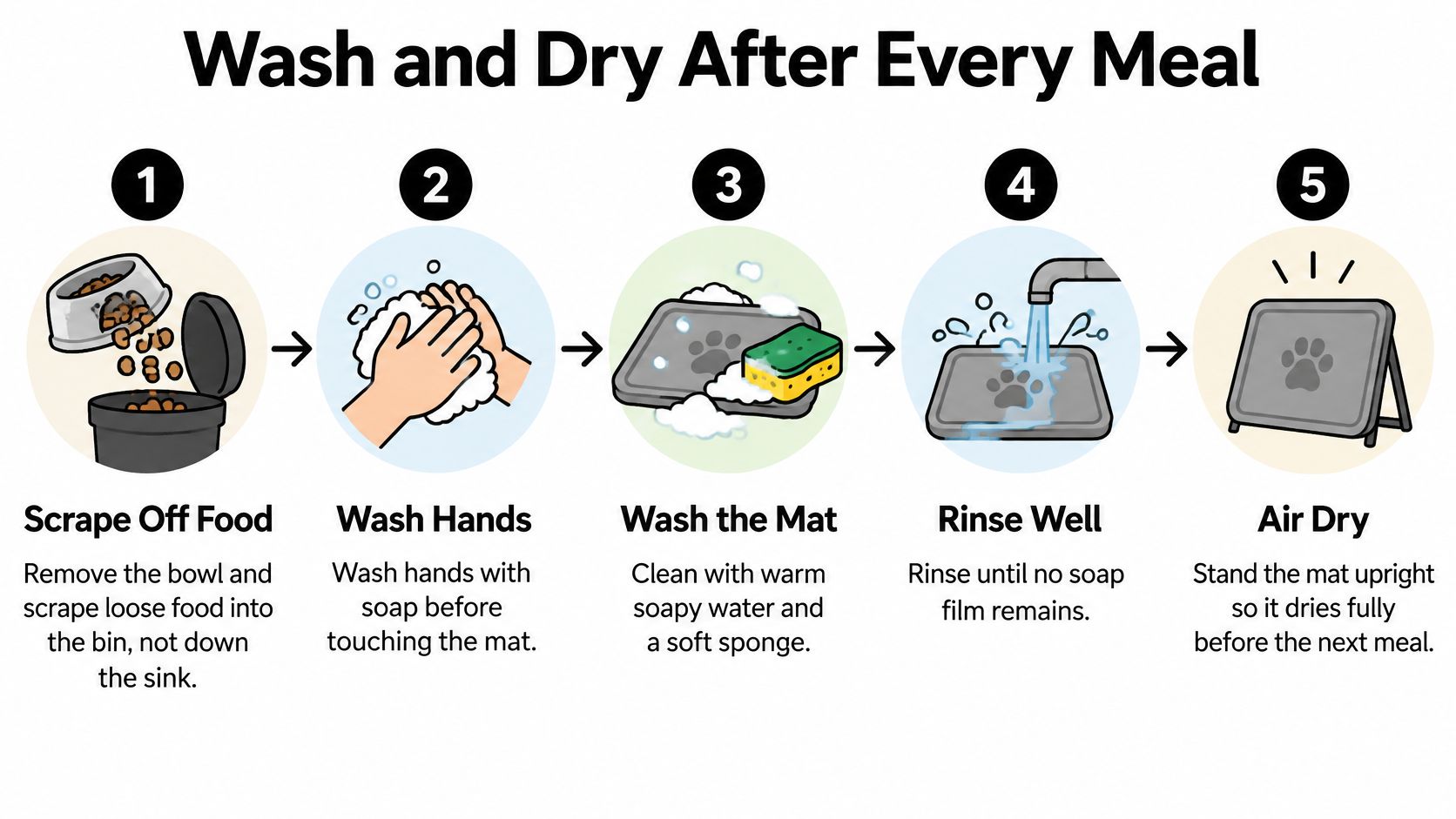
Follow an order that removes residue
- Clear the mat. Remove the bowls and scrape loose food into the bin, not the sink, so scraps don't collect around the drain.
- Wash your hands. Use soap and warm water before handling cleaned feeding equipment, and wash again after dealing with dirty items.
- Wash every surface. Use detergent and warm water, working a soft brush along the rim's inner junction, through any grooves, and across the underside. Skip abrasive pads; they scuff the finish and leave new texture where food can grip next time.
- Use only an approved sanitation method. Don't improvise a scalding-water treatment or assume an ordinary dishwasher cycle sanitizes. Follow the mat's written care instructions and the appliance's relevant cycle directions.
- Rinse thoroughly. Flush the corners and underside until no soap film or foam remains, because leftover detergent sits under the next meal.
- Dry both sides. Stand the mat upright or rest it on a rack so air reaches underneath, and return it only to a dry floor.
- Reset the feeding area. Clear wet or raw-food residue after the meal, clean affected bowls separately, and don't use a feeding bowl as a scoop inside the food bag.
The FDA's explanation of food-contact substance regulation evaluates materials under their intended conditions of use. For cleaning, that principle translates directly: the manufacturer's permitted wash method governs, not assumptions about what the material might tolerate.
Don't confuse washing with sanitizing
Dishwasher safe doesn't mean every cycle is suitable, and top-rack placement alone doesn't establish sanitation. Check the cycle, detergent compatibility, and loading instructions, the same checks worth running when choosing a dishwasher-safe dog bowl.
Detergent choice, including questions like why dish soap pH matters, doesn't replace the mat's care sheet or the need to rinse thoroughly.
The video below walks through the same routine end to end.
The common failures are simple: cleaning only the visible center, returning the mat while damp, or leaving food trapped beneath a bowl overnight. A washed top surface isn't a clean feeding station if the underside and floor remain wet or dirty.
Heat Limits, Lifespan and Signs It Is Time to Replace
Check heat limits before using hot cleaning methods. Don't treat a feeding mat as ovenware, a pan rest, or a protective pad beside a hot appliance unless the manufacturer specifically validates that use.
The FDA's chemistry guidance for food-contact submissions recommends testing under the most severe anticipated temperature and contact-time conditions and describes an accelerated room-temperature-use protocol of 40°C (104°F) for 10 days. That's a testing condition, not a universal cleaning limit or proof that an individual mat has passed testing.
Everyday feeding and hot washing are different exposures. Ask for the care temperature that applies to the finished mat, including any printed areas or attached components.
Replace by condition, not a calendar promise
There's no universal service life you can responsibly assign to every silicone dog food mat. Construction, handling, cleaning, chewing, and heat exposure all affect whether a particular mat remains usable.
Replacement Signs, Likely Causes and Actions
| Sign | Likely cause | Action |
|---|---|---|
| Sticky or tacky feel | Residue buildup or possible surface breakdown | Wash as directed; replace if abnormal tackiness persists |
| Cracks, tears, or cuts | Physical damage that creates residue traps | Replace now |
| Odor that stays after washing | Retained residue or a material problem | Clean thoroughly; replace if the odor persists or returns |
| Discoloration that won't wash out | Staining, pigment change, or surface wear | Replace if accompanied by texture changes or degradation |
| Warping or lost grip | Heat exposure, deformation, or wear | Replace if it won't sit flat or function reliably |
These signs help you make a maintenance decision; they don't identify the exact chemistry of a failing product. A stain alone doesn't prove contamination, and an unpleasant smell doesn't reveal which substance caused it.
Build a regular inspection into cleaning. Flex the mat gently, check the rim junction, inspect the underside, and smell it after it has dried. Look closely where bowls rub and where you lift the mat.
Replacement threshold: If cleaning leaves the surface sticky, damaged, or persistently odorous, stop trying to rescue it.
Don't glue a split rim, coat a worn surface, or trim around a tear and return it to feeding duty. Those repairs introduce new materials or leave damaged boundaries that are harder to inspect and clean.
Choose Your Mat and Confirm Before You Buy
Choose by fit, feeding style, and maintenance, then consider appearance. A mat that looks restrained in a kitchen still needs to contain your dog's actual mess and fit your cleaning routine.
Use a tape measure rather than judging proportions from product photography.
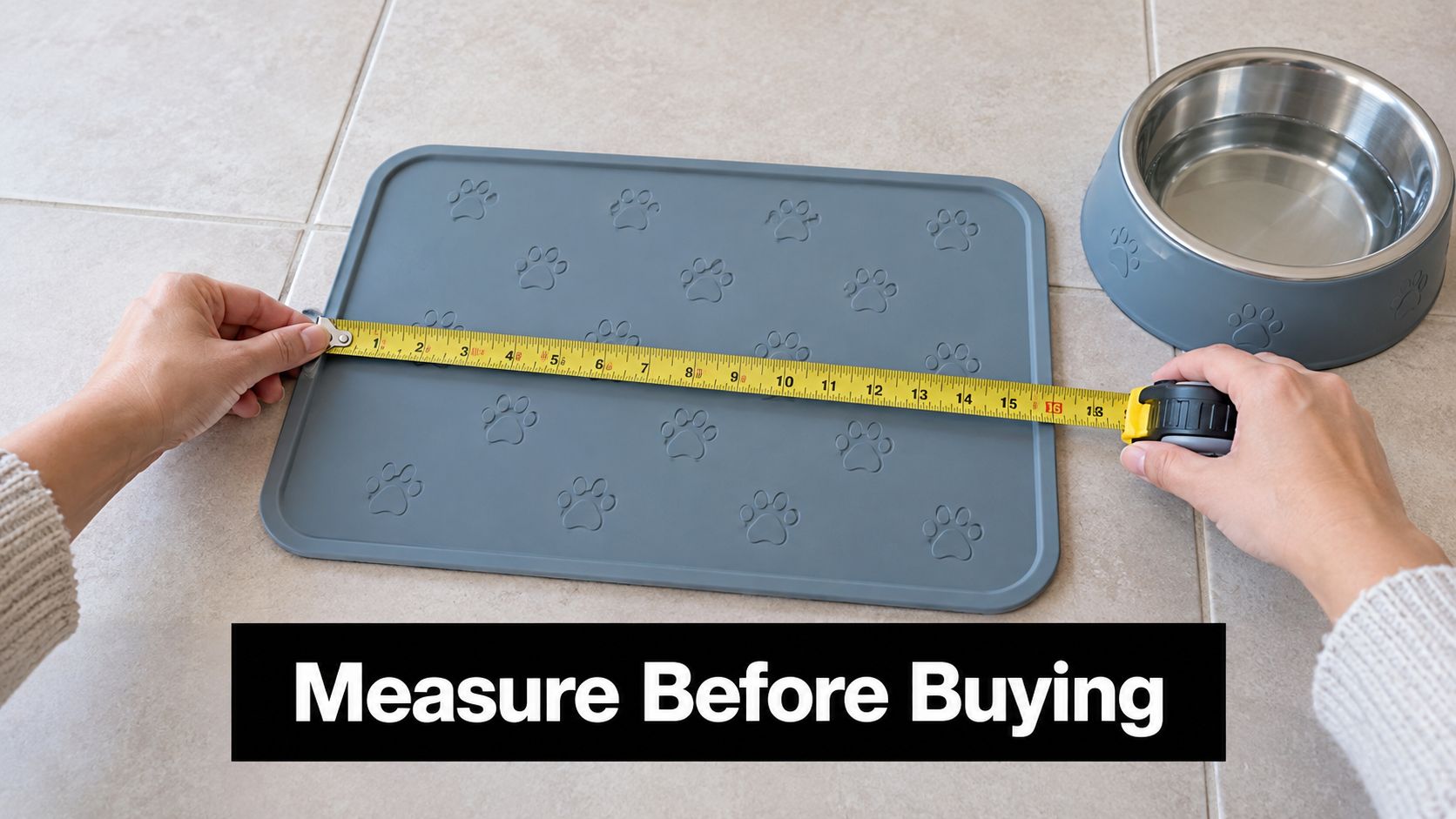
Match the mat to the room without sacrificing care
For a visible kitchen or apartment dining corner, I'd choose a solid tone and the lowest profile that still handles the dog's spills. Warm gray, sand, and charcoal can coordinate with a room without adding another prominent pattern. Color is a design choice, not evidence of material safety.
For a utility area used by a messy eater, prioritize a raised perimeter and an interior you can scrub easily. Texture is useful only when it solves a real slipping problem. Don't choose deep channels just because they look more technical.
Think through the whole handling cycle before buying. Can you lift the mat without pouring trapped water onto the floor? Can you carry it to the sink, wash the corners, and leave it somewhere to dry without blocking the kitchen?
A flexible mat can be convenient to carry, but an oversized floppy one may be awkward when full of water. A more structured rim can help handling while taking up more drying and storage space.
Confirm the listing before checkout
- Measured footprint: Compare your bowl arrangement with the usable interior dimensions, not only the outside measurements.
- Documented use: Request food-contact information tied to the actual product and formulation.
- Written care limits: Confirm the permitted washing method and maximum cleaning temperature.
- Accessible construction: Check rim shape, interior texture, and whether any joins can trap food.
- Floor compatibility: Test grip when possible, or confirm the return policy before ordering.
- Practical storage: Make sure you have a place to wash, dry, and store the mat flat.
If you're outfitting a feeding station from scratch, select the bowls before finalizing the mat. If you already have feeding essentials, measure those rather than replacing a workable setup to suit a mat's advertised size.
Check the listing against this checklist and ask the seller about anything missing. Buy only when the answers describe the product you'll receive, not merely the material category.
Nandog Pet Gear offers feeding essentials alongside beds, toys, and everyday pet accessories for a coordinated home setup. Visit Nandog Pet Gear to explore feeding options, then measure your chosen bowls before pairing them with a silicone mat that meets your space, documentation, and cleaning requirements.