


If a vet, a trainer, and a neighbor all recommend an e-collar, are they even talking about the same product? Often, they're not. That single name covers training equipment that delivers a correction and a medical cone that just blocks licking. Mixing them up leads to poor decisions, because the right questions are completely different. Pet e collars need to be separated first, then judged one type at a time, on their own evidence.
Three Products Share the E-Collar Name
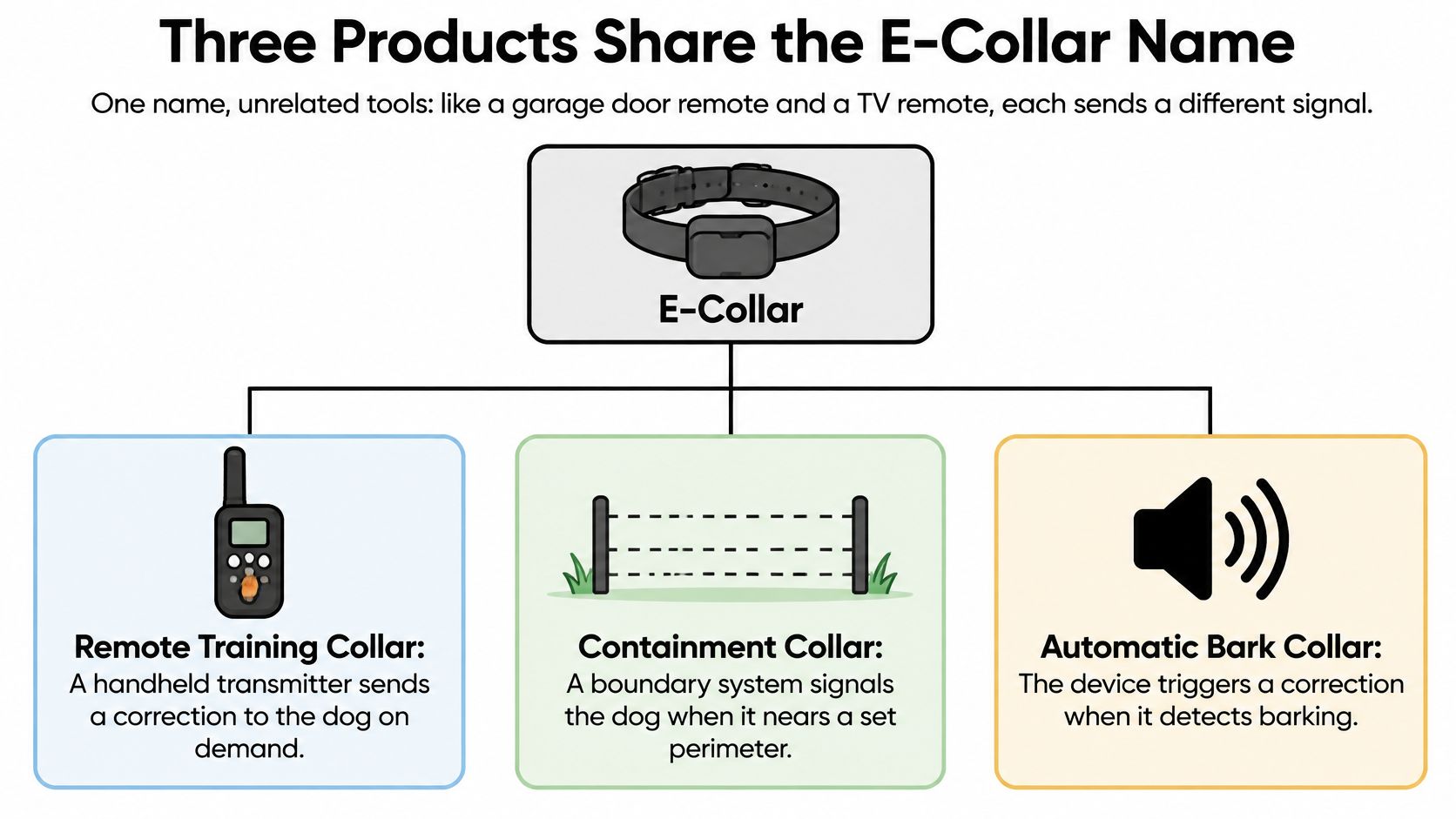
Three electronic devices share the e-collar name, and each answers to a different trigger: a handler's thumb, a bark sensor, or a buried wire.
A fourth product, the recovery cone, is often stocked in the same aisle and shelved under the same label. It is not an e-collar in any functional sense, so it stays outside the comparison below.
The diagram sorts the three electronic types before any debate about settings begins.
The Three Electronic Types at a Glance
| Type | How it works | Typical use | Main concern |
|---|---|---|---|
| Remote training collar | Handheld transmitter sends tone, vibration or electrical stimulation through neck contacts | Recall, livestock control, off-leash work | Stress indicators, pain at high settings, misuse |
| Bark-activated collar | Sensor triggers a correction when barking is detected | Nuisance barking | Reported as especially inefficient and injurious in real-world conditions |
| Boundary (containment) collar | Corrects when the dog crosses a buried-wire perimeter | Keeping pets inside a yard | Startle, fear and reliance on the correction |
A remote training collar lets a handler deliver a correction on demand, usually during recall or livestock work. A bark-activated collar removes the handler from that decision and responds to a sensor instead. A boundary collar is tied to a perimeter rather than a person.
The recovery cone belongs in a separate category entirely. It contains no electronics and delivers no correction. It is a rigid or soft physical barrier used after surgery or injury, so it raises questions about fit, eating, and sleep rather than questions about stimulation.
The first question isn't which setting to use. It's which product you're actually discussing.
That distinction matters in the evidence. A Scottish Animal Welfare Commission evidence review on electronic training devices reported that devices were less effective and more injurious in real-world conditions than in idealized study settings, and that bark-activated collars appeared especially inefficient and injurious. Findings like these apply to the three electronic types. They say nothing about whether a cone fits well or lets a dog drink.
Owners browsing everyday dog training accessories will see these products listed side by side, which blurs the category further. Name the product first. Then judge it by the questions that apply to it: welfare and learning for the electronic types, comfort and daily living for the cone.
Fitting and Living With a Recovery Cone
A recovery cone succeeds or fails on ordinary days, not in the clinic. The pet still has to drink, eat, rest, climb down from furniture, and go outside safely.
Start with fit. Veterinary guidance on Elizabethan collars in dogs says the collar should reach the nose, remain secure without being tight, and be checked daily for irritation. If it stops short, a determined pet may still reach a wound. If it's tight, rubbing becomes more likely.
Fit is only the beginning, though.
What Owners Report at Home
Owners commonly describe the same problems at home: pets that struggle to reach the water bowl, and collars that rub or irritate the skin during recovery. Those reports explain why sizing advice alone isn't enough. Daily checks and small adjustments to the household routine do most of the work.
| Daily task | Common problem | Practical fix |
|---|---|---|
| Drinking | Cone blocks reach to the bowl | Shallow, raised bowl or supervised hand-offered water |
| Eating | Head angle makes bowls hard to reach | Elevated bowl at a comfortable height or wet food on a flat dish |
| Stairs and furniture | Vision and width misjudged | Block stairs, use ramps, supervise every jump |
| Elimination | Cone catches on legs or litter edges | Low-sided tray and short supervised walks |
| Sleeping | Cone hits bed or wall | Low, wide bed placed away from walls |
| Grooming (cats) | Cannot reach the body to self-groom | Ask the vet about a veterinary-approved body suit; spot-clean as advised |
| Outdoor time | Reduced vision and hearing | Close supervision on a leash |
Cones reduce vision, amplify sound, and can startle pets, so doorways, chair legs, and other animals need more space than usual. A pet that can't judge width or hear normally shouldn't be left to find its way outdoors alone.
Cats face a particular frustration. They can't self-groom, which is a normal daily routine rather than a cosmetic extra. Gentle spot-cleaning, as your vet advises, can help while the wound heals.
When Softer Is Not Safer
Soft and inflatable collars look kinder, and sometimes they're appropriate. They may not protect eyes or facial wounds, because a pet can still rub or reach forward. In those cases, a rigid collar may be clinically necessary even if it's less comfortable.
A veterinary-approved body suit is another option for some torso wounds. Don't treat it as universally safe. Ask the vet whether it suits the exact wound site, drainage, and bandage plan.
Call the vet promptly if your pet refuses food or water, develops new swelling or bleeding, or the wound looks worse rather than better.
What the Welfare Research Found
Controlled trials give the welfare debate its clearest evidence. Across them, electronic collars have not shown a consistent training advantage over reward-based methods, and researchers have recorded more behavioral signs linked to stress.
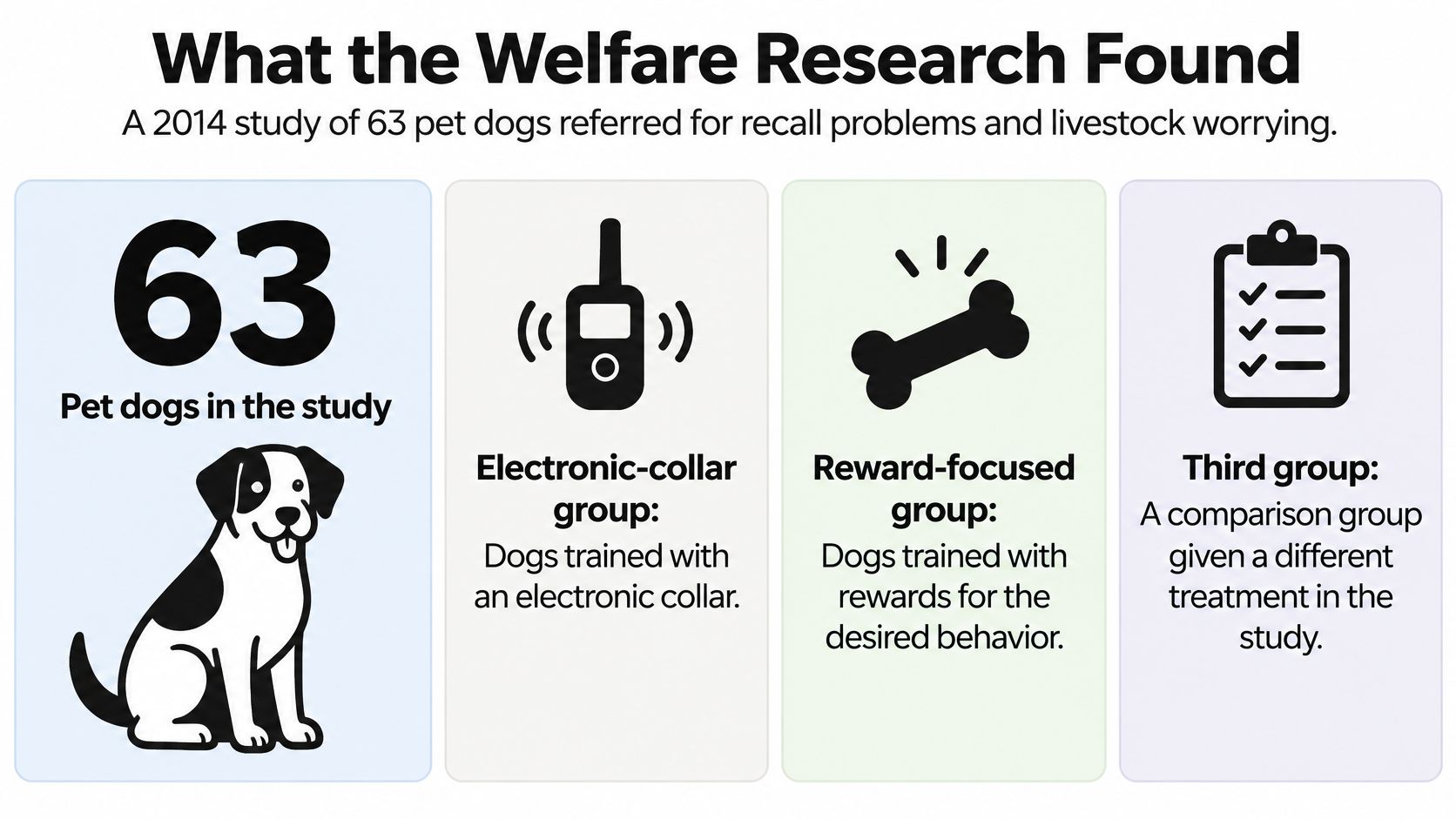
The illustration below summarizes the design of the foundational 2014 study.
The 2014 Field Study
The 2014 welfare study of 63 pet dogs referred for recall problems and livestock worrying split the dogs into three groups. Trainers experienced with electronic collars taught the first group using the devices. A second group received comparable training from the same trainers without an electronic collar. A third group was trained with a focus on rewards.
The researchers found no consistent training advantage for e-collars. Compared with the reward-based group, dogs trained with them spent significantly more time tense, yawned more frequently, and interacted less with the environment around them.
The study also measured what it could in the body. Salivary cortisol in the e-collar group was not significantly different from the other groups, and urinary corticosteroid results showed no significant group difference either.
The stress signal appeared in observed behavior, not in those hormone measures.
That limit matters for an honest reading. It doesn't erase the behavioral findings, and it means the study did not demonstrate a simple hormonal effect. The authors concluded that electronic collars created greater welfare risks than reward-based methods, with no measurable benefit to offset them.
The Later Remote-Collar Comparison
A controlled study of remote electronic collars for recall and obedience reached a similar performance conclusion. The reward-based group produced faster responses, needed fewer training commands, and made fewer errors on significant measures. The e-collar group showed behavioral indicators consistent with stress or discomfort.
Its authors concluded that conventional e-collar training was unnecessary for effective recall and added welfare risk without a demonstrated efficacy benefit. That does not prove no dog can respond to a correction. It does move the burden of proof onto anyone claiming an added benefit.
Stopping a behavior in the moment isn't the same as teaching a dog what to do instead.
Barking shows the difference. A correction may interrupt the sound the way unplugging a smoke alarm silences it. The frustration or anxiety behind the barking can remain, and the dog still hasn't learned an alternative response.
Supporters of the devices argue that skilled, low-level use differs from misuse, and that context matters. That is a fair point to test. In the 2014 study, experienced trainers handled the e-collar group, and the training advantage still did not appear.
The practical takeaway is about order. Build the desired behavior first with high-value reinforcement, clear cues, and environmental management. Then ask whether any additional tool is needed at all.
When an E-Collar Is Off-Limits or Restricted
These limits concern electronic training collars. A recovery cone raises fit and supervision questions instead, and no jurisdiction bans one for healing after surgery.
Many owners start by asking which level to choose. The prior question is whether this particular pet should wear an electronic collar at all. Age, health, pregnancy, temperament, and the reason for the behavior can rule the device out before settings enter the discussion.
A fearful dog, for example, isn't just a disobedient dog who needs a stronger signal.
When an E-Collar Is Inappropriate
| Situation | Verdict | Reason |
|---|---|---|
| Dog or puppy under six months | Avoid | Behavior is still developing; predictable routines and rewards suit this stage |
| Pregnant or nursing dog | Avoid | Added stress carries risk for the mother and litter |
| Dog with heart disease, an injury, illness or another health problem | Only with veterinary approval | Stimulation through neck contacts adds risk a vet must weigh first |
| Fearful, anxious or reactive dog | Avoid without a behavior professional | Punishment can increase fear or aggressive responses |
| Dog very old, or with a temperament that prevents an appropriate response | Avoid | A correction the dog cannot act on cannot teach |
| Healthy adult dog with a training goal reward training has not solved | Conditional | Only after a qualified assessment, with a written plan |
The six-month mark deserves a note. It is a common working recommendation rather than a cutoff set by the laws described below, and it exists because puppy behavior is still developing. Predictable routines plus rewards give owners a way to teach without adding an aversive stimulus during that window.
Health changes the calculation in two distinct ways. A dog with heart disease, a healing injury, or any other illness should not be fitted unless a veterinarian approves the plan. Frailty and temperament are a separate case, because when a dog cannot respond to a correction at all, the correction cannot teach anything clearly.
Law and Actual Use
Rules also vary by place. The Welsh government review of electronic collars in dogs and cats records that the Animal Welfare (Electronic Collars) (Wales) Regulations 2010 prohibited electronic collars for cats and dogs in Wales. The review concluded that likely welfare costs exceeded benefits because stimulation could cause pain, effective alternatives existed, and misuse was difficult to prevent.
Check your country, state, and local rules before buying or traveling with a device. Legality in one jurisdiction doesn't guarantee legality in another.
Reported use was also a minority practice in the survey data cited in that review. Among 3,897 English dog owners, 3.3% reported using electronic collars as remote trainers and 1.4% used them as anti-bark collars, according to the Welsh review. In a separate questionnaire of 188 respondents who had used an electronic training device, 36% reported using it for one month or less, while 16% were still using it after one year, as cited in the same review.
Those numbers don't settle the ethics by themselves. They do challenge the idea that these collars are a normal, long-term default for most owners.
Ask a final test question. Does the tool teach a better behavior, or does it only suppress an unwanted one? If you can't name the replacement behavior, the plan isn't ready.
How to Use One Safely If You Proceed
This guidance is for a narrow situation. A qualified trainer or veterinarian has assessed the dog, the device is legal where you live, the dog is not in an excluded group, and the goal is one defined behavior rather than general control.
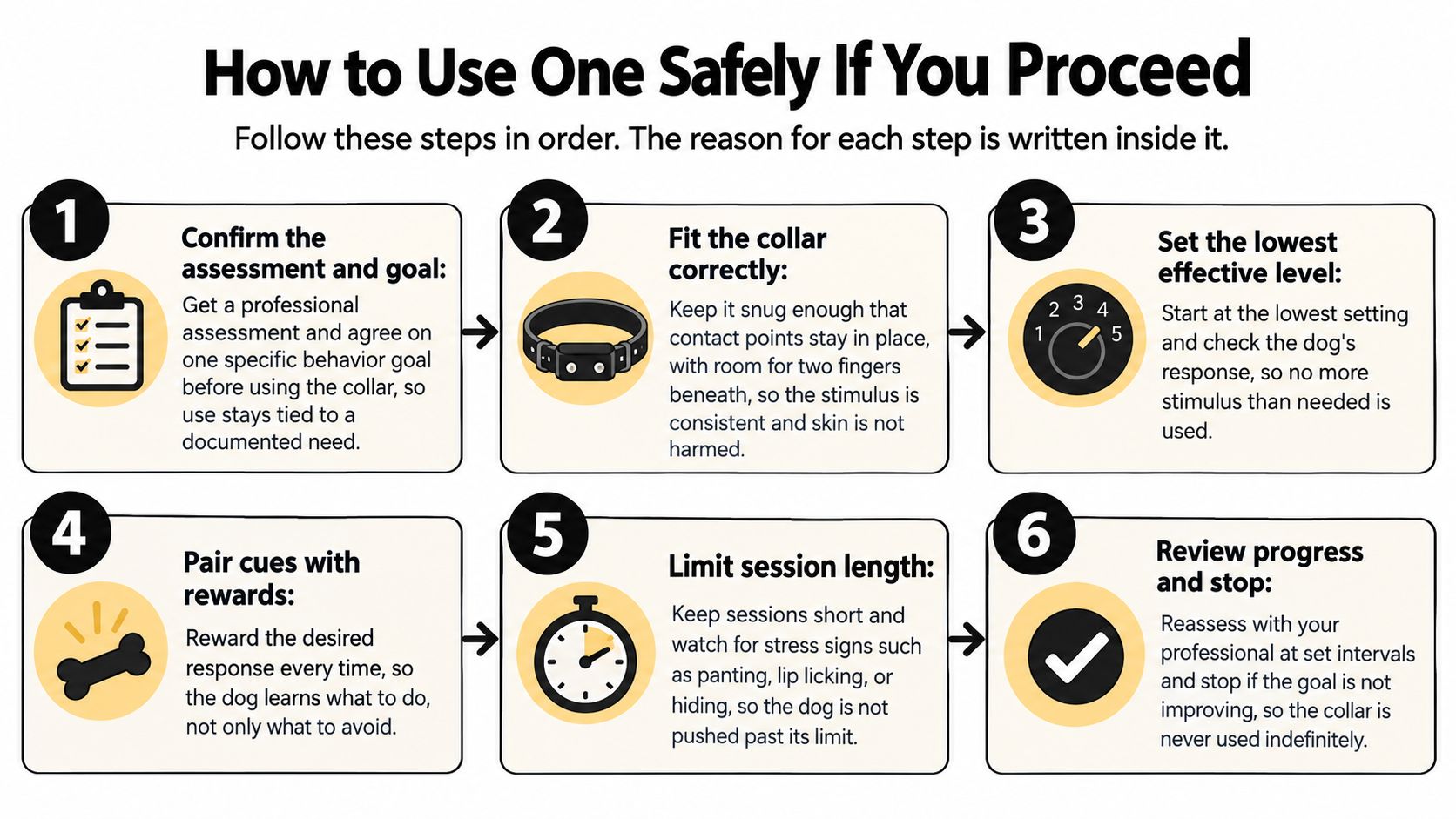
The steps below are summarized in the following guide.
A Cautious Procedure
- Confirm the assessment and goal in writing. Agree the target behavior, the cue, the reward plan, and the review date with a qualified trainer or veterinarian. Writing it down prevents the collar from becoming a general response to every mistake.
- Build the behavior first. Teach the response with high-value food or toy rewards, a clear cue, and environmental management. The dog should already understand what is being asked before any collar is introduced.
- Fit the contacts properly. Victorian guidance on training dogs and cats to wear electronic collars treats fit and duration as safety variables because stimulation is delivered through neck-contact electrodes. Contacts should sit firmly against the skin without restricting breathing, and the strap should adjust securely.
- Start at the lowest effective setting. Do not raise the level to force a response through distraction or fear. If the dog cannot respond in that setting, reduce the difficulty and rebuild the training step instead.
- Limit wear time and inspect the neck. Follow the duration limits in the Victorian code and the plan set by your vet or trainer rather than working to a fixed rule of thumb. Take the device off at intervals, check for redness or sores, and reposition the contacts so pressure is not concentrated in one place.
- Stop at the first warning sign. End the session if you see vocalization, a sudden body movement, avoidance, fear, or escalating arousal. Continuing after those signs risks teaching the dog to associate the context, handler, or nearby animals with discomfort.
A session that produces avoidance or escalating arousal is not making progress, even if the unwanted behavior pauses.
Keep a Record
Log the date, setting, wear time, context, and any stress sign. Note whether the dog performed the replacement behavior and what reward followed. Without that record, it is easy to remember the interruption and forget the cost.
Review the log with your professional at the agreed date. If progress depends entirely on the collar being present, or stress signs are increasing, stop and reassess. Rounded or protected contact points, clear instructions, and routine skin checks are more relevant safety features than maximum range or intensity.
Humane Alternatives Matched to the Problem
Most owners don't really want a collar. They want a dog who comes back, walks calmly, stays in the yard, or barks less. Starting with that problem usually reveals a more direct solution.
The photo below shows the basic pattern behind those solutions, a clear cue followed promptly by a reward.
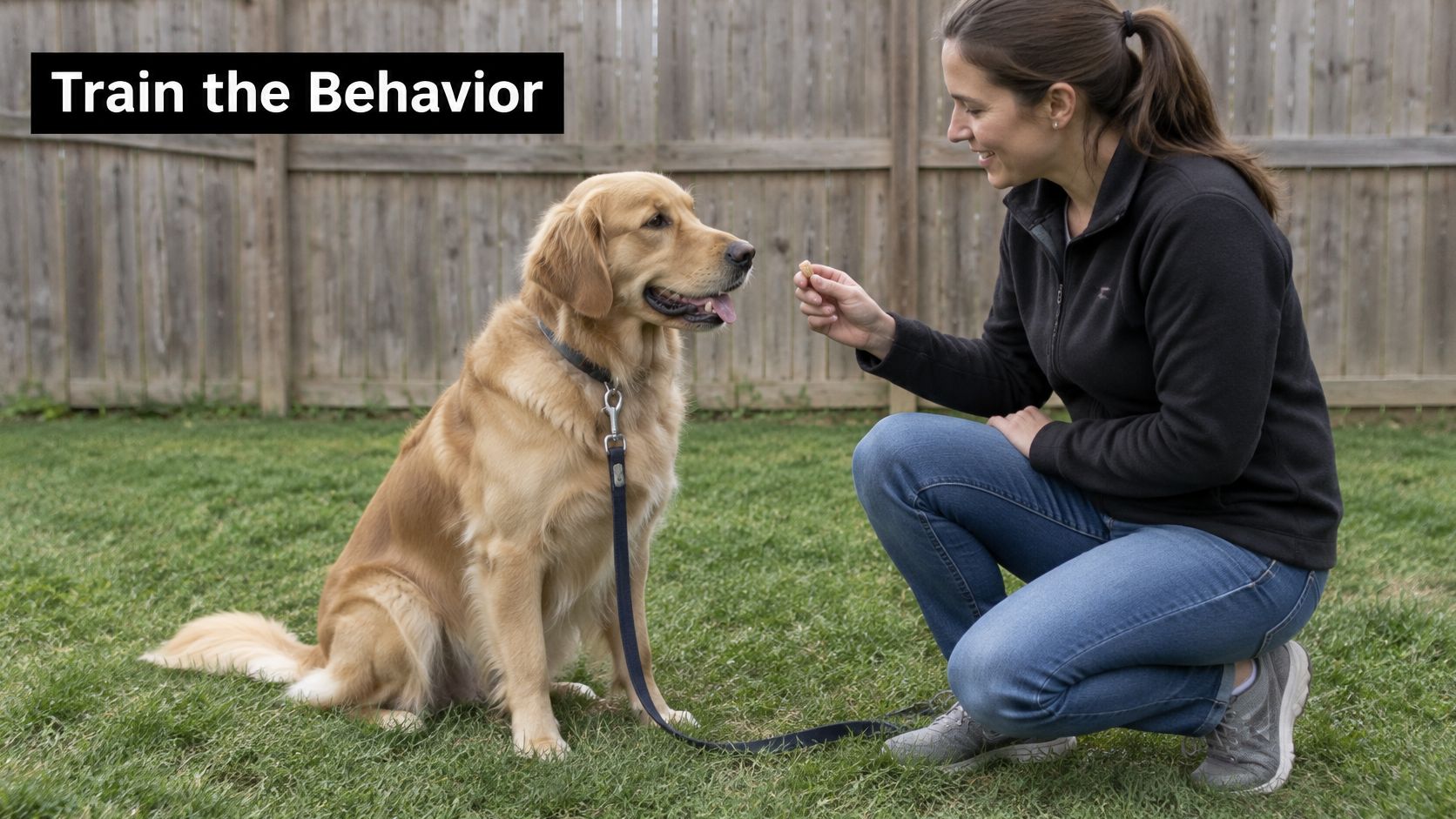
Reward-based training builds the behavior. Management prevents rehearsal while it's being built. Equipment, where it helps, mainly changes comfort and control rather than delivering a correction.
Humane Alternatives by Problem
| Problem | Humane alternative | Why it works |
|---|---|---|
| Pulling on walks | Well-fitted front-clip or neoprene harness with a loose leash and rewards for slack | Spreads force across the chest instead of the neck |
| Unreliable recall | Long line in a quiet place, paired cue and high-value treats, distance added gradually | Builds a dependable response before off-leash freedom |
| Chasing livestock or wildlife | Management with a leash or fenced area, plus reward-based wait and recall training | Prevents practice while the alternative behavior is built |
| Excessive barking | Identify triggers, reduce their intensity, reward quiet moments | Targets the motivation instead of punishing the sound |
| Escaping the yard | Secure fencing, supervised yard time, reward for coming back inside | Removes the reward of escape and teaches a return cue |
| Anxiety on walks or with visitors | Referral to a behavior professional, desensitization and counter-conditioning | Changes the emotional response instead of suppressing it |
For pulling, a well-fitted front-clip or neoprene harness spreads force across the chest rather than the throat. That suits many everyday walkers and dogs with sensitive necks, especially when it's paired with rewards for a slack leash. A step-by-step dog harness fitting guide can help you check strap position before the walk begins.
Recall needs rehearsal at a level the dog can handle. Start on a long line in a quiet place, pair the cue with high-value treats, and add distance or distractions in small steps. The long line prevents a failed recall from becoming a rewarding run.
The short video below demonstrates reward timing in a simple training context.
Barking requires a different diagnosis. Identify whether the trigger is a passerby, frustration, boredom, or alarm. Then lower the trigger's intensity, create distance, and reward quiet moments so the dog learns an alternative response.
These methods usually take weeks rather than an afternoon. That's the honest trade-off. In return, the dog learns what to do, and you can see progress without watching for fear or avoidance.
Anxiety-based problems belong with a qualified behavior professional. Reactivity, panic, and aggression aren't equipment problems, and suppressing the visible response can leave the underlying emotion unchanged.
Choose Your Next Step With a Vet or Trainer
Use the situation in front of you, not the product name, to decide what happens next.
- Recovery after surgery or injury. See the vet before buying, confirm the collar reaches the nose without being tight, and ask whether a rigid cone, soft collar, or body suit suits the wound site.
- Pulling, barking, fear, or reactivity. Ask the vet for a referral to a qualified behavior professional and request a written plan based on rewards and management. Owners working on leash manners can also use this guide on how to stop a puppy from pulling on the lead.
- An electronic collar has been suggested. Check the exclusion list, confirm legality where you live, and only proceed with a written plan, the lowest effective setting, time limits, and a review date.
Comfortable everyday gear supports that work. A well-fitted harness and a leash you can grip securely make training walks easier without relying on pressure at the neck.
Keep a two-week log of the problem, session length, wear time, and any stress signs. Bring it to your review. It turns a general impression into evidence you and your professional can judge together.
For reward-based walks and calmer daily routines, Nandog Pet Gear offers comfortable neoprene harnesses, Waterproof Poly-Flex sport leashes, beds, and everyday accessories designed around pet comfort. Visit the collection to choose gear that supports the training plan you've agreed with your vet or trainer, without relying on correction at the neck.