


Your small dog has probably already chosen the spot. She climbs between the front seats, settles on the center console, and rides there calmly because she can see you, feel close, and watch the road. It feels harmless, even sweet. My advice is blunt. Treat that perch as a restraint decision, not a cute habit, and judge any dog car seat for console use by placement, attachment, and size before you judge padding or looks.
Why Dogs End Up on the Center Console
Most console riding doesn't start as a safety choice. A small dog dislikes the back seat, whines behind you, then works her way forward until she's beside your elbow. You let her stay because she stops pacing, you can steady her with one hand at lights, and the drive suddenly feels easier.
That calm is misleading. She's still loose on a narrow, hard surface near the shifter, cup holders, and your right arm. One paw slips, one brake pedal jab happens, and you're reaching for a dog instead of watching traffic.
The habit is common because cars weren't built for dogs
Ordinary cabins give people belts, head restraints, and airbags. Dogs get none of that by default. They borrow human space and improvise, which is why so many end up on laps, footwells, passenger seats, and consoles.
The scale of that improvisation is clear in a 2018 canine passenger safety study reporting about 89.7 million U.S. dogs in 2016 and 63% of dogs traveling in cars unrestrained. That gap isn't mainly about owners not caring. It's about owners not having a defined place or system for the dog, so the dog invents one.
A dog who has claimed the console hasn't been restrained. She has only found the spot she prefers.
The American Veterinary Medical Association pushes owners toward a more deliberate setup, recommending an appropriate restraint system, crate, or carrier for travel. It also separates vehicle harnesses from walking harnesses, a distinction owners miss constantly. A pretty walking harness with a leash clip isn't automatically equipment for a moving car.
The AVMA also points owners toward crash-tested equipment that connects to the vehicle's seat-belt system and keeps the dog secured instead of roaming. That advice reframes the console question. The issue isn't whether your dog likes riding between the seats. It's whether anything limits her movement when traffic stops hard.
What you're really deciding
If you buy a console seat, you're trying to replace that improvised perch with a defined, bounded spot for a smaller dog. Done well, it can reduce roaming and keep the dog off your lap and controls. Done badly, it's upholstery on top of the same unrestrained problem.
Separate four questions from the start. Does it contain the dog during normal driving? Does it offer any meaningful protection in a crash? Is your dog the right size and shape for a raised perch? Does your specific console and cabin layout allow a secure installation? Comfort matters, but it's last on that list, not first.
What a Dog Car Seat for Console Is Meant to Do
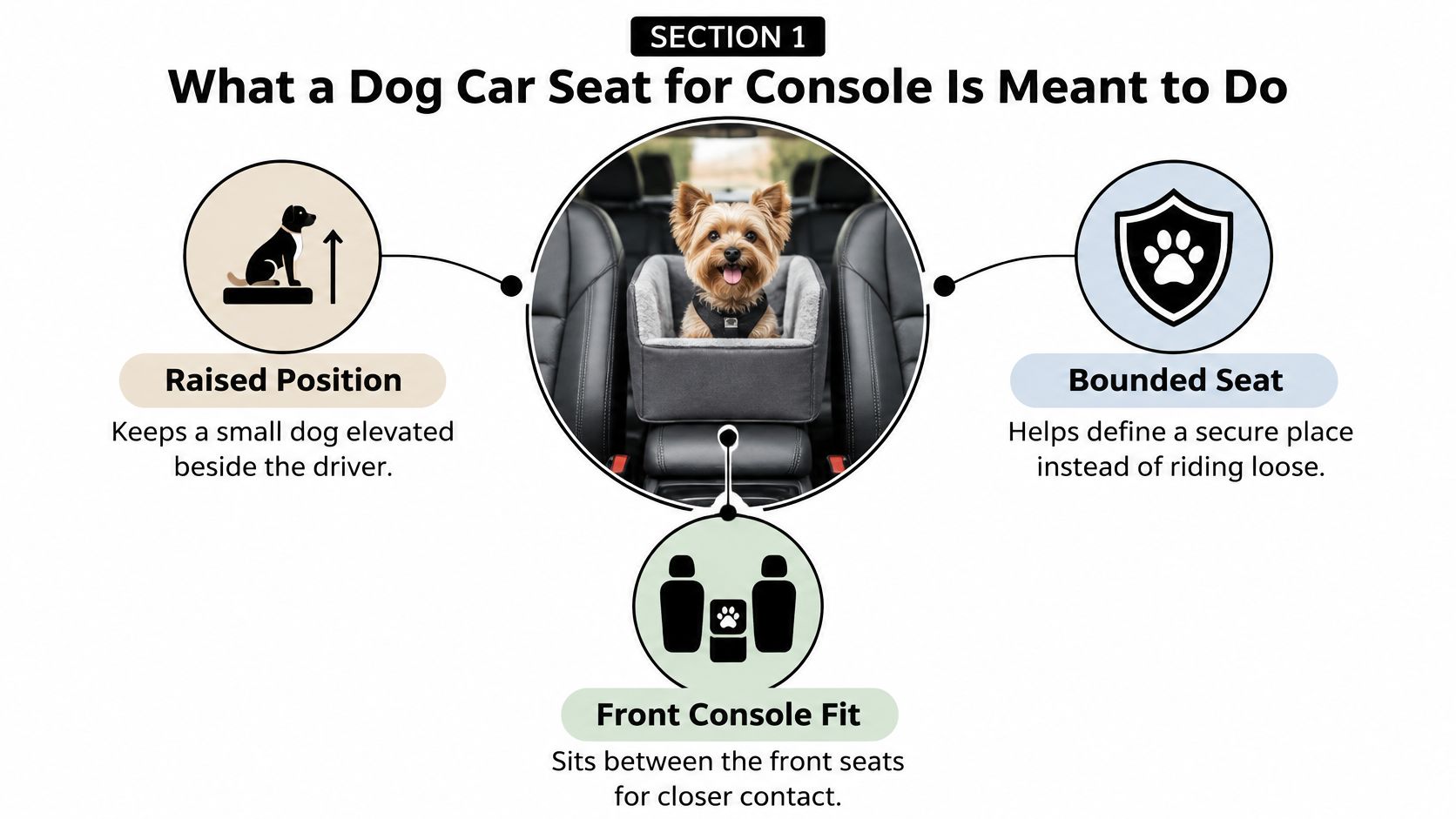
A dog car seat for console use is a small, raised, bounded seat designed to sit on or over the center console between the front seats. Its real job is containment and stability. It gives a smaller dog one place to sit or lie instead of drifting across laps, stepping near the shifter, or blocking your view to the passenger mirror.
Judge it in three parts. First, the seat itself must hold its shape and position. Second, the seat must attach to the vehicle through a credible load path, not just sit on a lid. Third, the dog must connect to that system with a tether clipped to a suitable vehicle harness, never to a collar.
What it can do well
For the right dog, the benefits are practical, not magical.
- Defined position: Your dog learns one spot and stops negotiating for your lap.
- Less roaming: Raised sides and a tether reduce pacing, pawing, and sudden lunges toward windows or floor scraps.
- Better sightlines for the dog: Elevation helps some small dogs settle because they can see out instead of scrambling for a view.
- Closer contact without lap riding: An anxious dog stays near you while your hands and legs stay free.
That's the legitimate case for the category. On short, familiar trips, a settled dog in one bounded place is safer to drive with than a loose dog climbing around the front cabin.
What it doesn't certify
Don't let product photos blur the boundary. Elevation isn't protection. Quilted padding isn't a crash structure. A tidy color match with your interior tells you nothing about what happens under sudden deceleration.
Practical rule: Score a console seat as a behavior and containment tool first. Assume it provides no certified crash protection unless the maker proves dynamic testing in plain language.
The same skepticism applies to universal fit claims. Consoles differ in width, height, lid shape, hinge movement, and distance to the shifter and dashboard. A seat that looks stable in one SUV can rock, overhang, or crowd controls in a compact sedan. If the listing won't state clear dimensions, weight limits, and attachment requirements, pass.
Your buying lens is simple. Bounded place, vehicle attachment, harness connection, correct size. If one of those four is missing, you don't have a system. You have a cushion.
Comparing Console Seats with Harnesses and Carriers
Choose by your dog's weight, height, neck and chest structure, and ability to sit upright, not by fabric. A console seat, a vehicle harness, and a carrier solve different problems, and swapping them based on convenience is how small dogs end up in gear that doesn't fit their bodies.
Start with the test record, because marketing words are cheap. The Center for Pet Safety found a 100% failure rate among tested canine restraints under conditions modeled on FMVSS 213, and size guidance in the same body of safety material notes dogs under 9 kg may need a carrier rather than a seat-belt harness because of neck-injury risk, while dogs above 55 kg should travel in a secured crate in the cargo area rather than restrained on a rear seat. Pet travel seats also lacked dedicated performance standards in that testing context. So when a listing says secure, safety hook, or seat-belt compatible, ask what was tested, how, and what failed or held. Those phrases aren't results.
Console Seat, Harness, or Carrier
| Option | Best fit | Main limit | Restraint role |
|---|---|---|---|
| Console seat | Small dog who fits fully inside, sits upright, and rides in a permitted front position | Front airbag zone, narrow base, vehicle-specific fit | Containment and positioning |
| Vehicle harness | Dog large and sturdy enough for harness loading, riding on the back seat | Wrong harness or loose tether allows excess travel | Connects dog to belt or anchorage system |
| Carrier or crate | Very small dogs, fragile necks, dogs who panic on an open perch | Must itself be secured or it becomes cargo | Enclosed containment |
Read my breakdown of how a dog car seat and carrier differ in everyday use if you're torn between an open seat and an enclosed option. The short version is this. Enclosure helps dogs who launch, spin, or chew tethers. An open console seat only suits a dog who will stay seated inside it.
How to read comfort features honestly
Some car seats in this category state features such as quilted micro plush interiors, secure safety hooks, and easy installation. Take those at face value. Plush lining can help a dog settle and grip. A hook gives you a clip point. Easy installation means you're more likely to set it up the same way every trip.
None of that, by itself, proves crash certification. Don't infer it. A hook clipped to a collar is a bad idea, and a hook clipped to a fashion walking harness may only be as strong as that harness's stitching and hardware. The hook is one link in a chain, and the chain fails at its weakest link.
My recommendation is direct. Very small or delicate dog, choose a properly secured carrier first. Medium dog who can wear a proper vehicle harness, use the back seat. Small, calm dog who fits the console seat's limits and your car's layout, a console seat can be your containment choice, with eyes open about its limits.
Front Console Placement and Crash Protection
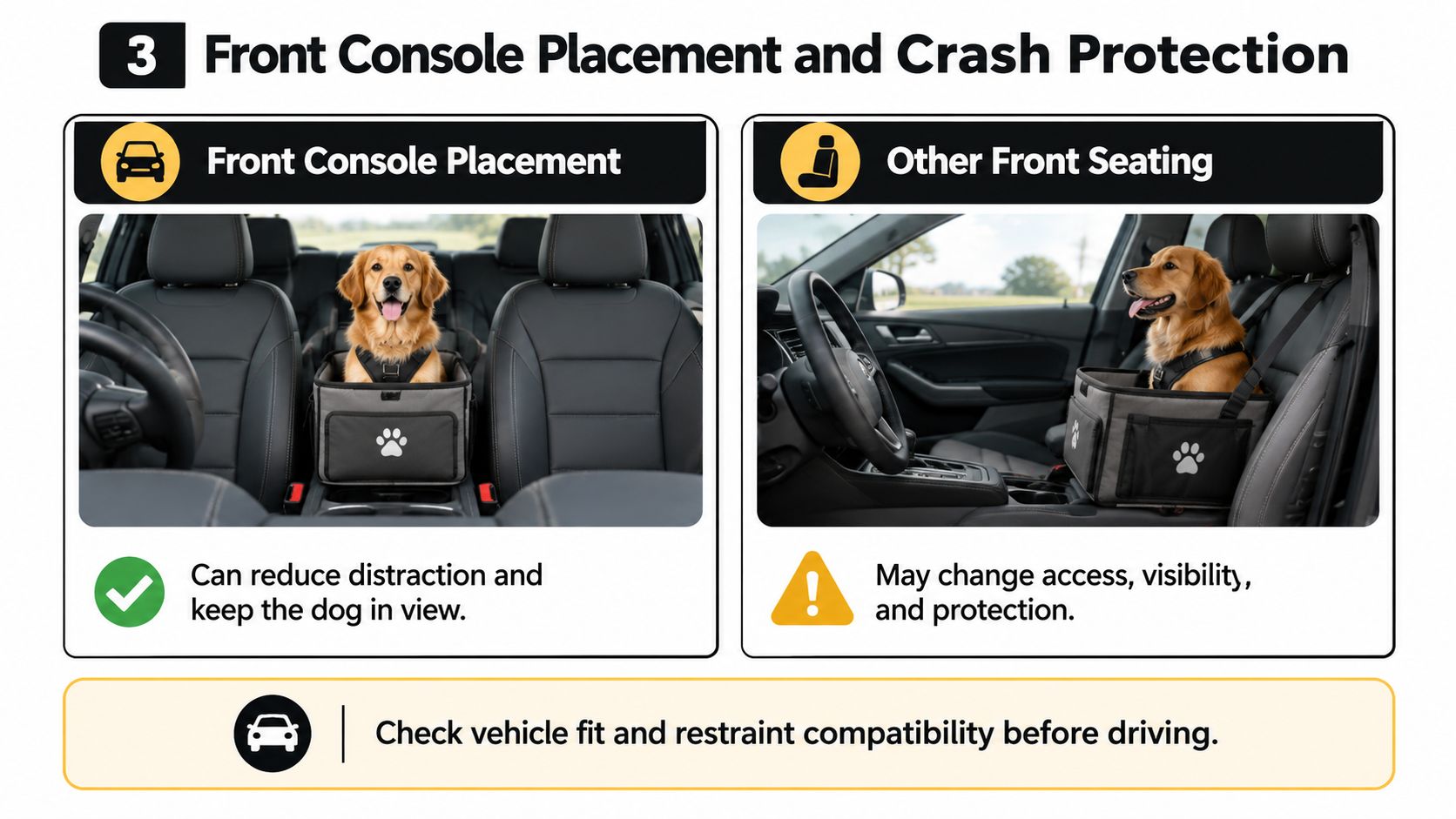
Here's the part most product pages won't tell you. The center console is not a neutral location. It's the front-center of the cabin, close to the dashboard, windshield, gear controls, and the passenger airbag deployment area. Your dog may be calmer there, and you may drive with fewer interruptions. That doesn't make the location protective.
The Center for Pet Safety's pet travel seat pilot study concluded that no performance or dynamic-testing standards existed specifically for pet travel seats at the time of testing, and that a travel seat may prevent distraction but is unlikely to provide meaningful crash protection. That distinction should drive your decision. Distraction control is valuable. It is not the same claim as surviving a frontal impact.
Why the back seat stays the default
The AVMA warns that unrestrained animals can be crushed by airbags or thrown through the vehicle. Airbags are engineered around adult human occupants in belted seating positions, not around a small dog positioned between the seats. In a frontal crash, intrusion and hard interior surfaces are also closer in front than they are in the rear seat.
That's why I won't recommend a console seat as your first choice when a back-seat setup works. Use the back seat as the default, then ask whether there's a specific, defensible reason to move forward. Wanting your dog within petting reach isn't one.
If you do consider the front position, check your vehicle manual first. Only disable or avoid an active passenger airbag where the vehicle manufacturer permits it and in the way the manual specifies. Don't guess, don't pull fuses, and don't assume a weight sensor has solved the problem for a dog seat sitting between the seats.
No undamaged belt, no system
Placement also depends on the belts and hardware you'll rely on. Inspect webbing for chewing, fraying, or stretched sections before you route anything through a seat or carrier. If your dog has already damaged a belt, repair chewed belts with Safety Restore before you build a pet setup around that belt, because a compromised belt undermines people and pets. My related guidance on whether dog car seats are safe and what that claim should mean follows the same logic. A stylish seat in the wrong zone, attached to damaged hardware, is still the wrong setup.
Treat a console seat as a permitted front-position containment choice, never as a certified substitute for a rear restraint.
Fitting a Console Seat to Dog and Vehicle
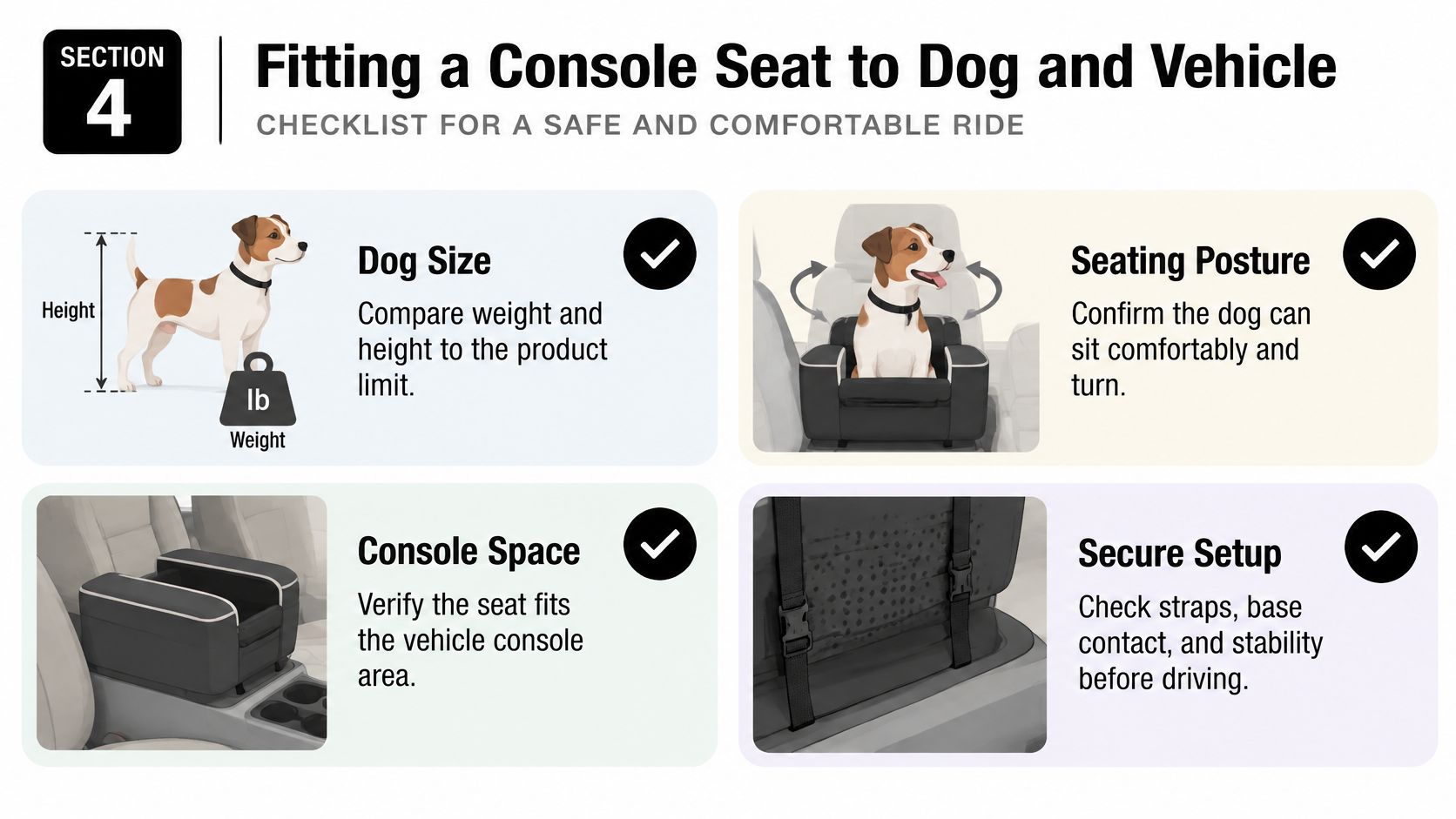
Do this check parked, with the engine off and your dog on a leash. If the setup fails in your driveway, it won't improve at speed. You need a yes on dog fit, console fit, driver clearance, and attachment. Anything less is a no.
The parked-car fit test
- Weigh and measure the dog: Compare weight, chest width, and sitting height with the maker's stated limits, not with the photo model dog.
- Test posture: Your dog should sit upright and lie down fully inside the walls without draping over the front edge.
- Check your sightlines: Sit in the driver's seat and confirm the dog's head doesn't block mirrors, controls, or your view across the cabin.
- Work the controls: Move the shifter, parking brake, cup holder covers, and console lid through their full range with the seat installed.
- Map the airbag zone: Confirm where the passenger airbag deploys and whether the seat or dog would sit in that path.
Cabin size changes every answer. A wide truck console and a narrow hatchback console aren't interchangeable, and owners comparing larger vehicles for family and pet trips can explore Suburban passenger comfort to see how much front-cabin layout varies. Measure your own car rather than trusting a vehicle list in a product title.
Attachment is where weak products fail
Research on booster and carrier failures is blunt about weak links. Center for Pet Safety pilot testing recorded anchor strap and plastic-buckle failures that left a test dog unrestrained or turned the seat itself into a projectile. For a console product, that means the seat can't depend on the console lid or hinge as its structure. Lids flex, pop open, and were designed to hold sunglasses, not a dog under braking load.
Look for a load-bearing path into the vehicle, such as a seat belt routed through a structural part of the seat or a purpose-designed anchorage. Friction pads, upholstery pressure, and a single tether loop aren't enough. Carrier testing that benchmarked attachment retention, containment, structural deformation, and excursion distance found better performance where the connection system stayed attached and kept the test dog contained. Use those four benchmarks as your questions to any maker. What stays attached, what contains the dog, what deforms, and how far can the dog travel forward or sideways?
Child-restraint guidance recognizes belts and anchorage systems, but those standards don't certify pet seats. So the maker's own weight, size, and vehicle-compatibility limits carry the burden. If those limits are vague, your fit test ends there.
Trips Where a Console Dog Seat Helps
The right answer changes with the trip, even for the same dog. Use the console seat where distraction control is the main problem and the placement rules still pass. Move to the back seat or a carrier when speed, distance, or your dog's body changes the risk.
The distraction and force numbers behind that advice come from MSPCA pet travel guidance reporting that nearly all surveyed drivers traveling with pets had been distracted at least once, about 11% said distraction almost caused a crash, 83% recognized an unrestrained dog could be dangerous yet only 16% used a restraint, restraint use was 32% among owners aware of an injury case versus 9% among those without that awareness, and a 50-pound dog in a sudden stop at 30 miles per hour can move with force comparable to almost nine 170-pound people pushing. Owners usually know loose dogs are risky. They just don't act until the risk feels personal. Act before that.
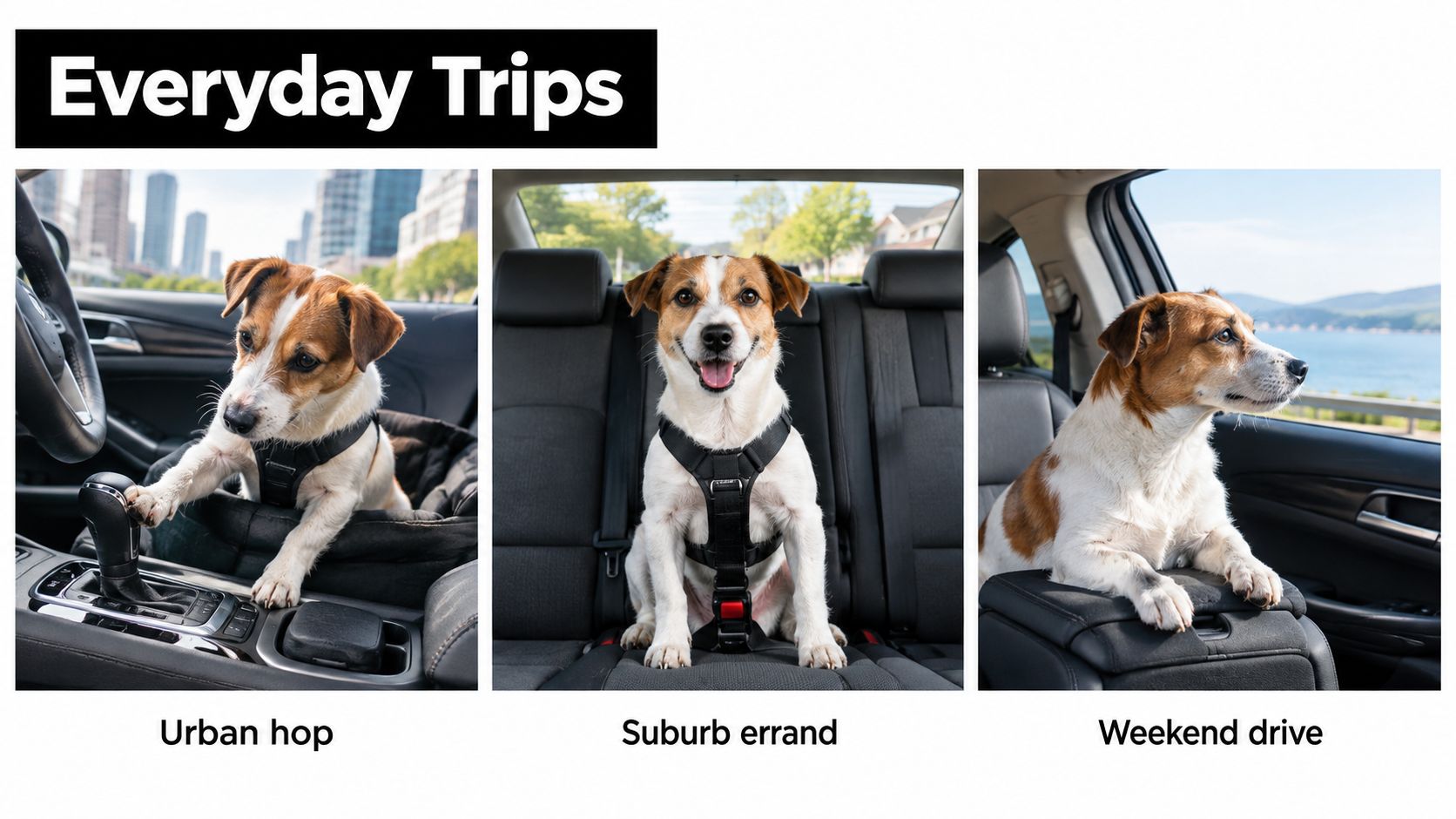
The collage below shows the everyday trips where owners make this call, from quick errands to longer drives.
Three drives and my call on each
Short urban hop, small dog pawing the shifter. This is the strongest case for a console seat. Your dog is contained beside you, off the controls, and less likely to lunge at every stop. Keep trips brief, tether to a harness, and don't feed treats while moving.
Highway trip across town or between cities. Move the dog back. Higher speeds raise the cost of a sudden stop, and fatigue makes dogs restless in a small perch. A back-seat harness setup or secured carrier gives you a better position and more room for the dog to resettle. My broader tips for traveling with pets on longer drives cover breaks, water, and practice runs that make that switch easier.
Dog who refuses the back seat. Refusal isn't an automatic front-seat exception. First try making the back seat boring and rewarding with short practice drives that end nowhere stressful. If you still use the console, you need manufacturer-permitted airbag handling, correct size, solid vehicle attachment, and a harness tether. If your dog is very small and fragile, a carrier beside you in spirit isn't the answer either. Put the secured carrier in back and build tolerance gradually.
This short video is useful for seeing how quickly a calm front-cabin routine can turn into reaching, steadying, and divided attention.
Name your own trips. If most of your driving is fast, long, or in heavy traffic, the console seat is the exception in your life, not the system.
Choosing a Console Dog Seat and Your Next Step
Make the purchase decision by situation, not by which photo looks best in your car. I recommend three paths, and only one of them ends on the console.
Choose the console seat when your dog is small enough to fit fully within the stated limits, your trips are mostly short, your vehicle manual permits that front position with airbag handling as specified, and the seat attaches to the vehicle rather than resting on the lid. Choose a back-seat harness or seat when the console can't be anchored cleanly, your dog blocks any control or mirror, or most trips involve highway speed. Choose a carrier or cargo crate when your dog is very small with neck risk, panics on an open perch, chews tethers, or is too large for a raised front seat.
Your final feature check
- Stated limits: Weight, internal dimensions, and vehicle restrictions are printed clearly.
- Attachment: The seat secures independently of the console lid and hinge.
- Harness connection: The hook or tether is meant for a vehicle harness, not a collar or walking harness.
- Posture room: Your dog can sit upright, turn, and lie down without leaning into your space.
- Real-world cleaning: Materials handle hair, drool, and muddy paws without a production every Sunday.
On that last point, be honest about your cabin. A pale plush seat in a car that already carries beach sand and coffee spills needs a cleaning plan, and owners weighing upkeep can look at interior extras from GP Mobile Car Wash to judge what professional interior care involves. Washable, forgiving materials matter because a seat you dread cleaning becomes a seat you stop installing.
Design-forward options in this category typically lead with quilted micro plush interiors, secure safety hooks, and straightforward installation. Those are comfort and everyday-use traits. Buy them for those reasons, and only after the fit and attachment checks pass. Don't buy them as proof of certified crash protection, because that claim needs separate evidence.
Your next step is concrete. Measure your console, weigh your dog, read your airbag section in the vehicle manual, then compare those three facts against the stated limits of any seat you're considering. Skip any seat that can't be attached to the vehicle itself, no matter how well it matches your interior.
Visit Nandog Pet Gear to compare design-forward dog car seats with quilted comfort and everyday installation features against your dog's weight and your console measurements. Bring those measurements with you, check the stated fit and hook details for each seat, and choose the setup you can install correctly on every trip.