


You buy a plush toy in the afternoon. By dinner, the squeaker is on the floor, stuffing is across the rug, and your dog is proudly chewing the empty shell. If you've lived with a pit bull, adolescent husky, determined terrier, or teething puppy, you know the routine. Most plush toys aren't destroyed because your dog is “bad.” They fail because they were designed for softness first and stress resistance second.
That doesn't mean plush belongs in the trash category for every strong chewer. Plush dog toys for strong chewers serve a different purpose from rubber or nylon. They're softer, quieter, easier to carry, and often better for fetch, tug, comfort, and indoor play. The mistake is expecting one fabric toy to function as a cuddle companion, tug toy, chew bone, and unsupervised babysitter.
The right approach is simple. Choose construction over cute details, supervise the play that can turn destructive, and retire the toy before your dog turns a loose thread into an ingestion hazard.
What Makes a Plush Toy Safe for a Strong Chewer
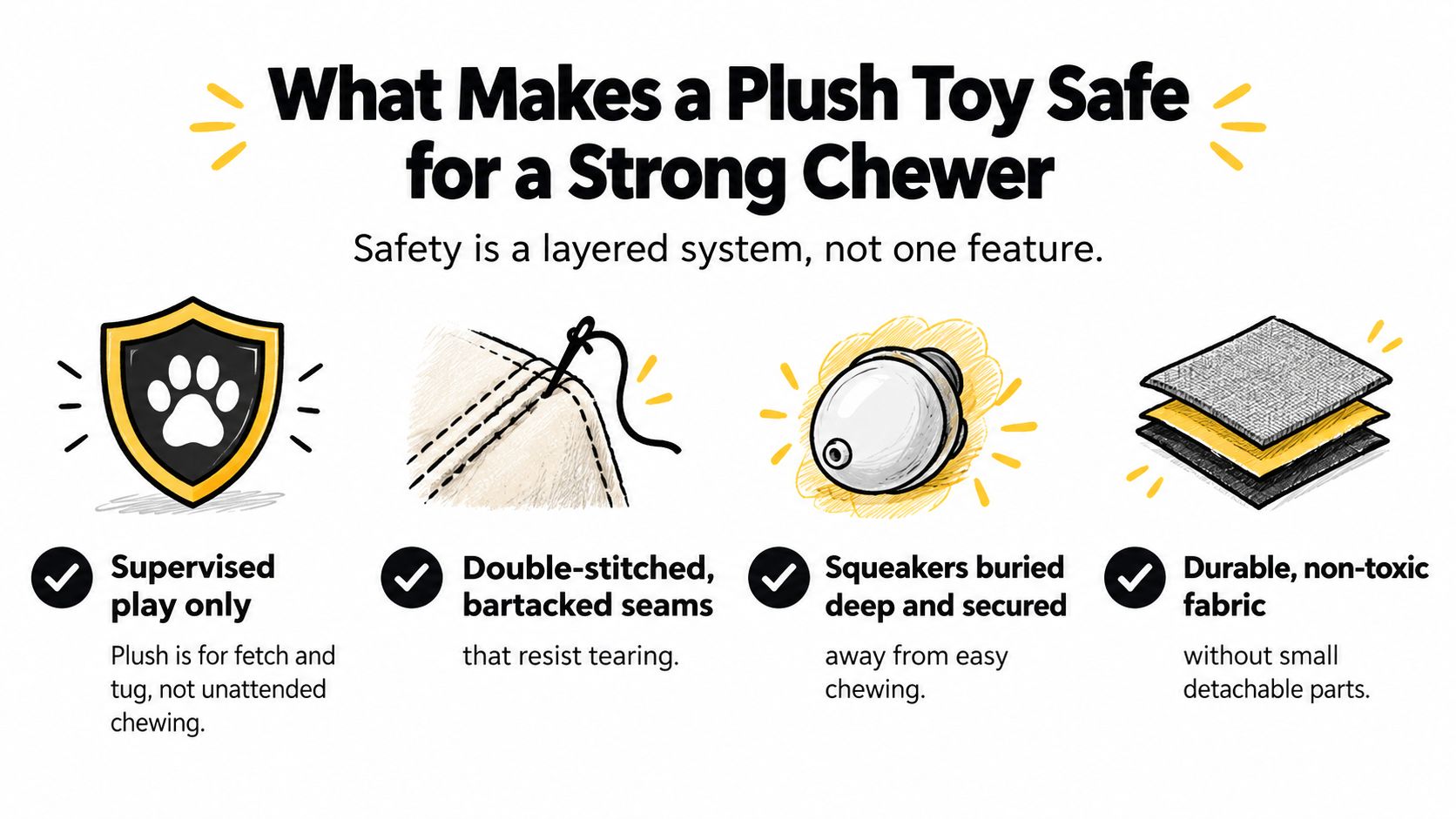
A safe plush toy isn't defined by one magic material or a label that says “tough.” Safety comes from several layers working together. The toy should slow destruction long enough for you to notice damage, and its design should reduce the consequences if a determined dog gets through the outer fabric.
Start by treating plush as a supervised play category. Fetch and interactive tug are usually better fits than leaving the toy in a crate for an extended gnawing session. Once a dog starts methodically shredding fabric, stuffing, squeakers, and loose threads can become choking or intestinal-blockage hazards. Veterinary guidance from Texas A&M's pet toy safety article warns that dogs that destroy toys may need to avoid soft plush and squeaker toys altogether, and that no toy should be considered fully indestructible.
Start with the fabric and finish
Look for non-toxic fabric and dye documentation, including certifications such as OEKO-TEX or GOTS where available. Certifications don't make a toy indestructible, but they provide more useful information than vague claims about being “premium” or “natural.” Avoid decorative parts that can detach, including button eyes, plastic noses, glued patches, beads, and hard accessories.
The stuffing matters, too. A toy with a stuffing matrix that stays relatively contained after a tear gives you more time to intervene than one that immediately sheds loose fibers across the room. No internal fill should be considered safe to swallow, but designs that resist complete extraction are preferable.
Test the toy against your actual dog
A pit bull power chewer may clamp and pull. An adolescent husky may attack seams and limbs. A teething puppy may work softer edges repeatedly. Those are different stress patterns, so breed labels alone won't tell you whether a toy fits.
Use a short observation cycle. Offer the toy for five to ten minutes, watch where your dog bites, and inspect it immediately afterward. Pay attention to exposed stitching, stretched corners, flattened squeaker chambers, and teeth marks around limbs. The purpose isn't to prove the toy is indestructible. It's to identify whether your dog treats it as a fetch toy or a disassembly project.
Practical rule: The first glimpse of stuffing is the retirement signal, not an invitation to sew up the hole and keep playing.
For a broader look at how plush construction affects play, compare the guidance in this plush dog toy overview. Keep the decision safety-first. If your dog begins tearing immediately, switch to a harder material and reserve plush for closely watched interaction.
Materials and Construction That Actually Hold Up
Marketing language hides the useful differences between fabrics. “Durable plush” can describe anything from a tightly woven outer shell to a thin fleece layer with decorative stitching. For a strong chewer, evaluate how the material handles tooth penetration, stretching, wet stuffing, and stress at the seams.
Canvas and ballistic nylon generally offer more resistance than plush fleece, polyester sherpa, or soft microfiber. Plush microfiber works well for gentle players and comfort-focused use, but it gives a determined dog more accessible fibers and edges to grab. A ripstop nylon liner adds another defensive layer. It won't make the outer fabric immune to teeth, but it can slow penetration after the surface is punctured.
The stuffing also changes what happens after damage. Cotton batting can mat and clump when wet with saliva, while recycled fiberfill and foam chips may remain more contained within a properly built cavity. Neither should be treated as edible or harmless if swallowed. The safer choice is the construction that gives the owner time to remove the toy before the fill becomes available.
Compare the useful construction choices
A single-layer plush body relies on one fabric panel and one seam line to contain everything. A double-panel design uses separate fabric sheets around the stuffing cavity, which can distribute pulling forces more effectively. Reinforced stitching, bartacks at attachment points, and a low-stretch inner lining matter more than a decorative outer nap.
A textile analysis of commercial plush toys found that 68% failed seam-integrity testing below 45 N, while the cited F963-23 benchmark for toys intended for dogs under 15 kg was 90 N. The same analysis reported hand-stitched samples using backstitch and 0.35 mm linen thread averaging 112 N pull resistance across 83 trials. Those findings support a practical conclusion: visual inspection alone isn't enough, and manufacturers should validate seams with pull-testing. See the textile safety analysis of plush dog toy seams for the testing context.
| Material | Tear Resistance | Tooth Penetration Delay | Best Chewer Type |
|---|---|---|---|
| Plush fleece or polyester sherpa | Low to moderate | Short | Gentle players and supervised comfort play |
| Plush microfiber | Low to moderate | Short | Dogs that carry and cuddle rather than shred |
| Tightly woven canvas | Moderate to high | Moderate | Fetchers and moderate tuggers |
| Ballistic nylon | High | Longer | Strong tuggers and supervised power chewers |
| Ripstop nylon lining | Adds reinforcement rather than acting as the outer toy | Extends delay after outer-fabric damage | Toys built with layered construction |
| Double-panel body with reinforced seams | Depends on the outer fabric, usually stronger than single-layer builds | Longer at seams and attachment points | Dogs that target corners, limbs, and tails |
Treat warning labels at face value. “Decorative only” means exactly that. A plush toy built around a plastic skeleton, or one with a squeaker box held by glue instead of stitching, may look substantial while failing at its first stress point.
Checking Seams, Squeakers, and Stress Points
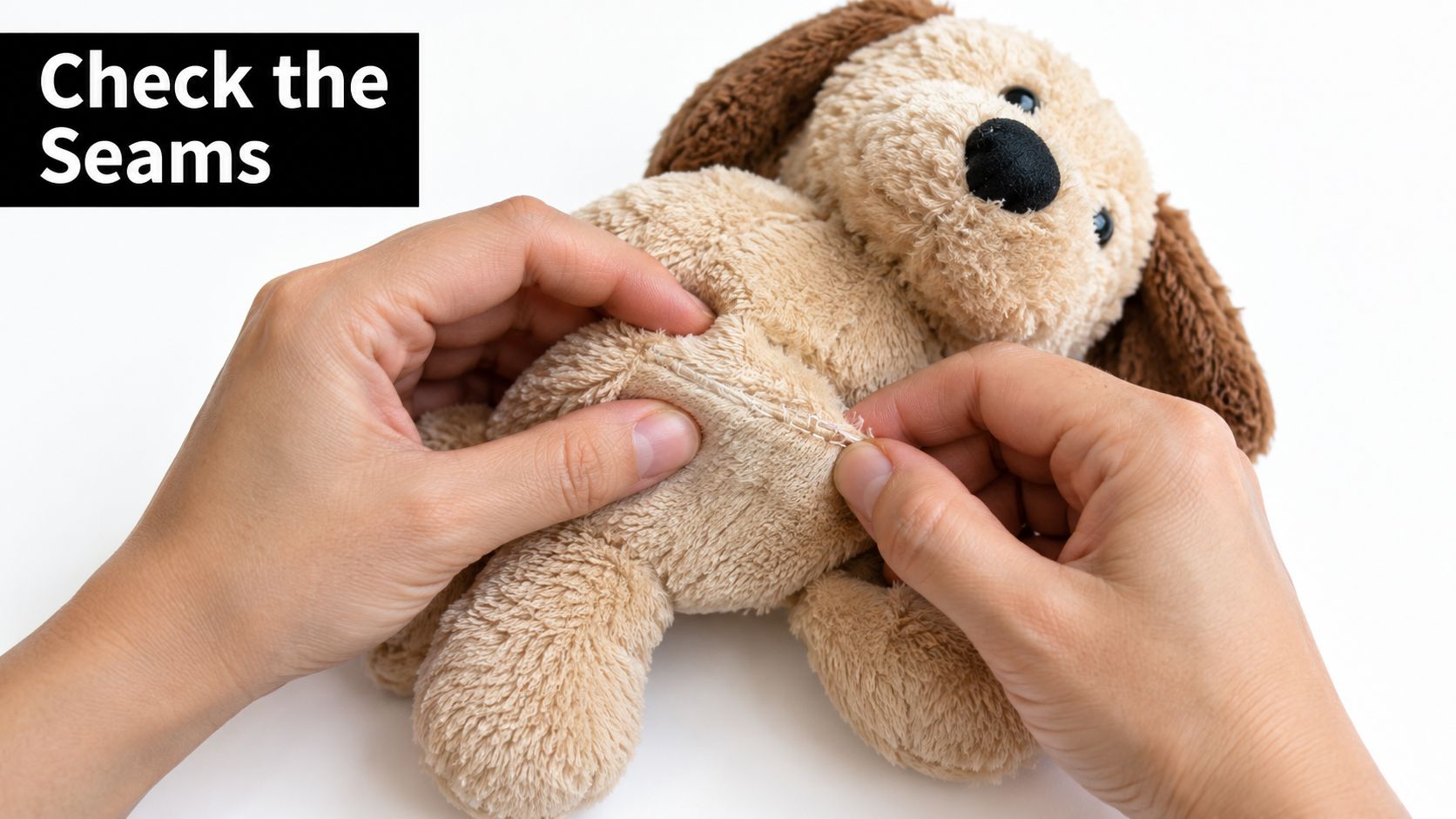
Turn the toy over in your hands before your dog ever sees it. The front display usually shows the face, colors, and character design. Your dog will find the weak point on the back, under a limb, beside a tail, or at the corner where several seams meet.
Inspect the seams first
Look for two parallel stitch lines, backstitching, or bartacks at high-stress points. A single straight stitch line is a poor choice for a power chewer because one broken run can open the entire cavity. Stitch density matters, but so does direction. Long, straight stitches at a corner can unravel quickly when your dog pulls sideways, while a locked or compact zig-zag pattern can distribute movement more effectively.
Run your fingers over every junction:
- Limbs and tails: Pull gently but firmly where they join the body. These protruding parts act as handles for tugging.
- Corners: Pinch the fabric and check whether the seam gaps when compressed.
- Ears and patches: Look for narrow attachment areas, decorative stitching, and glued details.
- Belly and back panels: Search for skipped stitches, loose thread ends, and uneven tension.
A separate test program examining 14 commercial plush toys found failure consistently occurred at limb seams when fabric elongation exceeded 16%. That result reinforces the need to inspect appendages, not just the main body. The commercial plush toy seam testing report explains why low-stretch reinforcement and stronger junctions matter.
Treat the squeaker as a separate component
Squeeze the squeaker chamber. It should feel enclosed in a fabric pouch that has been stitched into the body, not trapped loosely between stuffing or held in place with adhesive. A loose squeaker can become a choking hazard once your dog opens the outer shell.
If the product description emphasizes a loud squeak but says little about how the squeaker is secured, assume the sound is a selling point rather than a construction guarantee. A quiet or squeaker-free toy is often the better choice for a dog that targets the noisemaker first. You can find more ideas for evaluating sound-filled designs in this guide to plush dog toys with squeakers.
Before each session, mark suspicious areas with a washable fabric pencil or take a quick photo. Recheck those spots next time. No plush squeaker is indestructible, and the only reliable inspection schedule is the one you follow before play, not after a destruction event.
Safe Play Rules Most Owners Skip
Most plush emergencies begin with a routine decision: someone leaves a soft toy on the floor because the dog played nicely with it earlier. That calm session doesn't predict what happens when the dog is bored, overstimulated, teething, or determined to reach the squeaker.
A toy's label can't compensate for unsupervised access. The word “indestructible” loses its meaning when a dog has uninterrupted time to worry at a seam.
Change the way you offer plush
Use plush for a defined activity, then put it away. Fetch, short tug sessions, and calm carrying are reasonable uses for a well-made toy. Long solo chewing sessions are not.
Match the toy to your dog's mouth and play style. A toy should be large enough that your dog can't swallow it or fit it fully behind the teeth, but not so oversized that your dog can't carry it safely. Replace a plush toy with rubber during puppy teething, adolescent chewing bursts, and post-exercise zoomies, when dogs often move from interactive play into intense gnawing or shredding.
Keep one toy available during destruction-prone sessions. Multiple toys scattered around the room make it harder to identify which one caused a missing part, and they give a determined dog more material to work through. After play, remove loose threads, stuffing, and any detached squeaker immediately.
Use a hard-stop checklist
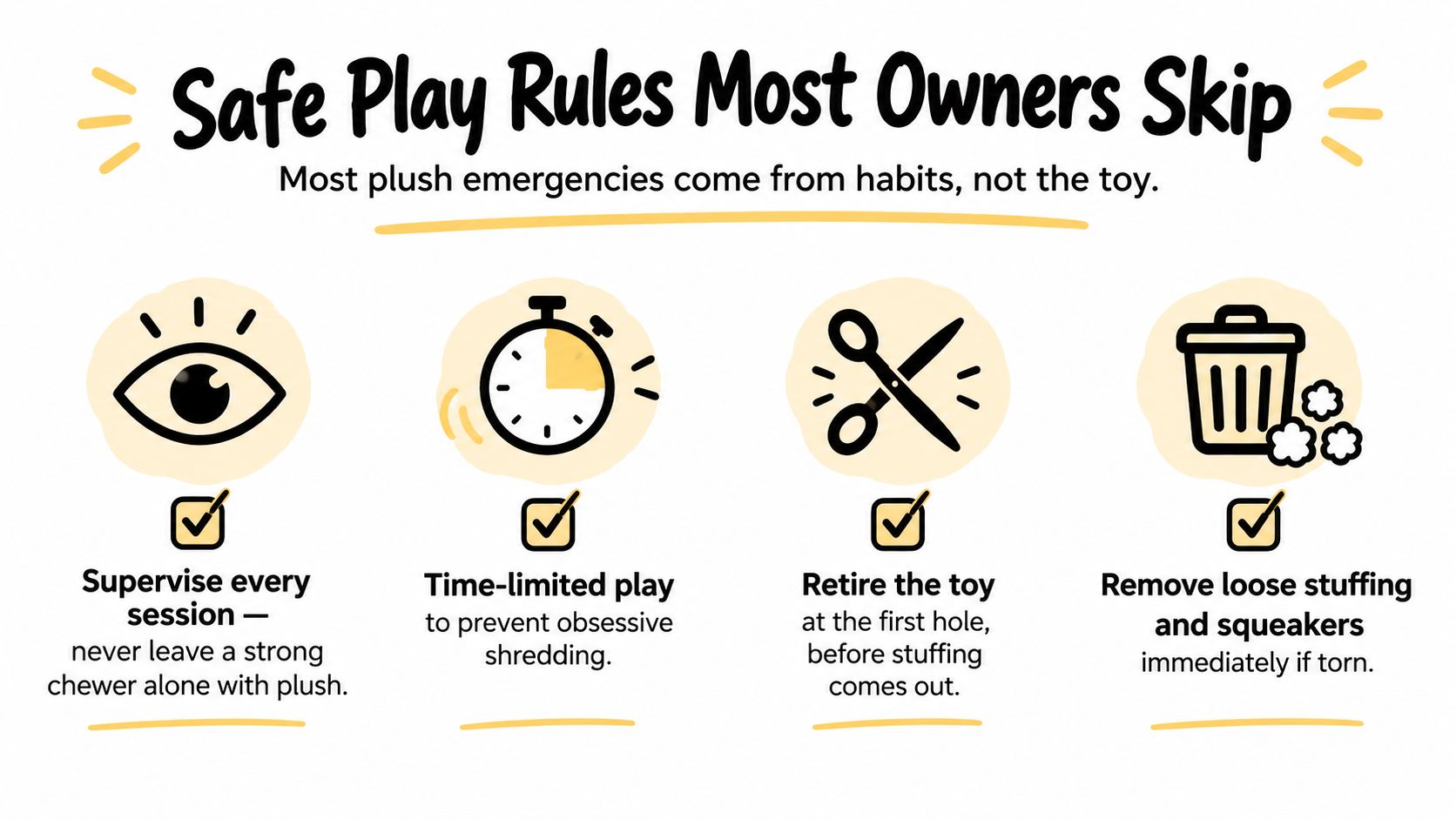
The owner, not the product label, decides when play ends. Follow this short enforcement list:
- Supervise every session: Stay close enough to take the toy away immediately.
- Time the interaction: Stop before fetch turns into focused seam work.
- Check the opening: Remove the toy at the first hole, exposed stuffing, or visible inner lining.
- Search for parts: Pick up loose squeakers, plastic pieces, and stuffing from the floor.
- Wash between uses when needed: Clean after heavy slobber sessions, illness, or sharing between dogs.
- Switch materials at the right moment: Offer solid rubber for sustained chewing instead of asking plush to absorb that job.
Owners should also watch what happens after ingestion. If a dog swallows stuffing, fabric, or a squeaker, contact a veterinarian rather than waiting for symptoms. Plush isn't automatically unsafe, but it demands a tighter supervision routine than a one-piece chew.
Plush vs Rubber vs Rope Alternatives
Plush, rubber, and rope aren't competing versions of the same product. Each material creates a different play experience, and strong chewers do better when you assign each toy a job.
Plush is the comfort and interaction specialist. It feels soft, carries easily, works well for indoor fetch, and supports gentle tug. Its weakness is sustained gnawing, especially when a dog attacks edges, limbs, and seams.
Solid rubber is the chewing and fetch workhorse. A suitable rubber toy usually has fewer detachable parts and can handle repetitive biting better than fabric. It still needs inspection. Extremely hard products can pose dental risks, and a cracked or damaged toy should leave the rotation.
Rope is the dental and tug option. Its fibers can provide texture during interactive play, but fraying creates a different hazard. Loose strands can be swallowed, so rope isn't a safe substitute for supervision.
| Material | Durability for Strong Chewers | Primary Risk | Best Play Mode | Cost Per Hour |
|---|---|---|---|---|
| Plush | Low to moderate during sustained chewing, higher for supervised fetch and comfort play | Stuffing, squeaker, fabric, and thread ingestion | Indoor fetch, short tug, carrying, comfort | Depends on how quickly the dog shreds it |
| Solid rubber | Moderate to high when correctly sized and inspected | Tooth damage from overly hard products, cracking, or swallowed fragments | Chewing, fetch, food enrichment | Often favorable for long chewing sessions |
| Rope | Moderate during supervised tug, lower once fraying begins | Swallowed fibers and detached strands | Tug, fetch, interactive dental texture | Depends on fiber shedding and replacement frequency |
Build a rotation around play mode
Give plush to the dog who wants to carry, chase, or tug with you. Give rubber to the dog who settles down and grinds at a toy. Use rope when you're actively playing and can remove it as soon as fibers loosen. A helpful resource on keeping dogs engaged with purpose-built enrichment is this guide to best toys for bored dogs.
Don't buy three versions of the same weak toy because your dog destroyed the first one. Match the material to the behavior. You can also compare construction options in this guide to durable dog toys for aggressive chewers, then keep plush in the rotation for the jobs it performs well.
Care, Repair, and When to Retire the Toy
Cleaning can extend a toy's useful life, but repair should never disguise a safety failure. A neatly sewn exterior is not enough if the inner fabric is thin, the squeaker has shifted, or the stuffing cavity has already been opened.
Wash machine-safe plush on a gentle cycle, ideally inside a laundry bag or pillowcase. Skip harsh agitation, and air dry completely. High heat can warp seams, shrink panels, or weaken glued decorations. Spot-clean after heavy slobber sessions so dirt and saliva don't remain trapped around the stitching.
Repair only minor damage
A small loose stitch may be reinforced with upholstery thread and a curved needle. Use tight, secure stitches that anchor into intact fabric. Don't use hot glue, loose craft trim, ordinary staples, or improvised plastic patches. Those materials can detach under pressure and create another object for your dog to swallow.
Freezing a clean, dry toy can help reduce surface bacteria without exposing the fabric to high heat, but it isn't a replacement for washing. If the toy smells after cleaning, remains damp inside, or develops mildew, retire it.
Retire at the first meaningful failure
Remove the toy immediately when you find:
- Exposed stuffing: The dog can now pull out and swallow the fill.
- A detached squeaker: The sound-producing component is loose.
- A punctured squeaker bladder: The chamber has been chewed or split.
- A torn limb, ear, or tail: The attachment point can become a larger opening.
- Lingering odor after washing: The material may be holding contamination or moisture.
- Thinning fabric around tooth marks: The next bite may create a full tear.
Run a weekly inspection routine even if the toy looks fine. Squeeze the body, check the squeaker chamber, trace every seam with your fingers, and inspect all protruding parts. Write the retirement date on a storage label or keep a simple note on your phone. That record stops you from repeatedly buying the same model after it fails in the same place.
For dogs that enjoy soft, interactive play, Nandog Pet Gear offers plush options in its My BFF collection, including designs with squeakers and crinkle textures. Use those products under the same inspection and supervision rules as any other plush toy, rather than treating a branded character or durable-material claim as a guarantee against destruction.
Nandog Pet Gear offers plush toys and other dog essentials designed for comfort, interaction, and everyday use, including its My BFF character collection with squeakers and crinkle textures. Visit Nandog Pet Gear to choose a soft-play option that fits your dog's routine, then supervise it closely and retire it as soon as the construction starts to fail.