


You leave the house under a gray sky, expecting a quick walk. Ten minutes later, your dog has charged through a puddle, the leash is soaked, and the handle feels like a cold rope in your palm. By the weekend, orange corrosion has appeared around the clip. The strap still looks fine, but the hardware is already becoming the weak link.
That's the mistake most buying guides make. They judge a waterproof leash for dogs by the strap alone, even though the leash is a system made from webbing, stitching, handle, swivel, snap, and D-rings. A coated strap can survive rain and mud while a cheap clip stiffens, pits, or stops closing properly.
The right purchase depends on where you walk, how strongly your dog pulls, how much control you need, and whether you'll maintain the leash after saltwater or muddy use. If your dog loves swimming or running through wet fields, a breed resource such as the PetCostEngine American Water Spaniel guide can also help you think about activity level and the type of outdoor gear your dog is likely to need.
Why a Wet Leash Is a Real Problem
A standard nylon leash rarely fails on the first rainy walk. It absorbs water gradually, becomes heavier, and stays damp inside the weave long after the surface looks dry. The handle loses its soft feel, the strap can smell stale, and repeated rubbing against your hand turns an ordinary walk into an uncomfortable one.
The control problem becomes obvious when a strong dog lunges. A wet nylon handle can slide or twist in your grip, especially if you're wearing gloves. On a reactive dog, that lost fraction of control matters more than the color or reflective stitching ever will.
The strap and the clip fail differently
The strap creates the comfort and cleaning problems. It absorbs moisture, holds grit, and can abrade at the edges or around the handle. The clip creates the safety problem. Water and salt work into the spring, swivel, and gate, where corrosion can make the mechanism stiff before the webbing shows visible damage.
Practical rule: Treat the leash as a strap-plus-hardware system. A waterproof strap doesn't make a corroding clip safe.
A rusting clip also changes how the leash behaves. The swivel may stop rotating, causing the strap to twist. The gate may fail to spring shut cleanly. A D-ring can weaken at its junction if the stitching or weld starts to deteriorate.
The decisions wet walks force
You need to choose more than a material label. Pay attention to:
- Webbing construction: Coated synthetic webbing handles rain and mud better than absorbent textile.
- Hardware metal: Saltwater demands more corrosion resistance than occasional inland rain.
- Length and width: A leash should provide control without adding unnecessary bulk.
- Handle design: Padding helps on long walks, while a traffic loop gives close control.
- Care routine: A rinse and full dry protect the clip as much as the strap.
Market demand supports the move toward synthetic constructions. The global pet leash market was valued at $1.82 billion in 2025 and is projected to reach $3.41 billion by 2034, with a projected 7.2% CAGR from 2026 to 2034, according to Dataintelo's pet leash market overview. Nylon rope held the largest share at 34.6% in 2025, while nylon-based products represented about 45.7% of material-segment revenue, a sign that synthetic leash construction is already central to the category.
The important distinction is simple. A wet leash is uncomfortable when the strap absorbs water, but it becomes dangerous when the hardware corrodes.
What Waterproof Really Means for a Dog Leash
A leash can look dry after a quick shake and still hold water inside its fibers. That trapped moisture adds weight, stays unpleasant against your hand, and keeps mud in the weave. “Waterproof” and “water-resistant” describe different levels of protection. Water-resistant nylon may shed light rain, but repeated soaking, puddles, and beach spray eventually reach the core.
A waterproof leash has a non-absorbent outer surface that blocks water during normal walks. Rain beads on the strap, mud stays on the surface, and the leash dries with a wipe rather than an overnight hang. Treat the leash as a strap-plus-hardware system, though. The coated webbing keeps water out, but the clip is often the first part to fail when salt and moisture reach the metal.
Look for the construction, not the adjective
Most waterproof dog leashes combine a synthetic core, usually polyester or nylon, with a polymer coating. PVC-coated nylon, TPU-coated polyester, and BioThane-style webbing follow this structure. The coating does the waterproofing, while the inner webbing provides much of the tensile strength.
Labels such as “splash-proof,” “all-weather,” and “weather-ready” are too vague to guide a purchase. Look for specifications that identify coated webbing, a waterproof polymer surface, wipe-clean construction, and hardware intended for wet conditions. Check the clip finish and gate as carefully as the strap. A leash is not waterproof in any practical sense if its snap hook rusts, sticks, or stops closing securely.
A retail example shows the level of detail worth seeking. Recent gear coverage identified a 6-foot waterproof leash rated to 2 kN and priced at $29, along with rust-resistant hardware and a wipe-clean surface. Those details appear in the D. Gluckly overview of dog leash materials.
What you should notice in use
After rain, beach spray, or a muddy trail, check for these signs:
- Predictable grip: The handle should not become saturated, slippery textile.
- Stable weight: The strap should shed water instead of storing it.
- Fast drying: Wiping or hanging should not leave the inside damp.
- Simple cleaning: Mud should rinse away with water and mild soap.
- Intact coating: Cracking, peeling, or tackiness signals surface failure.
- Sound hardware: The clip should open, swivel, and close smoothly after exposure to moisture.
Independent gear testing describes waterproof multi-filament polypropylene rope as water-beading and quick-drying. It describes coated webbing as 100% waterproof and easy to wipe clean for rain, beach use, and muddy walks. The Treeline Review dog leash testing helps because it examines material behavior instead of repeating marketing claims.
The same construction check applies across dog gear. This guide to waterproof dog collars offers a useful comparison. Verify the coating, core, stitching, and clip before trusting a weather label.
Coated Webbing and the Materials Worth Knowing
You'll usually encounter five material categories. They don't feel the same in your hand, and they don't age the same way in wet or cold conditions.
PVC is the budget workhorse. It creates a waterproof surface at a relatively accessible price, but it can feel stiff in cold weather and may become less pleasant to handle when temperatures drop. For a dog that mostly walks in mild rain, PVC can be perfectly serviceable. For winter use, I'd choose a more flexible coating.
TPU is the better default for most climates. It tends to feel lighter and more flexible than PVC, and it handles regular outdoor exposure well. Technical material guidance describes TPU-coated webbing as highly abrasion-resistant and durable, with protection against hydrolysis and microbial degradation. That makes it a strong choice for dogs that move through wet grass, grit, and muddy paths.
BioThane-style coated polyester sits in the premium tier. It has a soft, leather-like hand feel, and the surface usually provides confident grip when wet. You're paying for finish, handling, and consistency, not just for the word “waterproof.” It's my preferred material when the leash will be used daily and comfort matters as much as cleanability.
Generic coated polyester webbing falls between PVC and premium coated products. It can offer good water resistance and durability, but quality varies sharply between manufacturers. Inspect the edges, coating thickness, stitching, and attachment points rather than assuming every coated polyester leash performs alike.
Uncoated nylon is the baseline to beat for wet use. It's light, inexpensive, and familiar, but it absorbs water, can stretch when wet, and may develop mildew or odor if it's stored damp. Nylon still makes sense for dry-weather walking, but it isn't my recommendation for a beach or rainy-climate workhorse.
Waterproof leash materials compared
| Material | Wet Grip | Cold Flexibility | Weight | Odor | Price Tier |
|---|---|---|---|---|---|
| PVC-coated webbing | Good, may feel firm | Fair, can stiffen | Moderate | Low | Budget |
| TPU-coated webbing | Good to very good | Very good | Light to moderate | Low | Mid-range |
| BioThane-style coated polyester | Very good | Good to very good | Moderate | Low | Premium |
| Coated polyester | Good | Varies by coating | Moderate | Low | Mid-range |
| Uncoated nylon | Poorer when soaked | Good, but absorbs water | Light when dry, heavier when wet | Higher if stored damp | Budget |
The technical distinction matters because the coating changes how the leash responds to abrasion, water, and contamination. Titape's TPU-coated webbing specifications describe abrasion resistance, durability, and protection against hydrolysis and microbial degradation. A separate waterproof webbing specification cited in the same technical discussion describes PVC-coated webbing as abrasion-resistant, bacteria-resistant, and non-stretching.
My recommendation is straightforward: choose TPU or BioThane-style coated polyester for most dogs, especially if you walk in rain, mud, or near the coast. Choose PVC when price is the main constraint and cold-weather flexibility isn't a priority. Don't stop at the strap, though. The next inspection point is the clip.
For readers comparing synthetic materials across collars, harnesses, and accessories, this explanation of neoprene material helps clarify why soft, flexible materials can still behave very differently after repeated exposure to water.
The Hardware Question Most Buyer's Guides Skip
The clip is where waterproof leash marketing usually gets lazy. A coated strap can repel water completely, but a thin plated snap may pit at the spring, seize at the swivel, or stop closing after repeated wet cycles. In real use, the webbing often remains serviceable while the metal attachment becomes unreliable.
Stainless steel is the safest general recommendation for wet environments, especially when the leash will see saltwater. Bolt snaps and trigger snaps can both work well, but the shape and spring design matter. The gate should close fully without grinding, and the swivel should rotate smoothly instead of dragging against the body.
Metal choices in practical order
Stainless steel is the first choice for coastal walking. It resists corrosion better than ordinary plated metals, though it still needs a freshwater rinse after ocean exposure. Marine-grade stainless hardware is preferable when the leash regularly encounters salt spray or brackish water.
Brass handles corrosion well and can be useful around saltwater, but it's heavier and less common in lightweight leash designs. Its weight may be acceptable on a large-dog leash, but it can feel excessive on a small dog's setup.
Zinc alloy is common because it's economical and easy to shape. It can work for casual inland use, but I wouldn't choose it as my first option for a beach dog. Once plating wears through at the spring or swivel, corrosion can progress quickly.
Aluminum is light and doesn't rust in the same way steel does, but it may not provide the same combination of gate strength, spring performance, and wear resistance as a well-made stainless snap. Treat it as a design-specific choice, not an automatic upgrade.
Painted and coated clips deserve skepticism. A black or colored finish can look flawless in the product photo while the spring cavity begins to pit underneath. A “rust-resistant” sticker doesn't mean rust-proof hardware.
Clip material performance in wet conditions
| Material | Freshwater | Saltwater | Pool Chlorine | Typical Lifespan |
|---|---|---|---|---|
| Stainless steel | Strong choice | Best general option, rinse after use | Good with rinsing | Depends on grade and care |
| Brass | Very good | Good, with added weight | Generally suitable with rinsing | Depends on construction and care |
| Zinc alloy | Acceptable for occasional use | Poorer choice after plating wear | Vulnerable to finish damage | Highly variable |
| Aluminum | Lightweight option | Varies by alloy and design | Varies, rinse promptly | Highly variable |
| Coated carbon steel | Good while coating is intact | Risk rises sharply after coating damage | Finish can degrade | Highly variable |
Inspect more than the snap. Check the D-ring, O-ring, swivel, and seam where the hardware meets the webbing. Bar-tacked or welded attachment points should place reinforcement directly at the load area. Folded seams need clean stitching with no loose edge that can abrade against the ring.
Outdoor equipment buyers already apply this system-level thinking to wet and load-bearing gear, from harnesses to wing foiling gear for beginners. Dog leashes deserve the same scrutiny. Coastal walkers should choose stainless hardware, rinse it after every ocean outing, and reject any clip that develops a gritty spring or fails to self-align.
Matching Length, Width, and Style to Your Dog
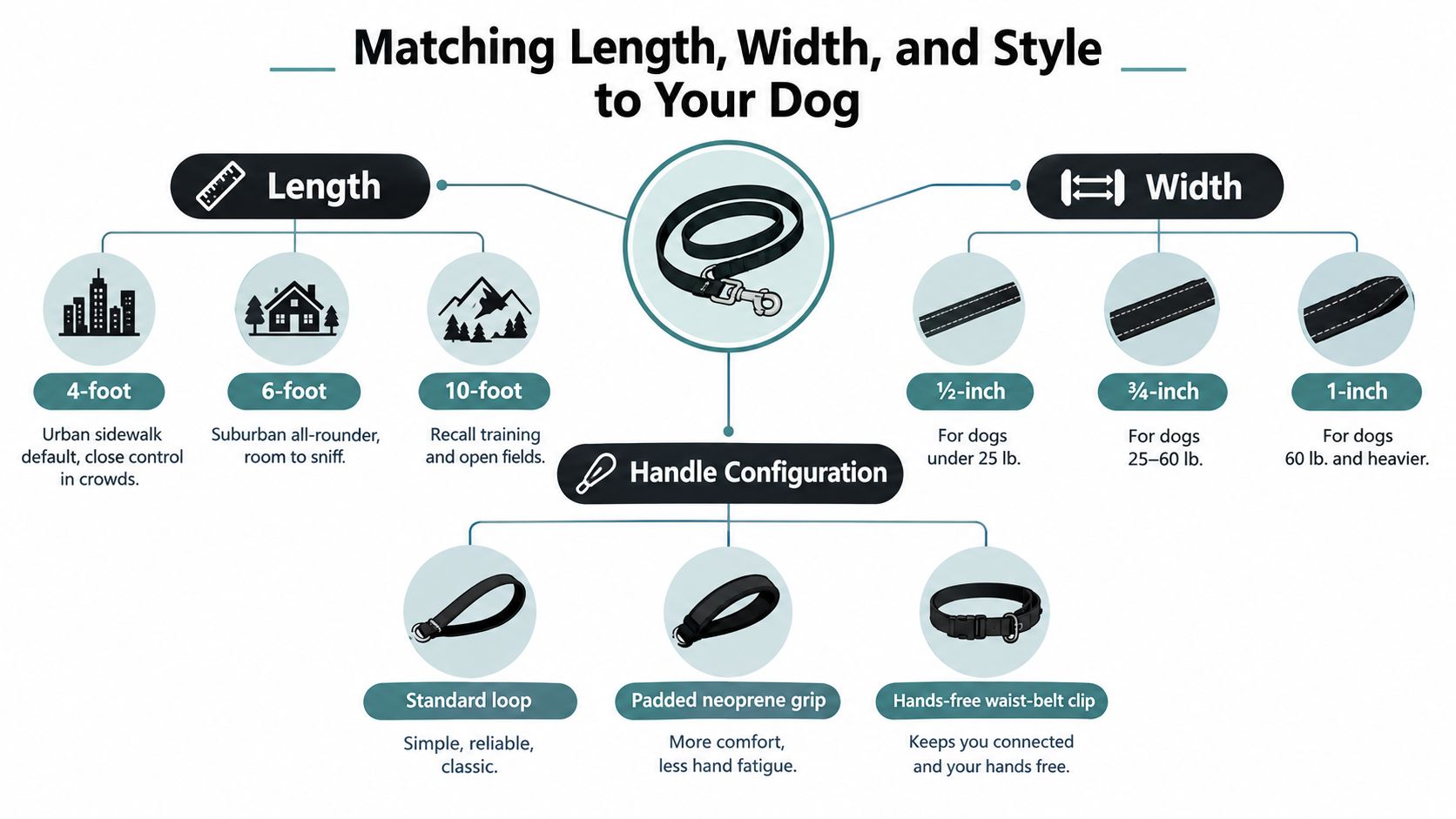
A leash should give you the right amount of control for the environment, not the maximum amount of material. The useful choices are length, width, and handle configuration. Get those three right and the leash feels deliberate rather than bulky.
Start with length
A 4-foot leash is my urban default when sidewalks are crowded, crossings are frequent, and your dog needs to stay close. It limits wandering and reduces the amount of strap that can wrap around legs, benches, or bike wheels.
A 6-foot leash is the all-purpose choice. It gives a dog room to sniff while keeping the handler close enough for ordinary neighborhood control. If you're buying one fixed leash, this is the sensible starting point.
An 8 to 16-foot line belongs in open spaces, recall practice, and controlled beach work. It creates freedom, but it also creates more opportunities for tangles and sudden loading. Don't use a long line as your everyday crowded-sidewalk leash.
Match width to the dog and the handler
Width affects strength, weight, and comfort. A useful starting guide is:
- Under 15 pounds: 3/8-inch strapping is usually sufficient.
- 15 to 50 pounds: Choose 5/8 to 3/4 inch for a balanced feel.
- 50 pounds and up: Choose a full inch or a reinforced traffic loop.
Those ranges aren't a substitute for inspecting construction. A narrow, well-sewn leash can outperform a wide strap with poor stitching, while a very broad leash can be unnecessarily heavy for a small dog.
Pick the handle for the walk
A traffic-handler loop is useful on crowded sidewalks, around elevators, and with reactive dogs that need close positioning. A padded loop suits long walks and handlers who deal with hand or joint discomfort. A coupler makes sense for two-dog households, but inspect the shared swivel carefully because both dogs can load the junction at once.
Hands-free waist belts and convertible hand-and-shoulder leashes are useful for running and hiking. They also deserve extra caution. A waist clip transfers the dog's lunge directly to your hips, and a weak buckle or poorly placed attachment can become the failure point before you have time to grab the leash.
Running buyers should compare control, attachment position, and emergency handling, not just comfort. This safe dog running leash guide is a useful reference for evaluating running-specific designs. For everyday setups that combine collar and leash decisions, review this dog collar and leash combination guide.
Cleaning, Care, and When to Replace
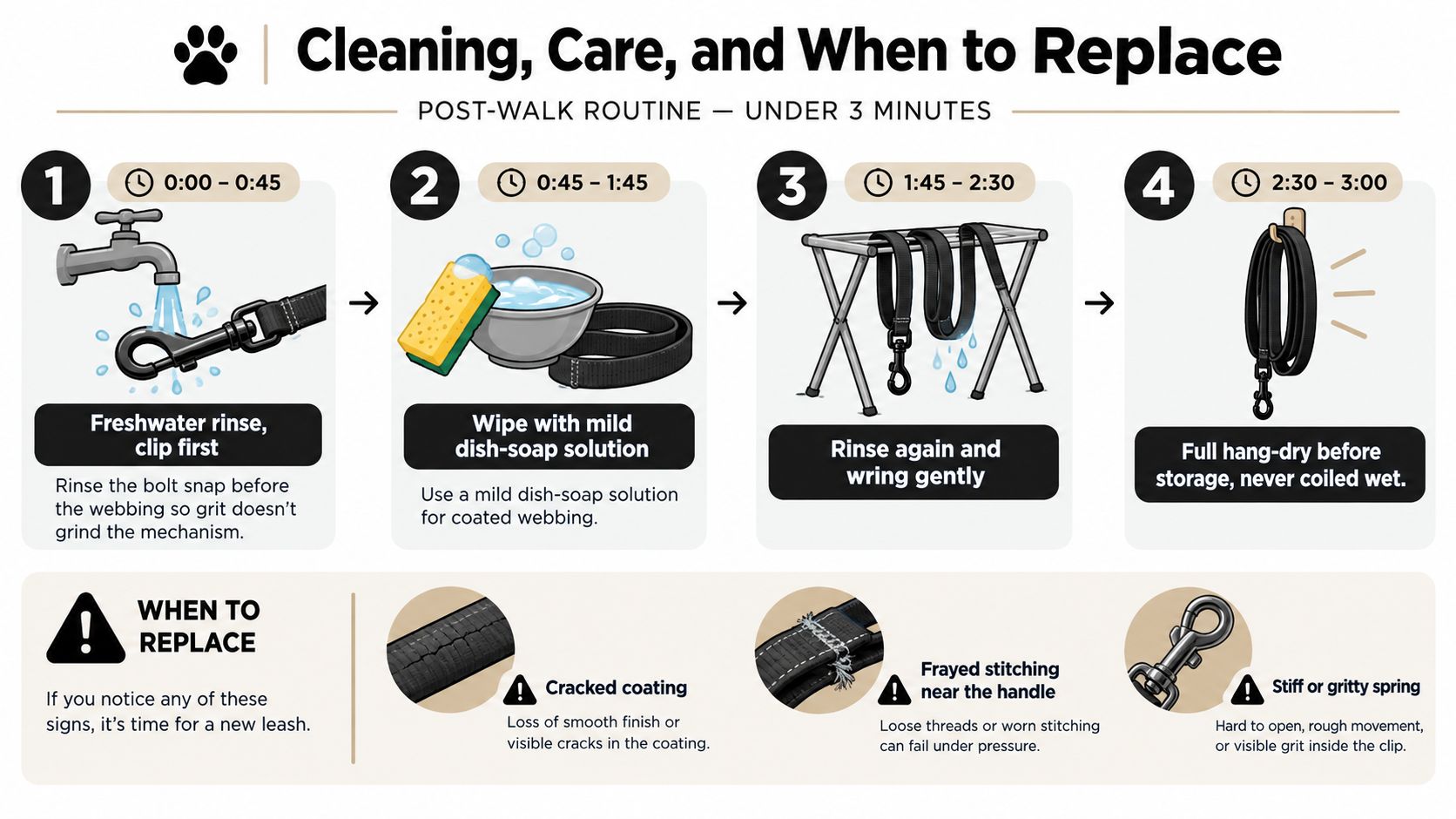
A waterproof leash doesn't need a complicated maintenance ritual. Give it a quick rinse after wet or dirty walks, then deal with the clip before you coil the strap.
Start with the clip and swivel. Freshwater flushes out grit and salt from the moving parts. Wipe coated webbing with a mild dish-soap solution, rinse again, and hang the entire leash until it's completely dry. TPU and BioThane-style coatings tolerate scrubbing better than absorbent nylon, but no material should be stored damp.
A short post-walk routine
- Rinse the hardware first: Move the gate and swivel while clean water runs over them.
- Wipe the strap: Use mild soap on mud, oils, and residue.
- Rinse thoroughly: Leave no soap film around the handle or clip.
- Hang it open: Don't coil the leash until the inside of the handle and attachment folds are dry.
A car trunk is a poor drying rack. Stuffing a wet leash into a gear bag or leaving it coiled under the rear window traps moisture and exposes the coating to concentrated heat and ultraviolet light. Water causes obvious mess, but long-term UV exposure can age some coated materials faster than ordinary rain.
Look closely at the attachment points during cleaning. Retire the leash if you find:
- Fraying at a stitch line, especially near the handle or clip.
- Sticky or tacky coating under the handle.
- A gate that no longer closes with a clean click.
- Rust pitting on the spring or swivel.
- A visible crack in the D-ring weld or folded seam.
A daily beach dog can wear through a mid-tier leash in one to two seasons, while a weekend-only hiker may stretch one to three seasons, depending on exposure, pulling force, storage, and construction. Those are usage-based expectations, not guarantees. Replace the leash when the hardware or attachment shows a safety concern, even if the strap still looks presentable.
Your Buying Checklist and Pitfalls to Avoid
Product pages often bury the useful information under color options and lifestyle photos. Ignore the photography until you can answer the construction questions.
The checklist I use before buying
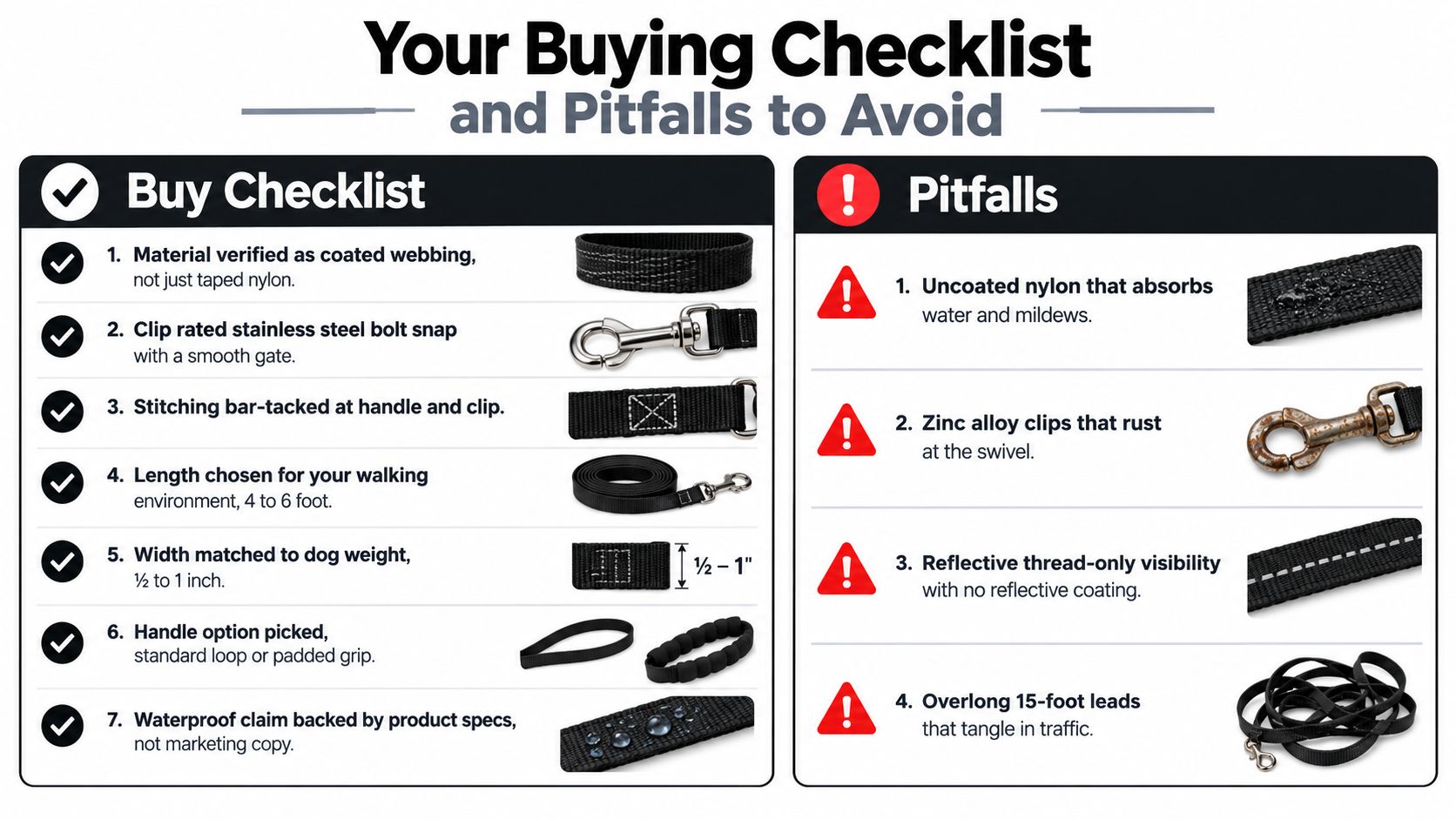
- Verify coated webbing: The listing should identify a polymer-coated strap, not merely “treated” or “water-resistant nylon.”
- Choose suitable hardware: Stainless or marine-grade hardware is the right starting point for coastal use.
- Inspect the attachment: Look for bar-tacked stitching, clean welds, and reinforcement around the clip.
- Match the handle to the walk: Use a standard loop for general use, a padded grip for longer walks, and a traffic loop for close control.
- Scale width to the dog: Small dogs need less bulk, while large or forceful dogs need broader, reinforced construction.
- Select the right length: A 4 to 6-foot leash suits most daily walking, while longer lines belong in open training spaces.
- Check the policy: A warranty or replaceable-clip policy tells you whether the manufacturer treats hardware as a serviceable component.
The traps that catch otherwise careful buyers
“Water-resistant nylon” sounds closer to waterproof than it is. Look at the weave and edges. If you can see ordinary textile fibers with no continuous coating, expect the strap to absorb moisture.
A coated strap can hide a cheap clip. Product photos often show the webbing clearly while the snap is too small to inspect. Zoom in on the spring, swivel, gate, and attachment seam. If the listing doesn't identify the metal, assume it's a cost-driven choice until proven otherwise.
The widest leash isn't automatically safer. Excess material adds weight and can make a small dog's setup awkward. Strength comes from the entire construction, including webbing, stitching, ring, snap, and load path.
Cold stiffness is easy to miss online. Flex the leash in your hands if you can. A material that feels rigid at room temperature may become unpleasant in winter, especially around the handle.
Choose the leash that matches your dog's environment and behavior. “All-weather” is not a specification, and a fashionable finish can't compensate for a weak spring.
Waterproof Leash Questions Worth Answering
Is saltwater safe for a waterproof leash?
Saltwater attacks hardware, including stainless components. Rinse the clip, swivel, D-ring, and coated webbing with fresh water after every ocean outing. Move the gate while rinsing to flush salt from the mechanism.
How do I introduce a stiffer coated leash to a puller?
Use short, familiar walks with few distractions first. Give your dog time to adjust to the leash's weight and feel before taking it to a busy route, beach, or crowded trail.
Which waterproof material feels best in cold weather?
PVC can stiffen below freezing. TPU and BioThane-style coatings generally stay flexible to roughly -20°C, as described in the product-development reference from D. Gluckly. Check the manufacturer's cold-weather guidance before using any material in severe conditions.
When should I replace the leash?
Replace it when the coating turns sticky, the webbing cracks, stitching frays, the clip stops self-aligning, or rust appears through the finish. A sound strap cannot compensate for a failing attachment.
Judge the clip as carefully as the waterproof coating.
Nandog Pet Gear offers waterproof Poly-Flex sport dog leashes designed to resist dirt and odor and clean with soap and water. Visit Nandog Pet Gear to compare that option with other everyday walking gear.