


At 2 a.m., your senior Labrador is stretched across the bathroom tile while the expensive foam bed sits untouched in the next room. The floor feels cooler, but it offers no cushioning for stiff hips or elbows. Your dog has chosen heat relief over joint support, which is exactly the compromise a well-designed cooling orthopedic dog bed should eliminate.
The category is full of vague promises. “Cooling” can mean a slick fabric that feels cool to your hand, a gel layer that slows heat buildup, or a breathable structure that helps the sleeping surface shed heat. “Orthopedic” can mean a supportive foam core, or it can be little more than a label on a thin cushion. The right purchase separates those claims and checks both functions independently.
Why Dogs Overheat at Night and What a Cooling Bed Really Does
Dogs don't cool themselves exactly as people do. Panting does most of the work, while sweat from the paw pads contributes less. Once a dog lies flat on a dense, poorly ventilated bed, the surface can hold warmth beneath the ribs, chest, hips, and joints. A thick coat makes that trapped heat more noticeable, especially during a warm night.
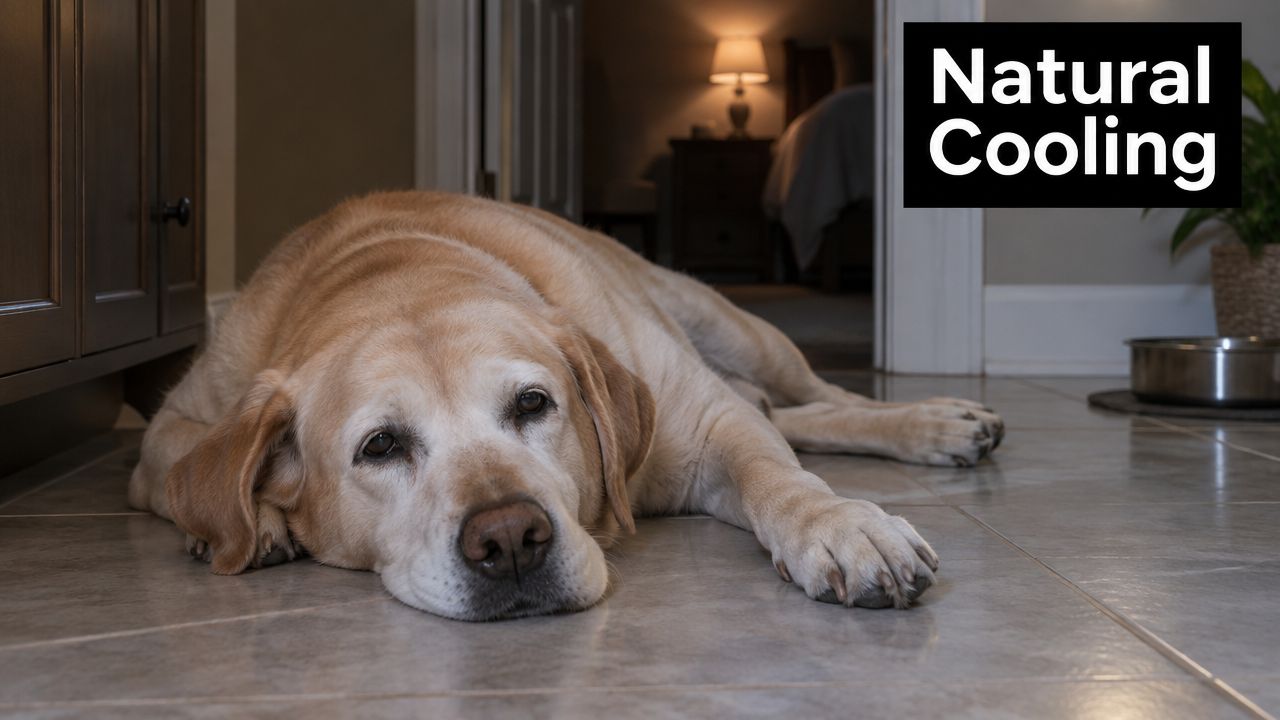
The problem is not just that the bed feels warm. A dog that keeps shifting between the bed and the floor may be losing the uninterrupted rest that helps sore joints recover. An older dog, an overweight dog, or a brachycephalic breed has even less room for a bed that solves comfort only on one side.
Two jobs, one sleep surface
A cooling orthopedic bed should do two separate jobs:
- Distribute weight: The support structure should cushion elbows, hips, shoulders, and hocks without collapsing beneath the dog.
- Move heat away: The cover, foam surface, gel, or airflow system should reduce heat accumulation at the contact layer.
- Stay usable overnight: A surface that feels cool for a few minutes but becomes insulated later isn't a complete solution.
Independent pet-bed guidance supports the hybrid approach. High-density memory foam can provide strong pressure relief, but it may retain warmth, so manufacturers pair it with gel-infused or phase-change layers designed to improve heat dissipation. The orthopedic bed buying guidance from Paws & Tales also notes that raised cot designs improve airflow by lifting the dog 6–9 inches off the floor.
That distinction sets the buying standard. Don't ask only whether a bed feels cool when you touch it. Ask whether it provides measurable surface-temperature control while preserving enough structure for the dog's weight and sleeping posture.
Orthopedic Support and Cooling Explained in Plain Terms
Orthopedic support means the bed holds a dog's weight in a stable position instead of letting the body sink until it meets the floor. The spine should remain reasonably level, and the foam should spread pressure across a wider area rather than concentrating it at the hips, elbows, shoulders, or hocks.
Think about a worn office chair. You sit down, the padding compresses immediately, and the hard frame starts taking the load. A supportive mattress feels different. It yields around the body but pushes back underneath it. A dog bed needs that same balance, especially for a heavy dog or one that stays in one position for long periods.
Memory foam and orthopedic design aren't competing categories. Memory foam describes a material that contours to weight and body heat. Orthopedic describes the bed's function, usually achieved through a dense core, layered construction, or both. The Nandog explanation of orthopedic dog beds is useful because it separates softness from structural support instead of treating every foam bed as equivalent.
Cooling is heat management, not refrigeration
A cooling layer doesn't actively chill a dog like an air conditioner. It helps transfer or disperse heat so the contact surface doesn't build warmth as quickly. Conductive materials, breathable textiles, open structures, and airflow beneath the bed all contribute, but they don't replace proper veterinary care if a dog is showing signs of overheating.
Independent reviews report that pressure-activated cooling gel pads can hold the sleeping surface about 12–18°F, or 7–10°C, below ambient room temperature, while raised mesh cots typically reduce perceived temperature by about 3–7°F, or 2–4°C, through continuous airflow. The cooling-bed review guidance from Paws & Tales provides those benchmarks and makes the practical point clear: cooling performance should be judged by surface behavior, not by a product name.
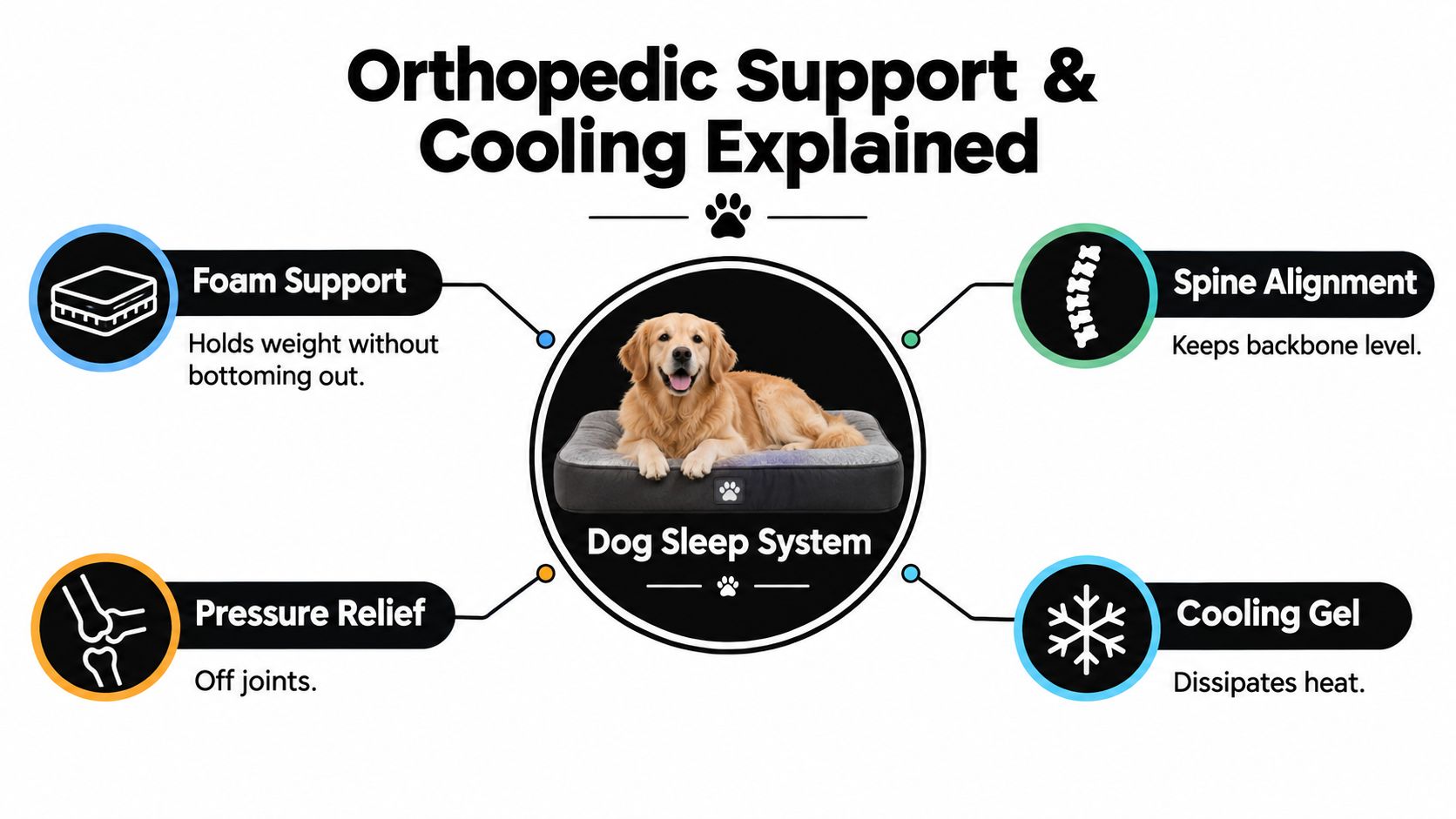
A bed can be excellent at pressure relief and mediocre at heat dissipation. It can also feel cool to the palm while offering almost no joint protection. If your dog has arthritis or mobility problems, use practical resources such as this guide to finding vet costs for dog arthritis alongside your bed research, because bedding supports comfort but doesn't diagnose or treat joint disease.
Here's a concise visual explanation of how support and cooling interact:
Inside the Materials That Make These Beds Work
A cooling orthopedic dog bed is a system, not a single magic ingredient. Start at the bottom and inspect each layer for the job it performs.
The support core carries the load
The foundation should resist compression and prevent bottoming out. For a smaller or lighter dog, a supportive foam core with a contouring top may be enough. Larger dogs usually need a layered base, with firmer support foam below memory foam, because their weight can compress a single soft layer too much.
High-density foam matters because memory foam alone can contour pressure points while retaining warmth. The orthopedic bed buying guide from Paws & Tales specifically identifies high-density memory foam as useful for pressure relief while also noting its heat-retention trade-off.
Cooling inserts manage accumulated warmth
Gel-infused memory foam, phase-change overlays, and pressure-activated gel pads can absorb or redistribute heat at the sleeping surface. They're helpful, but they aren't permanently cold. A gel layer slows heat buildup, then reaches its practical limit as the dog continues lying on it.
The cover decides whether heat can escape
A dense, impermeable cover can undermine a good foam core. Look for breathable mesh, moisture-wicking knits, or 3D spacer fabrics that allow heat and humidity to move away from the body. This matters even more in humid homes, where a surface can feel clammy before it feels obviously hot.
Raised construction adds passive airflow
Raised mesh cots use moving air beneath the dog rather than relying only on a chemical or gel insert. The design lifts the sleeping surface 6–9 inches off the floor, according to the Paws & Tales orthopedic-bed guidance, and can be especially useful outdoors or in rooms with poor floor-level airflow.
| Layer | Common Materials | What It Does | Watch Out For |
|---|---|---|---|
| Support core | High-density foam, layered support foam | Distributes weight and limits bottoming out | A soft single layer may collapse under a large dog |
| Comfort layer | Memory foam, contoured foam | Cushions pressure points and shapes around the body | Traditional memory foam can retain warmth |
| Cooling layer | Gel foam, cooling gel pad, phase-change material | Moves or absorbs heat at the contact surface | Cooling slows heat buildup, but doesn't remain cold forever |
| Cover and base | Breathable knit, mesh, spacer fabric, raised cot mesh | Releases heat and moisture, or adds airflow below | Waterproof membranes may reduce breathability after washing |
The buyer's priority should be structural balance. A paper specification that highlights gel but says little about support foam is incomplete. The coolest surface may be the least useful bed for a dog whose hips or elbows need genuine pressure distribution.
Which Dogs Benefit Most from Cooling Orthopedic Support
Some dogs clearly benefit from combining heat management with joint cushioning. The best match depends on why your dog runs warm and where the body carries pressure.

Seniors need easier rest and easier movement
Older dogs often spend longer periods lying down, which concentrates pressure at bony contact points. Stiff hips, elbows, and hocks also make getting up harder. Choose a stable, low-access bed with enough cushioning to relieve pressure and a surface that won't encourage constant repositioning because it feels hot.
Large and giant breeds compress ordinary cushions
A Labrador, Golden Retriever, German Shepherd, Mastiff, or Great Dane puts substantial load through the hips, shoulders, and sternum. A thin or low-density cushion may feel comfortable at first but provide little protection once the dog settles. Larger bodies also create more contact-area heat, so a supportive base paired with a breathable top is the sensible combination.
Overweight dogs need structure before softness
Extra body weight increases loading at every resting joint. It also insulates the body against the bed, making heat retention more noticeable. Avoid beds that let the dog sink into a plush cavity. A medium-firm support layer with a heat-dissipating surface usually makes more sense.
Brachycephalic breeds have less cooling margin
Bulldogs, Pugs, and French Bulldogs can struggle to move enough air through narrowed upper airways. A cooler, more breathable resting surface can reduce environmental heat load, but it isn't a treatment for breathing difficulty. If your dog is panting excessively, weak, distressed, or unable to settle, contact a veterinarian rather than relying on bedding.
Thick-coated dogs turn insulation into a problem
Huskies, Bernese Mountain Dogs, Newfoundlands, and Akitas carry dense coats that already hold warmth close to the body. Their beds need airflow and moisture management, not just a smooth “cool-touch” cover. A breathable top or raised design can help prevent the bed from becoming a warm pocket beneath the coat.
Post-surgery dogs also need careful support, though cooling should never distract from the recovery instructions provided by the veterinary team.
Cooling Orthopedic Beds Compared to Other Cooling Options
The cool tile at the start of this guide works because hard surfaces conduct heat away. It also punishes pressure points. That trade-off explains why dogs often choose tile when they're warm, then struggle to rise after lying there for hours.
| Surface | Joint Support | Cooling Effect | Washability | Best For |
|---|---|---|---|---|
| Tile or hard floor | Very low | Strong conductive cooling | Easy to clean | Short-term heat relief for dogs without joint sensitivity |
| Elevated cot | Limited to moderate | Continuous airflow | Usually practical to wash | Outdoor use, humid rooms, and dogs that prefer firm surfaces |
| Standard foam bed | Moderate, depending on construction | Often weak because foam can retain warmth | Depends on cover design | Dogs that need cushioning without a major cooling requirement |
| Cooling orthopedic bed | Designed to combine pressure relief and heat management | Cooling surface or airflow, depending on design | Strong only if the cover and liner are washable | Senior, large, thick-coated, overweight, or heat-sensitive dogs |
Tile is cool but unforgiving
A tile floor has no foam to compress and no fabric to trap warmth. That makes it attractive during hot weather, but it provides no meaningful pressure relief for hips, elbows, or shoulders. Use it as a temporary choice your dog can access, not as the only overnight surface for an older or arthritic dog.
Elevated cots solve airflow, not every joint problem
An elevated mesh cot keeps the dog away from a hot floor and lets air pass underneath. Independent cooling-bed guidance reports that these designs typically lower perceived temperature by about 3–7°F, or 2–4°C, through continuous airflow. The Paws & Tales cooling-bed review guide supports that comparison, but the mesh sling may still lack the contouring support a heavy or stiff dog needs.
Standard foam is comfortable until it isn't
Traditional foam can cushion the body, yet its insulating structure may hold warmth under a sleeping dog. A cooling orthopedic design gives up some of tile's cold, hard sensation in exchange for pressure distribution, a more stable sleeping posture, and potentially better washability.
For a more seasonal comparison of practical bed features, see Nandog's guide to dog beds that keep dogs cool in summer. The choice should follow the setting. A cot may win outdoors, tile may work for short cooling breaks, and a hybrid foam bed usually makes the strongest all-night compromise for joint-sensitive dogs.
How to Choose the Right Size, Firmness, and Care Routine
Start with fit, not color or cooling language. A dog that can't stretch fully will bunch against the edge, while a bed that's oversized for a small dog may feel exposed and fail to provide the secure support many dogs prefer.
Measure the sleeping dog
Measure from the nose to the base of the tail while your dog lies in a relaxed, extended position. Add 15–20 centimetres for stretching and side sleeping, then compare the result with the manufacturer's dimensions. Don't trust small, medium, or large labels by themselves. Match the dog's length and weight to the actual sizing chart.
Check the entry as well. A low edge helps a stiff dog step on and off without lifting painful joints, while bolsters can give a head-resting dog useful boundaries. The best size is the smallest one that allows full extension without forcing the limbs against the sides.
Pick firmness by body and condition
Medium-firm foam suits many adult dogs because it cushions the joints without allowing the body to sink to the floor. A thin senior with prominent hips may prefer a softer comfort layer, but the base still needs to resist collapse.
Press the bed with your palm. If your hand reaches the hard base easily, a heavy dog will likely bottom out. If the surface barely yields at all, it may provide poor pressure relief. The right feel is controlled give with noticeable pushback.
Treat washing as part of performance
A cooling layer loses appeal if the cover holds odor, moisture, or hair. Prioritize:
- Removable, machine-washable covers: Hidden zippers protect the closure from chewing and reduce snagging.
- A water-resistant inner liner: It keeps accidents and dampness away from the foam core.
- Air-dry access: Foam should be able to dry fully before the bed returns to use.
- Reversible or replaceable components: Flipping or replacing a worn surface can extend practical use.
Recent market analysis identifies a technical gap in moisture-wicking breathability for beds used in humid or outdoor conditions and warns that waterproof membranes can lose breathability after machine washing. The IndexBox orthopedic dog-bed market analysis also points to phase-change materials and fully washable support structures as designs gaining traction for year-round use.
Read the care label before buying. Non-removable covers, glued-in foam that can't be flipped, and dry-clean-only fabric are poor choices for real dog ownership. For practical cleaning steps, use Nandog's memory-foam dog-bed cleaning guide.
Common Misconceptions About Cooling Dog Beds
The most common mistake is treating “cooling” as a promise of active refrigeration. A cooling orthopedic bed doesn't make a dog's body cold. It manages heat at the surface through conductivity, airflow, moisture control, or a combination of those features.
Independent coverage makes the same distinction in broader pet-cooling guidance. Cooling-gel foam generally reduces heat buildup rather than lowering a dog's body temperature, so buyers should separate perceived coolness, thermal insulation, and actual temperature reduction. Wirecutter's guidance on keeping pets cool is particularly useful for comparing a gel bed with tile, raised cots, and ordinary foam.
A cool touch proves very little
A smooth cover can feel cool when your palm first touches it because your hand transfers heat quickly. That sensation doesn't tell you how the surface behaves after a dog has rested there for an extended period.
Look for evidence about surface-temperature reduction, conductive layers, airflow, and breathability. Independent reviews report that pressure-activated cooling gel pads can maintain a sleeping surface about 12–18°F, or 7–10°C, below ambient room temperature, while raised mesh cots provide a smaller perceived reduction through airflow. Paws & Tales' cooling-bed review guidance offers those concrete comparison points.
More foam isn't automatically hotter
Thickness alone doesn't determine thermal behavior. Foam structure, ventilation channels, the cover textile, and the presence of a conductive surface layer all affect whether heat escapes or stays trapped. A thick layered bed with a breathable top can perform better than a thin, sealed cushion.
A cooling label doesn't guarantee joint care
A thin gel pad may feel pleasant but fail to distribute weight around arthritic hips or elbows. Conversely, a dense orthopedic bed may support the skeleton well while running warm. Read the specifications as separate categories:
- Support: What holds the dog up?
- Pressure relief: What cushions contact points?
- Thermal performance: What moves heat away?
- Washability: What protects the materials after repeated cleaning?
Buyers who score each category separately are less likely to trade joint care for a gimmick.
Bringing It All Together for a Better Night's Sleep
Choose the bed around the dog first, then evaluate the cooling claim. Weight, body length, age, coat density, mobility, and preferred sleeping position tell you more than a product name. A long-coated senior needs a different sleep system from a small, healthy dog that curls into a tight ball.
Confirm the orthopedic construction next. Look for a support core that doesn't bottom out, a comfort layer that relieves pressure, and a low-access profile if your dog has trouble standing or stepping over edges. Then inspect the cooling features independently. Breathable fabric, airflow channels, gel, phase-change material, or a raised base can each contribute, but none should conceal weak support.
Care determines whether those materials remain useful. Recent market analysis notes that fully washable support structures and phase-change materials are being developed as year-round solutions, while waterproof construction can create a breathability trade-off after machine washing. The IndexBox analysis of orthopedic dog beds supports treating hygiene and thermal performance as linked buying decisions rather than separate features.
Nandog Pet Gear's Dream Better approach fits that practical standard. Its product range includes orthopedic beds described as using orthopedic memory foam for joint support, while the brand emphasizes washable, reversible, comfort-focused construction. Treat Nandog as one option to compare against other beds, and verify the exact model's materials and care instructions before buying.
Practical rule: Measure twice, press the sample with your palm, and read the care label before trusting the word “cooling.”
Your dog should be able to stretch, settle, stay supported, and remain comfortable as the night progresses. Prioritize the specification sheet over glossy language, and choose the bed that balances orthopedic integrity with real heat management.
Nandog Pet Gear offers orthopedic, reversible, and fully washable bed designs that pair supportive comfort with home-friendly styling. Compare the construction, fit, and care details at Nandog Pet Gear, then choose the model that gives your dog both a stable place to rest and a surface you can keep clean.