


You've just opened a new plush toy. The fabric feels velvety, the body springs back after a squeeze, and the toy seems simple enough. But inside that soft shape is a carefully assembled system: a textile shell, a selected filling, stitched seams, and sometimes eyes, noses, pellets, squeakers, or crinkle inserts.
So, what are soft toys made of? Most use a pile textile on the outside, such as plush, fleece, velour, minky, or terrycloth, with polyester fiberfill inside. Some designs use cotton, wool, pellets, kapok, banana fiber, corn husk fiber, or other materials. The final result depends on more than the headline fabric. Seam strength, filling movement, washable construction, trims, and flammability all influence how comfortable, durable, and safe the toy will be.
Introduction to What Soft Toys Are Really Made Of
A soft toy is easiest to understand as a small engineered object rather than a piece of cloth stuffed with fluff. It is similar to a winter coat. The outer fabric gives the first impression, the inner insulation affects warmth and shape, and the stitching keeps everything contained. A plush bunny works in much the same way.
The first layer is the outer textile shell. It provides the touch, color, surface pattern, and much of the visual character. A teddy bear with long faux-fur-like plush feels different from a smooth minky character, even if both use similar stuffing.
The second layer is the filling. Synthetic fiber, cotton, wool, plant fibers, foam-like materials, pellets, or combinations of these determine whether the toy feels springy, dense, floppy, or weighted. Modern toys commonly use synthetic fiberfill because it's light, resilient, washable, and capable of retaining its loft. Historical toys used materials such as straw, horsehair, sawdust, felt, velvet, and mohair, which shows how dramatically construction has changed over time. The history and material overview of stuffed toys explains this transition from older fillings to modern forms.
The third layer includes trims and closures. These might be embroidered facial features, sewn-on patches, plastic safety eyes, noses, buttons, pellets, sound components, or a final closing seam. These details can affect safety as much as the fabric itself.
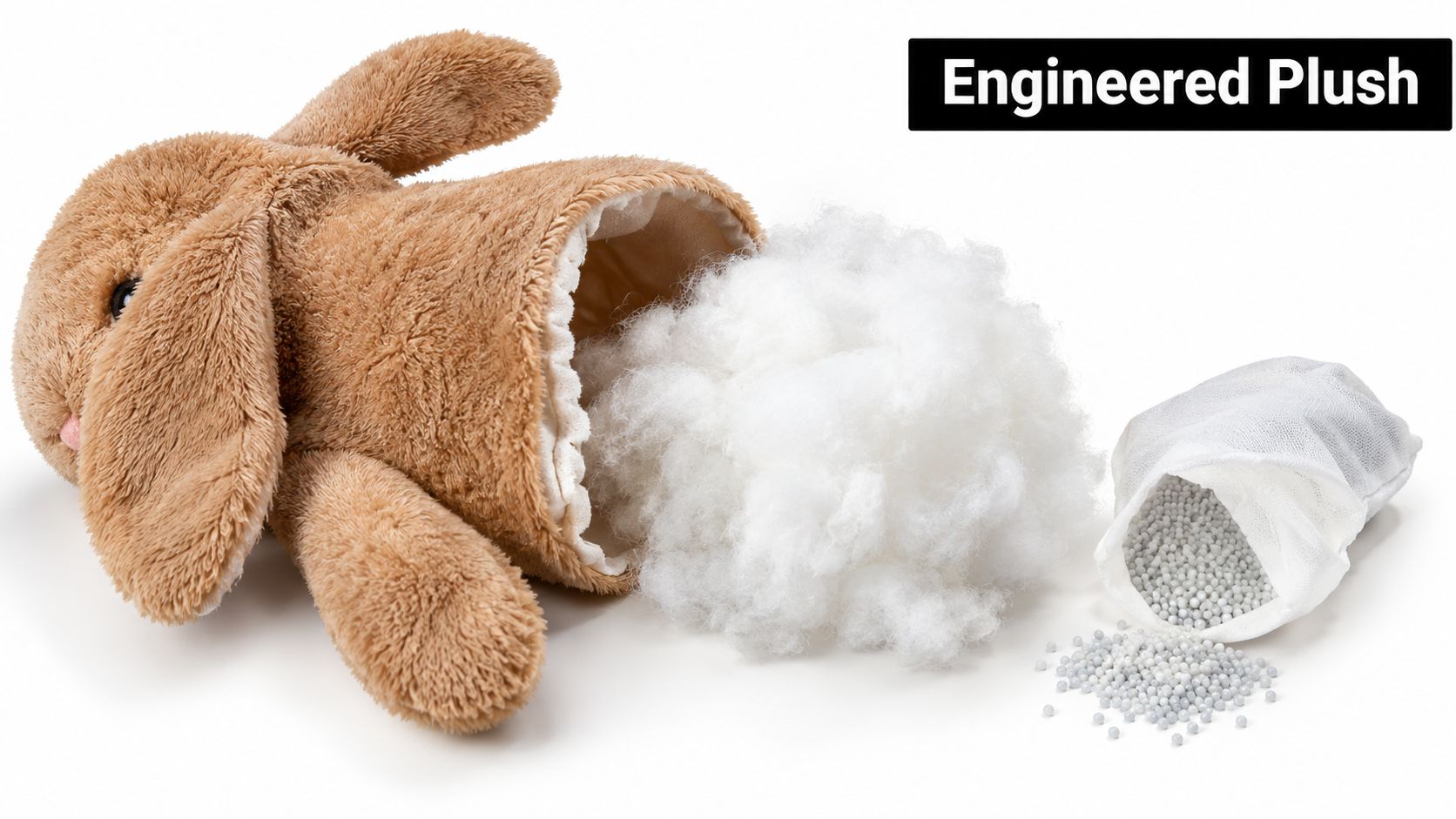
Practical rule: A soft surface doesn't automatically mean a well-made toy. Check what holds the surface and filling together.
When you pick up a toy, notice how quickly it recovers after compression, whether the filling shifts into empty corners, and whether the seams remain smooth. Those small observations reveal the quality of the hidden construction.
Outer Fabrics That Give Soft Toys Their Feel
The outer fabric is the toy's skin. Many soft toys use a pile textile, meaning fibers or loops rise above the base fabric. A useful comparison is a carpet. A short, dense carpet feels sleek and firm, while a longer pile feels fuller and more tactile. Plush toys use the same basic idea, but with textiles designed for handling and sewing.
Plush usually has a soft raised surface that can resemble short fur or a teddy bear's coat. Longer pile creates a more dramatic furry appearance, while shorter pile makes facial embroidery and printed details easier to see. Terrycloth has loops rather than a smooth raised nap, giving it a towel-like texture. Those loops can create a relaxed, casual look, although they may catch more easily than a dense short pile.
Velour has a short, dense surface with a smooth, velvet-like hand. It can make a toy feel polished and rich. Minky is commonly associated with very soft micro-polyester fabric and may have a dot pattern or other raised texture. For a closer look at how minky is made and used, see fabrics by The Fabric Company.
How textile specifications affect the finished toy
Fabric descriptions sometimes include measurements that sound technical but have a practical meaning.
- GSM describes fabric weight per square metre. A fleece specified at 200–300 GSM has a different body from a lightweight lining.
- Thickness affects how padded or substantial the surface feels. Fleece may be specified at 0.8–1.9 mm, depending on the desired construction.
- Areal density matters for linings. A woven cotton lining may be specified at 100 g/m², giving manufacturers a reference for its weight and handling.
These specifications influence how easily the fabric bends, how much stuffing shows through, and how well embroidery and seams hold their shape. A lightweight fabric may feel flexible, but it can require careful stitching around curves. A denser textile can support structure more effectively, though it may feel less airy.
Cotton, polyester fleece, velour, minky, and other plush fabrics all serve different design goals. Polyester-based textiles dominate mainstream production because they're generally resilient, easy to clean, and cost-effective. Cotton and other natural fibers may be selected for breathability, hand-feel, or a premium design direction.
Inside the Toy Fillings and Stuffing Options
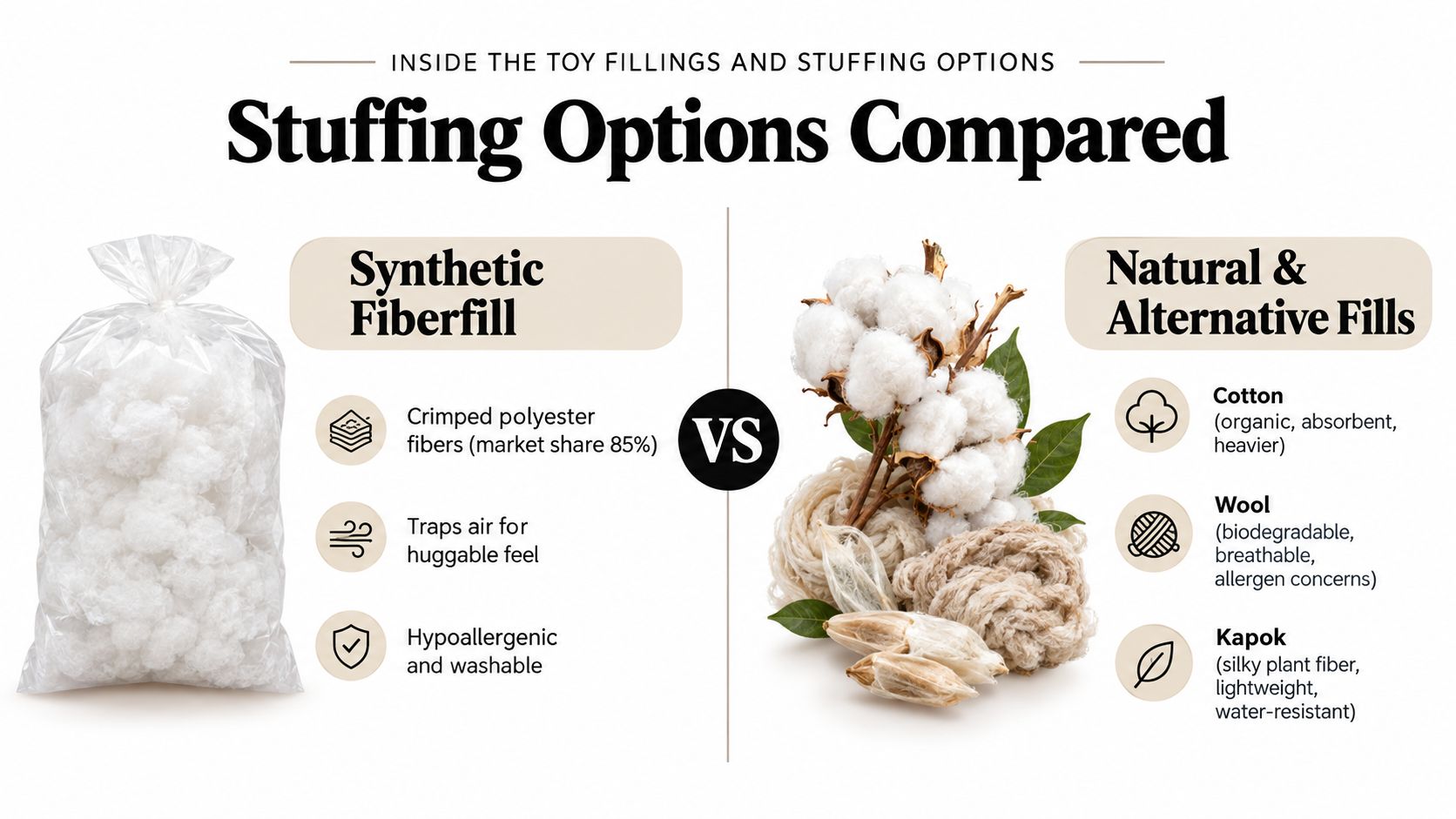
Open a typical modern plush toy and you'll often find polyester fiberfill, a loose mass of crimped synthetic fibers. The crimp acts like a collection of tiny springs. It traps air between the fibers, which helps the toy feel light and recover after a hug.
Polyester also absorbs little moisture compared with more absorbent natural fibers, so it suits toys that need regular cleaning. Its resilience helps reduce permanent flattening, although any filling can compress or migrate if the shell, stitching, or stuffing process is inconsistent.
You may also see the term “PP cotton” in product descriptions. Despite the name, industry guidance distinguishes this stuffing from polypropylene. In many plush applications, the term refers to polyester or PET fiber rather than actual cotton or polypropylene. A materials guide to plush toy stuffing discusses this terminology and the practical properties associated with polyester fiberfill.
Natural and alternative fillings
Natural fillings can create distinctive sensations, but they bring different trade-offs.
- Cotton can offer a familiar, natural hand-feel, but it may be more absorbent and denser than loose polyester.
- Wool can feel breathable and resilient, but manufacturers must consider possible allergen concerns and the way the fiber behaves during cleaning.
- Kapok is a silky plant fiber valued for lightness and natural water resistance.
- Banana fiber and corn husk fiber demonstrate how plant materials can enter soft-toy development, although they remain more specialized than polyester.
- Pellets add weight or help a toy sit in a particular position. They must remain securely contained so they can't escape through a tear.
A materials-focused development paper also identifies 100% cotton fleece as an outer option and lists banana fiber, corn husk fiber, kapok fiber, and polyester fiber as possible stuffing inputs. The choice depends on whether the designer prioritizes lightness, washability, natural content, weight, or a specific tactile effect. This guide to dog plush toys offers a useful pet-product context, where softness and construction must also account for animal interaction.
| Filling Type | Feel and Loft | Washability and Durability | Best For |
|---|---|---|---|
| Polyester fiberfill | Light, springy, and airy | Generally suited to washable plush construction | Everyday cuddling and repeated handling |
| Cotton | Softer and more natural, potentially denser | Can absorb moisture and may change feel after washing | Natural-fiber designs |
| Wool | Breathable with a resilient hand | Requires careful care and attention to allergen concerns | Specialty or premium designs |
| Kapok | Silky, light, and naturally water-resistant | Needs controlled construction to maintain even distribution | Plant-based, lightweight concepts |
| Pellets | Weighted rather than fluffy | Must stay inside a secure pouch or sealed chamber | Sitting toys and weighted designs |
The main lesson is simple. The filling changes the toy's personality, but the shell and seams determine whether that personality survives use.
Safety Labels Seams and Hidden Construction Details
A toy can have a soft, pleasant fabric and still have weak points elsewhere. Safety depends on how the manufacturer contains the filling, attaches trims, finishes the shell, and communicates intended use.
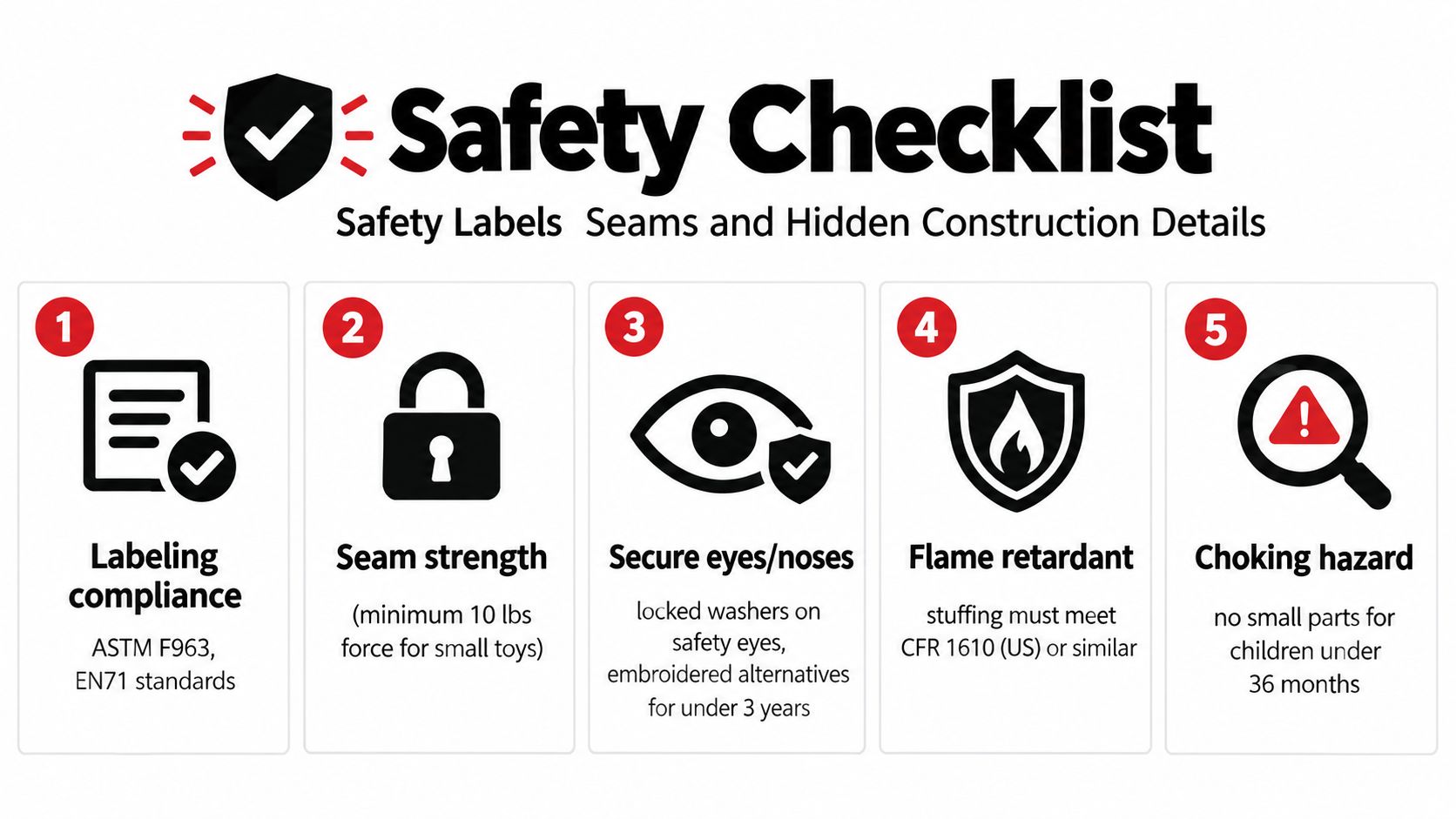
Canadian toy regulations treat stuffing as a regulated component. For dolls, plush toys, and soft toys, the stuffing must be clean, free of hard or sharp foreign matter, non-irritating, and within toxicological limits. In the European Union, EN 71-1 includes mechanical requirements for soft-filled toys with fibrous filling. Seam testing checks whether filling or small components can become accessible under probe tests. The Canadian Toys Regulations provides the relevant regulatory requirements.
Why seams and filling movement matter
A seam has two jobs. It gives the toy its shape, and it acts as a barrier between the filling and the outside world. A seam that opens slightly may allow loose fiber to migrate, expose pellets, or loosen an attached feature.
Fill migration happens when stuffing shifts through gaps, weak stitches, fabric distortion, or a tear. You may notice it as a thin area in the body, a lump in one limb, or a soft ridge near a seam. A well-constructed toy distributes the stuffing evenly and uses a closure that resists repeated compression.
Detachable eyes, noses, buttons, ribbons, and decorative pieces create separate risks. Embroidered features remove some hard components, but buyers should still inspect thread security and the surrounding fabric. For caregivers comparing options for infants, a practical starting point is this guide to safe non toxic toys for babies, while remembering that “non-toxic” is not a substitute for checking construction and age guidance.
Flammability and labels
The outer covering can face separate flammability requirements in major markets, including Canada and the European Union. That means a materials list alone doesn't tell you whether a toy has been evaluated as a complete product.
Before buying, check:
- Age guidance: Follow the stated age range, especially where detachable parts or long decorative elements appear.
- Construction: Look for even seams, secure closures, and no visible filling.
- Features: Treat eyes, noses, sound devices, pellets, and accessories as inspection points.
- Care information: A toy that can't be cleaned as intended may deteriorate faster.
- Market labeling: Look for appropriate compliance information for the country where the toy is sold.
Pet toys require another level of judgment. A dog may pull at a seam, chew an embroidered feature, or puncture a fabric panel. This guide to plush dog toys with squeakers is relevant when sound components and chewing behavior are part of the design.
How Soft Toys Are Manufactured Step by Step
Manufacturing starts with a pattern. Designers create separate pieces for the head, body, limbs, ears, tail, or other forms, then cut those pieces from the selected outer fabric. Direction matters, especially with plush and other pile textiles. If the pile runs in different directions across adjoining pieces, the finished toy can show uneven shading and feel inconsistent.
Workers then sew the shell, usually leaving an opening for turning and stuffing. Once the shell is turned right side out, the maker checks the shape and prepares it for filling. The opening must be large enough for controlled stuffing but positioned so the final closure remains discreet and secure.
Turning a fabric shell into a soft form
Stuffing is added in stages rather than dumped in all at once. Small amounts can be pushed into narrow limbs, ears, or corners before the central body receives more fill. This controls density and helps prevent hollow spots.
The amount and distribution of filling affect compression recovery. A tightly packed toy feels firmer and may hold a more sculpted shape. A loosely filled toy feels floppy and flexible. Poor distribution can produce clumps, while inconsistent fiber preparation can leave one area dense and another thin.
After stuffing, the opening is closed by machine or hand stitching. Quality checks focus on skipped stitches, loose thread ends, uneven tension, and gaps through which fibers might escape. Makers also test attached features and inspect the surface for defects.
Embroidery is often added during a planned stage of production, depending on access and design. It can define eyes, mouths, paws, whiskers, or decorative markings without using hard parts. For makers working on facial details, these plush animal embroidery tips provide practical craft context.
Adding interaction features
Some toys include squeakers, crinkle inserts, or small internal pouches. These components must remain enclosed and shouldn't create sharp edges or exposed fragments if the shell fails. Pet toys need particular attention because chewing and tugging apply different forces from ordinary cuddling.
Buyers may also request chemical verification. Global buyers often ask for testing such as OEKO-TEX Class I or an equivalent assessment for stuffed-toy applications. That verification concerns potentially hazardous residues and complements, rather than replaces, mechanical inspection.
Two toys can use the same fleece and polyester filling yet feel completely different. Pattern proportions, seam allowance, stuffing density, closure technique, and quality control turn raw materials into the final experience.
Sustainable and Eco Friendly Material Alternatives
“Eco-friendly” describes a direction, not a complete material assessment. Recycled polyester uses recovered PET content, but recycled polyester is still polyester. It can reduce dependence on newly produced polyester inputs while retaining that fiber's performance and end-of-life characteristics.
Organic cotton and wool provide natural-fiber options, yet natural origin does not automatically mean greater durability, easier washing, or safer use in every toy. Cotton absorbs moisture, while wool needs careful cleaning and may concern users with sensitivities. Kapok and banana fiber are plant-based possibilities, but their behavior inside a soft toy depends on preparation, containment, and how the material performs over time.
This sustainability guide for plush toys explains why certifications and disposal conditions matter when brands make environmental claims. For pet-specific context, see this guide to sustainable pet products.
Look past the front-of-pack wording
A bio-based material may still need a specific disposal route. PLA may require industrial composting, so a compostable label does not necessarily mean the toy belongs in a home compost bin. Disposal instructions should match the material's actual processing requirements.
Product life matters as much as fiber choice. A toy made with a preferred material may create more waste if it tears quickly and needs early replacement. For pet products, chewing, laundering, and seam stress test the construction repeatedly. Secure seams and controlled fill migration help a toy remain usable, not merely appear sustainable on its label.
Flammability also belongs in the evaluation. Fiber content, surface treatment, and construction can affect how a toy responds to heat or flame, so environmental claims should not replace applicable safety checks. Strong chemical odors deserve attention as well. Materials or additives may release volatile organic compounds, and some emissions can irritate skin, eyes, or airways. “Natural,” “green,” and “non-toxic” describe different ideas.
Use a practical evidence check:
- Material claim: Identify the exact fiber, not only “eco fill.”
- Certification: Look for a named, relevant certification or testing standard.
- Care instructions: Confirm that the material tolerates your cleaning routine.
- Disposal route: Check whether composting requires industrial facilities.
- Construction: Assess seam strength, fill containment, durability, and flammability alongside fiber content.
A responsible choice balances recycled content, verified chemistry, useful service life, cleanability, and realistic disposal.
Choosing Cleaning and Caring for Soft Toys
A toy that feels soft can still hide different cleaning needs. Polyester fiberfill and polyester-based outer fabrics often suit washable designs, but trims, sound components, pellets, embroidery, and seam closures may need gentler treatment than the main fabric.
Use this routine:
- Read the care instructions first. Follow the listed temperature, cycle, and drying method.
- Inspect before washing. Repair or retire any toy with an opening, exposed filling, loose trim, or damaged squeaker.
- Choose the mildest suitable method. Spot clean toys with delicate details when possible.
- Air dry completely. Moisture trapped in dense stuffing can cause odors and reduce comfort.
- Restore the shape gently. After drying, redistribute the filling with your hands rather than pulling on seams.
Cleaning is only one part of care. Repeated washing, chewing, and rough handling can strain seams, loosen closures, and encourage fill migration. A secure seam keeps stuffing contained, while an even outer shell helps the toy hold its shape. Natural fillings may clump or change texture after becoming wet, so they often require more cautious handling than synthetic fiberfill.
Before buying, squeeze the body, examine the closures, read the material label, and match the toy to its user. A child's comfort toy and a dog's chewable companion face different stresses. Nandog Pet Gear offers plush pet toys and washable products designed for play and companionship.
Choose a Nandog Pet Gear plush toy by checking its fabric feel, interactive features, construction, and intended play style. Consider how easily it can be cleaned and whether its seams and filling suit everyday use.