


Your small dog circles three times, scratches at the cushion, sighs, then curls into a tight ball with one ear folded over. You bought the bed because it looked soft and matched the sofa, yet by morning she's on your pillow or wedged against a laundry basket. That mismatch is common, and it's rarely about stubbornness. It's usually about fit, support, warmth, and cleanliness working against how she sleeps.
Why Small Dogs Deserve a Luxury Bed
A Chihuahua who weighs very little can still claim the warmest corner of a room with complete confidence. That confidence drops when her bed is too deep, too flat, or placed on a cold floor where she has to work just to settle. She'll circle, dig, reposition, and finally choose your jumper instead, because it wraps around her body in a way the bed doesn't.
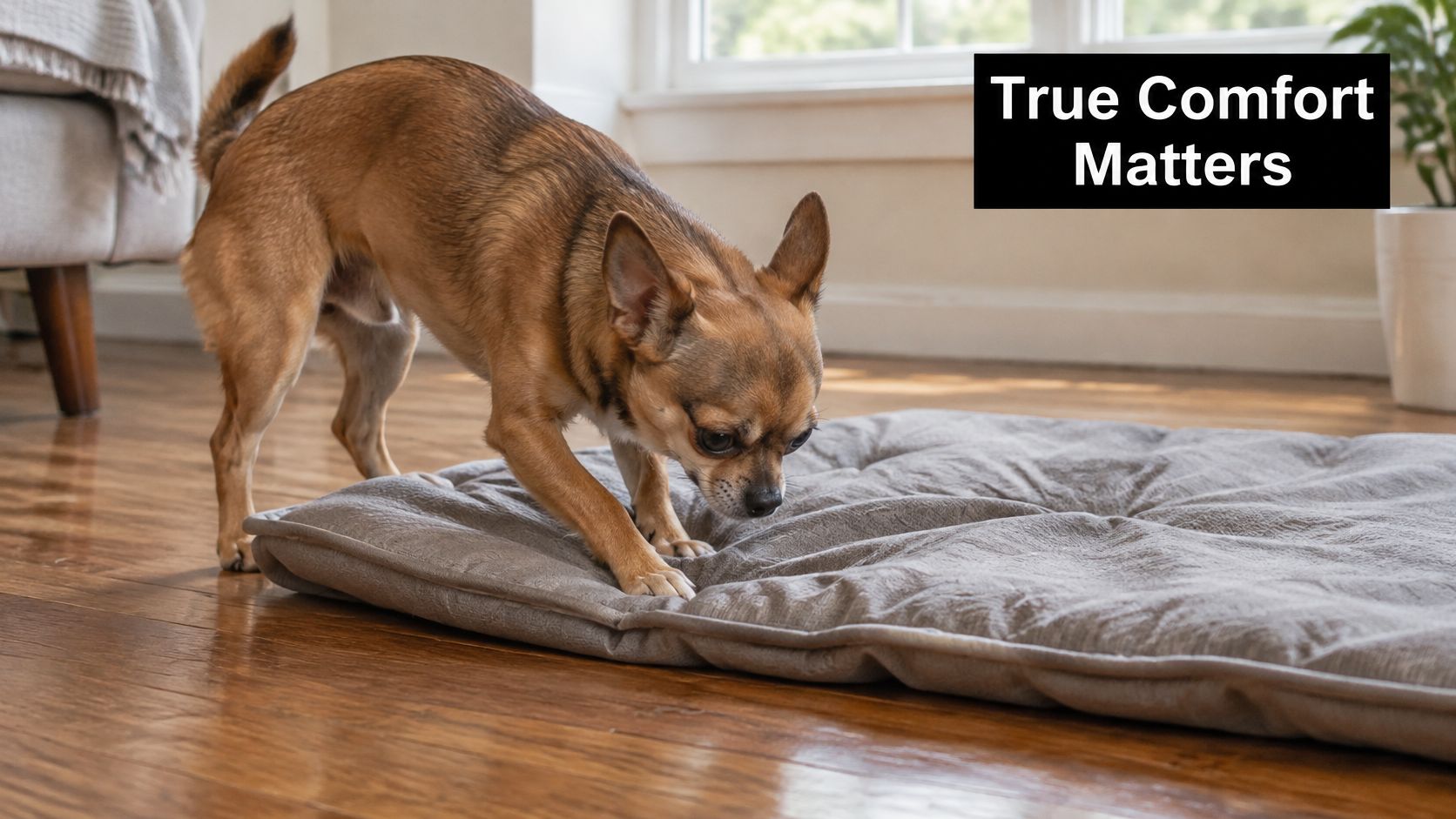
That's the practical case for luxury pet beds for small dogs. Luxury shouldn't mean a prettier version of the same thin pad. It should mean a bed proportioned for a small body, with a low enough entry for short legs and a surface that responds before she has to mold it herself.
Sleep takes up a real share of the day
Canine sleep research shows that young dogs commonly sleep for roughly 10 hours per 24-hour period, and adult dogs older than 1.5 years spend 60–80% of a 12-hour nighttime period asleep, according to the Generation Pup sleep analysis published in PMC. A surface used that often isn't decoration. It's where your dog recovers, regulates temperature, and spends long, still stretches putting steady pressure through her shoulders and hips.
Consider your own mattress. You would not judge yours only by the color of the cover. You would notice whether you could turn over easily, whether your shoulder sank or stayed pinched, and whether you woke up too warm.
Judge a premium bed by what your dog can do in it without effort. Step in, stretch out, turn, and settle again.
What small size changes
Very light dogs don't always compress fill designed for heavier bodies. They can perch on top of it rather than nestle into it, which leaves them exposed to drafts and without that tucked-in feeling many toy breeds seek. At the other end, a bed that's all loft and no structure can swallow a tiny dog and make changing position harder than it needs to be.
A well designed small bed solves both problems. It gives enough contour for security, enough stable base for easy movement, and a shape that suits curling without forcing it. When those pieces line up, you often see the difference quickly. Less circling. Less migrating to your bedding. More choosing the bed on purpose, in daylight, when every other spot in the home is available.
What Sleep Research Tells Us About Bed Design
Sleep isn't a single long block for most dogs. It's a pattern of nighttime rest and daytime naps, repeated in the same favorite places. That repetition is why small design flaws matter. A lumpy seam, a base that slides, or a cushion that has flattened in the middle affects your dog again and again, not just once.
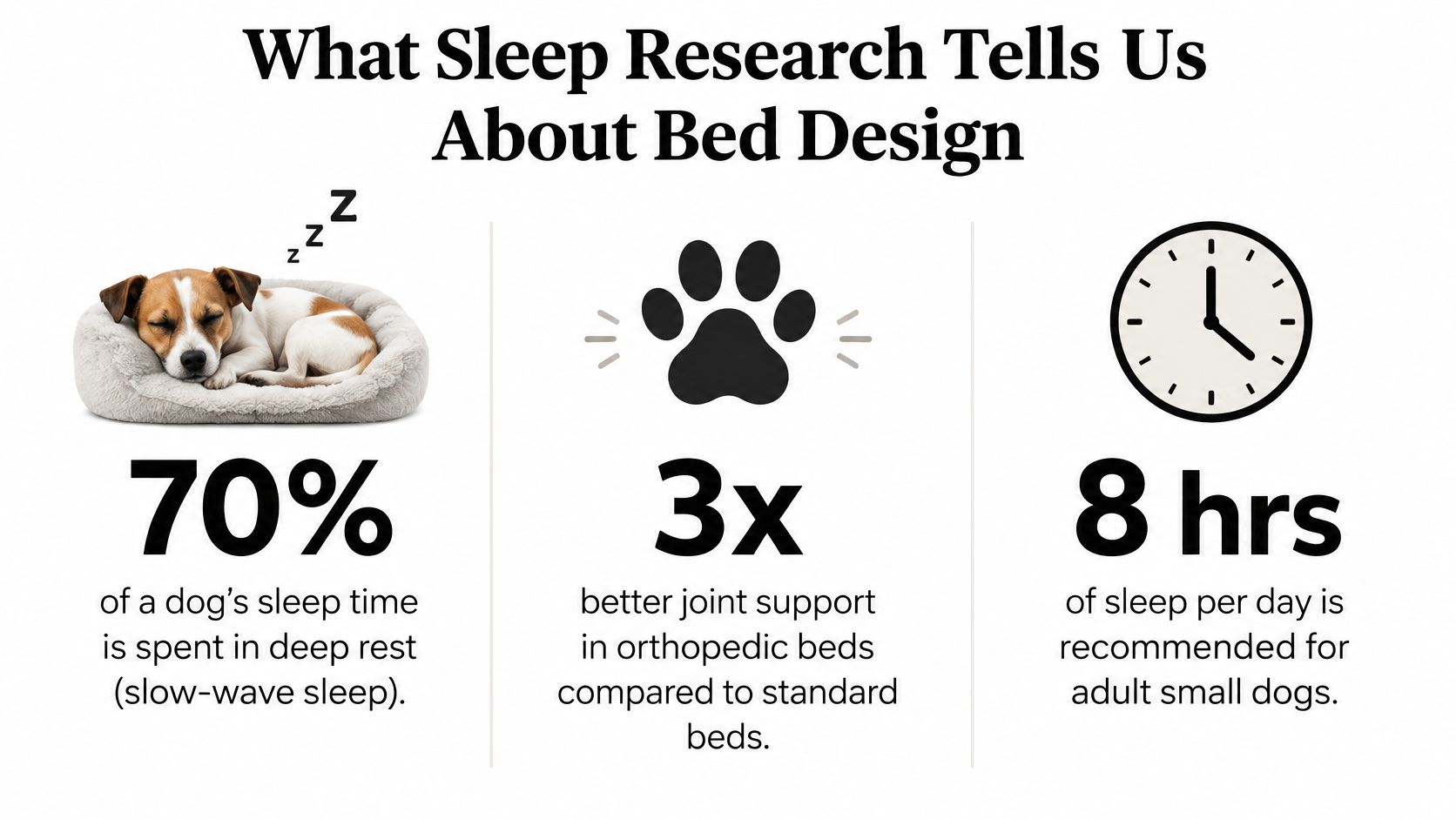
The Generation Pup data described earlier followed large groups of young dogs and tracked how daytime and nighttime sleep shifted as they matured. Puppies and young adults rested often, older dogs generally slept more than younger adults, and rest remained a major part of daily life across that span. You don't need to memorize the figures to use them. The takeaway is simpler. The bed is a high use health surface, so it deserves the same seriousness you'd give food or a harness.
From hours slept to design choices
Long, repeated rest periods point to three design priorities:
- Consistent support: The surface shouldn't collapse into a hammock in the center after regular use.
- Easy repositioning: Your dog should be able to shift from curled to side lying without climbing out of a deep well of fill.
- A clean contact layer: The part touching skin and coat needs regular washing, because it's in use every day.
Owners sometimes focus only on softness because it's what a hand feels in a shop. A hand press is a poor test. Your dog lies with her full body for extended periods, so recovery after compression matters more than that first sink. Press the cushion, let go, and watch whether it springs back evenly or holds a dent.
If you want a broader refresher on why consolidated rest supports mood and daily functioning, the importance of sleep guide covers the human side of that principle in plain language. The species differ, but the design lesson carries over. A sleep space works when it's predictable, comfortable, and free of small irritations that fragment rest.
A useful test: Watch where your dog naps when she can choose freely. She'll show you her preferred firmness, enclosure, and temperature faster than any label will.
Placement belongs in this conversation too. Put the bed where your dog already seeks rest, away from heavy foot traffic but not isolated from the household. Small companion dogs often settle best when they can see their people without being stepped around.
Finding the Right Size and Fit for Your Dog
Breed labels on packaging are a rough starting point, not a measurement. Two dogs described as small can have very different leg length, spine length, and preferred posture. A long bodied Dachshund and a compact Pomeranian may share a weight bracket and need completely different sleeping space.
Measure your dog while she's resting, not standing. That's the body the bed has to accommodate.
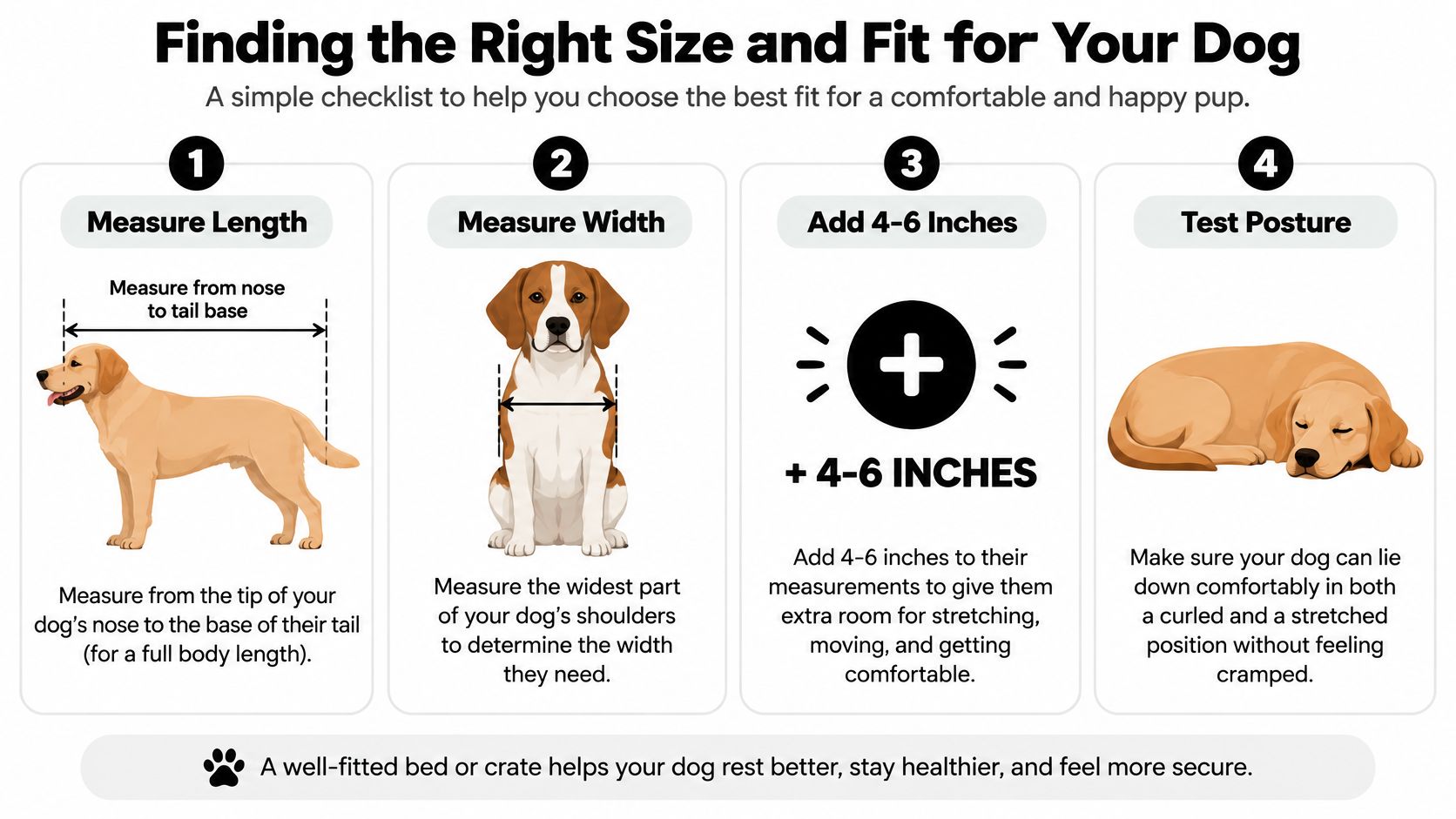
A simple measuring routine
Wait until she's asleep in her usual position. Note the space she occupies curled, then, on another occasion, note her length stretched on her side. Compare both with the inner resting area of the bed, not the outer footprint. Bolsters and thick walls can make a bed look generous while leaving very little usable room inside.
Small-dog beds should be sized to allow full lateral extension rather than forcing a tightly curled posture, particularly for senior or stiff dogs, a point supported by veterinary pressure mapping research on resting surfaces. Curling is natural and often chosen for warmth. Being unable to do anything else is the problem.
A short demonstration can help you visualize entry height and turning space before you buy.
The fit check most owners skip
Run through these questions with the bed on your floor, taped out to its inner dimensions if you haven't bought yet:
- Entry: Can she step in without jumping or scrambling over a high wall?
- Turning: Can she rotate fully without her back pressing hard against the sides?
- Spine position: When she's on her side, does her back stay reasonably level rather than bending around the bed's shape?
- Exit: Can an older or sleepy dog get out easily at night without catching a leg?
If you're choosing specifically for a tiny breed, this guide to beds sized for Chihuahuas shows how proportions change at the smallest end of the range. When you're between sizes, size up. A little extra room preserves choice. Too little room removes it, and dogs vote against that by sleeping elsewhere.
Orthopedic Support Versus Plush Nesting Comfort
Owners often hesitate here, since both options sound caring. A firm orthopedic bed promises joint support. A plush nest promises comfort and calm. The right answer depends on your dog's body and habits, not on which label sounds more premium.
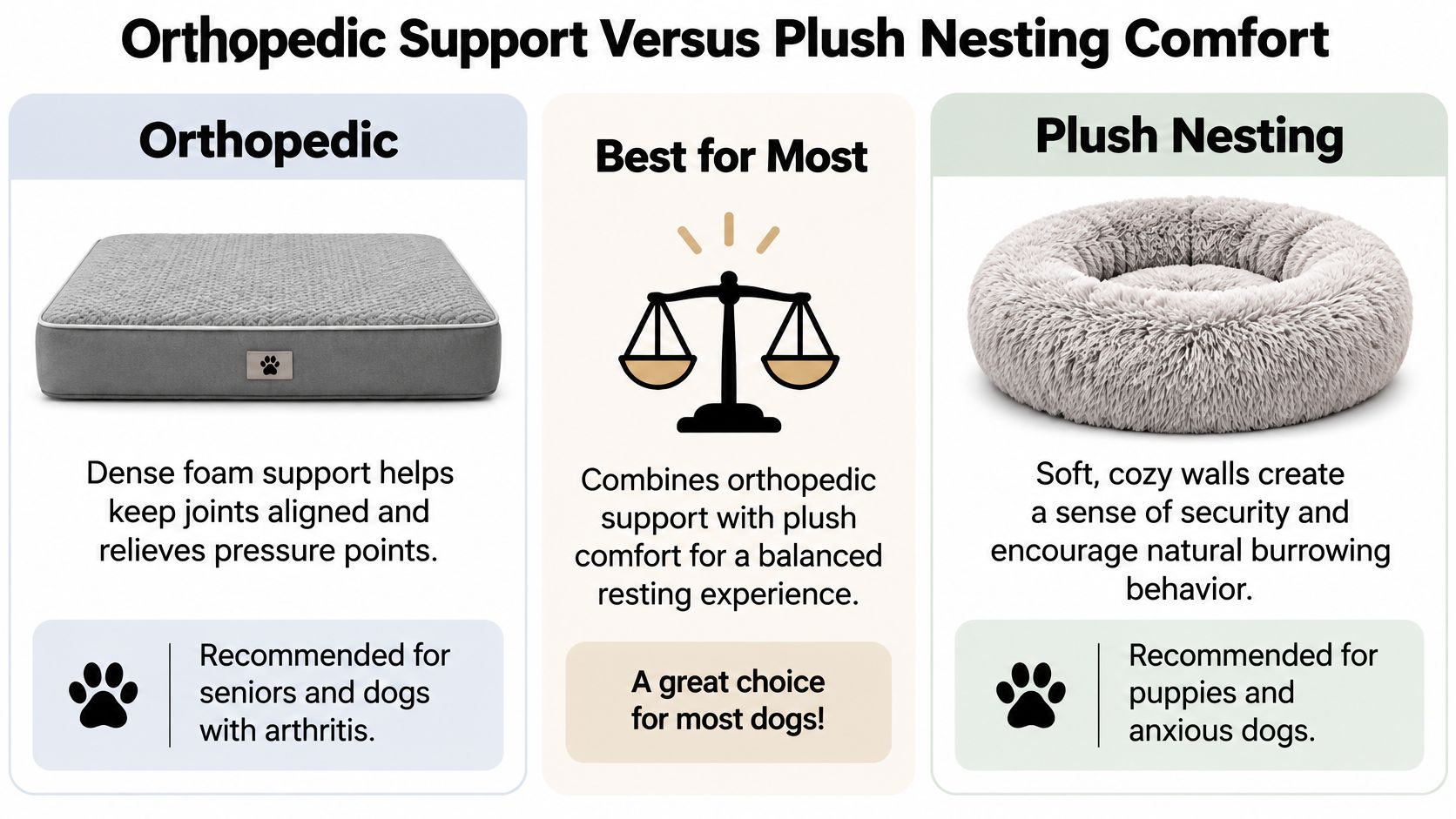
Pressure mapping work in veterinary patients found recurring high pressure over the shoulder joint, greater trochanter, and thirteenth rib. Pressure relieving surfaces reduced loads in those areas compared with standard supports, but no static surface removed the need for repositioning. That last point matters. No bed does the whole job alone. Your dog still needs room to shift, and you should still notice if she's reluctant to lie on one side.
When firmer support earns its place
Lean toward a resilient orthopedic core if your dog is senior, stiff after rest, low in muscle mass, or recovering under veterinary guidance. Look for foam that resists bottoming out, recovers its shape, and still has a contouring top so bony points aren't resting on a board. Treat the word orthopedic as a construction claim. Ask about density, thickness, and recovery. A plush top layer over weak fill isn't orthopedic, whatever the tag says.
For broader context on supportive designs for seniors, supportive beds for aging pets is a helpful reference to compare against. Pair that with this explainer on what makes a dog bed orthopedic in construction before you pay a premium for the term.
When a nest suits better
A healthy young dog who curls tightly, burrows under blankets, and leans against sofa arms often settles faster in a bolstered nest. The raised edge gives her something to press against, blocks drafts at floor level, and provides a headrest. Anxious dogs frequently choose that enclosed feeling on their own.
| Your dog's pattern | Better starting point |
|---|---|
| Stiff, senior, side sleeper | Firmer supportive core with room to stretch |
| Curler, burrower, leaner | Plush nest with a surrounding bolster |
| Mix of both | Supportive base with low bolsters |
Many small dogs do best with that hybrid. Nandog Pet Gear's reversible bed designs, for example, pair a cushioned sleeping surface with a structure intended to be washed as a whole rather than relying only on a removable cover. Whatever you choose, watch for pain signals such as limping, yelping when rising, or sudden sleep changes, and take those to your veterinarian rather than trying to solve them with bedding alone.
Materials, Temperature, and Thermal Comfort
A bed that's perfect in January can be ignored in July. Small dogs feel floor level conditions directly. Cold tile pulls heat from a thin pad, and a deep synthetic plush in a heated apartment can leave a thick coated dog panting and relocating to the bare floor by midnight.
A Frontiers in Veterinary Science study reported that sleep increased with both temperature drops and hot weather, while activity decreased in heat, indicating that environmental temperature alters the balance between resting and activity, as described in the Frontiers research on temperature and companion animal rest. There's no single ideal bed temperature hiding in that finding. There's a design instruction instead. Build in thermal flexibility.
Matching fabric to your home
Start with where the bed will live. On hardwood or tile, you need a padded, insulating base that creates distance from the cold surface. In a warm, carpeted room, breathability matters more, and a moisture managing contact fabric will feel better than dense fleece piled high.
- Warm sleepers and thick coats: Choose a smoother, breathable top and avoid deep heat trapping pile.
- Lean, short coated dogs: Choose insulating loft and sides that block drafts.
- Homes with strong seasons: Choose reversible or layered surfaces so you can flip to a cooler or warmer side.
This roundup of bed approaches for keeping dogs cool in summer is useful if heat is your main problem. The mistake to avoid is buying maximum softness and assuming it equals maximum comfort. Excessively dense plush retains heat. Thin, non resilient padding transmits cold and leaves pressure points unprotected.
Your dog moving off the bed onto cool floor isn't ingratitude. It's temperature feedback you can act on.
Touch tests that tell you something
Rub the fabric firmly and check whether your palm feels hot within moments. Compress the base against a hard floor and feel whether your knuckles meet the ground. Then check care instructions, because a breathable fabric that can't be washed properly won't stay breathable once it's loaded with coat oils and dust.
Stable support, a breathable contact layer, and a surface you can adapt by season will outperform the fluffiest bed in the shop across a full year.
How to Clean and Care for a Luxury Bed
Luxury doesn't automatically mean hygienic. A beautiful bed with a decorative cover you rarely remove, over a core you can't wash at all, becomes a reservoir for moisture, dander, and odor. Your dog won't tell you this in words. She'll scratch more, smell of the bed after naps, or start choosing cleaner surfaces.
A 2025 microbiological survey of household fabrics used by dogs and cats in Japan found average bacterial and fungal loads of 5.7 and 4.1 log CFU per 100 cm² after two weeks to one year of use, and washing with laundry detergent reduced bacterial levels below the detection limit in eight of nine contaminated samples, according to the Japanese veterinary microbiological survey of pet household fabrics. Washing works. The question is whether your bed's construction lets you do it.
Build a routine you'll keep
Wash more often when your dog sheds heavily, has allergies, is a puppy having accidents, is senior with incontinence, or comes in damp from walks. Wash after any accident the same day. Between washes, shake the bed outdoors, vacuum the crevices where hair collects, and let it air fully rather than leaving it damp against a wall.
Drying deserves equal attention. A bed returned to use while the center is still moist will smell again quickly and can degrade fill. Dry it thoroughly, check seams for trapped moisture, and fluff or redistribute filling so it doesn't clump to one side.
For choosing cleaning products that won't leave harsh residues where your dog sleeps, this guide for pet owners lays out safer options in practical terms. Keep the approach simple. A routine you repeat beats an elaborate deep clean you postpone.
Fully washable versus cover only
A removable cover protects the surface, but accidents and drool can reach the core through seams and zips. A fully machine washable bed lets you clean the whole structure, which matters most for puppies and seniors. Either design can work if you're honest about your laundry habits and machine size.
Inspect the bed as you wash it. Split seams, flattened channels, and fill that stays lumpy after drying are early retirement warnings, not cosmetic flaws.
Durability, Value, and Long-Term Investment
A cheap bed rarely fails all at once. It flattens a little, the cover pills, the zip catches, the base starts to slide. Your dog compensates by circling more or sleeping half off it, and one day you realize you're buying a replacement for a bed that never really worked. That's the true cost comparison to make.
The audience for getting this right is enormous. A report citing American Pet Products Association survey data stated that about 82 million U.S. households owned a pet in 2024, that 44% of households owned a dog, and that 70% of dog-owning households had one dog, 23% had two, and 8% had three or more, as summarized in the AVMA compilation of U.S. pet ownership statistics. Multi dog homes feel durability fastest, because one shared bed takes double the washing, scratching, and weight.
Where durability actually lives
Check the parts that take stress. Seams at the corners. The zip track. The junction where a bolster meets the base. Turn the bed over and look for a bottom that grips rather than skates across the floor, since a moving bed unsettles small dogs and wears fabric faster.
Inside, resilient fill or foam is the investment. Press it hard, release, and time the recovery with your eyes. Slow, uneven recovery in a new bed only gets worse. Even distribution matters too. Channelled or structured filling that stays in place will outlast loose stuffing that migrates into corners and leaves the center bare.
Design features that extend useful life
- Reversible surfaces: Spreads wear and gives you a fresh side between washes.
- Washable whole bed construction: Prevents the core from becoming the reason you throw the bed away.
- Replaceable or repairable covers: Lets you refresh the contact layer without discarding sound support underneath.
Value also includes your home. A bed in a fabric that releases hair in the wash, holds its shape for guests to see, and doesn't carry a stale smell is a bed you'll keep in the main living space, which is exactly where your dog wants to be. Pay for structure, washability, and recovery. Those are the qualities still working long after the novelty of a fashionable pattern fades.
Making the Final Choice for Your Small Dog
You now have four questions that cut through most product pages. Does it fit her stretched body, does it match how she sleeps, can you wash the whole thing properly, and will the support still be there after months of nightly use? If a bed fails one answer badly, a lower price or a prettier colour won't fix it.
Budget realistically, because every dog household is balancing competing costs. Veterinary care represented 31% of U.S. dog-related spending in 2025, up from 30% in 2024, while spending per household shifted toward value-conscious choices, according to the PetfoodIndustry report on dog owner spending trends. Value conscious doesn't mean buying the cheapest bed twice. It means spending once on the features your specific dog will use.
A decision order that prevents regret
Start with size and entry, because a bed she can't get into or stretch in is unusable at any quality level. Next choose support by age and mobility, firmer for stiff or senior dogs, more enveloping for healthy curlers. Then check temperature fit for your floors and climate. Only after those decisions should style have its vote.
Introduce the new bed where the old one sat, with a familiar blanket on top for the first few days. Reward her for choosing it, but don't lift her into it repeatedly. Small dogs learn quickly which surface feels right, and forced placement can create suspicion around a bed she'd otherwise adopt on her own.
Replacement rule: Retire a bed when the center stays dented after washing and fluffing, when odor returns immediately after cleaning, or when seams open enough to expose filling.
Watch her for the first week. Sleeping stretched on her side, returning to the bed voluntarily during the day, and rising without hesitation are good signs. Sleeping with her head hanging off the edge, perching on the bolster instead of the cushion, or abandoning it for the floor tells you fit or temperature is off, and that's fixable information, not failure.
Choose the bed that serves the dog you have, in the home you live in, with the laundry routine you will keep. That is what luxury means at floor level.
Your small dog deserves a bed built around real sleep, with washable construction, thoughtful support, and proportions made for her body rather than shrunk down from a larger design. Explore the small dog bed collections at Nandog Pet Gear to compare plush, reversible, and orthopedic styles you can clean as a whole and place proudly in your living space. Pick the fit she'll choose on her own, and let her dream better tonight.